
Patio chair cushions are the highest-volume product in the outdoor cushion market — which means the selection is enormous, the price range is wide, and the difference between a set that lasts a summer and a set that lasts a decade is invisible in the product photo. Whether you call them patio chair cushions or outdoor chair cushions, the product is the same and so is the decision: five specifications decide everything, and the retailer is not one of them. This guide covers those five specs, the sizes that actually exist, where each buying channel wins and loses, and the fit discipline that separates satisfaction from a return cycle. The measuring method underneath it all: how to measure outdoor cushions.
The Five Specs That Decide Everything
In order of importance:
- Dimensions. The cushion must match the seat — width and depth seam-to-seam, thickness within what the chair’s geometry allows (arms, table aprons, knee clearance). Everything else is negotiable; this is not.
- Fabric fiber. “Solution-dyed acrylic” and “Olefin” are the survive-the-sun tiers; “polyester” and “spun polyester” are the covered-porch tier. The fiber is the durability fact; marketing coating names are not fiber (best outdoor cushion fabric).
- Fill. Foam-core and high-resilience foam hold loft; loose polyfill feels plush in the store and mats by August. Fill families compared: cushion filling types.
- Attachment. Ties at positions your chair actually offers, grip backing, or both — a cushion that walks under you is a nightly annoyance regardless of its other virtues.
- Construction. Sewn seams, welt cord (piping) on the edges, wipe-clean families that keep the maintenance cycle humane through year three and beyond — the details that decide the long run (replacement cushion covers explains why cleanability is a lifecycle feature).
A cushion that passes all five is a good buy at any channel; a cushion that fails the first is a bad buy at any discount.
The Sizes That Actually Exist
The market’s standard grid, and where your chair sits on it:
| Seat shape | Grid size | Market verdict |
| Square dining seat, 19-21 inches | 19×19, 20×20, 21×21 squares | Best-served sizes in the entire market |
| Slightly-rectangular dining seat | 18×20 through 22×24 rectangles | Well served; match both dimensions, not one |
| Deep seat, 23-27 inch depth | 23-24 inch deep-seat cushions | Thinning — universal depth tops out around 23; past that is custom territory (deep seat cushions) |
| Rounded or trapezoid seats | Off-grid | Custom — measured as radius or front/back widths (cushion shapes) |
| Wrought-iron and smaller vintage frames | Often 16-18 inches | Patchy; measure and expect custom for the odd sizes |
| Wicker with curved front | Chord + camber | Custom — curved wicker measuring |
Thickness for dining chairs runs 2.5 to 3 inches — enough to sit on, not so much that you hit the table apron or perch above the arms. Lounge and deep-seat pieces run 4-5 and up, a different product class.
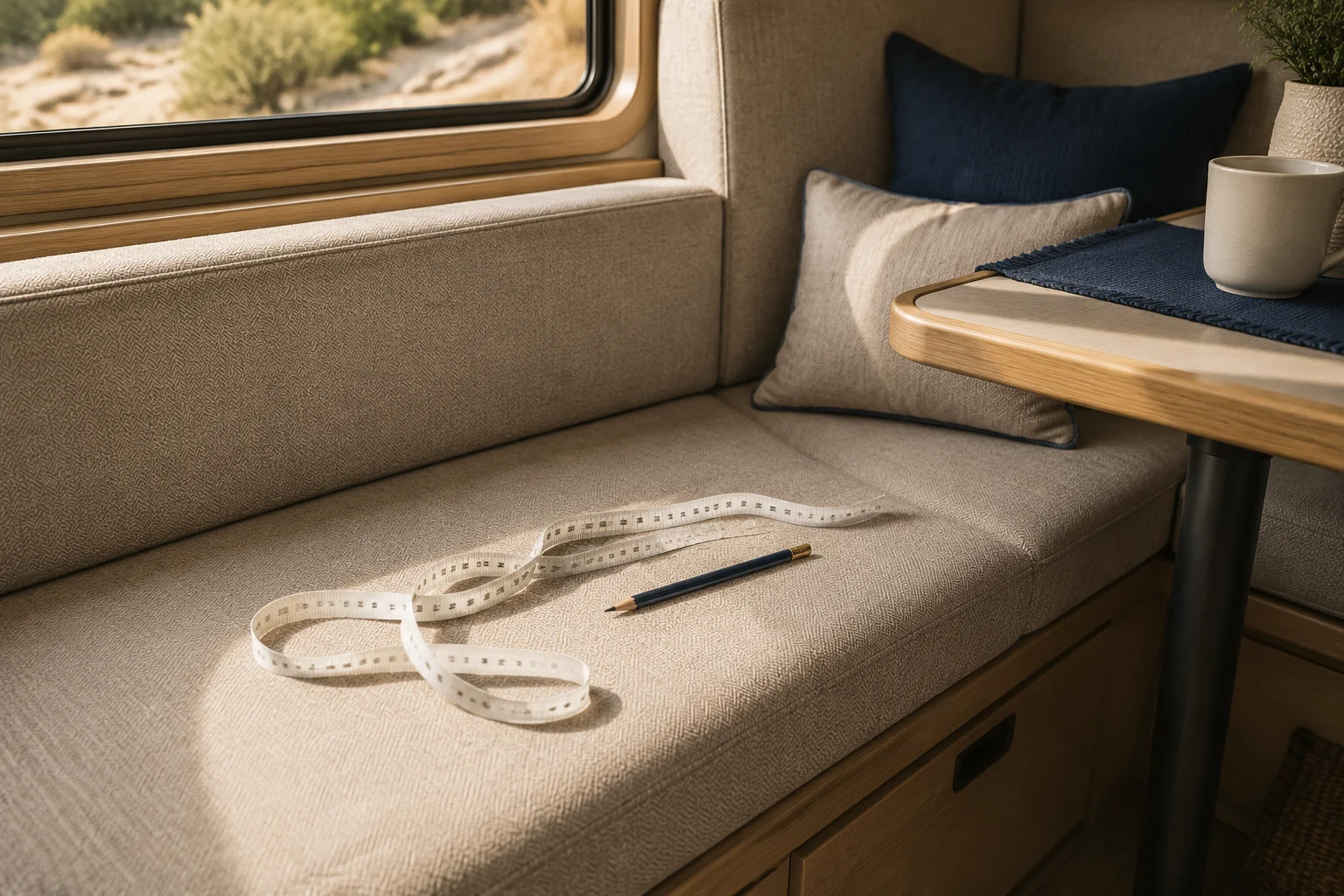
Measure first, always: seam-to-seam at the seating surface, thickness at the edge, tie positions from a corner, recorded to the nearest quarter inch. The ten-minute method is how to measure — and it converts every shopping trip in this guide from a gamble into a comparison.
Fabric Tiers, Honestly
The market sells three real tiers, whatever the branding says:
- – Solution-dyed acrylic (the Sunbrella class). Color that survives years of sun, bleach-cleanable, the premium-set standard — with the fade warranty the brand provides on its fabrics. The economics that justify it are worked through in is Sunbrella worth it.
- – Olefin. The other sun-capable fiber — strong colorfastness, generally friendlier pricing than acrylic; the head-to-head is Sunbrella vs outdoor fabric.
- – Polyester family. The entry tier: fine under cover, fades and abrades in full sun on a two-season-ish clock. Perfectly defensible for a covered porch; the expensive choice for an open patio.
The honest rule: match the tier to the exposure, not to the budget aspiration — a covered porch in polyester is smart, an open patio in polyester is a plan to re-buy.
Where to Buy: Channel by Channel
Big-box and decor-store seasonal walls (Walmart, Target, Lowe’s, At Home and kin) — deepest on-grid selection, seasonal pricing cycles, clearance windows in late summer. Each channel’s mechanics are covered in its own guide: Walmart, Target, At Home.
Online marketplaces (Amazon and kin) — widest grid selection, spec-table discipline required, review reading as a skill (the Amazon guide). The closeout channels (Overstock, Big Lots) put real discounts on standard sizes at the cost of lot-completion risk (Overstock, Big Lots).
Brand replacement routes — if your chairs are a named brand line (Hampton Bay and the Martha Stewart patio collections are the ones we document piece by piece, with 195+ verified sizes across 31 collections), the brand-line route can deliver exact fits: Hampton Bay replacement guide.
Custom workshops — the off-grid answer and the durability answer: cushions cut to your measured dimensions, fabric from a filtered library, foam specified by density (35-65D; 50D-60D for daily use). Pricing from a $45 make-base plus per-sqft foam and fabric rates — a standard dining square lands from about $73; smaller pieces from $52. Start at custom outdoor cushions.
The Buying Decision Table
| Your situation | The winning route |
| Standard squares, covered or seasonal use | Any big-box or marketplace on-grid buy that passes the five specs |
| Standard squares, full sun, daily use | Acrylic or Olefin tier wherever found at a fair price — or custom |
| Deep seats, curves, trapezoids, odd sizes | Custom — the grid ends and guessing begins |
| Named brand set, current season | The brand’s accessory window while it is open |
| Named brand set, retired | Database-backed custom (documented brands) or measured custom |
| Whole dining set worth keeping | Custom set in one run and one dye lot |
Making the Right Cushions Last
Whatever the channel, the maintenance system is universal, and it is the difference between a cushion’s spec-sheet life and its real life: store cushions off-season (the winter method), edge-dry after rain and treat persistent heaviness (draining), clean at first stain with the fiber’s chemistry (the cleaning playbook), rotate positions for sun, and mend ties at the first fray. The complete system: outdoor cushion maintenance tips — and the signals that a cushion is done rather than dirty: when to replace outdoor cushions.
The Chair-Type Spectrum: What Each Frame Asks of Its Cushion
Patio chairs are not one product class, and the cushion spec shifts with the frame:
- – Wicker and woven frames want ties at the weave’s strong points and respect for curved fronts — the whole subclass is covered in wicker furniture cushions, with the curved-front measuring method in its own guide (how to measure curved wicker seating).
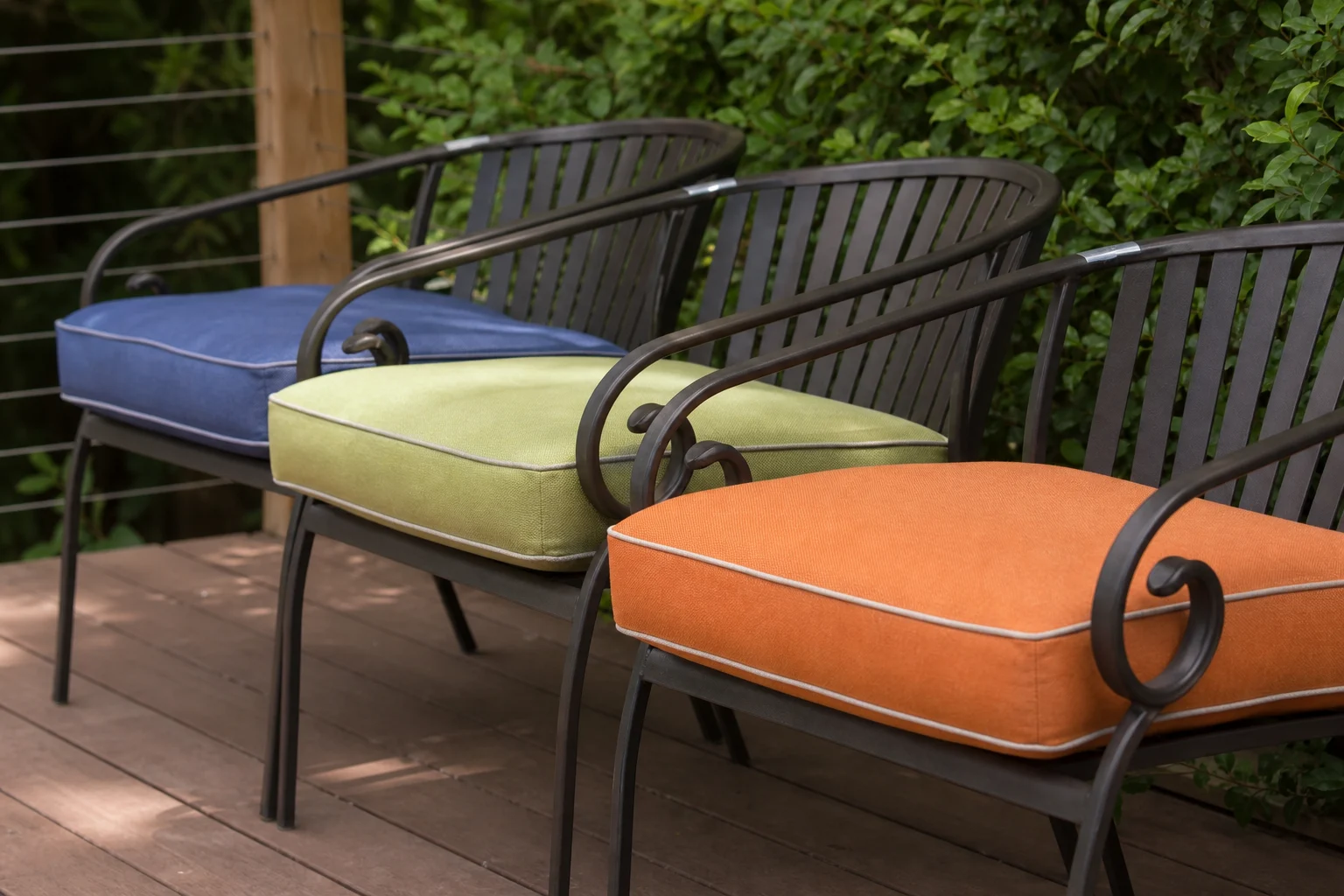
- – Metal and wrought-iron frames run narrow seats and rounded corners — the small-grid territory where stock coverage thins and radius-corner specs begin (how to measure radius corners). Metal frames also transmit heat and cold; a thicker core insulates the sitter from the frame’s mood.
- – Wooden dining frames are the grid’s home turf — squares, ties at the slats, and thickness bounded by the table apron.
- – Stackable and folding chairs favor thinner pads (1.5-2.5 inches) that do not defeat the stacking; measure the folded stack’s tolerance before ordering thick.
- – Adirondack and deep-lounge chairs are shape-language changes, not size variations — tall-back patterns (adirondack guide) and hinge-and-fold constructions (chaise measurements) each have their own pages.
The pattern across the spectrum: the closer the chair is to a plain square on legs, the more the market serves it off the shelf; every deviation — curve, hinge, height, narrowness — moves the answer toward measured cushions.
Ties, Grip and the Details That Decide Daily Life
The attachment question is small at purchase and large in use. Ties are the traditional answer and the one woven and slatted frames invite — count your chair’s usable tie points before buying anything, because generic tie spacing on a specific frame is the “attached at one corner, sailing at the other” failure. Grip backing is the invisible modern favorite on smooth surfaces, and the two combine happily. The maintenance corollary: ties are wear items. The sawing motion of daily use frays them, and the two-minute re-stitch at the first loose thread is the difference between a tie that lasts the cushion’s life and a tear-out that strands a sound cushion — the constant-motion version of this failure is covered in the rocking chair guide, where motion never stops.
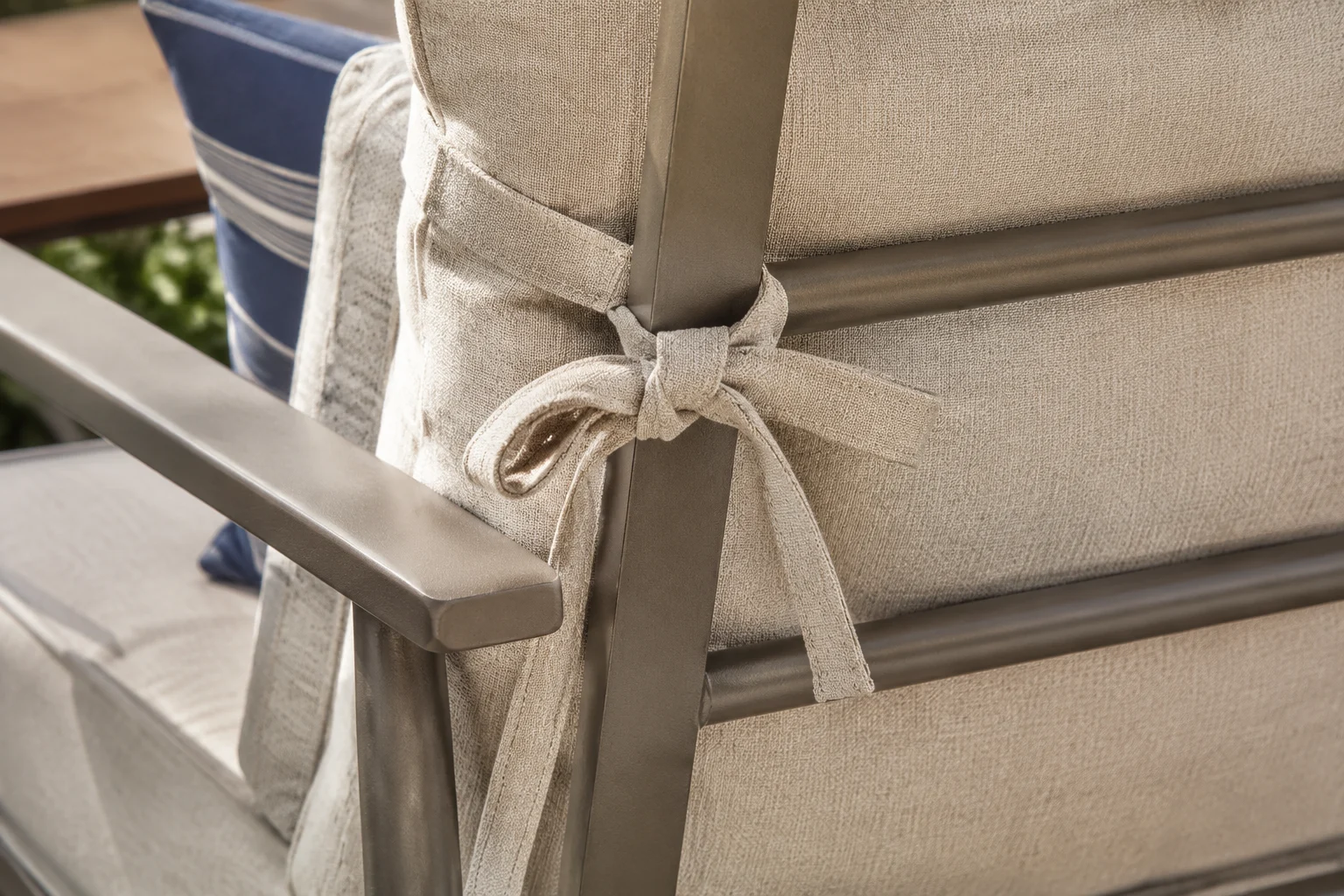
Beyond attachment, three construction details separate satisfying cushions from frustrating ones at the same price: welt cord (piping) on the seams, which stiffens the edge and keeps it crisp through seasons of sitting (the welt cord guide); wipe-clean families, which keep the weather maintenance cycle humane for years (covers vs cushions); and sewn ties rather than glued, which is the difference between an attachment system and a suggestion.
Set Logic: Buying for Four, Six or More
Patio chairs travel in sets, and the set changes the buying arithmetic in three ways. First, count fidelity: multipacks come in counts that rarely match your count (five-packs for four chairs and vice versa), and the per-cushion price stops being a deal when two pieces live in the garage — buy exact counts or accept the surplus consciously. Second, one dye lot for everything: order the full set plus spares in a single order, because patio palettes and fabric lots drift between batches, and the drift is visible across a table. Third, the spare-seat rule for daily-use sets: one spare cushion in the box at purchase time is the cheapest insurance in outdoor furniture — the matching piece will exist now and not later (when to replace outdoor cushions explains the wear clock the spare is insuring against).
The set-level maintenance rotation belongs here too: swap chair positions around the table monthly so the fade and wear distribute across the set rather than concentrating on the two favorite chairs — a free habit that doubles the set’s presentable life (outdoor cushion maintenance tips).
FAQs
What size patio chair cushion do I need?
Your seat’s seam-to-seam dimensions decide — measure width, depth, and thickness allowance to the nearest quarter inch per how to measure, then match both dimensions against the grid; seats on the 19-21 inch square grid are the best served, and everything curved or deeper than the grid is custom territory.
What is the best fabric for outdoor chair cushions?
Solution-dyed acrylic for full sun and longevity, Olefin as the other sun-capable tier, polyester only under cover — the fiber named in the specs is the fact, and coating marketing names are not fibers (best outdoor cushion fabric).
How thick should a patio dining chair cushion be?
2.5 to 3 inches — enough padding to sit on, not so much that you hit the table apron or rise above the arms; lounge and deep seating run thicker and are a different product class (deep seat cushions).
Are expensive cushions worth it?
When the exposure is real — full sun and daily use justify acrylic over polyester and dense foam over polyfill within a few seasons; for covered, occasional seating, the entry tier is honest value (custom vs standard cushions).
Where should I buy outdoor chair cushions?
On-grid sizes: whichever channel passes the five specs at the best effective price; off-grid shapes and daily-use sets: custom cut to your measurements from custom outdoor cushions, from a $45 make-base plus per-sqft rates.
Next Steps
- Measure every chair you are dressing — seam-to-seam, thickness allowance, tie points — per how to measure.
- Run the five specs against your candidates at whatever channel you shop; the table above routes by situation.
- For off-grid shapes or a set worth keeping, price custom outdoor cushions — 4-7 business days, nothing cut until your dimensions are confirmed.
Outdoor Rocking Chair Cushions: The Weatherproof Guide to Sizes and Fabrics
An indoor rocking cushion dies fast on a porch. The sun bleaches the print in a single season, the foam
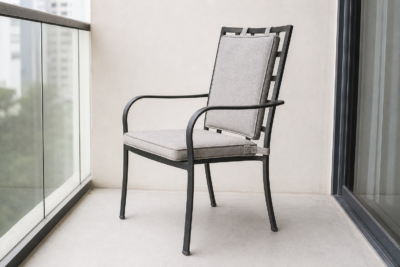
Cushions for Metal Patio Chairs: Frame Types, Grip and the Heat Question
Cushions for metal patio chairs guide: wrought iron, aluminum and steel frames and what each means for pads, sliding on slick metal, heat absorption in sun, sizing across mixed metal sets, and the outdoor duty spec.
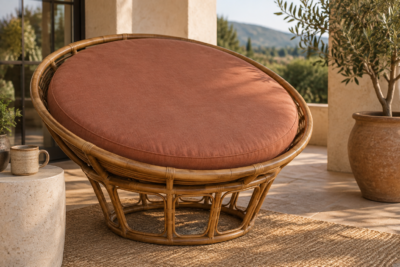
Outdoor Papasan Cushions: Weathering the Big Round
Outdoor papasan cushions fail in a known order — fabric, fill, bowl. The overhang-vs-inset diameter decision, fiber vs foam outdoors, and the honest line between a flat round and the concave original.
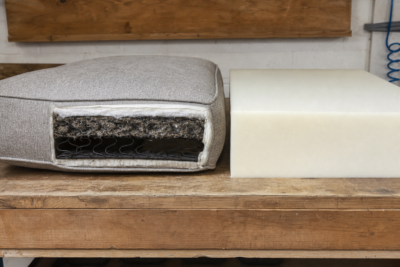
High Density Foam Couch Guide: What Density Actually Means
What high density foam actually means for a couch — the ×10 density convention, density vs firmness (ILD), the 35D–65D grades ranked by use, how each grade fails, and what density costs per square foot.
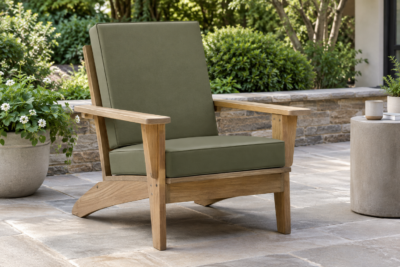
Adirondack Chair Cushions: Sizes, Selection & Replacement Guide
Adirondack cushion sizes decoded: 20×20 seats, tall-back options, tie patterns, best fabrics — plus fitting odd or vintage chairs.
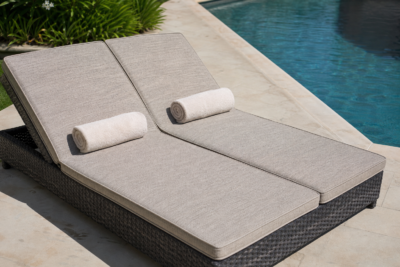
Double Chaise Lounge Cushions: Two-Position Geometry and Shared Lounging
Double chaise lounge cushion guide: back-to-back and side-by-side layouts, measuring two lounging positions in one piece or two, fill for shared daily lounging, and outdoor fabric for a full-sun centerpiece.