
Amazon is the biggest cushion wall in the country, and it is not a retailer shelf at all — it is a marketplace of hundreds of sellers listing overlapping products under rotating brand names. That structure produces the platform’s whole character: unbeatable convenience, real bargains on standard sizes, and a specific set of traps that physical retail does not have. This guide covers how the Amazon cushion market actually works, the five checks that separate the good listings from the burn, and when ordering custom beats another marketplace roulette spin. The measuring baseline is how to measure outdoor cushions; the same walk-through for big-box retail is in the Walmart and Lowe’s guides.
What You Are Actually Buying on Amazon
Four seller layers, each with different incentives:
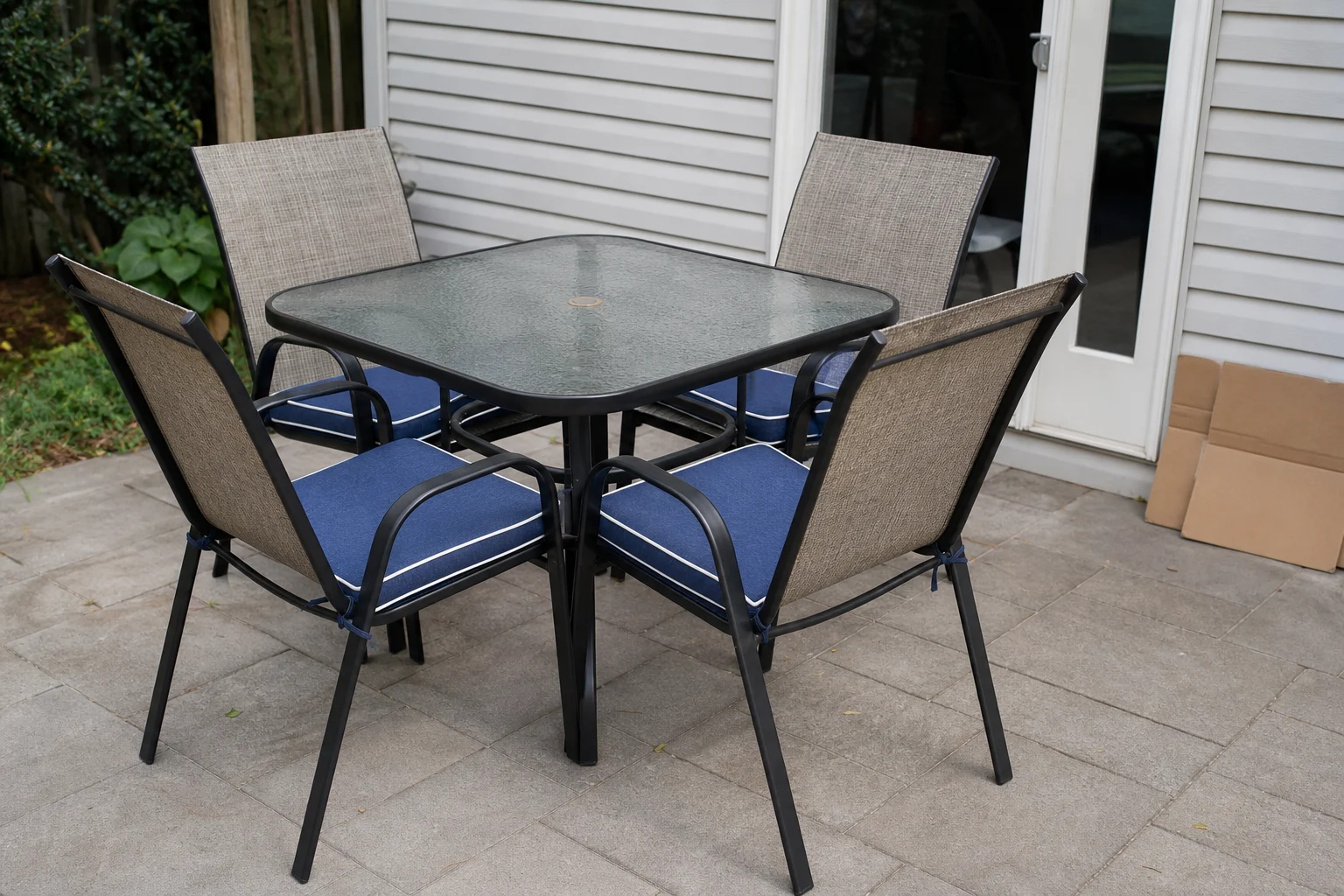
- Aggregator brands. Dozens of cushion “brands” that exist only as storefronts — generic-import product under logos you will not find at any physical retailer. Quality is genuinely mixed: some of these run the same factories as big-box house lines, some do not.
- National brands’ official stores. Sunbrella-fabric lines and established manufacturers selling direct. The price band is higher and the spec tables are honest — this is the safest layer.
- Third-party resellers of branded product. Legitimate stock, occasionally stale or storage-faded; returns depend on the seller’s terms.
- Handmade and small-workshop listings. Often better-made than the aggregator tier, sometimes actually custom-capable — but one workshop deep, with the capacity and lead-time limits that implies.
The structural point: there is no “Amazon cushion” spec. Two listings with near-identical photos can be different foam, different fabric, and different factories. The listing page is the only place the difference is visible — which is why the checks below matter more here than anywhere.
The Five Checks That Matter
1. The spec table, never the title. Dimension drift is the platform’s signature trap: a “24 inch cushion” whose table says 23.5 x 22.5 is normal, not fraud — but the title rounds up and your frame does not. Read width, depth, and thickness from the table and compare to your seam-to-seam measurements (how to measure). Also check the corner shape: rounded and square corners are listed interchangeably in titles, and a rounded-corner cushion on a square-corner frame leaves visible gaps.
2. Fabric fiber, not marketing names. The honest tiers: “solution-dyed acrylic” and “Olefin” are the survive-the-sun tiers; “spun polyester,” “polyester,” and unqualified “outdoor fabric” are the fade tier unless the piece lives under cover. Marketing coating names are not fiber names — the fiber is the fact. What each fiber actually does over three summers is in best outdoor cushion fabric.
3. Fill, stated or dodged. “Foam core,” “high-resilience foam,” or “densified fiber” are real specs you can order against. “Plush,” “extra-plush,” and “overstuffed” describe a showroom feel, not a material — overstuffed polyfill is the mats-by-August product on most one-star reviews. The fill-family logic is in cushion filling types.
4. Review math, not review average. A 4.3 average breaks down into two populations: “great for the price” and “flat in one season.” Sort recent reviews by lowest and read for the failure mode — fading, matting, tie tear-out, zipper failure. Reviews older than a year describe a production batch that may no longer exist. And photos beat text: reviewer photos of the cushion on a real chair tell you more about loft and fit than any listing image.
5. Returns and the seller. Who ships, who takes returns, and in what window. Aggregator listings with thin return terms are the expensive kind of cheap.
What Amazon Is Actually Good For
The platform has real strengths, and pretending otherwise is not useful:
- – Standard-square dining cushions (19-21 inch seats) in acrylic or Olefin — the deepest selection anywhere, honest prices, and the fit math works. This is the platform’s sweet spot.
- – Completing counts — a two-cushion gap in a set is exactly what a marketplace inventory exists to fill.
- – Fast replacement of a known-good product — reorder the same listing you already own and trust.
- – Spec-table comparison shopping — five listings’ tables side by side is a faster fabric-and-fill education than any store aisle.
Where Amazon Fails
- – Exact-fit replacement for non-standard frames. Deep seats past 23 inches of depth, hinged chaises with set-specific hinge positions, one-piece loveseat benches, curved wicker fronts — the marketplace does not stock these because generic sizing does not cover them, and “closest” listings are a remake lottery.
- – Sets matched across pieces. Ordering a sofa + chairs + ottoman run from a marketplace listing means betting every piece arrives from the same dye lot and the same pattern of dimension drift. Sometimes it does.
- – Anything with a number that matters. When your frame requires 24.5 x 26.5 x 5 cut around specific tie points, the marketplace answer is “approximately” — and approximately is the word that costs a return cycle. Branded patio sets are the clearest case: the Hampton Bay Palm Canyon firepit chairs and the Oak Cliff five-piece run carry numbers no generic listing matches, which is exactly why their charts exist.
Marketplace vs Custom: The Honest Comparison
| Amazon cushions | Custom-made | |
| Price per standard dining cushion | Lowest | Higher ($45 make-base plus per-sqft rates; from about $51 for small pieces) |
| Non-standard shapes | Not available — approximation only | The entire product |
| Foam spec control | Whatever the listing says today | Your choice, 35-65D, in writing |
| Fabric choice | The listing’s palette | Library selection, filtered indoor/outdoor |
| Failure accountability | Seller-dependent returns | We re-verify your dimensions before cutting; nothing is cut until your numbers are confirmed |
| Timeline | Days | 3-6 weeks delivery, crafted in 4-7 days, made to order |
The pattern that decides it: standard squares, gentle use — the marketplace is a fair deal. Exact fit, daily use, or a set worth keeping — one custom order ends the loop. The full economics are in custom vs standard cushions, and the price-band context for the whole market is in the outdoor cushions price guide.

It is also worth naming what the marketplace cannot do at any price: cut to a number you give it. The entire platform sells what already exists — which is its strength (selection, speed, reviews) and its ceiling (no listing takes a tape measurement). Every off-grid replacement problem in this guide series ends at the same door for the same reason, and the door is a workshop with a cutting table, not a search result.
A Worked Example of Review Reading
The method above compresses into one habit: sort by recent, read for failure mode. A typical pattern on a mid-priced listing:
- – Five-star reviews clustered in spring (“perfect color,” “fits my chairs”) describe purchase satisfaction, not durability — they were written weeks after delivery.
- – The informative reviews are one and two stars from month six onward, and they almost always name the exact failure: “faded to a different color by July” (polyester in sun), “went flat and stayed flat” (polyfill compaction), “ties tore out within weeks” (generic tie positions fighting a specific frame), “zipper split the first wash” (lightweight closure on a cover sold as washable).
- – Reviewer photos at the one-year mark outrank every listing image — a cushion photographed on a real chair after a real summer tells you the fabric tier, the loft loss, and the fit honesty in one glance.
Ten minutes of that reading is a more reliable durability forecast than any brand name on the marketplace — and it transfers directly to what to demand in any purchase: named fiber, named fill, tabular dimensions. Those three facts are exactly what a spec sheet from a workshop that cuts to order provides in writing, which is why the custom lane’s pitch is not “better cushions” in the abstract but “the spec you choose, in writing, confirmed before anything is cut.”
The Return-Cycle Cost Nobody Prices In
The platform’s convenience makes one pattern easy to miss: replacing “close enough” cushions every season is not cheaper than one correct order. Two failed marketplace sets — purchase, discover the misfit, return or absorb, repurchase — cost more in money and weeks than a single made-to-measure run, and the second set often repeats the first’s failure because the listing changed underneath you. The measurement discipline that prevents the cycle is ten minutes: how to measure, dimensions recorded to the nearest quarter inch, checked once against the frame.
Maintenance: The Same Physics, Whatever the Seller
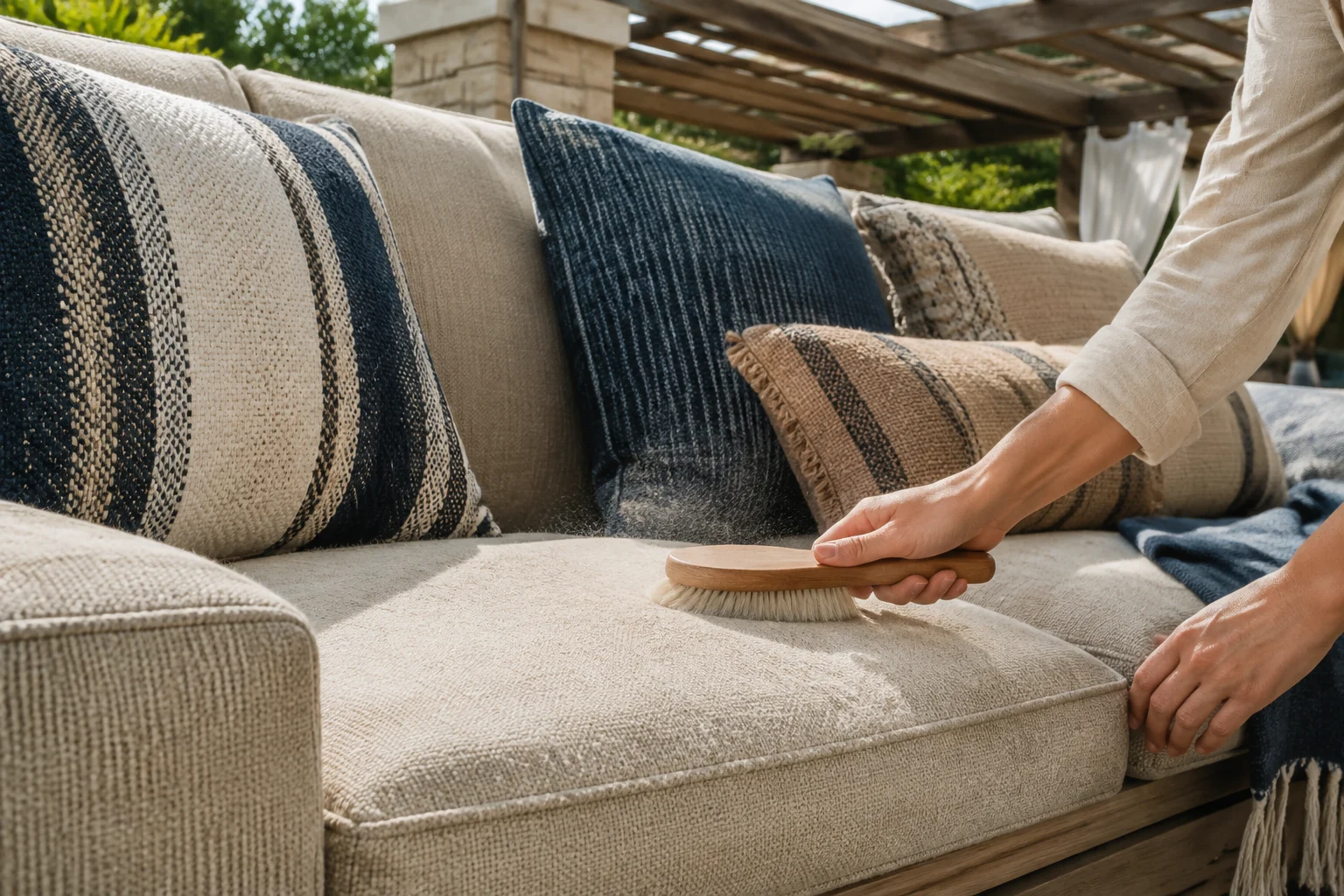
Marketplace cushions obey the same weather physics as any others, so the longevity habits transfer one-to-one: store or cover cushions in the off-season (the full method: how to store outdoor cushions for winter), stand them on edge after rain so both faces dry, re-fluff fiber backs monthly, and clean stains within days rather than seasons (how to clean outdoor cushions). What changes on the marketplace is accountability: a cushion that fails early routes through a seller’s return terms and a shipping label, while a spec chosen deliberately — foam density, fiber, construction — fails on its own schedule, which you set. The full habit system is here, and the timing signals that say replace-don’t-nurse are here.
What Arrives Versus What Was Photographed
The last marketplace-specific gap to name: listing photography is produced lighting on styled product, and cushions are three-dimensional objects that compress in cartons. A seat cushion shipped vacuum-packed needs days to recover its loft — press and patience, not a return label — while a cushion that arrives already uneven at the seams was sewn that way. The tells that separate shipping compression from construction defect: compression is uniform and recovers; construction defects (crooked seams, corners that will not fill, ties sewn into the zipper line) do not recover, and photographing them against a tape measure the day of arrival is what makes the seller-conversation efficient. This is also why reviewer photos outvalue listing photos: they show the product on real furniture, at real loft, after real weather — the three things studio photography is engineered to avoid showing.
FAQs
Are Amazon outdoor cushions good quality?
Mixed by design — the platform is a marketplace, so quality spans national-brand official stores down to generic aggregator imports; the listing’s spec table and review-failure-mode reading separate the tiers faster than price does.
How do I know an Amazon cushion will fit my furniture?
Read the spec-table dimensions — width, depth, thickness, corner shape — and compare them to seam-to-seam measurements of your seat taken per how to measure; the listing title rounds, the table does not.
What does “outdoor fabric” mean on Amazon listings?
Nothing specific until the fiber is named — solution-dyed acrylic and Olefin are the sun-proof tiers, spun polyester is the fade tier for covered use, and coating marketing names are not fiber facts (best outdoor cushion fabric).
Can I buy deep-seat or one-piece cushions on Amazon?
Only approximately — generic depth tops out around 23 inches and one-piece frames need specific lengths, so the marketplace answer to exact-fit shapes is “closest listing,” which is the misfit-and-return cycle in advance.
Is custom worth it when Amazon is so cheap?
For standard squares under gentle use, no — but for exact-fit shapes or daily-use sets, one custom run at 50D-60D foam outlasts several cheap rotations; start at custom outdoor cushions.
My cushions arrived compressed and flat — are they defective?
Usually not — vacuum-packed cushions need several days to recover loft, and uniform compression that improves day by day is shipping, not defect; crooked seams, corners that never fill, and ties sewn into closure lines are construction issues, and a day-of-arrival photo against a tape measure settles which one you have.
Next Steps
- Measure the target seats — seam-to-seam, to the nearest quarter inch, per how to measure.
- If your numbers are standard squares, run the five checks against shortlisted listings and buy from the official-store tier first.
- If any number is non-standard, skip the marketplace lottery and price custom outdoor cushions — 3-6 weeks delivery, crafted in 4-7 days, cut only after your dimensions are confirmed.
Patio Chair Cushions: The Complete Buying Guide (Outdoor Too)
Everything that decides a patio or outdoor chair cushion — sizes, thickness, ties, fabric tiers and where each buying route wins. Custom from $45 when grids fail.
Outdoor Rocking Chair Cushions: The Weatherproof Guide to Sizes and Fabrics
An indoor rocking cushion dies fast on a porch. The sun bleaches the print in a single season, the foam
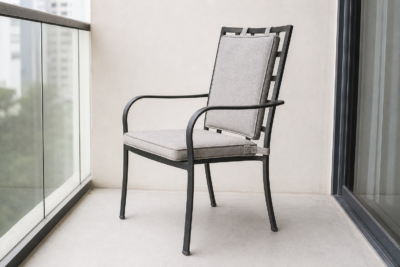
Cushions for Metal Patio Chairs: Frame Types, Grip and the Heat Question
Cushions for metal patio chairs guide: wrought iron, aluminum and steel frames and what each means for pads, sliding on slick metal, heat absorption in sun, sizing across mixed metal sets, and the outdoor duty spec.
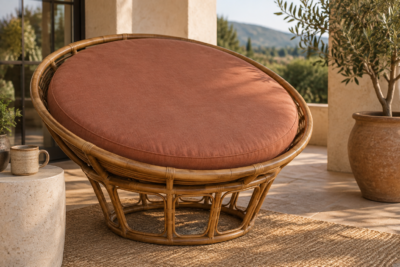
Outdoor Papasan Cushions: Weathering the Big Round
Outdoor papasan cushions fail in a known order — fabric, fill, bowl. The overhang-vs-inset diameter decision, fiber vs foam outdoors, and the honest line between a flat round and the concave original.
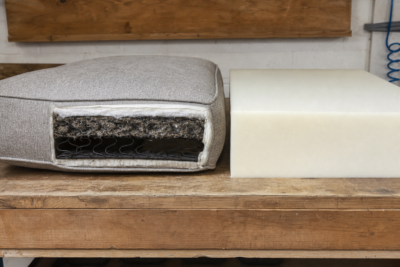
High Density Foam Couch Guide: What Density Actually Means
What high density foam actually means for a couch — the ×10 density convention, density vs firmness (ILD), the 35D–65D grades ranked by use, how each grade fails, and what density costs per square foot.
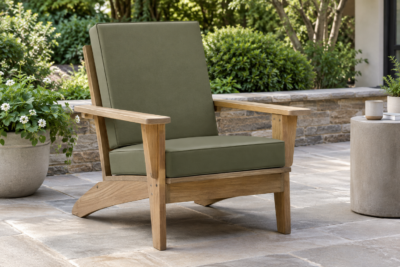
Adirondack Chair Cushions: Sizes, Selection & Replacement Guide
Adirondack cushion sizes decoded: 20×20 seats, tall-back options, tie patterns, best fabrics — plus fitting odd or vintage chairs.