
Look at any cushion catalog and the tops divide into two camps: the tufted — buttons or stitches pulling the surface into patterns of dimples and channels — and the unbuttoned (sometimes styled “knife-edge” or plain-top) — a smooth, unbroken expanse. The choice is usually sold as style, and style is real; but the stitch decision is also engineering. Tufting changes how fill behaves, how the pad ages, where it cleans, and what it costs — and the right answer differs for a bench run, a dining chair, a daybed, and a floor cushion. This guide covers both camps honestly. The construction context: cushion filling types; the piping companion detail: cushion piping and welt cord.
What Tufting Actually Does
The tuft (a stitch pulling the cover down through the fill to the bottom panel, traditionally finished with a button) does three physical jobs:
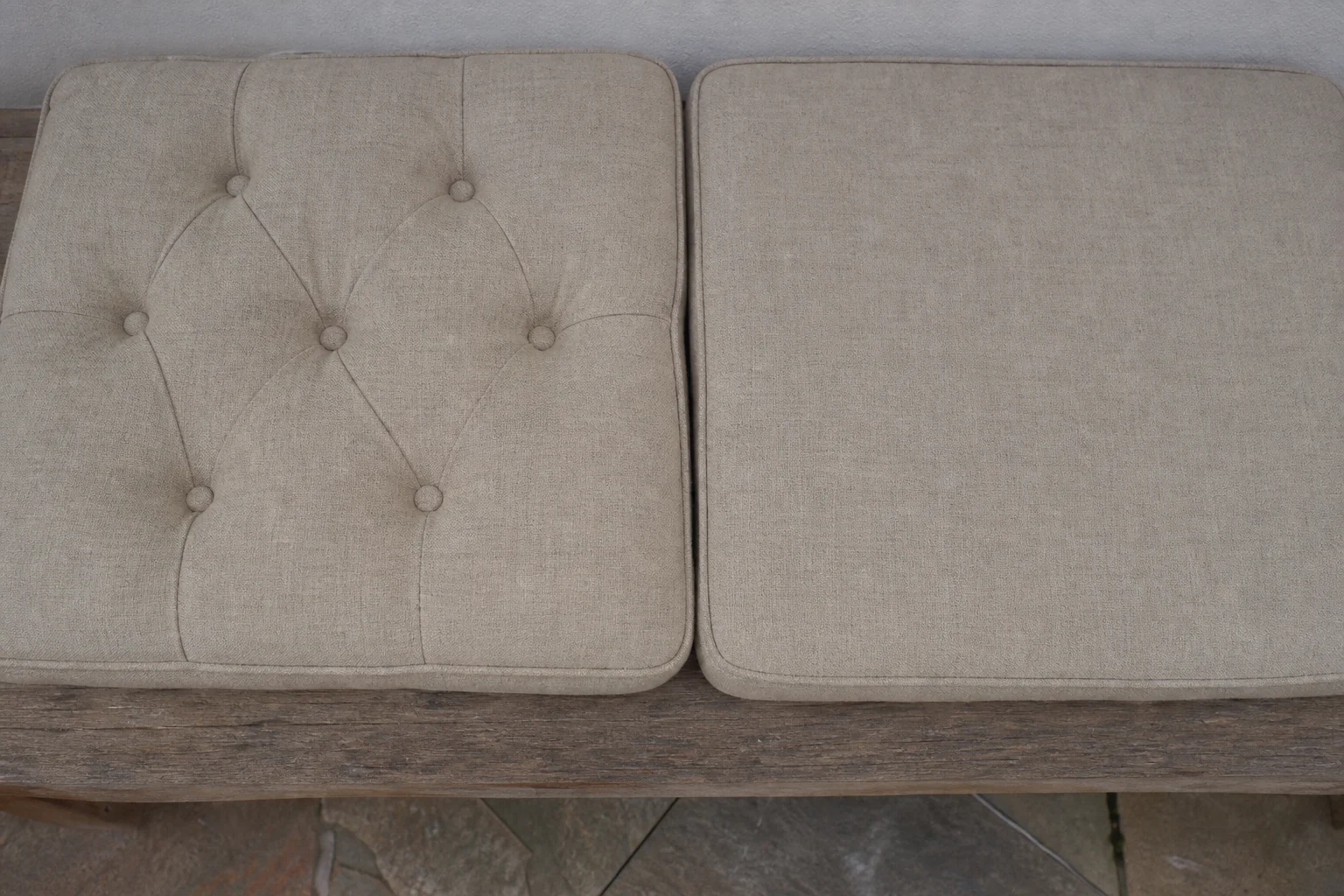
- It pins the fill. Every tuft is an anchor point that stops fill from migrating — the physics that hollows long pads’ middles and shifts tall pads’ loft downward. A tufted pad holds its section-to-section consistency for years where a plain pad of the same fill develops topography. This is why the long-bench and thick-pad guidance throughout this series (extra long bench cushions, extra thick cushions) recommends stitch patterns as fill management, not decoration.
- It firms the sit. The stitch compresses the fill locally — tufted pads read firmer and more upholstered than the identical fill unquilted. The dimples are comfort architecture: they create zones of differing compression that contour the sitter.
- It creates wear points and cleaning seams. Buttons and stitch knots collect the debris that plain tops shed; each tuft is also a potential failure point (the classic lost button) and a cleaning focus.
The Plain Top’s Case
The unbuttoned cushion argues back with real advantages:
- – The full loft. Nothing compresses the fill; plain pads deliver the maximum plushness and uniformity the fill can give — the reason luxury-seat builds (deep-seat loungers, daybeds) often run plain: the comfort layer works unimpeded (deep seat cushions).
- – The clean surface. No buttons to snag, no stitch wells to collect crumbs, no lost-button repairs — the practical choice for dining and kitchen duty, where the pad is wiped and spot-cleaned weekly (how to clean outdoor cushions).
- – The modern line. Design eras aside (channel-tufted mid-century versus plain minimalist), a plain top suits the clean-lined frames and reads less “traditional parlor.”
The plain top’s honest cost: with loose or wrapped fills, it trades years for loft — the migration that tufting prevents happens on a two-to-five-year clock by fill grade (cushion filling types). Solid-foam plain pads dodge the problem entirely (foam doesn’t migrate), which is why custom plain tops on dense cores age as well as tufted ones.
The Stitch Patterns: A Field Guide
Tufting has a vocabulary, and the patterns behave differently:
- – Diamond tufting — the classic buttoned lattice; the traditional upholstery look. Maximum fill pinning, maximum firmness, maximum traditional styling. The formal-parlor choice; also the pattern that shows every lost button.
- – Channel (biscuit) tufting — vertical channels of stitching, no buttons; the mid-century signature. Channels pin migration along their length while letting the pad breathe across — the lounge and sofa-back pattern, and the look of many premium patio lines.
- – Grid stitching — plain sewn lines both directions, no dimples, no buttons. The working pattern for long bench runs and thick pads: fill management without the tufted look (extra long bench cushions).
- – Linear stitching — single-direction sewn lines; the tailored look that pins migration in one axis. The subtle upgrade on dining pads and bench runs.
- – Button versus stitch construction — buttons are the traditional finish (and the maintenance item); plain stitch tufts give the same pinning with nothing to lose. Modern custom work offers both; the stitch-only versions are the practical choice anywhere buttons would face abrasion or laundering-adjacent cleaning.
Feel: The Sitting Difference
Same fill, same thickness, tufted versus plain, what the sitter notices:
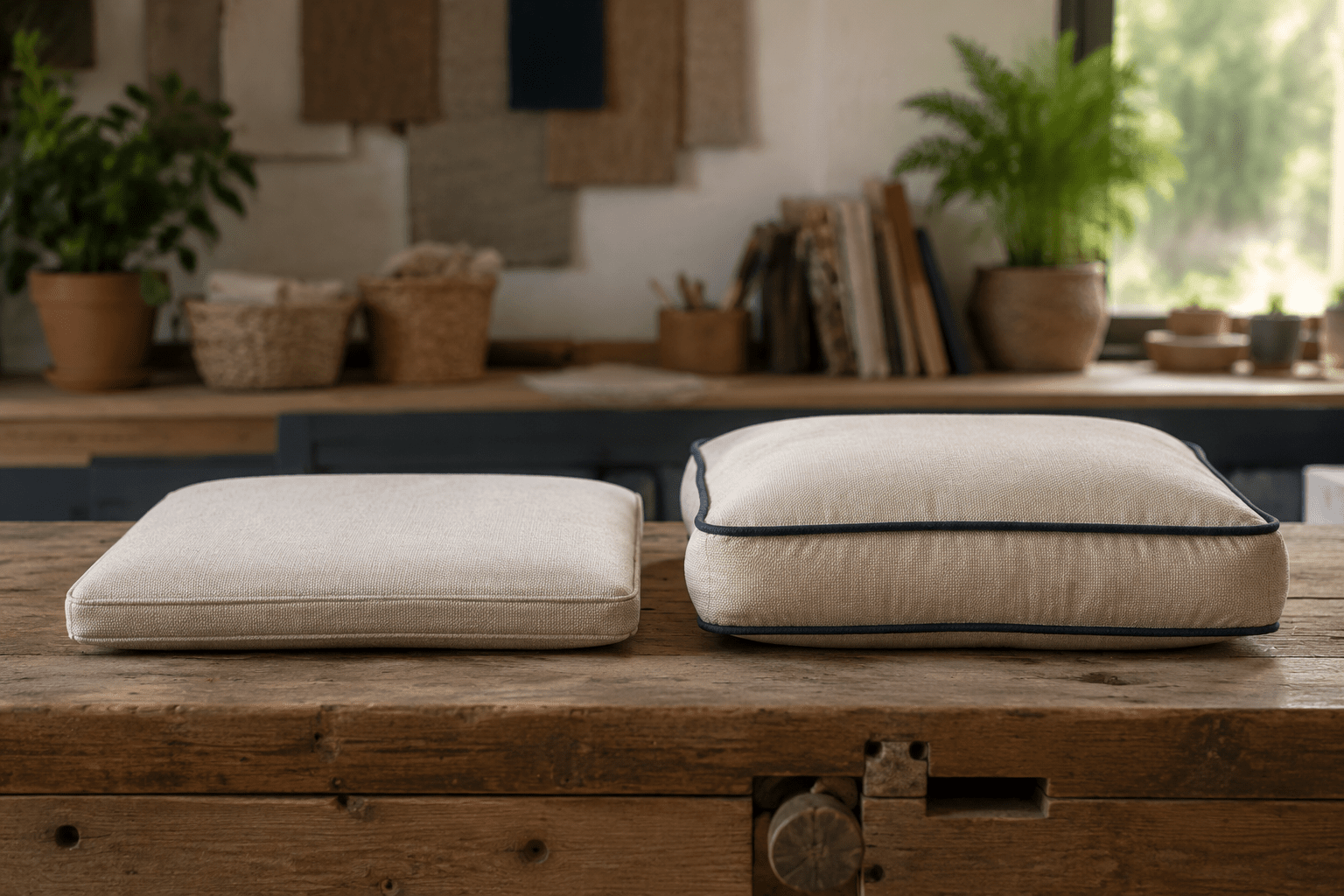
- – Tufted sits firmer and breaks in zones — the initial plushness gives way to a supportive, upholstered feel. Long diners and readers often prefer it; sinkers and softness-seekers don’t.
- – Plain sits at the fill’s full character — plush if the fill is plush, firm if it’s a dense core. The honest way to get a soft plain cushion that stays soft is a dense base with a genuine comfort layer (memory foam topped cushions), not a light fill in a plain cover.
- – The density interaction: tufting a 50D core firms it further (sometimes too much — over-tufted dense pads read hard); tufting light fills rescues them (the classic quilted-fiber pad is tufting making a weak fill serviceable). The density logic: how to choose foam density.
The Custom Ordering: Stitch Styles as Line Items
In custom work, the stitch decision is a specification with a small price: plain tops carry no sewing add-on; linear and grid stitching are modest per-piece add-ons; channel and diamond (especially buttoned) carry more — the sewing time is real. The value logic:
- – Long runs and thick pads: the stitch pays for itself in fill management — order grid or linear (extra long bench cushions).
- – Dining sets: plain tops wear the duty best; the stitch is style money on furniture that gets wiped, not admired from across the room.
- – Lounge builds: channel or plain by the fill — dense cores plain, wrapped fills channel-tufted.
- – The matched-set note: whatever the choice, the whole set matches — one stitch pattern across every pad in the order, from one dye lot, per the matched-order discipline (sectional cushion replacement).
Outdoor Tufting: The Weather Versions
The stitch decision outdoors runs the same engineering with weather riders:
- – Stitched patterns (grid, linear, channel) survive weather fine — the sewing is thread-through-fabric, and outdoor grades use the outdoor threads; the fill management benefit applies doubly to outdoor fills, which fatigue and migrate under sun and cycles.
- – Buttons outdoors are the maintenance item — UV and moisture work the button’s thread channel, and the lost-button problem arrives faster in weather. The stitch-only patterns are the practical outdoor choice (outdoor cushion maintenance tips covers the inspection habit that catches button threads before they part).
- – Quilted outdoor pads — the fiber-filled tufted look — are the budget category’s signature and its honest weakness: the tufting makes light fiber serviceable, but fiber-plus-moisture is the mildew pairing (polyfill cushion filling covers fiber’s outdoor limits; quick dry foam for outdoor cushions the proper fill). Quality outdoor tufted work is foam-core-with-stitch-pattern, not fiber-in-a-quilt.
- – The cleaning interaction: tuft wells collect outdoor grit — the round-brush routine in how to clean outdoor cushions pays attention to the stitch lines, where plain tops wipe clean in one pass. Covered placements can carry tufting without the grit tax; open patios earn their plain tops.
A Quick Choosing Table
| Build | Plain | Grid/linear stitch | Channel | Diamond (buttons) |
| Dining set, daily | Best — wipes clean | Style option | Too formal | Too formal |
| Long bench run (60″+) | Fill migration risk | Best — pins the length | Occasional | No |
| Thick pad (5″+) | Migration + edge roll | Best with boxing | Good | Over-tufted risk |
| Deep-seat lounger | Best on dense cores | Fine | The signature look | Period pieces |
| Back cushions | Best | Fine | Common | Traditional sofas |
| Outdoor duty | Best (cleanest) | Good, stitched only | Good, stitched only | Buttons weather poorly |
The one-line version: plain for duty, stitched for length and thickness, channel for the look, diamond for the parlor — and the whole set in one pattern, whatever the choice.
FAQs
Are tufted cushions better?
Different — tufting pins fill against migration and firms the sit; plain tops deliver full loft and clean maintenance. The right choice depends on the fill and the furniture: the comparisons above.
Why do long cushions sag in the middle?
Fill migration — every sit lets the fill creep, and plain long pads hollow at the middle. Grid or linear stitching prevents it: extra long bench cushions.
Do tufted cushions feel firmer?
Yes — the stitches compress the fill locally and create support zones. Over-tufted dense cores can read hard; light fills benefit most from tufting’s support.
What’s the difference between diamond tufting and channel tufting?
Diamond is the buttoned traditional lattice; channel is the vertical-stitch mid-century pattern without buttons. Both pin fill; the looks belong to different frames.
Are buttons a maintenance problem?
The one real failure point of buttoned work — lost buttons and snagged threads. Stitch-only tufting gives the same fill pinning with nothing to lose, and is the practical choice for duty furniture.
Does stitching cost more on custom cushions?
A modest per-piece add-on for linear or grid, more for channel and buttoned diamond — the sewing time is real. It pays for itself on long runs and thick pads; it’s style money on dining sets.
Next Steps
- Decide by fill and furniture: plain for dining and dense-core builds; grid or linear for long runs and thick pads; channel for wrapped-fill lounges.
- Fix the whole set’s pattern — one stitch style across every pad, one dye lot, one order.
- Specify at custom indoor bench cushions (or the type-appropriate builder) — stitch styles and fabric in one flow, from a $45 make-base plus per-square-foot rates, confirmed before cutting, 4–7 business days.
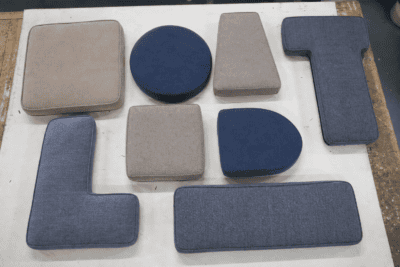
Cushion Shapes Guide: All 11 Shapes, What They Fit, and How to Measure Each One
A field guide to every cushion shape we cut — rectangle, chaise, L-shape, T-cushion, bowed, notched, round, oval, half-round and wedge — which furniture each one belongs to, how to measure it in inches, and exactly which shape to pick in our custom cushion builder.
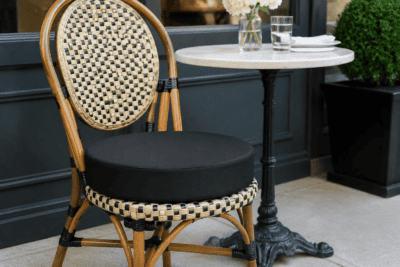
Round Outdoor Cushions: Diameter Duty on the Patio
Round outdoor cushion guide: round patio dining sets, fire-pit seating and round loungers; diameter measuring with the two-axis check, thickness bands, weather specs for circular pads, and ordering rounds.
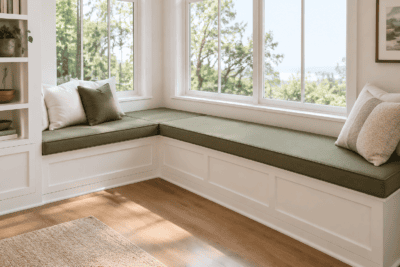
U-Shaped Cushions: Measuring the Wraparound Seat
U-shaped cushion guide: the three-arm geometry of wraparound seating, inside versus outside radius measuring, seam placement at the corners, continuous versus sectioned builds, and ordering U-runs to template.
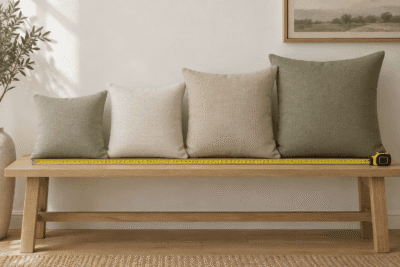
Throw Pillow Sizes: Standard Chart and How to Measure
There is no industry law, but there is a firm convention: throw pillows cluster at 16, 18, 20 and 22
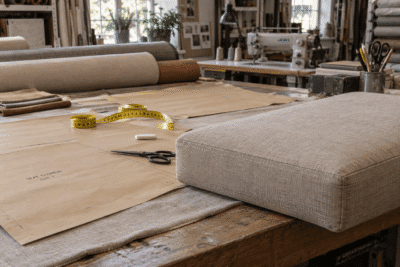
How Much Fabric Do You Need for Custom Cushions? (Yardage, Math and a Reality Check)
Two very different people ask how much fabric a cushion needs. One is sewing it herself and standing at a
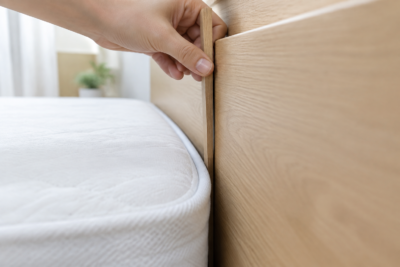
What Size Bed Gap Filler Do I Need? Thickness, Length and Density
Size a bed gap filler from three measurements, not the bed’s name: thickness equals gap width plus half an inch to one, length runs the full seam, height runs platform to mattress top. Density starts at 50D.