Memory foam has a mattress reputation and a cushion problem. As a seat core it underperforms — slow recovery reads as unstable when you shift, and rising means climbing out of a mold (the full physics is in memory foam vs regular foam). But as a topper — a thin viscoelastic layer over a firm high-resilience base — memory foam is genuinely excellent — at mattress scale, the custom mattress topper runs the same logic — and it is the one configuration where mattress technology translates to cushions. Then the marketers added gel, and the category got confusing. This article is the layer-by-layer verdict: when a memory top helps, when gel helps on top of that, when both hurt, and the specs that separate a working build from a label.
The Build: What a Memory-Topped Cushion Actually Is
Three layers, each with a job:
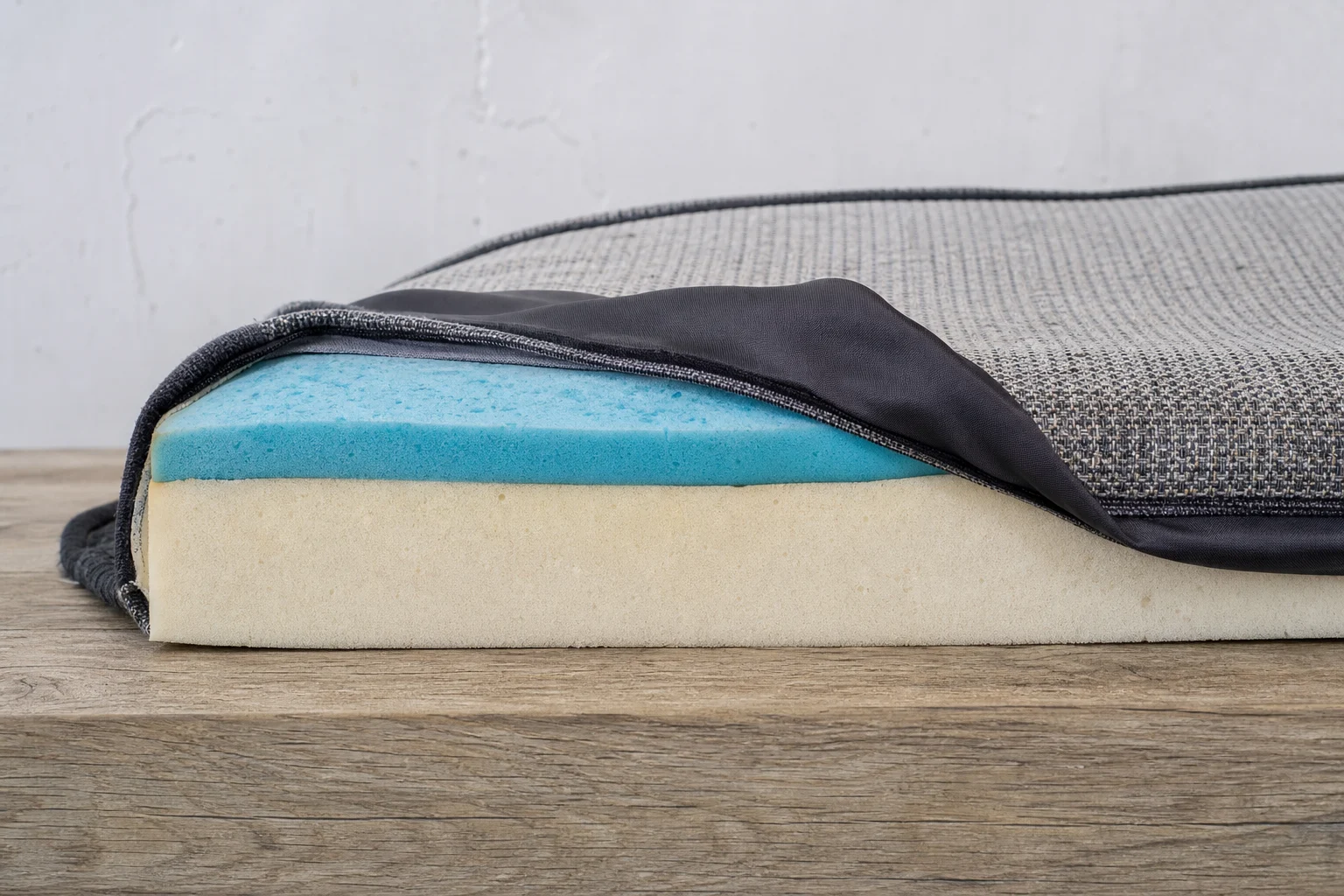
- The base — the structural layer. A slab of high-density foam (typically 35D–50D) at the full working thickness of the cushion. It carries body weight, controls sitting height, and sets the durability calendar.
- The memory layer — the surface layer. 1″–1.5″ of viscoelastic foam bonded on top. It is what your hip meets first: it contours to pressure points and delivers the “sinks to fit you” feel.
- The cover. In a family matched to how the seat lives, because surfaces wear before structures.
The division of labor is the whole design: spring at the structure, contour at the skin. Neither layer can do the other’s job — visco cannot support (it is designed to yield), and HR foam cannot contour (it is designed to push back evenly). That complementarity is why “layered builds” is its own section in cushion filling types compared — the same logic that produces down-wrapped cores produces memory-topped ones.
Where the Build Sits on the Triangle
On the softness–support–durability triangle, layering is how a cushion occupies two positions at once:
- – Softness: high, at the surface only. Contour for the first inch and a half; below it the cushion behaves like the firm base it is.
- – Support: high, on loan from the base. Whatever the base grade is, that is the support you get — the topper changes the entry, not the structure.
- – Durability: set by the base. Visco layers do wear (they soften and take impressions over years), but when a 1″ surface layer fades, the cushion still works; when the base dies, nothing above it matters.
The configuration fails when the roles blur — a 3″ memory layer over a thin base is a soft cushion all the way down: contour on contour, no spring anywhere, and the quicksand feel memory foam is blamed for.
The Base Still Follows the Rule: Density Is Lifespan, ILD Is Comfort
Because the topper is cosmetic-structural, the buying logic of the base is unchanged: density is lifespan, ILD is comfort, and the two are independent. The D number on the base predicts how many years the cushion holds its shape; the ILD tunes the firmness you sink through to reach it. A memory topper over a 24D base is a luxury surface on a two-season calendar — the showroom feels identical to the same topper over 50D+, and the third summer is where the money went. The full spec decoder, including the compression-set test that predicts dishing, is in memory foam vs foam cushions.
Rule: when a listing mentions the memory layer but not the base density, the base density is the news they are not printing. Ask for both numbers.
Gel Layers: What Gel Does, and What It Cannot Do
Gel-infused memory foam is standard visco with gel beads, swirls, or a laminated gel pad dispersed through it. The honest mechanism:
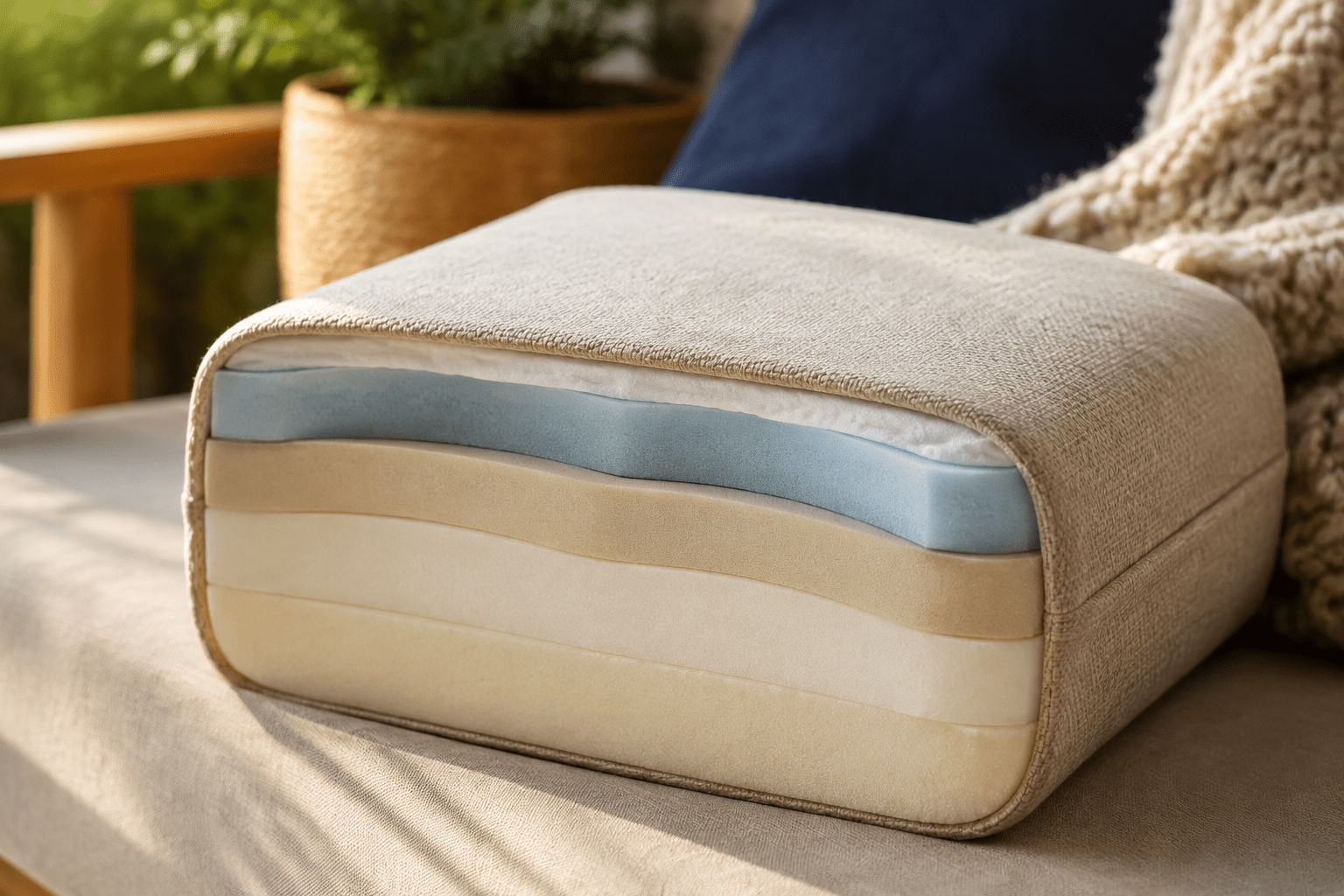
- – Gel helps by conducting heat. Visco’s flaw is warmth — it softens with body heat (that is literally its activation mechanism) and reflects heat back at the sitter. Gel conducts heat away from the contact zone faster than foam does. The result is real but modest: a cooler first few minutes and slightly less heat-softening in a warm room.
- – Gel does not make memory foam durable. It does not change density, compression set, or the aging calendar. “Gel-infused” over a low-density base is a cool surface on the same short calendar.
- – Solid gel pads add weight and a boundary feel. A distinct firm plane under the visco — some sitters notice it, some do not.
Verdict on gel: a legitimate refinement for the cases where memory tops help at all — and pure label value everywhere else.
When Memory Tops Help, and When They Hurt
Help:
- Loungers, daybeds, and chaises you actually nap on. Static lying is visco’s native use case; a 1″–1.5″ topper over a 50D+ base is the luxury configuration for covered nap pieces (measure per chaise measurements).
- Long reading sessions in one position. Window seats and reading nooks get genuine pressure-point relief from the contour layer (window seat guide).
- Pressure-sensitive sitters. Households managing circulation or pain issues on static seating benefit from contour distribution; this is the medical case that mattresses built the reputation on.
- Covered indoor-only use, always. Every point above assumes indoor conditions.
Hurt:
- Dining chairs and any seat you shift on. Re-contouring on every movement reads as instability, and the get-up problem — rising out of a closing imprint — is worst at dining frequency and worst for aging knees.
- Outdoors, without exception. Visco absorbs and holds water, and it heat-softens in sun — a patio cushion in afternoon sun goes from supportive to sludge-firm as the temperature climbs. Nothing about “gel” makes visco outdoor-suitable; the outdoor comfort question is drainage: quick-dry foam explained.
- Thick toppers, anywhere. Past about 1.5″, the memory layer stops being a surface and starts being a soft seat — and soft seats are what the base exists to prevent. More memory is not more luxury; it is less structure.
- As a fix for a dead base. A topper over dished foam puts a contour surface on a slope. The base is the patient; the topper is not medicine.
What Layered Builds Cost at Market Prices
Memory-topped cushions price above plain high-density foam equivalents at market prices — the visco layer carries a premium per unit volume, and gel-infused variants a further one. Whether the premium is justified is entirely the use case: for a nap lounger it buys real contour relief; for a dining chair it buys instability at a markup. In both cases the base density decides how long any of it lasts — and it is the number most often unstated.
Our Menu, Stated Plainly
We are the factory — ten years of cutting foam and sewing covers — and our menu is high-density foam in four grades (35D–65D). Here is when that is the right answer, and when another fill serves you better.
Right answer: every seat you sit upright in — dining, conversation sets, benches, window seats — where a high-density core at your measurements delivers the stable, all-day sit that memory tops would only soften into instability. Where customers want a plusher entry, density and thickness do the work in the custom cushion builder: a 50D core at one thickness increment up reads plusher and still behaves like structure. Every cushion is made to order in 4–7 business days.
Another fill serves you better: a true memory-topped build for nap loungers and covered daybeds — a vendor who layers visco over a stated base density is the right workshop for that piece, and asking them for both numbers is the test of whether they are one. The layering theory is on our side of the street; the visco layer itself is not.
Thickness and Price in the Builder
In the builder, fill grade and thickness price together: every shape takes a thickness field (the C dimension, 2″–8″ in 1/8″ increments), and the quote is footprint at per-sqft foam and fabric rates, times a shape factor, on a $45 make-base. The layered logic carries over even in single-fill builds: rather than 3″ of soft, order 4″ of 50D — thickness buys plush volume while density holds the structure, and the price difference shows live in the quote as you change either field.
FAQs
Are memory foam topped cushions good?
Built as designed — a 1″–1.5″ visco layer over a 35D+ base — they are excellent for lounging and long static sitting, and wrong for dining chairs and everything outdoors; the base density decides the lifespan.
Do gel memory foam cushions actually run cooler?
Moderately — gel conducts heat away from the contact zone faster than foam alone, which buys a cooler first few minutes and less heat-softening; it does not change density, durability, or water behavior.
How thick should a memory foam topper be on a seat cushion?
1″–1.5″ — enough to contour the contact zone while the base still controls the sit; at 2″+ the topper stops being a surface and becomes a soft seat with the instability that implies.
Can I use gel memory foam cushions on my patio?
No — viscoelastic foam holds water and softens dramatically in heat, and neither gel beads nor any cover changes the material; outdoor comfort is a drainage problem answered by reticulated quick-dry foam (the guide).
Is a memory foam topper a fix for sagging cushions?
No — a topper over dished foam adds contour to a slope; the fix is replacing or upgrading the base core by density, then adding surface plushness only after the structure is sound.
Can I order a 4 inch memory foam seat topper?
A 4 inch memory foam layer is the ceiling for toppers — memory foam 4 inch builds ride on a 60D base so the seat still pushes back. A memory foam sheet thinner than 1.5 inches on a seat simply disappears under weight.
Can I reuse full bed memory foam as a cushion topper?
Full bed memory foam is the same visco material, but mattress stock is too soft as a seat core — slice it thin (under 2 inches) over 60D HR foam, never as the whole cushion.
Next Steps
- Classify the seat’s job — upright and dynamic points to a plain dense core; long static lounging is the only case for a memory top.
- Measure the piece following how to measure — layered or not, the cushion is cut to the same numbers.
- Configure in the custom cushion builder — choose the density grade and thickness; the quote updates live as each spec changes.
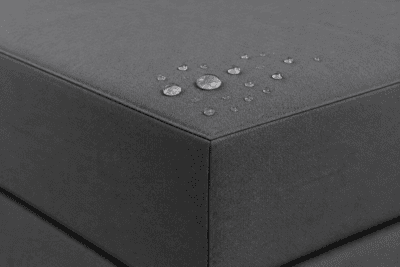
Best Outdoor Cushion Fabric: How to Choose by Climate, Exposure and Budget
A factory guide to outdoor cushion fabrics — solution-dyed acrylic, olefin, polyester grades and blends — ranked for fade, water, mold, comfort and cost per year.
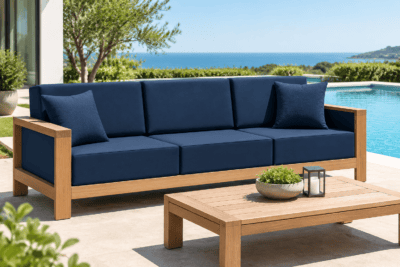
Is Sunbrella Fabric Worth It? An Honest Cost-Per-Year Analysis
Whether the Sunbrella premium pays off depends on sun exposure, horizon and color — here’s the honest math, warranty mechanics and when to skip the upgrade.
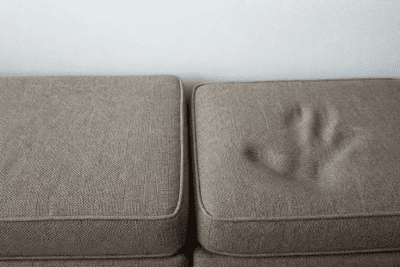
Memory Foam vs Regular Foam Cushions: What a Cushion Factory Wants You to Know
Memory foam vs high-resilience foam for seat cushions — density (35D–65D), ILD firmness, compression set and airflow explained by the people who cut foam daily.
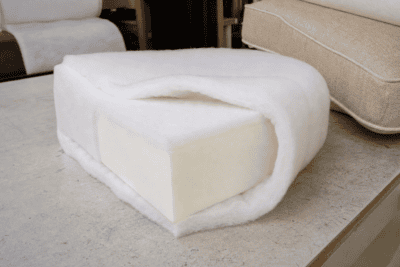
Dacron Batting: The Wrap Layer Explained (What It Does and When to Order It)
Dacron batting for cushions explained: the polyester wrap layer around foam cores, what it does for feel edges and fabric wear, thickness options, indoor and outdoor uses, and when the wrap earns its cost.
Latex Foam Cushions: Natural Rubber Seating, Honestly Assessed
Latex foam cushion guide: what natural and blended latex actually offer versus polyurethane — resilience, feel, lifespan, weight and cost — who latex seating serves, and the honest counterarguments.
Are Waterproof Cushions Real? What Water-Resistant Actually Means
Why ‘waterproof’ outdoor cushions mostly aren’t — hydrostatic head, coated vs breathable fabrics, quick-dry foam and drainage design explained honestly.