
“King size” is not a gap measurement. The same king frame can show a 2-inch seam with one mattress and a 5-inch seam with another, because the gap comes from frame clearance, mattress shrinkage and drift — none of which the bed’s name tells you. Sizing a filler is three numbers and one rule, and this page is that rule.
The short answer: order the filler half an inch to an inch thicker than the gap is wide — that interference is what holds it in — with the length running the full seam rail to rail and the height running from the platform to the mattress top (plus two or three inches if you want a pillow lip). Density starts at 50D for a gap that takes nightly pillow load.
For why the gap exists and the three ways to close it, start with how to fill the gap between your mattress and headboard; this page assumes you have decided on a foam strip and need the spec. The measuring discipline is the same one we publish for rectangle cushion orders — read to the nearest quarter inch, several readings, keep the largest.
Start With Three Numbers, Not a Bed Size
Stock filler is sold by bed type — king, queen, twin — at one fixed thickness, because a warehouse picks a box, not a tape measure. Your gap does not care what the bed is called. Three numbers do all the work:
- Gap width: mattress back edge to headboard face, measured horizontally at left, center and right; keep the largest reading.
- Gap height: platform or slats up to the mattress top (this sets how tall the strip stands).
- Seam length: rail to rail along the headboard, inside the frame.
A quarter inch of care per number is the difference between a strip that drops in once and never moves, and one that rides up out of the seam by the second week. If the three width readings disagree by more than an inch, note it — the fix is a tapered cut, covered below.
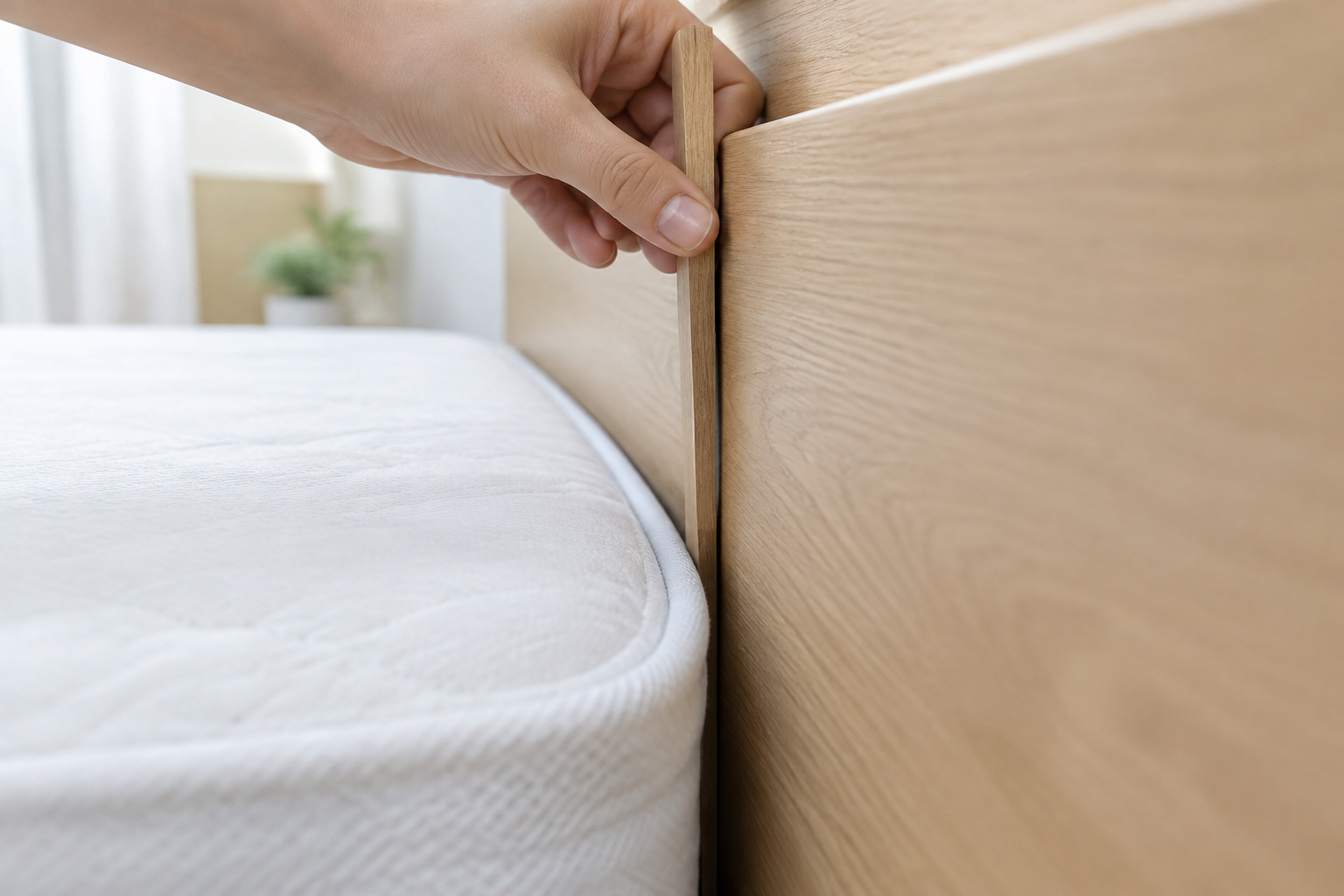
Thickness: the Gap Width Plus Half an Inch to One
Foam holds a gap the way a wedge holds a door: by being slightly too big to be there. Compressed into an opening narrower than itself, the strip pushes outward on both faces, and that constant outward push — interference — is the retention. There is no adhesive and no fastening in a properly sized filler, and none is needed.
The working rule, from how these strips are actually sized in production:
| Your gap width | Order this thickness | What it feels like installed |
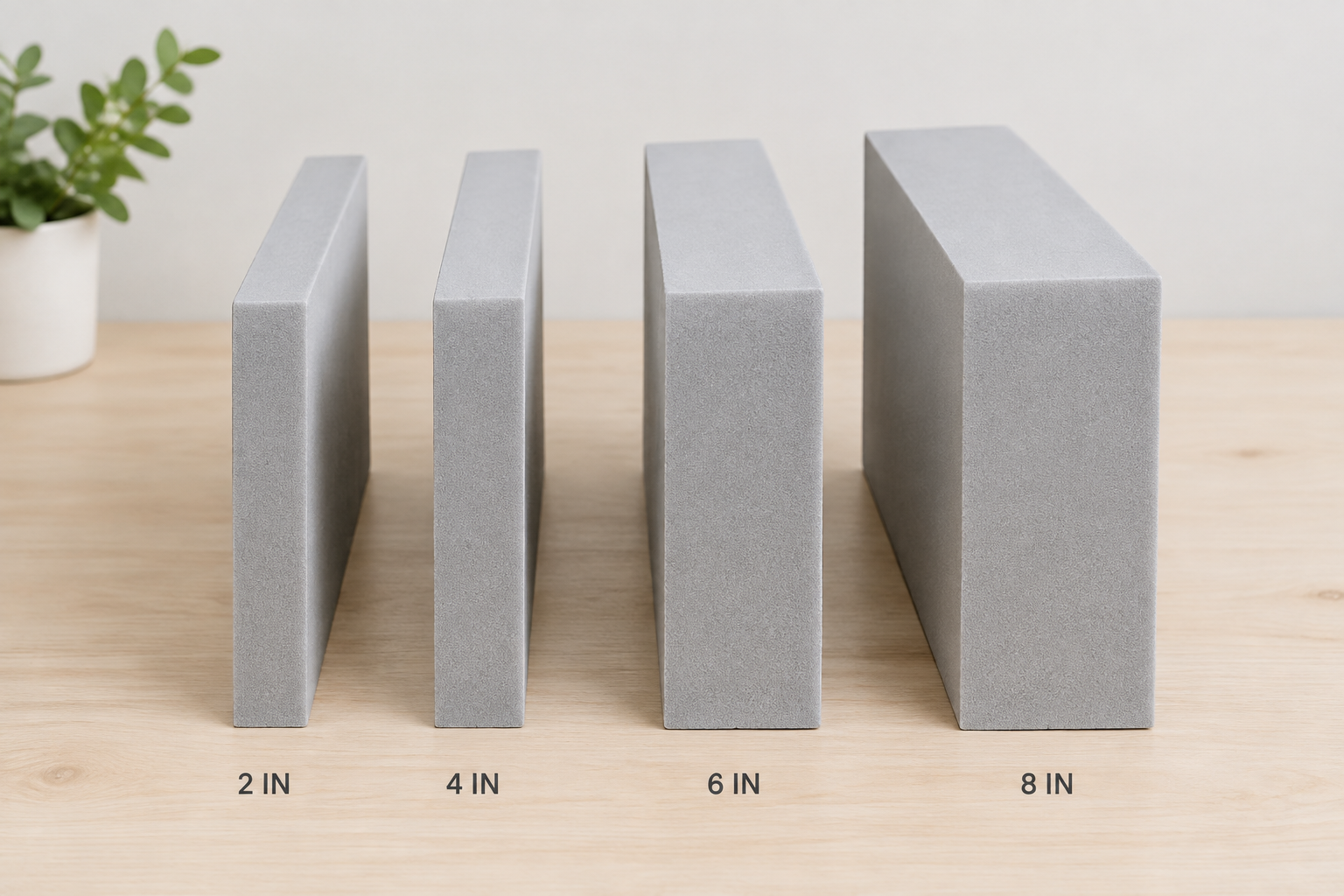
| 1 to 2 inches | 2 to 3 inches | Presses in with a flat hand, firm immediately |
| 2 to 4 inches | 3 to 5 inches | The general case; most headboard gaps land here |
| 4 to 6 inches | 5 to 7 inches | Needs a firm shove along the whole seam, locks hard |
| 6 to 7 inches | 7 to 8 inches | Top of the thickness range; anything wider wants two-sided support |
Two failure modes bracket the rule. Too thin — a 2-inch strip in a 3-inch gap — and there is no interference at all: the strip tips, wanders and works its way out. Too thick — 6 inches of foam compressed into a 2-inch gap — and the strip bows upward out of the seam, lifting the head of the bed cover. Half an inch to one inch of interference is the band between the two.
We cut thickness in 2 to 8 inch stock — the same range the rest of our custom foam work runs on — in eighth-inch increments on the order form.
Height: Platform to Mattress Top, or a Little Higher
The strip’s height decides where the wall stops. Three positions, each correct for a different complaint:
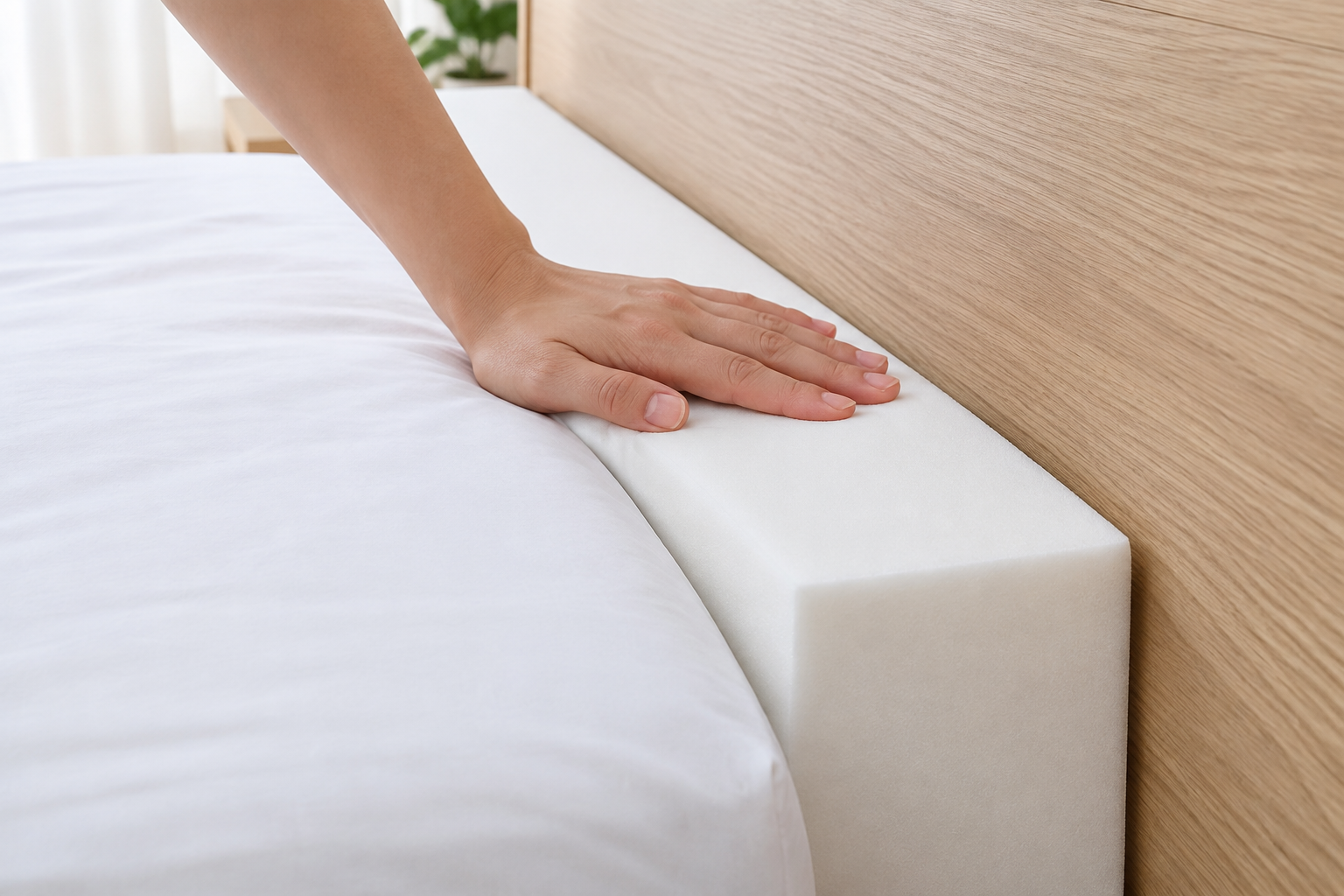
Level with the mattress top — the standard. Fills the void, keeps the sleeping surface continuous, hides below the linens. Measure platform to mattress top at the corner where the tape sits square.
Two to three inches above the mattress — the pillow lip. If pillows are what disappear into the gap, run the strip higher than the mattress so the pillow rests against foam instead of sliding down behind it. A 13-inch strip over an 11-inch mattress is a common build.
Below the mattress top — the storage look. Some people want the gap gone but keep a low profile at the head of the bed; the strip simply runs shorter. Note that the top of the gap stays open, and phones will still find it.
Mattress heights run roughly 8 to 14 inches across the market (industry-typical range), so most full-height strips land between 8 and 16 inches tall. Height carries no interference — order it at the measured number, not over.
Length: Run the Full Seam
Length has one rule: the strip runs rail to rail, the whole seam, in one piece. A partial-length filler rotates — the pillow presses the covered half and the uncovered half becomes the new gap. And every end or joint in a run is a leak for exactly the crumbs and cables the gap already collects.
Multi-pack short sticks (20-piece sets on eBay, 16-piece sets on AliExpress — US listings observed September 2026) are the pieced version of this, and their joints are where the format fails: each seam between sticks is a hinge that lets the run walk apart under nightly pillow load. If the gap exists only along part of the headboard — a winged board with one open side — order the strip for the open run only, butted square against the wing.
Length, like height, carries no interference: order the measured number, minus nothing, plus nothing.

Density: 50D Is the Floor, Not the Upgrade
A headboard strip works compressed, every night, for years — squeezed between two faces and leaned on by whatever the sleeper shoves against the head of the bed. That duty cycle is the definition of a seating load, and the density ladder for seating applies:
- 35D — guest rooms, decorative beds, gaps that get pressed a few nights a month.
- 50D — the correct default for a bed slept in nightly; supportive with give.
- 60D and 65D — heavy nightly load, adjustable bases, or a strip that must hold its exact height for a decade.
Density is lifespan, not firmness — how much substance per cubic foot, deciding how many years the strip holds its shape under load. The number to refuse is the unlisted one: commodity 1.8 lb (18D) foam fills most boxed multipacks and dishes back within one to two years of nightly compression. The two rating systems — D and lb/ft³ — are translated side by side in foam density explained: D ratings vs lbs, and our per-density foam rates are published on the couch foam cushions page.
Reading a Stock Size Chart Against Your Numbers
A stock chart is still a reasonable buy when your numbers happen to match it. Put yours alongside the listing’s, all six cells:
| Spec | Stock “king” filler | Your numbers should read |
| Length | 76 inches, fixed by bed type | The measured seam, rail to rail |
| Thickness | 6 inches, fixed | Gap width + ½ to 1 inch |
| Height | 10 inches, fixed | Platform to mattress top (or +2-3 for a lip) |
| Density | Rarely stated; assume 18D commodity when unstated | 50D minimum for nightly use |
| Shape | Rectangle only | Rectangle, tapered, L or notched as the seam demands |
| Coverage | One size per bed type | Cut to order |
A stock filler wins when the row matches your row — same length within an inch, gap near 5 inches, mattress near 10 inches tall, and a straight seam. Every cell that misses is a compromise you will look at nightly: a bowed-up wedge, an open end, a corner that leaks. The rectangle card takes all three numbers plus density directly, with the price updating as you type.
FAQ
How much thicker than the gap should the filler be?
Half an inch to a full inch. That band gives enough compression to grip both faces without bowing the strip up out of the seam. Under half an inch, the strip wanders; over an inch, it lifts.
Is a 5-inch gap too wide for foam?
No — it is near the middle of the range. We cut 2 to 8 inches thick, so a 5-inch gap takes a 6-inch strip and locks hard. Past 7 inches of gap, a strip still works but wants both faces solid: mattress on one side, headboard or wall flat on the other.
Should the filler be longer than the seam?
No — equal to the seam, rail to rail, in one piece. Extra length has nowhere to go and buckles; short length re-opens the gap at one end. Interference belongs in the thickness only.
My gap reads 2 inches on one end and 4 on the other. What do I order?
A tapered strip — 3 inches at one end, 5 at the other — not an average. Record both readings; the order form takes them, and the cut follows the seam instead of arguing with it.
Can a gap filler be too firm?
At 65D in a narrow gap, yes — it reads as a hard wall at the head of the bed. 50D is the default exactly because it grips without turning the head of the bed into a barricade. Reserve 60D and above for heavy loads and full-height pillow lips.
Next Steps
- Take the three numbers: width at left, center and right (keep the largest), height platform to mattress top, length rail to rail.
- Enter them with your density pick on the rectangle card — the thickness field is where the gap width plus your interference goes.
- Undecided between shapes or watching a gap that keeps changing? The causes and the alternatives are laid out in how to fill the gap between your mattress and headboard. More measuring guides live in the measurement guides library.

Cushion Thickness & Seat Height: Match the Pad to the Table
Cushion specs usually answer comfort questions. Thickness answers a geometry question: how high off the floor you end up sitting,

Church Pew Cushion Sizes: Standard Dimensions and How to Measure
Standard pew seats run 19-21 inches deep; cushions are cut 2-3 inches thick to measured runs at plus-or-minus half inch tolerance. Dimensions table, taper rules, and the pew-by-pew measuring method.
Chaise Lounge Cushion Measurements: A Complete Guide to Getting the Fit Right
How to measure a chaise lounge cushion correctly — seat depth, back height, thickness, hinge points and one-piece vs two-piece styles — with real Hampton Bay chaise dimensions.
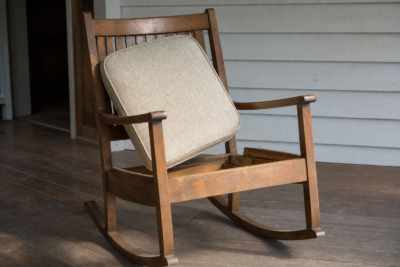
How to Measure Rocking Chair Cushions: Seats, Backs and Tie Positions
How to measure rocking chair cushions — tapered seats, curved backs, slat-gap tie maps and rock clearance — with the three-number protocol for both pieces of a rocker set.

Window Seat Cushion Measurement: How to Get a Perfect Fit
Measure a window seat cushion correctly — width across alcoves, depth front to back, thickness vs sill height, radius corners and bay window angles — with tips from the cutting floor.

How to Measure Adirondack Chair Cushions: Seats, Fan Backs and Slat Gaps
How to measure Adirondack chair cushions — tapered seats, fan-back heights, recline geometry, strap-through slat-gap maps and two-piece sets for the tall-back chair.