Two very different people ask how much fabric a cushion needs. One is sewing it herself and standing at a fabric counter wondering whether three yards is enough. The other just received a custom-cushion quote and wants to know whether the number is honest. Both deserve a real answer, and the real answer is longer than the one most calculators give — because most calculators add up areas, and fabric does not work that way.
We cut cushions on our own mill floor every day, and this guide shows both accounts: the cutting-table math for people buying their own fabric, and how our quotes count material instead — which is by the square foot of the cushion, not by the yard. Same geometry, two ledgers.
First, What a Yard of Fabric Actually Is
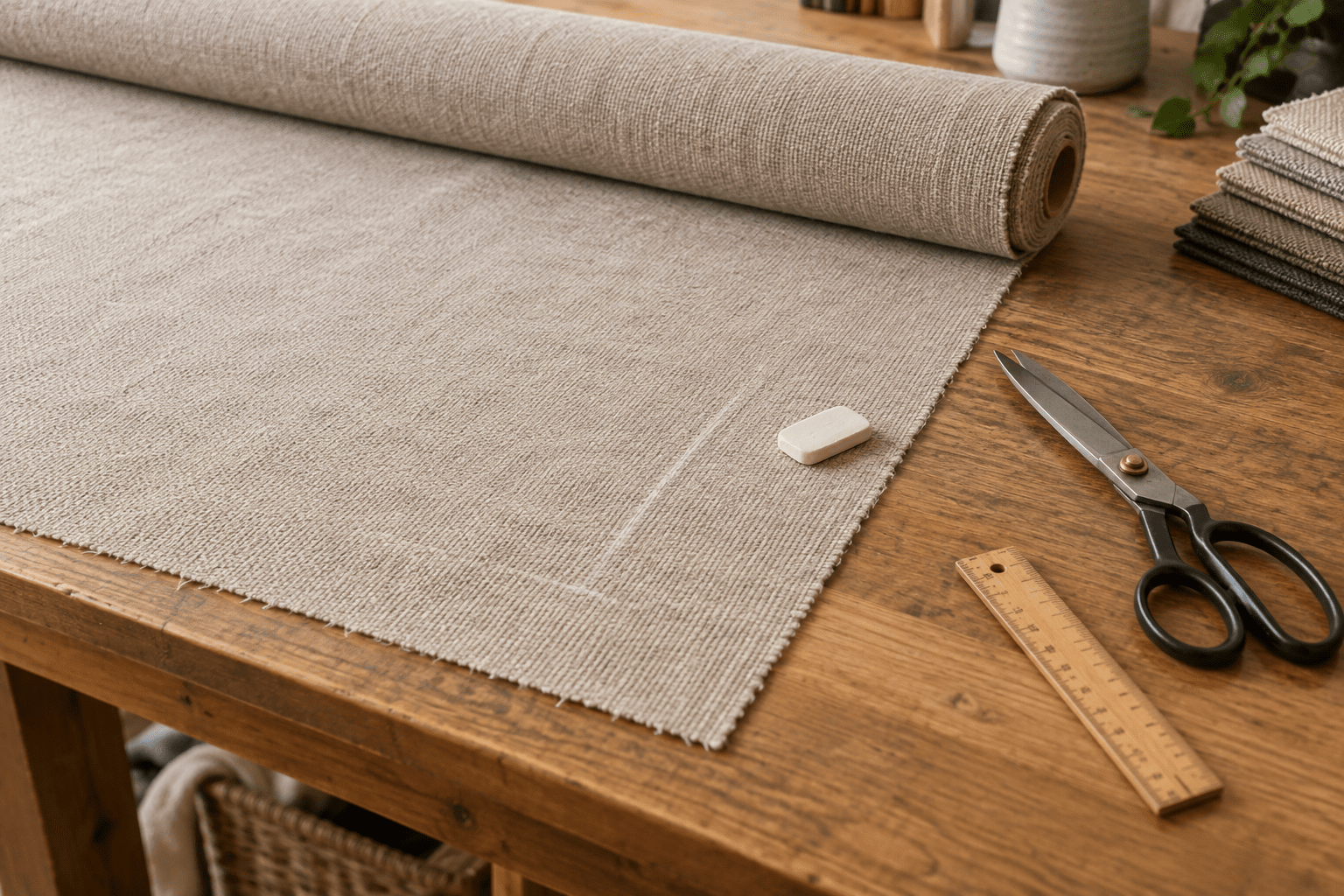
A yard of fabric is 36 inches of length along the roll. The full dimensions of a yard are therefore 36 inches by whatever the fabric’s width is — the bolt’s usable width, called the usable width in the trade. Apparel and quilting cottons run 44 to 45 inches. Upholstery-weight fabrics, including most solution-dyed acrylics used outdoors, run 54 inches as the de facto standard. A few specialty bolts run 60 inches or wider, and some outdoor textiles run narrower at 46 inches.
So “one yard” is not one amount of fabric: a yard of 54-inch upholstery fabric is 1,944 square inches — about 13.5 square feet — while a yard of 45-inch quilting cotton is 1,620. Every calculation below assumes 54-inch fabric unless stated otherwise, and the width assumption matters more than almost anything else in the math.
The Box Cushion Formula — and Why Calculators Undercount
A standard box cushion (two flat faces plus a side band wrapping the edge) needs three pieces:
- Two faces: each cut to width plus seam allowance, by depth plus seam allowance.
- One side band: cut to the full perimeter of the face plus seam allowance, by thickness plus seam allowance.
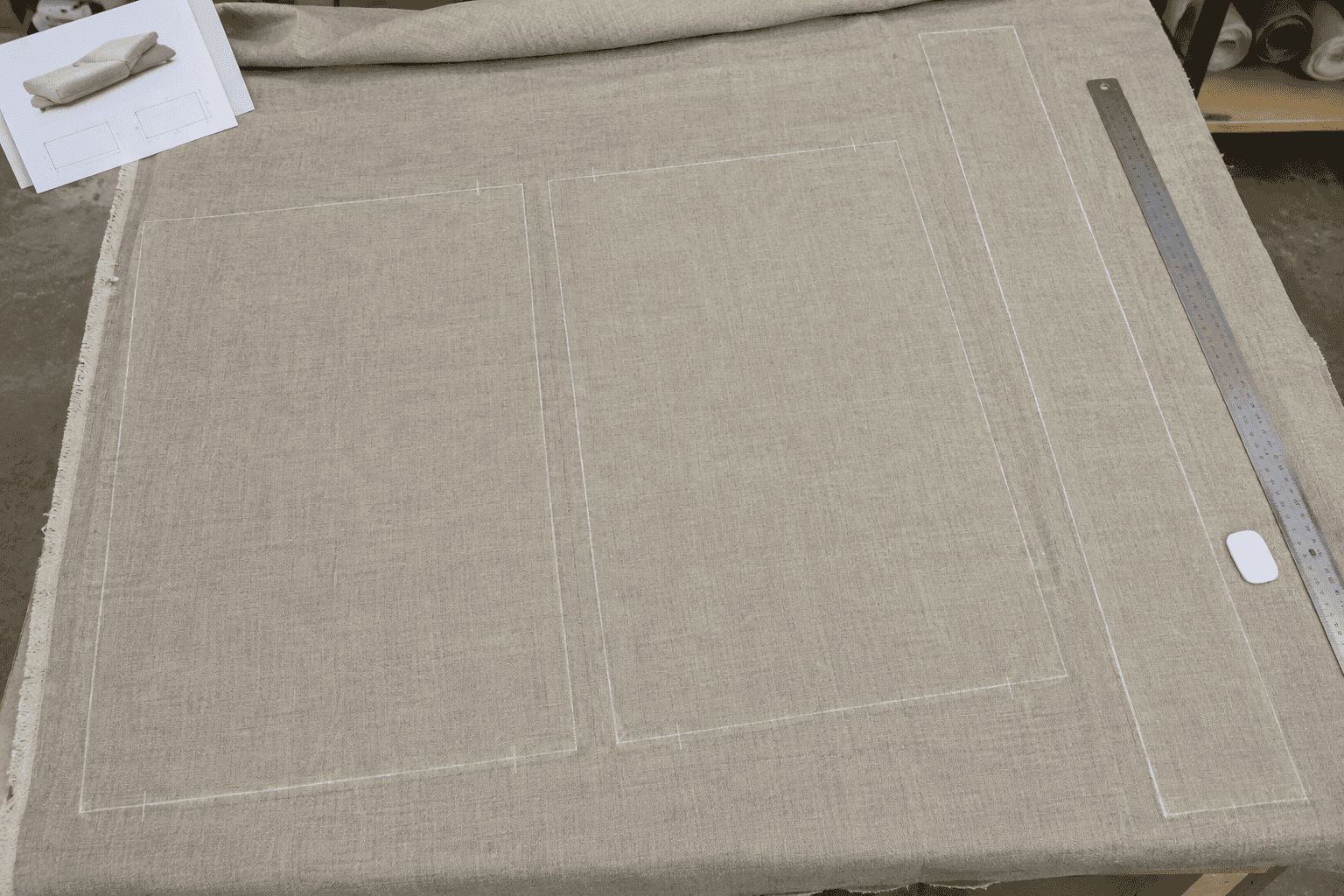
With a half-inch seam allowance on every edge, the formula for a 72-by-20-by-4-inch bench cushion works out like this: two faces at 73 by 21 inches side by side occupy 42 inches of the bolt’s width — they fit across a 54-inch bolt in one pass. The side band is the trap. The perimeter of the face is 184 inches, plus allowance makes a single strip roughly 185 inches long and 5 inches wide. It fits in the leftover width, but its length cannot be shortened, because a properly sewn cushion has one continuous band — a spliced side band is a visible seam and a weak point on the edge that takes the most abrasion.
So the true fabric length is the longer of the two demands: about 185 inches, which is 5.1 yards — call it 5.25 to 5.5 yards with cutting losses. Now run the same cushion through an area-based calculator: two faces (2,880 square inches) plus band (736 square inches) equals 3,616 square inches, divided by 54 inches of width gives 67 inches of length — under 2 yards. Both numbers are “correct” arithmetic. Only one of them leaves the store with enough fabric.
That gap — 2 yards versus 5-plus on the same cushion — is the single most common yardage mistake in DIY upholstery, and it comes from treating a continuous strip as if it could be cut into pieces and reassembled.
Yardage by Cushion Shape
The same strip logic, applied to the shapes we cut most often. Figures include seam allowances and a modest cutting loss, on solid 54-inch fabric:
| Cushion | Example size | Fabric needed (54″ solid) |
|---|---|---|
| Knife-edge seat pad (no side band) | 18 × 18 in | About ¾ yd |
| Box seat cushion | 18 × 18 × 3 in | About 2¼ yd |
| Box bench cushion | 72 × 20 × 4 in | 5¼–5½ yd |
| Round box cushion (see round measuring) | Ø24 × 3 in | About 2¼ yd |
| Oval box cushion (oval measuring) | 48 × 24 × 3 in | About 3½ yd |
| T-cushion (T-cushion measuring) | Standard club chair | Add ~25% over the bounding box |
| Trapezoid / tapered (trapezoid guide) | Front wider than back | Measure at the wider front; same as its bounding box |
| Notched cushion (notch measuring) | Corner cut for a radiator | Same as the full rectangle — the cutout is waste, not savings |
| Hinged chaise pad (chaise measuring) | One-piece seat-and-back | Sum both sections, then add one extra band width |
| Bay window set (see bay window guide) | Three panels | Estimate each panel separately; matching patterns across panels adds more |
Two rows in that table deserve a second look. A notched corner saves no fabric — you pay for the rectangle the notch was cut from, because the strip and the face are cut before the notch exists. And a trapezoid is measured at its widest face, the front; the fabric consumed is the full bounding box, the same rectangle our pricing uses.
For the general measuring workflow behind every row, the measuring guide is the place to start, and the common traps are collected in cushion measurement mistakes — most of them cost fabric exactly the way bad yardage math does.
Fabric Width, Pattern Repeat and Direction
Three fabric properties change the numbers:
- Usable width. On a 45-inch bolt, the 72-inch bench cushion above cannot put its two faces side by side — each 21-inch-wide face plus the band no longer fits across the bolt in one pass, and total length roughly doubles. This is why upholstery fabric is worth its premium for seating projects: the width itself is part of the purchase.
- Pattern repeat. Every cut piece must start at the same point in the pattern, so each face’s cut length rounds up to a whole multiple of the repeat. Industry rule of thumb: buy 15-20% extra for stripes and medium florals, and up to 25% for large-scale repeats — or more honestly, buy one extra repeat per piece.
- Direction. One-way prints, velvet nap and directional stripes all force every piece to be cut the same way up. That forbids some of the efficient zig-zag layouts and quietly adds 10-15%. Railroaded fabric (pattern running along the bolt’s length) can be a saving grace for long side bands — worth asking about at the counter.
If any of this is turning a small project into a spreadsheet, that is the honest moment to compare it against a made-to-measure price — more on that below. For fabric characteristics that affect how a cushion ages in sun rather than how it cuts, see how to choose cushion fabric.
How Our Mill Counts Fabric — Why Quotes Show No Yards
Here is the second ledger. When you order a custom cushion from us, the quote is not in yards. It is a $45 base per order plus a per-square-foot fabric rate — one flat $7.43 across all 119 fabrics — figured on the bounding rectangle of your cushion. The foam is charged the same way, by the same rectangle, at $17.13–33.72 per square foot by density and thickness.
Why the difference? Because a mill does not buy fabric the way a home sewer does. We cut from full bolts and nest orders together — the leftover 12-inch width beside your bench cushion faces becomes the band for someone else’s dining pad the same afternoon. The waste that would sit in your closet as an unusable strip never becomes your cost. Per-square-foot pricing passes that efficiency to the customer directly: two cushions with the same footprint cost the same, whatever shape the corners are.
For a shopper comparing quotes, this is also a sanity check. A shop quoting you “about 6 yards of fabric plus labor” for a bench cushion may be honest — remember the true math above — but a shop quoting square footage on your measured rectangle is showing you the arithmetic you can verify yourself with a tape measure. We prefer it that way: nothing is cut until your measurements are confirmed, and odd numbers get a phone call rather than a guess.
Quick Answers for Common Cushions
For readers who skipped straight to the number: a 20-by-20-inch knife-edge throw pillow cover needs about ¾ yard of 54-inch fabric. An 18-by-18-by-3-inch box seat cushion, about 2¼ yards. A 72-by-20-by-4-inch bench cushion, 5¼ to 5½ yards solid — and yes, that number surprises people weekly. Curved fronts follow the bowed cushion measurement page; rounded corners that need a radius follow the radius corner guide and consume the same fabric as square ones.
FAQs
How many yards of fabric do I need for a 72-inch bench cushion?
For a 72-by-20-by-4-inch box cushion in solid 54-inch fabric, plan 5¼ to 5½ yards. The side band alone is a 185-inch continuous strip, which is what pushes the number past five yards — area-based calculators that return about 2 yards are ignoring that the band cannot be cut into pieces.
How much fabric for a 20-inch throw pillow?
About ¾ yard of 54-inch fabric for a knife-edge cover — two 21-inch squares side by side across the bolt. Add a third of a yard if the pillow has a boxed edge, and 15-20% extra for patterned fabric.
Does fabric width really change the yardage?
Yes — dramatically. The same bench cushion that needs 5½ yards on a 54-inch bolt can need nearly twice the length on a 45-inch bolt, because the two faces and the band no longer fit across the bolt in a single pass.
How much extra fabric should I buy for stripes or a large pattern?
Industry rule of thumb: 15-20% extra for stripes and medium patterns, up to 25% for large repeats — or one extra repeat per cut piece, whichever is easier to figure at the counter. Each piece’s cut length rounds up to a whole multiple of the repeat.
Why did my custom cushion quote not mention yards at all?
Mill pricing counts square footage on your cushion’s bounding rectangle, not retail yards — fabric is cut from full bolts with orders nested together, so bolt-width waste never becomes the customer’s cost. The number you can verify is your own measurement times the per-square-foot rate.
Do you sell fabric by the yard?
No — fabric is sold as part of a finished cushion, priced per square foot across our three fabric tiers. That keeps dye lots consistent, since every piece of your order is cut from the same bolt.
I want to sew my own but I’m not sure about my measurements first. Where do I start?
Start with the measuring guide, then price the same cushion at the designer — seeing both numbers side by side is the fastest way to decide whether the sewing is worth the yardage.
Cushion Shapes Guide: All 11 Shapes, What They Fit, and How to Measure Each One
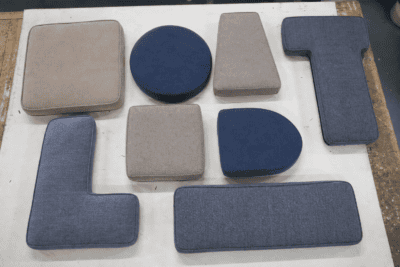
A field guide to every cushion shape we cut — rectangle, chaise, L-shape, T-cushion, bowed, notched, round, oval, half-round and wedge — which furniture each one belongs to, how to measure it in inches, and exactly which shape to pick in our custom cushion builder.
Round Outdoor Cushions: Diameter Duty on the Patio
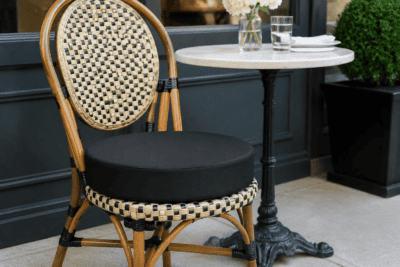
Round outdoor cushion guide: round patio dining sets, fire-pit seating and round loungers; diameter measuring with the two-axis check, thickness bands, weather specs for circular pads, and ordering rounds.
U-Shaped Cushions: Measuring the Wraparound Seat
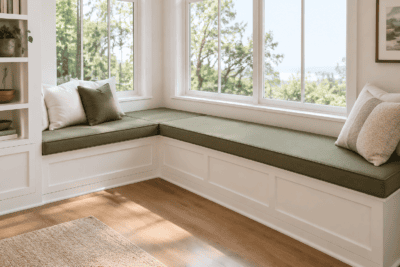
U-shaped cushion guide: the three-arm geometry of wraparound seating, inside versus outside radius measuring, seam placement at the corners, continuous versus sectioned builds, and ordering U-runs to template.
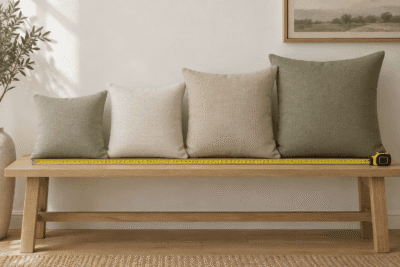
Throw Pillow Sizes: Standard Chart and How to Measure
There is no industry law, but there is a firm convention: throw pillows cluster at 16, 18, 20 and 22
Tufted vs Unbuttoned Cushions: The Stitch Decision
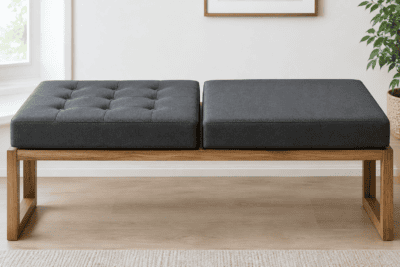
Tufted versus plain cushion tops compared: what tufting and stitched patterns actually do to fill, feel and lifespan, button versus stitch construction, the market’s custom stitch styles, and when plain wins.
What Size Bed Gap Filler Do I Need? Thickness, Length and Density
Size a bed gap filler from three measurements, not the bed’s name: thickness equals gap width plus half an inch to one, length runs the full seam, height runs platform to mattress top. Density starts at 50D.