
There is no industry law, but there is a firm convention: throw pillows cluster at 16, 18, 20 and 22 inch squares, lumbars run long and low at 12×20 to 14×22 — and the right size is decided by the furniture under it, not by taste alone. A pillow too small reads as a sample on a deep sofa; one too large eats the sitting space. This is the full size chart, the seam-to-seam measuring method, and the cover-versus-insert rule that trips up most buyers.
The Standard Throw Pillow Size Chart
Sizes exist for a reason: fabric is cut in standard widths, inserts are manufactured in fixed squares, and covers are sewn to fit those inserts. Step outside the ladder and you leave the system — every insert, every replacement cover, every matching pillow later becomes a custom order.
| Size (inches) | Shape | Common name | Where it works best |
|---|---|---|---|
| 16 × 16 | Square | Small accent | Boudoir scale: slipper chairs, window seats, kids’ rooms, front of a pillow stack |
| 18 × 18 | Square | The standard | The most common throw pillow made — dining chairs, smaller sofas, beds |
| 20 × 20 | Square | Full-size standard | Standard-depth sofas, queen beds, the workhorse of most arrangements |
| 22 × 22 | Square | Oversized | Deep-seat sofas, sectionals, king beds, the back layer of a stack |
| 26 × 26 | Square | Euro | Beds only — leans against the headboard behind the sleeping pillows |
| 12 × 20 | Lumbar rectangle | Lumbar | Lower back support solo, or the front layer of a stack |
| 14 × 22 | Lumbar rectangle | Long lumbar | Wide chairs, benches, sofa fronts |
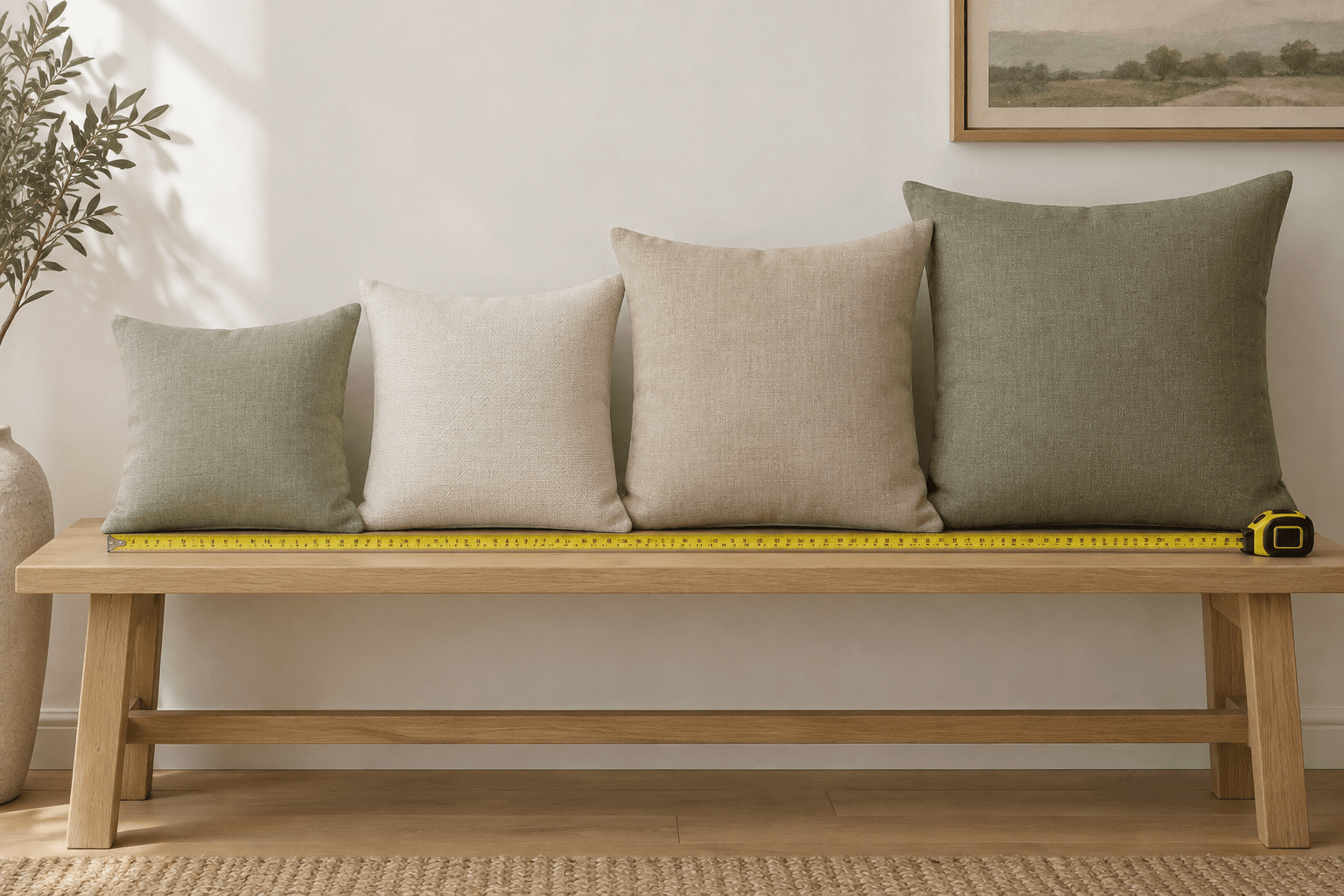
Two honest notes on the chart. First, “standard” describes the insert — the filled pillow — and covers are sewn to match it, which is why the cover-and-insert section below matters before you buy anything. Second, rectangular throw pillows outside the lumbar lane (long bolsters, 12×24s, odd 14×30s) exist but have no meaningful standard; they are almost always custom cuts. For seating cushion sizes — the pads you sit on rather than lean against — the companion chart is standard cushion sizes.
How to Measure a Throw Pillow (Seam to Seam)
Whether you are replacing a worn pillow, ordering a cover, or matching a new pillow to old ones, the method is identical — and the two most common mistakes happen in the first ten seconds.
Mistake one: measuring corner to corner. A pillow’s corners pull inward once stuffed, so a diagonal read always comes up short of the true seam width. Mistake two: measuring over the bulge. Draping a tape across the puffed-out center adds the loft — half an inch to a full inch of fill that has nothing to do with the cut size.
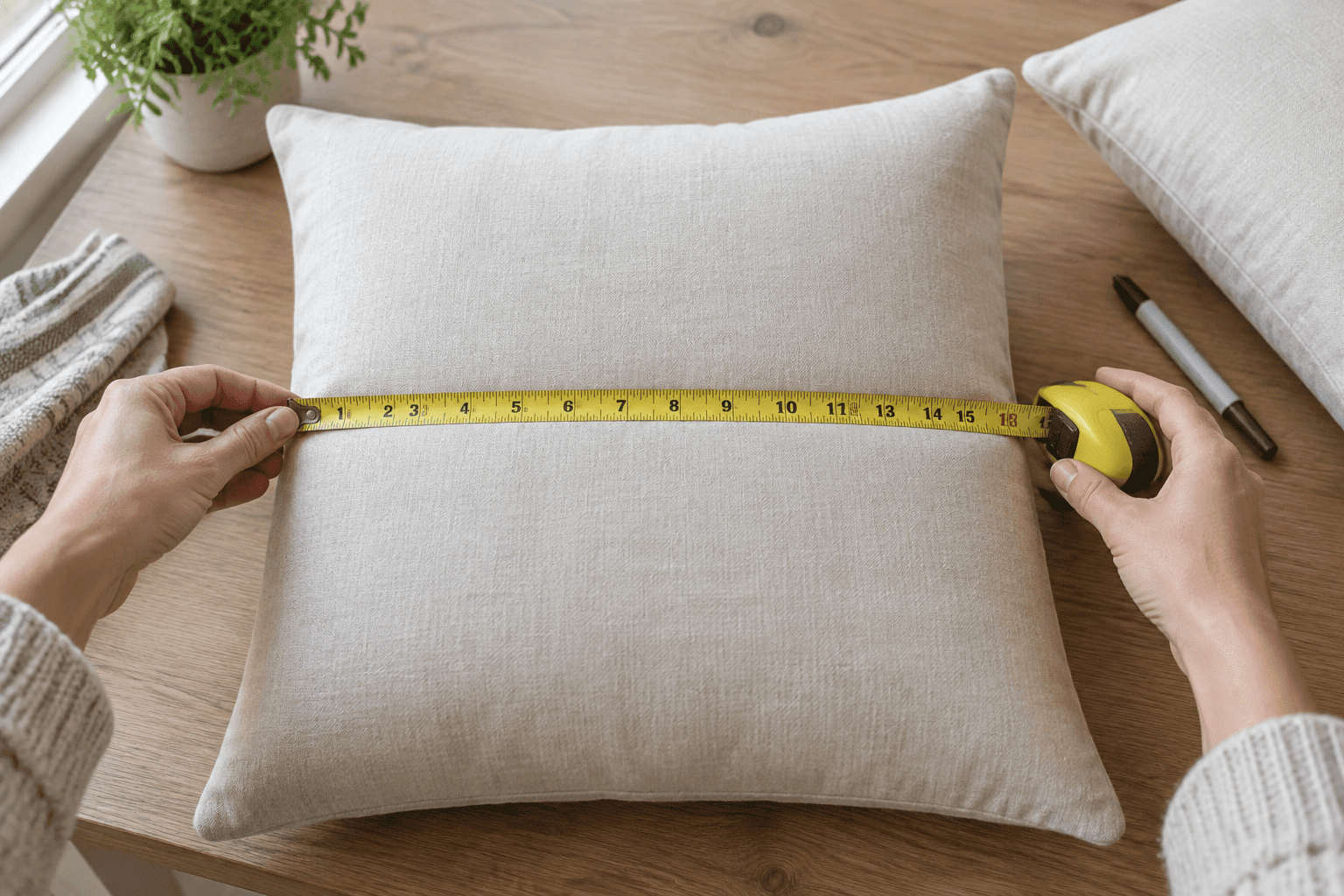
The correct sequence:
- Stand the pillow up and squash it flat. Compress it gently so the front face is a flat panel, not a dome. If it is a cover, remove the insert entirely and lay the cover flat, zipper closed.
- Measure seam to seam, across the center, edge to edge. Run the tape from one side seam straight across to the other, parallel to the pillow’s top edge — not corner to corner, not over the curve of the fill.
- Repeat in the other direction. Height and width can differ by a surprising half inch on old pillows that have compressed unevenly. A true 18×18 reads 18 both ways; if you get 18×17½, it is an 18 that has slumped.
- Round to the nearest standard size. A pillow measuring 17⅞ × 18 is an 18; one measuring 17¼ was never an 18, and you should note the real number for any custom order.
For thickness: a classic throw pillow is a knife-edge — two flat panels sewn flush around the perimeter, plump in the middle, thin at the seam. Thickness is not a number you order; it is a product of the fill and the cover size. You only measure thickness when replacing box-constructed cushions, which are a different product — see how to measure a rectangle cushion for that job.
The Cover-and-Insert Rule: Why an 18 Needs a 20
The single most misunderstood fact of throw pillow sizes: a cover and its insert are deliberately not the same size. Covers are made to be overfilled. An 18×18 cover takes a 20×20 insert; a 20×20 cover takes a 22×22 insert. Lumbar covers follow the same logic on their long axis — a 12×20 cover wants a 12×22 or 14×22 insert.
The reason is posture. An insert exactly the size of its cover sits inside like a mailed letter in an envelope: flat corners, sagging faces, the “department store floor model” look. One size up forces the fill into the corners, stands the pillow up on the sofa, and produces the fat, pressed-center look interior designers call the “chop” — the spot where a karate chop across the top holds a crease, only possible when the fill is genuinely under pressure.
The failure modes in both directions:
- Insert too small: floppy corners, a cover that looks one size too big, fabric that pills where it folds over on itself.
- Insert more than two sizes up: the zipper strains, seams bow, and the cover eventually splits along a stitch line. The rule is one size up, not as large as will physically fit.
When you measure an existing pillow to replace it, you are measuring the cover’s seam size — then buy the insert one standard size up from that number. And when the cover itself is what needs attention, the washing rules are in how to wash cushion covers.
Sizes by Furniture: Couch, Sectional, Queen and King
The size ladder only makes sense against the furniture it sits on. The working scale: on a standard sofa, 18 and 20 inch squares dominate; on deep seats and sectionals, 22s take over; on beds, the pillow follows the bed width.

Standard sofa or loveseat: three to five pillows, arranged odd-numbered. The reliable formula is a back layer of 20×20 (or 22×22 on a three-seat sofa), a front layer of 18×18, and optionally one 12×20 lumbar off-center in front. Two identical 18s centered is the minimal, always-safe arrangement.
Sectional: the corner wedge swallows pillows — size up. 22×22 in the corner, 20×20 down each arm, lumbars where the chaise meets the arm. On sectionals, undersized pillows are the most common styling failure; a 16 on a 40-inch-deep chaise corner disappears.
Queen bed: two or three 20×20 squares in front of the sleeping pillows, or the layered look — two 20×20 plus one 12×20 lumbar centered in front. Euros (26×26) behind everything if you like a tall headboard line.
King bed: two or three 20×20 or 22×22 across, with a pair of 26×26 Euros standing behind. Kings are wide enough that a single pair of 18s reads thin; go bigger or go three across.
There is a practical test for any furniture: a throw pillow should never be wider than roughly half the row it sits in, and never smaller than its visual weight demands. When in doubt, hold a cardboard square cut to 18 or 20 inches against the back — it previews the silhouette for free.
Custom Sizes: When the Ladder Is Not Enough
Oversized 24×24 and 30×30 floor pillows, long bench lumbars, pillows for odd antique chairs — past a point you leave the standard system, and the choice is between hunting retail oddments and having the size cut.
Our lane is the cut-to-size one: knife-edge pillows sewn to your exact measurements, in the same fabrics as our cushion lines, filled with a structured foam core instead of blown fiber. The trade is honest and worth stating plainly — a foam-core pillow is firm, holds its square shape permanently, and never needs fluffing; it will not feel like a soft polyfill pillow you sink into. For structural accent pillows, window seat backrests and reading piles that take daily abuse, that firmness is the point. For the soft, squishable kind, a retail insert with a standard cover is the better buy — and we say so.
Two boundaries we hold: we do not sew covers-only for retail inserts (a different product with different economics — see cushion covers vs full replacement), and all our standard construction rules apply — plain knife-edge seams, square corners, no trim. If you are sewing covers yourself instead, the yardage math is in how much fabric for cushions.
FAQs
What is the standard throw pillow size?
18×18 inches is the single most common throw pillow size, with 20×20 close behind. The full standard ladder is 16, 18, 20 and 22 inch squares, plus 26×26 Euros for beds. When a store or article names one “standard,” it means the 18 or the 20.
How do you measure a throw pillow?
Compress it flat and measure seam to seam across the center — never corner to corner, never over the bulge of the fill. Take the measurement in both directions; a true square reads the same both ways. For a cover, remove the insert and measure the cover flat with the zipper closed.
Should the insert be bigger than the cover?
Yes — one standard size bigger. An 18×18 cover takes a 20×20 insert; a 12×20 lumbar cover takes a 12×22. The overfill is what makes the pillow stand up and hold its corners. More than one size up strains the zipper and bows the seams.
What size throw pillows for a couch?
20×20 as the back layer with 18×18 in front is the reliable formula on a standard sofa; step up to 22×22 on deep seats and sectionals. Keep the count odd — three or five — so there is a clear center or a deliberate asymmetry.
What size throw pillows for a queen or king bed?
Queen: two to three 20×20 squares, optionally with 26×26 Euros behind. King: 20×20 or 22×22 across with a pair of 26×26 Euros standing behind them. Beds tolerate larger pillows than sofas — the bed’s width does the framing.
Can I order a throw pillow in a custom size?
Yes — knife-edge pillows cut to your measurements are standard work for us, in any square or rectangular size, with a structured foam core. Made in 4–7 days (3–5 on the rush lane) and shipped flat-rate with tracking. For soft polyfill pillows in odd sizes, retail inserts are the honest route.
Is there a throw pillow sizes chart that covers every standard size?
A typical throw pillow size ladder runs 14×14, 16×16, 18×18 and 20×20 inches; the throw pillow standard size most couches use is 18×18. Throw pillow sizes chart tables differ because makers mix in 12×20 lumbar and 26×26 squares — a normal throw pillow size above 22 inches usually means a floor pillow. Standard accent pillow sizes on our chart map straight onto 119 cover fabrics.
How many pillows on a couch, and what size pillows for a sofa?
How many pillows on couch seating comes down to seat length — two to three on a standard seven-foot sofa. What size pillows for sofa balance as 20-inch squares in the corners with 18-inch (plus a lumbar) in front; what size throw pillows for couch and loveseat pairs follow the same 20/18 rule with one less pillow. What size throw pillows for sofa sectionals scales the same way, and what size pillows for couch seating never goes past 22 inches — pillow sizes for sofa sets and pillow sizes for couch sets all hit that ceiling before they eat the seat.
How do you measure pillow covers so the insert fits?
How to measure pillow covers: take the cover alone, corner to corner along the seam, and order the insert 1 inch larger. How to measure a pillow for a custom cover follows the finished-size convention — how to measure pillow dimensions is always seam to seam, never edge to edge. How to measure pillows for covers you already own is exactly why throw pillows measurements should be taken with the insert out.
What are standard decorative pillow sizes for layering?
Standard decorative pillow sizes layer 22 → 18 → 14 from back to front; decorative pillow sizes above 24 inches read as floor cushions. Accent pillow size for lumbar support runs 12×20. Our throw pillow size guide maps each size to custom covers sewn in 119 fabrics within 4–7 days.
Next Steps
- Measure what you have — seam to seam, both directions — before shopping, because “18 inch” on a tag has been known to mean 17.
- Pick the size from the furniture, not the shelf — 18/20 on standard sofas, 22 on deep seats and sectionals, 20–22 with Euros on beds.
- Price the custom cut — knife-edge pillows to your exact numbers start at $45 plus per-square-foot fabric rates at custom cushions; the seating-size context is in the standard cushion sizes chart.
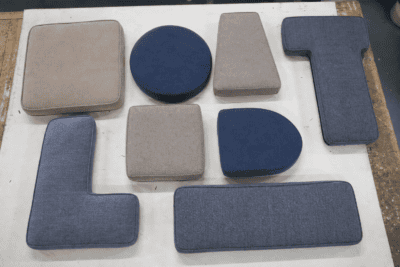
Cushion Shapes Guide: All 11 Shapes, What They Fit, and How to Measure Each One
A field guide to every cushion shape we cut — rectangle, chaise, L-shape, T-cushion, bowed, notched, round, oval, half-round and wedge — which furniture each one belongs to, how to measure it in inches, and exactly which shape to pick in our custom cushion builder.
Round Outdoor Cushions: Diameter Duty on the Patio
Round outdoor cushion guide: round patio dining sets, fire-pit seating and round loungers; diameter measuring with the two-axis check, thickness bands, weather specs for circular pads, and ordering rounds.

U-Shaped Cushions: Measuring the Wraparound Seat
U-shaped cushion guide: the three-arm geometry of wraparound seating, inside versus outside radius measuring, seam placement at the corners, continuous versus sectioned builds, and ordering U-runs to template.

Tufted vs Unbuttoned Cushions: The Stitch Decision
Tufted versus plain cushion tops compared: what tufting and stitched patterns actually do to fill, feel and lifespan, button versus stitch construction, the market’s custom stitch styles, and when plain wins.
How Much Fabric Do You Need for Custom Cushions? (Yardage, Math and a Reality Check)
Two very different people ask how much fabric a cushion needs. One is sewing it herself and standing at a
What Size Bed Gap Filler Do I Need? Thickness, Length and Density
Size a bed gap filler from three measurements, not the bed’s name: thickness equals gap width plus half an inch to one, length runs the full seam, height runs platform to mattress top. Density starts at 50D.