
Curved vs Bowed Cushions: Terms, Fit and Measuring
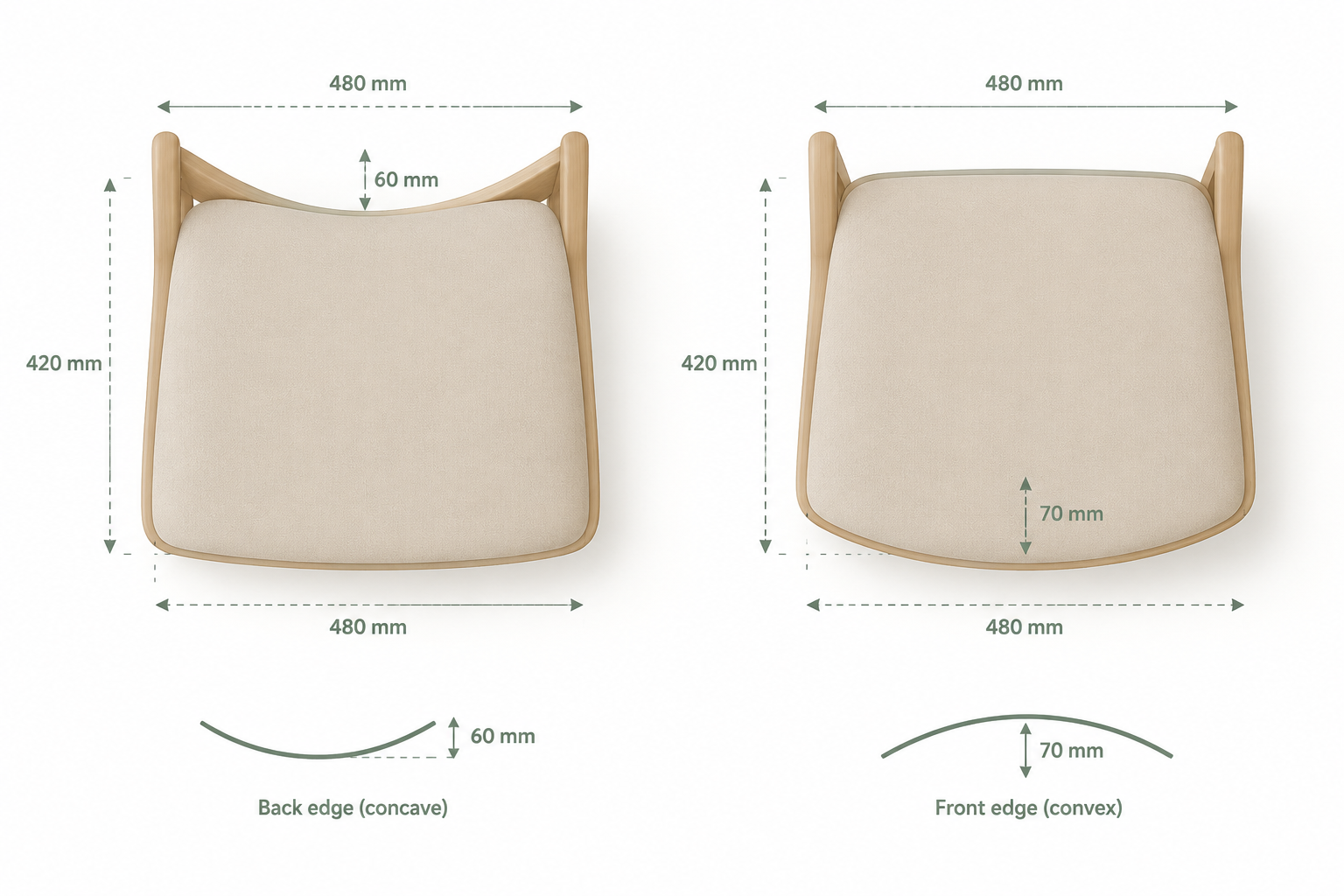
Search for a cushion with a curve in it and you will meet three words used as if they meant one thing: “curved,” “bowed,” sometimes “rounded.” They do not mean one thing. A curved back and a bowed front curve on opposite sides of the same seat, need opposite measurements, and a cushion ordered against the wrong word will not fit — custom cutting makes errors exact. This guide fixes the vocabulary, shows how two real configurators ask for the same shape in different languages, and lists the measurements to take before either one gets your money.
The Four Terms, Sorted
| Term | Which edge curves | Direction | Typical furniture |
| Bowed front (a “bowed” cushion) | The front edge | Bulges outward — convex | Window benches, breakfast nooks, banquettes |
| Curved back | The back edge | Follows the furniture’s back rail — often concave | Round dining sets, curved sectionals, vintage sets |
| Curved front | The front edge | Same edge as bowed; some shops’ word for it | Same furniture as bowed — pure vocabulary difference |
| Rounded corners | Corners only | Radius on each corner, straight edges between | Wrought iron, rattan, mid-century frames |
The trap is real: one shop’s “curved cushion” means the back rail; another’s means the front. When a configurator gives you a single “curved” option, the first job is finding out which edge it means — everything downstream depends on it. (Corner radii are their own measurement problem, handled separately in how to measure radius corners.)
How Two Configurators Ask for the Same Shape
We drove both shops’ curved-bench flows in September 2026 — one competitor’s curved-indoor-bench configurator and our own builder — for the same 22″-side curved bench:
| Competitor configurator | Cushion Mill builder | |
| Shape vocabulary | “Back Curved” / “Front Curved” width fields, with live validation of the curved-vs-straight difference | A Bowed shape — front edge bow, height of the curve entered directly |
| Fields you fill | Side length, back width (curved and straight), front width (curved and straight), thickness (integer steps) | Side length, width, bow height, thickness, foam, fabric |
| Guardrail | Real-time check that curved and straight widths stay consistent | Live footprint pricing as you type |
| Front-curve upcharge | $0 in our walk-through (curving the front added nothing; the back curve carried the change) | No shape surcharge — any of the 11 shapes prices on footprint |
| Configured price (closest match) | $186.30 at 6″ HD ≈ $174 at 5″ | $130 (22″ bowed, 5″, frequent-use foam) |
The vocabulary column is the one that costs people money. Their model treats “curved” as a pair of width numbers per edge; ours treats the bow as its own dimension — the height of the curve off the straight line. Neither is harder; they are dialects, and the measuring section below translates.
The Three Measurements Every Curved Order Needs
Whatever the shop calls the shape, every curved cushion on earth is fixed by the same three numbers plus thickness:
- 1. Straight-line length of the curved edge. Pull the tape tight across the curve’s endpoints — chord, not arc. This is the number most often inflated by measuring along the bulge.
- 2. The depth from the curved edge to the opposite (straight) edge, at the deepest point.
- 3. The bow or curve height — how far the curve stands off the straight line between its endpoints. A 2″ bow and a 4″ bow on the same length are different cushions; this is the measurement that makes “bowed” a shape rather than a style.
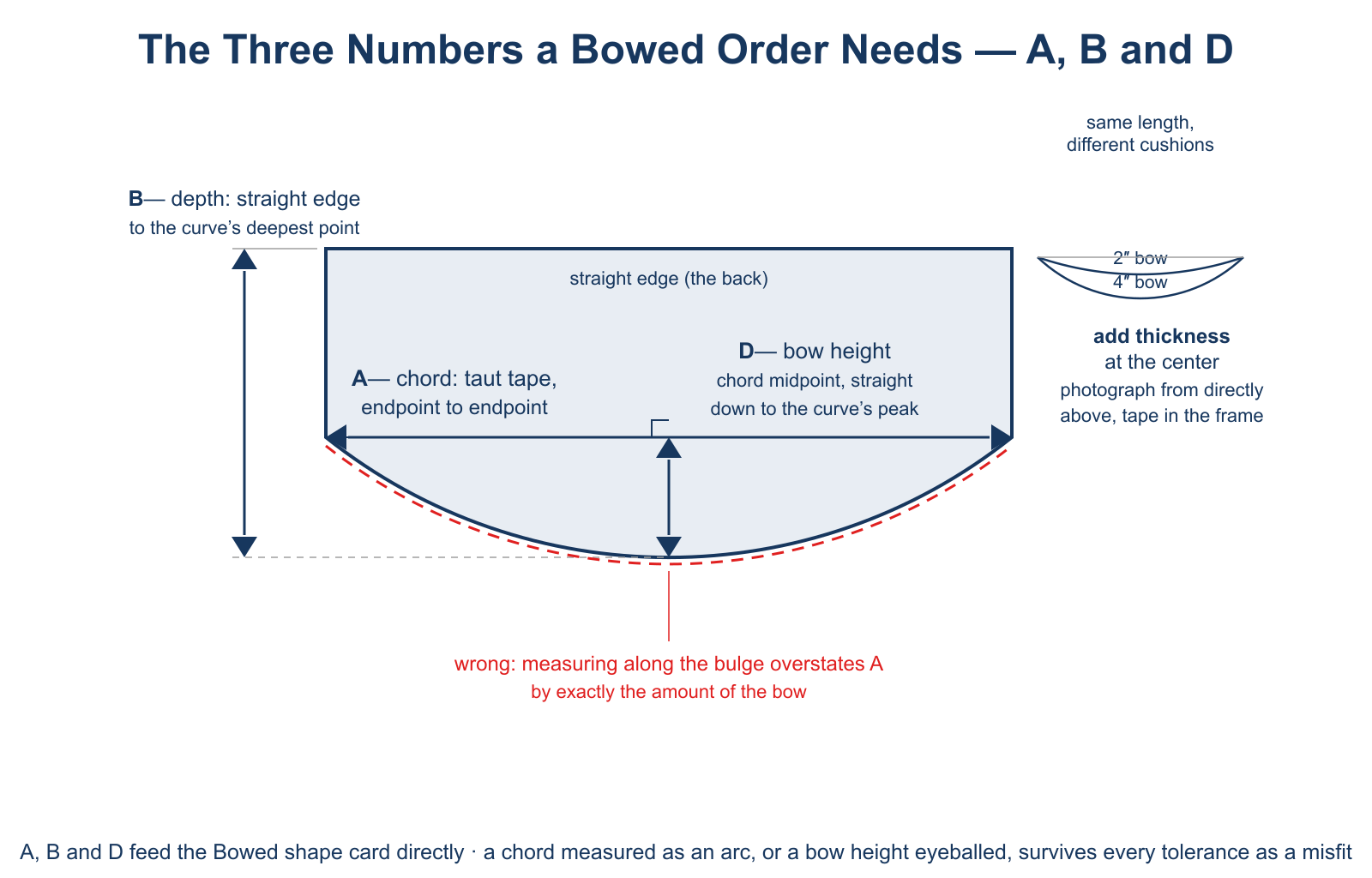
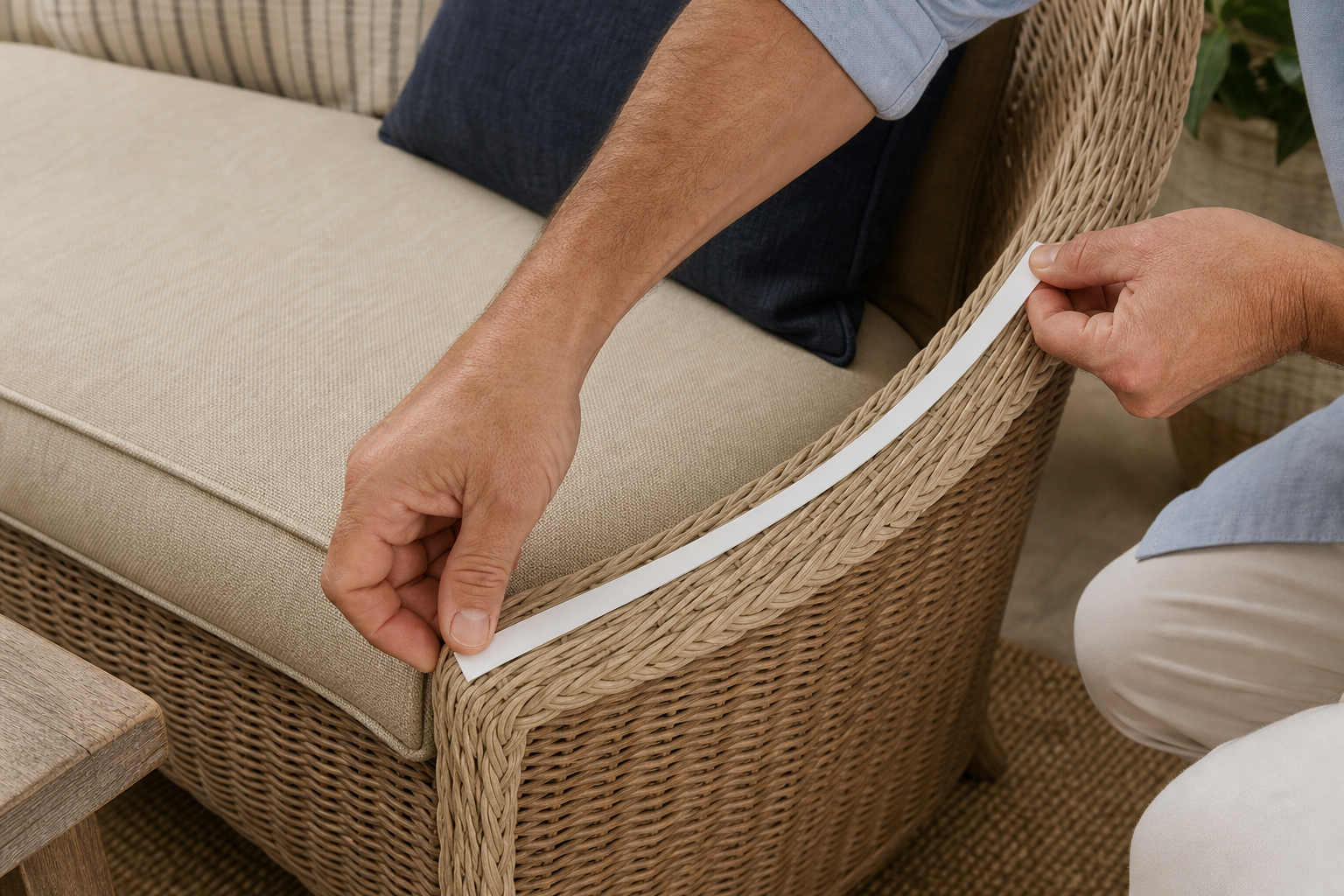
Add thickness at the center, and photograph the seat from directly above with a tape in the frame — most curved-order errors we see are a chord measured as an arc, or a bow height eyeballed instead of measured. The full curved-seating protocol, including curved wicker frames with rails, is in how to measure curved wicker seating.
Measure all three and our configurator’s Bowed shape card takes them directly — start with the Bowed shape pre-selected.
Fit: Where Curved Orders Go Wrong
Three failure patterns account for nearly every misfit curved cushion, at every shop:
- – The wrong edge curved. Ordering “curved” against a shop that curves the back when your furniture curves the front. Ask which edge before entering dimensions — our bowed shape is explicit: front edge, bow height as its own field.
- – Arc-versus-chord confusion. Measuring along the curve overstates length by exactly the amount of the bow. Taut tape, endpoint to endpoint.
- – Half-inch tolerance assumptions. A custom shop cuts to a stated tolerance (ours is ±½″) — but the tolerance protects the cut, not the measurement. A 1″ measuring error survives every tolerance in the industry as a 1″ misfit.
Ordering the Shape
Curved and bowed furniture is exactly where ready-made cushions stop existing — no universal cushion has your breakfast nook’s radius in stock, which is why this whole category runs on made-to-measure. Both shops in the table above will cut the shape properly if fed the right numbers; the difference in configured price for the benchmark piece ($130 vs $186.30 at the closest comparable spec, with their premium-fabric lines adding up to $35 more) is the difference between footprint pricing and a longer option ladder — worth a look before multi-piece nook orders. Start the shape directly in the cushion builder, or see the indoor benchmark use case at custom bench cushions.
The one-sentence version: curved and bowed describe which edge bends — back or front — and once you know your edge, the three numbers that matter are chord length, depth, and bow height, measured with a taut tape, to a shop that says in writing which edge it will curve.
Couch Cushion Foam Replacement: Density, Cost and Buying Guide
Replace couch cushion foam in one right order: 50D vs 60D density, measuring the old core, four ways to buy, and real worked prices for one seat and a full set.
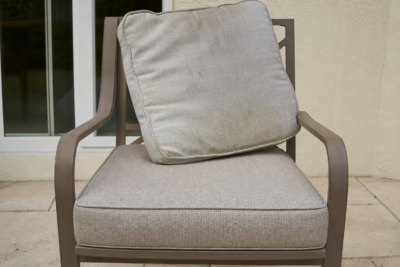
Where to Buy Replacement Patio Cushions: 5 Ways, Compared
Five ways to replace patio cushions — the set maker’s parts program, seasonal aisles, universal-fit listings, specialists and measured custom — plus the Home Depot house-line route with 31 measured collections.
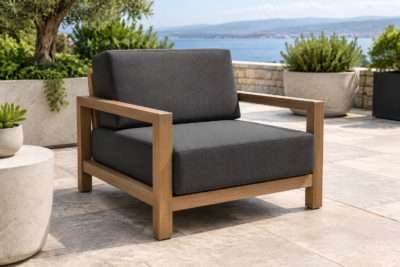
Why Is Patio Furniture So Expensive? The Cost Anatomy, Explained
What actually drives patio furniture prices — weatherproof materials, UV-stable finishes, marine-grade hardware, freight on bulky goods, and seasonal retail economics — why the good stuff costs 3-5x the box-store set, and where the value concentrates.
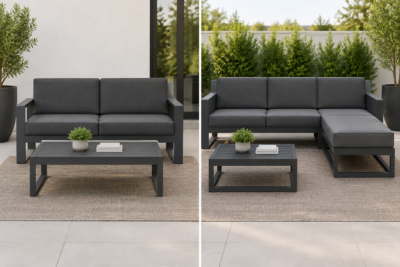
Patio Set vs Buying Separately: The Real Trade-offs
Buying a complete patio set versus assembling pieces: price coherence and one-click convenience versus fit-to-space precision, mixable quality and replacement flexibility — how to decide, and the hybrid strategy that captures both sides.
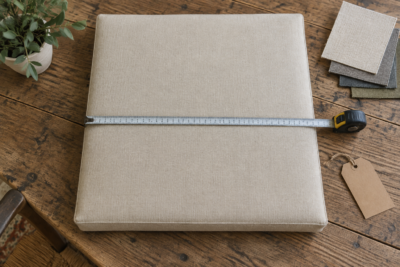
How Much Do Custom Cushions Cost? Price Ranges by Shape (2026)
Custom cushions cost USD 50-400 depending on shape, size, density and fabric. Live factory-direct price ranges for bench, window seat, outdoor, sofa and boat cushions — and how to price your own.
Outdoor Cushion Foam: Density and Thickness Guide With Real Numbers
Short answer: for a daily-use outdoor seat, order 3 inches of foam at 50D–60D; move to 4 inches and 60D