
A bay window is three window seats pretending to be one, and that is the whole problem. The center panel runs parallel to the house; the two flanking panels leave the wall at an angle — commonly 30 to 45 degrees — and meet the center at mitered corners that factory cushions approximate badly. The result of assuming “it’s one long bench” is always the same: a pad with triangular gaps at the corners, edges that wander off the frame, and a reading seat that looks like an apology. Done right, a bay window cushion is the best seat in the house — a sun-warmed reading nook built to the frame’s actual geometry. This guide covers the measuring, the angles, the radii, and the build. The straight-window version is covered in window seat cushion measurement; bay-window pricing and builder entry points are at custom bay window cushions.
The Three-Panel Truth
Measure a bay as three separate panels, not one length. Each panel has its own depth (the window seat’s front-to-back dimension at that section) and its own width, and the two corner seams carry the geometry:
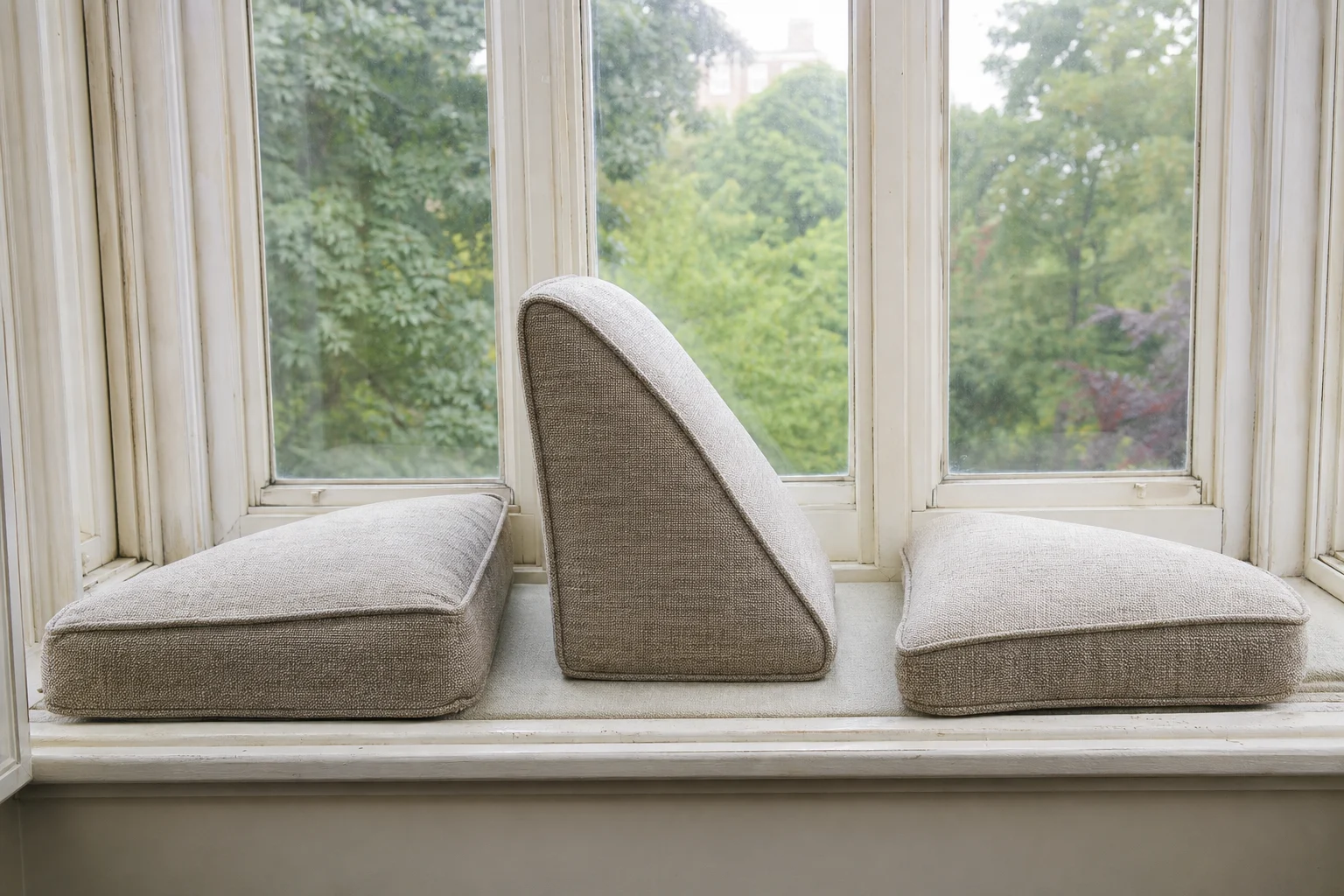
- – Center panel: width (left corner to right corner), depth at both ends — they should match, but verify, because some bays taper.
- – Flank panels: each measured from its corner seam to the end of the window seat — into the wall return or to the frame’s end cap. If a flank runs wider or narrower from wall edge to front edge — the trapezoid case, common where the corner seam is mitered — measure both widths plus the perpendicular depth (front to back, measured straight, never along the slanted end) and spec that panel on the wedge shape card; the full routine is in our trapezoid cushion measuring guide.
- – Corner angles: the angle at which each flank leaves the center. Record it as the angle between the two panels’ front edges, measured with a protractor or an angle finder app. 45 degrees is common; 30, 35, and 60 appear in real houses; “roughly 40-ish” is what gaps are made of.
The alternative — one pad long enough for the whole run, with the corners seamed at guessed angles — produces the triangular gap at every miter. Panels cut to measured angles close the seam lines tight, and the cushion reads as one continuous seat.
Radii and Curved Bays
Bow windows (the curved variant) and many modern bays curve the frame instead of angling it. Then the panels are segments of an arc, and the spec changes:
- – Record the radius where the frame’s seat edge curves — the chord-and-radius method is in how to measure radius corners, and it applies to whole curved runs, not just corners.
- – Or template it. For genuinely irregular curves, kraft-paper templates remain the undefeated method: lay paper on the seat, crease it to the frame’s edge, label front/back and each panel’s position, and send the templates. Custom shops cut to templates as routine work; the template habit is recommended in cushion measurement mistakes for every shape that resists three numbers.
Thickness and Firmness: A Seat People Actually Read In
Bay window seats are used two ways — briefly, as a landing pad, or seriously, as a reading chair — and the cushion spec should know which:
- – 3 inches is the standard thickness. Enough comfort for real sitting sessions; proportionate to the low frame of a window seat.
- – 4–5 inches for the primary-reading-nook build. The thicker pad invites the long stay; check the sill and any window hardware above the seat so the added height doesn’t collide with latches or blinds.
- – 50D foam for a seat used daily. Window-seat duty looks gentle, but reading hours are long static hours, and a soft pad bottoms out over a chapter or two. Density logic: how to choose foam density. 35D serves the occasional-landing-pad bay.
- – A firmer edge helps you get up. Reading seats are low; a dense core with a firm front edge gives the push-off that soft fill denies.
The same trade-offs for the straight window seat — including the memory-top option for long static sits — are worked through in window seat cushion measurement and memory foam topped cushions.
Fabric: The Sunniest Seat Indoors
A bay window cushion sits inside a solar collector. The fabric spec is therefore an indoor version of the outdoor spec:
- – Fade resistance first. Direct sun through glass fades ordinary fabrics on a one-to-two-year clock — the stripes and wash-outs that antique shops sell as “character.” Solution-dyed acrylics (the Sunbrella family) hold color in ways indoor fabrics don’t; whether the premium pencils out is argued honestly in is Sunbrella worth it.
- – Heavy indoor weaves are the alternative. Cotton linen blends and chenilles in mid-tones accept the fade gracefully where pale solids show it first — the color-and-sun logic is in choosing cushion colors.
- – Spot-clean between washes. Quality zippered-cover cushions clean with mild soap and water at the mark; a reading nook with coffee nearby will exercise this routine regularly. The fabric-by-fabric method is in how to clean couch cushions.
Special Cases
The storage bay. Many bay window seats are storage boxes with cushion lids. The lid changes the spec: the pad needs to be hinged or lift-off, sized to the lid’s footprint exactly (an overhanging pad jams the lid; an underhung pad looks wrong), and light enough to lift every time someone needs the blankets. A foam-core pad in a light fabric grade is the practical build; keep thickness at 3 inches so the lid’s hinge isn’t fighting leverage.
The radiator bay. Older houses sometimes run a radiator under the window seat. Heat rises through foam and ages it; specify the pad with ventilation in mind (a slatted surface under the cushion helps) and choose a foam grade on the dense end, which tolerates warmth better than light fills — the density-age relationship is in high density foam for couches.
The bay with a back. If your bay has a backrest — cushions against the window framing — those back pads are separate order lines measured to the back panels’ widths, and they can run a grade lighter than the seats. The multi-piece measuring discipline (every piece, one session) is in how to measure couch cushions.
Ordering: Where the Angles Get Respected
Standard-size pads cannot carry a bay’s geometry — the angles, the differing depths, the curves. The custom path is the main path, and it is a well-worn one:
- Measure each panel (width × depth), record the corner angles (or radius, or send templates), fix thickness at 3–5 inches by intended use.
- Specify density per duty — 50D for the daily reading seat, 35D for the landing pad — and pick the fabric with the fade question answered.
- Order at custom bay window cushions: panels cut to the measured angles, seams closed tight at the miters, pricing from a $45 make-base plus per-square-foot foam and fabric rates, 4–7 business days, and every dimension re-verified against your numbers (and photos, where angles are involved) before anything is cut.
A well-specified bay cushion is also one of the highest-compliment-per-dollar pieces in a house — it turns leftover architecture into the seat everyone fights over.
The Reading-Nook Layer: Cushions Plus Pillows
The bay cushion is the seat; what makes a bay window a destination is the layering above it — and the layering should be planned with the cushion spec, not improvised onto it:
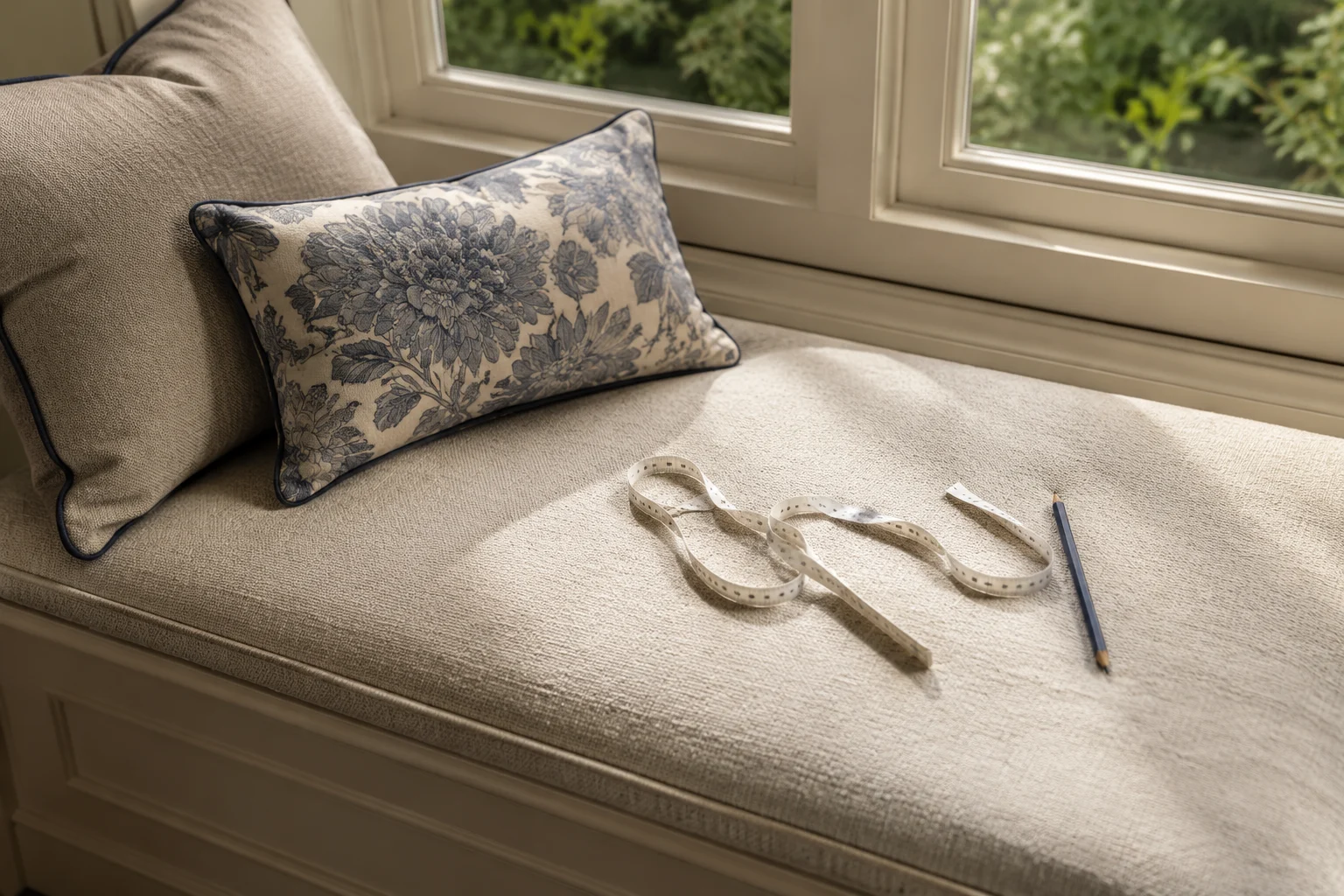
- – Lumbar pillows sized to the window frame. A bay’s back is the window itself (or a low sill wall), which is not a backrest; a lumbar pillow per panel turns the glass into a chair. Two to three pillows, one per sitting position, anchored by weight against the window framing — their fill and sizing logic lives in cushion filling types.
- – The seat pad carries the pillows’ dirt load. Pillows land on the seat when someone actually sits; spec the seat fabric assuming it will catch whatever the pillows track (a real consideration with pets, whose fur and grit migrate from pillow to seat — the fabric hierarchy for that is in dog friendly outdoor fabric, which transfers indoors).
- – Color: the seat recedes, the layers speak. The working scheme is a mid-tone seat pad (the fade-and-wear logic above) with the personality carried by the pillow layer — which is cheap to change seasonally. A loud seat fabric with timid pillows is the backwards build; the reverse keeps the architecture calm and the styling current.
FAQs
How do I measure a bay window for cushions?
As three separate panels — center width and depth, each flank’s width and depth, and the corner angles between them — never as one length. The angles close the seams; guesses open triangular gaps.
How thick should a bay window seat cushion be?
3 inches standard, 4–5 for a serious reading seat, checking sill hardware for clearance. Reading seats earn thickness; landing pads don’t need it.
Can I get one long cushion for the whole bay?
Only if the corners are seamed at the measured angles — a single unseamed pad cannot turn a corner. Panel construction with angle-matched seams is what makes a bay read as one seat.
What fabric survives a sunny bay window?
Solution-dyed acrylic for zero-compromise fade resistance, or a mid-tone heavy indoor weave that ages gracefully. Pale solids in direct sun fade first; the trade is mapped in choosing cushion colors.
What about a bay window with storage underneath?
Size the pad exactly to the lid’s footprint and keep it 3 inches and liftable. Overhangs jam the lid; heavy builds fight the hinge.
How do curved bow windows get measured?
Radius at the seat edge, or kraft-paper templates for irregular arcs — templates are routine custom-shop input. The chord-and-radius method is in how to measure radius corners.
Next Steps
- Measure the three panels and the corner angles in one session; for curved runs, make paper templates and label every panel’s position.
- Fix thickness and density by real use — reading seat or landing pad — and answer the fade question before the color question.
- Order the panels at custom bay window cushions with angles and templates included; every dimension is confirmed before cutting, 4–7 business days.
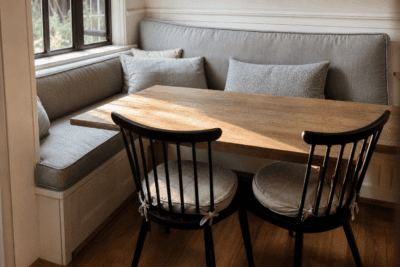
Breakfast Nook Cushions: The Corner-Seating Build Guide
Breakfast nook cushion guide: L-shaped and U-shaped runs, corner geometry and seam placement, seat-plus-back builds at dining height, morning-sun fabric logic, and ordering the whole run from one fabric lot.
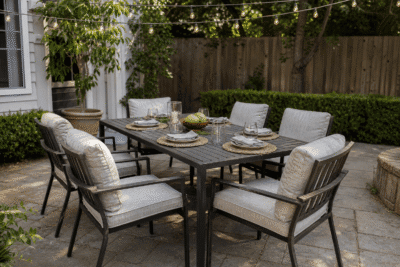
Outdoor Dining Sets: Buying the Set Right So the Cushions Work
Outdoor dining set buying guide: how the set choice locks in your cushion future — seat sizes, arm heights, frame materials, cushion quality in boxed sets versus custom pads, and set versus separate buying.

At Home Outdoor Cushions: The Decor Superstore’s Seasonal Wall
At Home runs a full-scale seasonal cushion department at decor-store prices — what the wall stocks, the fit grid, and when the superstore route ends at custom.
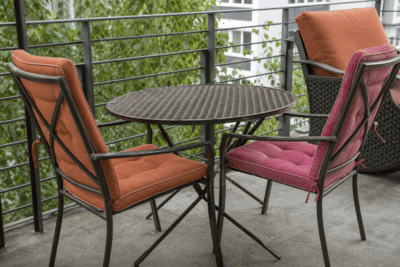
Target Outdoor Cushions: Threshold, Sizing and Replacement (2026)
Target’s Threshold cushions look designer but run generic sizes. What fits, what the seasonal rotation kills, and when custom replacements beat another Threshold refresh.
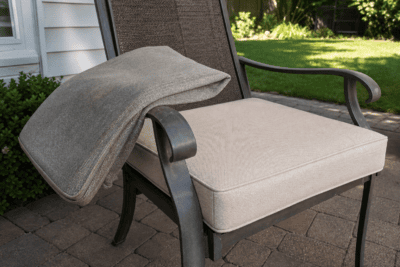
Hampton Bay Cushion Covers: Replacement Covers vs Full Cushion Replacement
The Hampton Bay covers question answered — why OEM cover-only replacements are rarely available for most series, the exact-fit route (full cushions by your series dimensions), re-covering services and DIY, and how to identify your series first.
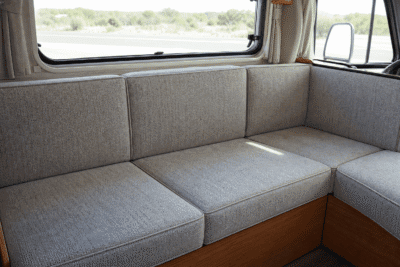
RV & Camper Cushion Replacement: The Complete Guide
RV dinette and berth cushion replacement — sizes, 45–60D foam for daily use, spill-proof fabrics, and the paper-template method for odd cabin shapes.