
“Upholstery foam” is not one material — it is a purchasing spec. The phrase covers the flexible polyurethane foam cut for seats, backs, benches and headboards, and every order comes down to three numbers: the density (how many years it holds its shape), the thickness (how tall the cushion sits), and the cut size (whether it actually fits the cover or the frame in front of you). This guide walks through what the term means, how the numbers work together, and where the honest buying routes are — including the one most retail sheets quietly fail. If you want the short version first: for a daily-use seat, 60D foam at the same thickness as the old core, cut to the old core’s dimensions plus half an inch of compression allowance, ordered from a factory that cuts to size.
What “Upholstery Foam” Actually Is
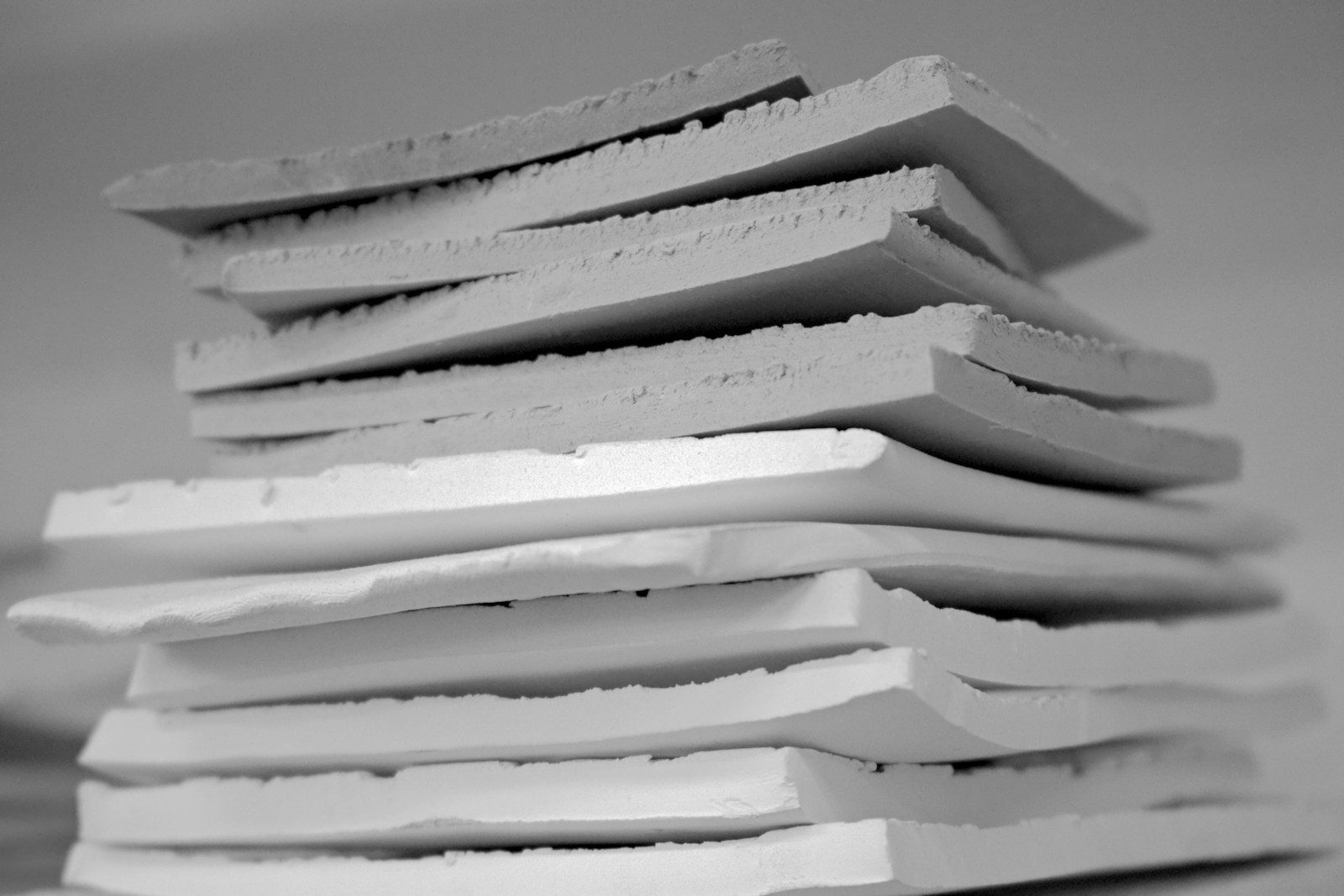
Walk into a supply house and ask for upholstery foam and you will be handed flexible polyurethane foam — the open-celled, compressible foam that makes up the overwhelming majority of seat and back cores in furniture. It is the same family of foam whether it is sold as a 2-inch craft sheet or a custom-cut 24 × 24 bench block; what separates a craft sheet from a furniture-grade core is not chemistry, it is density grade and cell structure. That distinction matters because the retail vocabulary is unreliable: a store “high density” label has no enforced standard behind it, which is why two foam purchases that look identical can differ threefold in lifespan. The reliable way to buy is by numbers — density rating, thickness, and cut size — which is exactly how upholstery professionals order. Memory foam, latex and reticulated (quick-dry outdoor) foam are all legitimate cushion materials, but they are specialist branches rather than the default; if you are choosing between them, the comparisons live in how to choose foam density and the quick-dry foam guide.
Density: The First Number That Buys Years
Density describes how much material is packed into the foam, and it predicts longevity more reliably than any firmness word on a label. Our cut-to-size foam comes in four in-stock grades, and the honest mapping to furniture hours looks like this:
| Grade | Best for | Rough service life in daily use |
|---|---|---|
| 35D | Guest rooms, seasonal pieces, decorative pads | 3–5 years |
| 50D | Back cushions, moderate-use seating | 6–10 years |
| 60D | Daily-driver seat cushions | 10+ years |
| 65D | Heavy users, commercial hours, bench seating | 10+ years, firmer sit |
Two cautions. First, density and firmness are related but not identical — firmness also depends on the foam’s ILD rating, which is explained separately in the ILD rating guide. Second, the “1.8 lb foam” you see in budget furniture is roughly the floor of this scale; the full story of how D-ratings and pound ratings relate — and why the numbers get quoted two different ways — is covered in foam density explained: D ratings vs lbs. For a seat that gets sat on every evening, 60D is the grade that stops the yearly “my cushions are flat again” cycle; 50D is the standard choice for back cushions and lighter duty, which is why most of our complete cushions default to a 60D seat / 50D back pairing.
Thickness: The Second Number
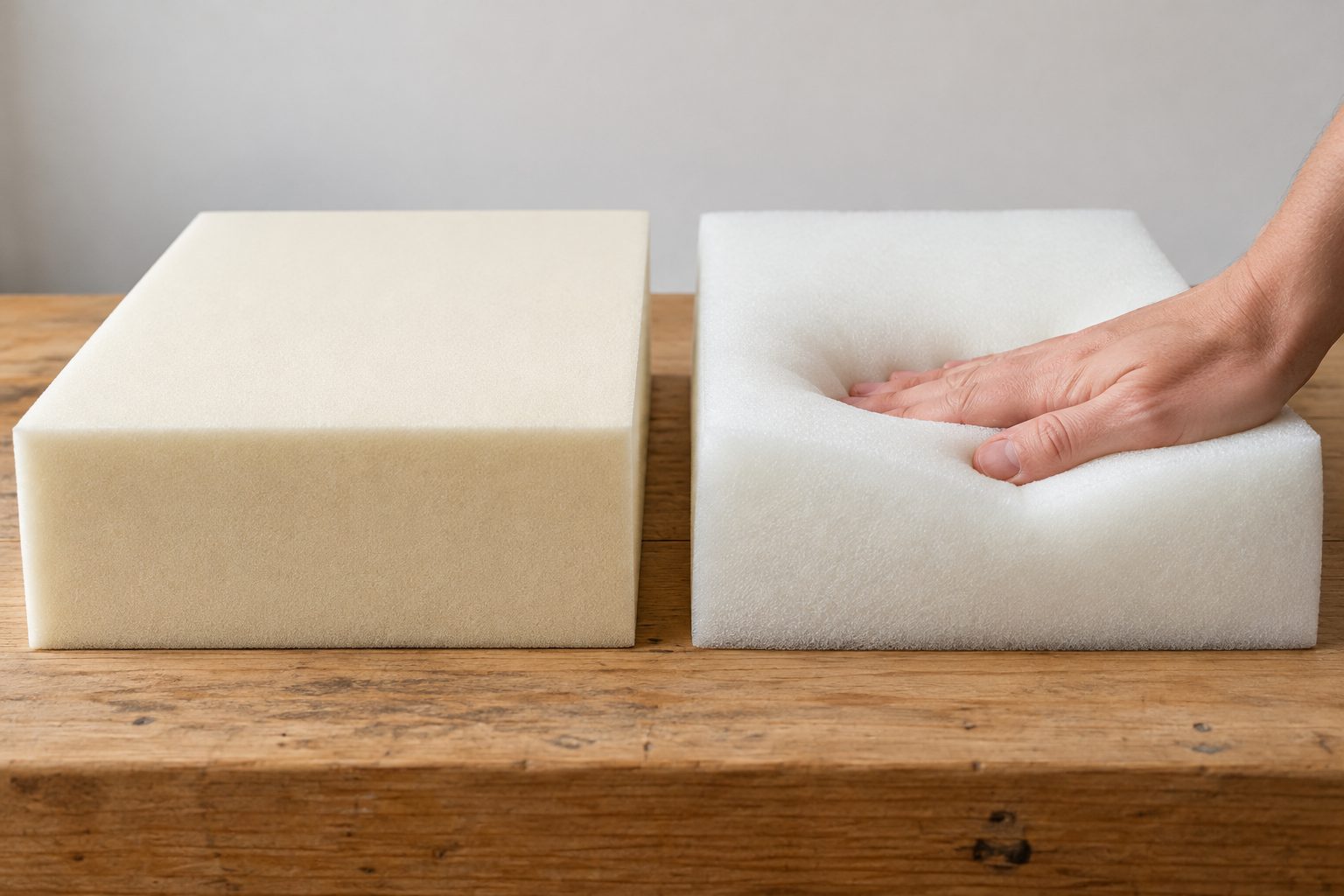
Thickness is the simplest spec but the easiest to get wrong, because the right answer is almost always “whatever the old core was.” Foam thickness sets seat height and support depth, and deviating from the original changes how the furniture feels and fits:
- 1–2 inches — headboard panels, stool pads, sling-chair replacements, layering over an existing core.
- 3 inches — dining chairs, window seats, occasional chairs.
- 4–5 inches — standard sofa and loveseat seats; the most common replacement range.
- 6–8 inches — deep seats, floor cushions, daybed and bench builds.
If you are re-covering rather than re-foaming, note that a wrap of batting adds height — the layer question is covered in the Dacron batting guide. And if the seat felt too hard or too low before it wore out, thickness is the lever to adjust in the same order, one inch at a time.
Sheets, Rolls and Custom-Cut Blocks

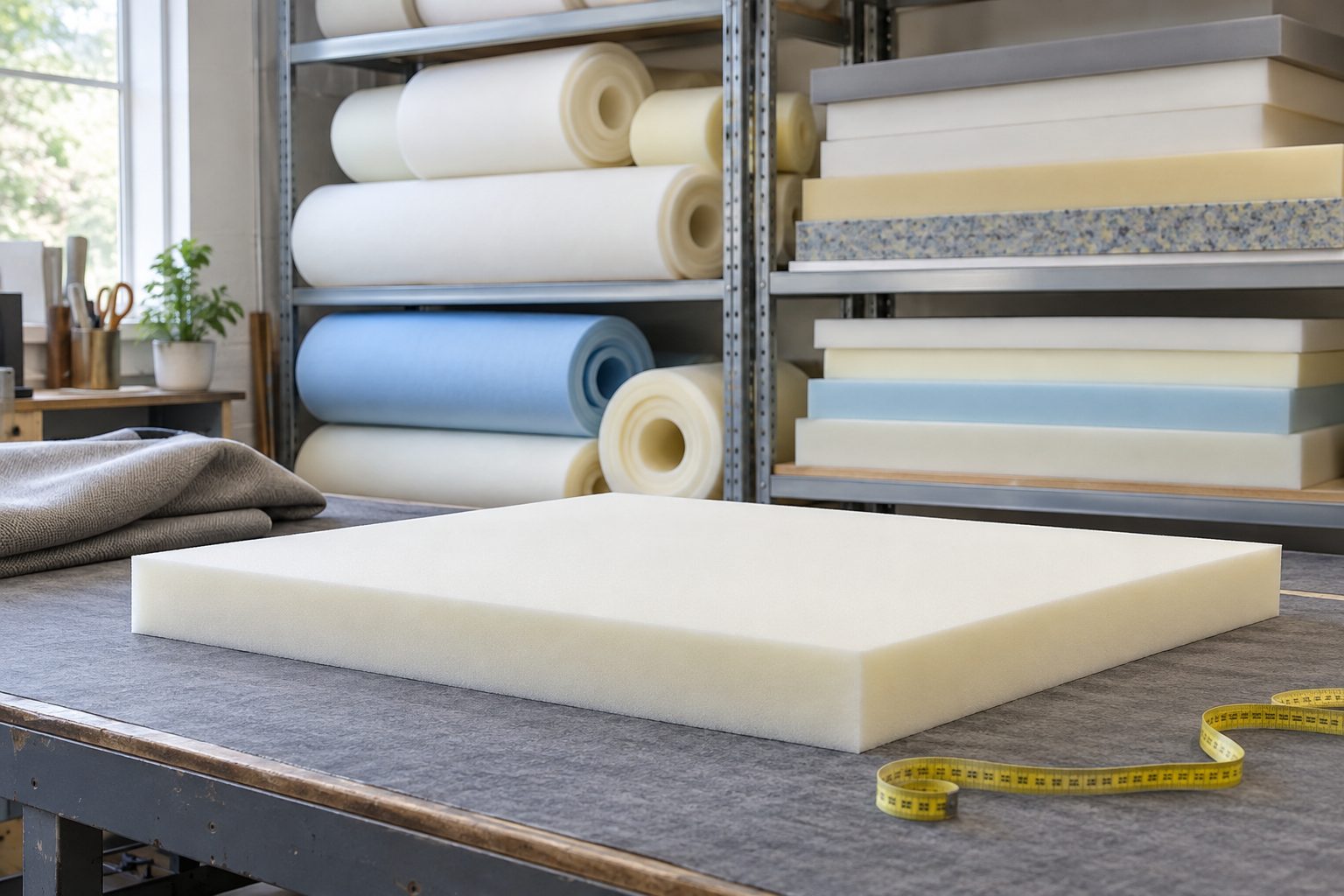
Retail upholstery foam arrives in sheets and rolls: fixed footprints like 24 × 72 inches, in a few set thicknesses, and you cut it down at home with the techniques in how to cut foam. That route suits craft projects and odd repairs. It suits cushions poorly, for three reasons. Fixed sizes never match a cushion footprint, so you pay for foam you discard. Set thicknesses force a compromise on seat height. And big-box sheets are frequently a lower density grade than advertised, which is why a “firm” retail sheet can feel flat within a season while a furniture-grade core lasts a decade. Custom-cut ordering flips the arithmetic: you give length, width and thickness in inches — thickness steps by the inch from 2 to 8 — and the factory cuts your exact block, which is the same spec sheet approach used in sofa foam cut to size. Curved, rounded or notched seats are simply a matter of supplying the right measurements, as in measuring round cushions.
Local Supply Shop or Online Factory
Searches for upholstery foam nearby are really asking “where can I see and touch foam before paying.” A local upholstery supply house is genuinely the right stop when you need a same-day small piece or want to hand-compare grades. For replacement-size blocks, online factory ordering has pulled ahead on both price per block and — more importantly — precision, because a cut-to-order house works to a stated tolerance and stands behind re-cuts. The trade-offs, including when a local upholsterer beats an online shop and when it is the reverse, are laid out in local upholsterer vs online custom cushions. If your starting point is a sagging couch rather than a raw material question, the replacement-specific decision path is in the couch cushion foam replacement guide, and the where-to-buy comparison for couch foam lives in where to buy foam for couch cushions.
What Upholstery Foam Costs
Foam is priced by grade, thickness and area — never by a single “per cushion” number that fits every project. At our current rates, a complete sewn cushion starts at $89 for a 16 × 16 × 2 seat pad in 35D, and a full 24 × 24 × 3 seat cushion — new core, new cover, sewn and fitted — runs about $154 in 50D or $160 in 65D, with one flat $45 order base shared across a whole set. Foam-only blocks bought without a cover run cheaper per piece since you keep the fabric; the cost logic, including how foam compares to fiber and down alternatives, is unpacked in custom cushion pricing explained and the foam-versus-fiber breakdown in foam vs fiber cushion filling. Orders over $158 ship free; below that it is a flat $29.
FAQs
What is upholstery foam made of?
Nearly all upholstery foam is flexible polyurethane foam — an open-celled foam that compresses and springs back. Grades differ by density (how much material per volume) and ILD (firmness), not by a different chemical family. Latex, memory foam and reticulated outdoor foam are separate specialty materials.
What density of upholstery foam do I need?
For seat cushions used daily, 60D. For back cushions and moderate-use seating, 50D. Guest-room and seasonal pieces are fine at 35D, and heavy or commercial use justifies 65D. The full decision walk-through is in our foam density guide.
What thickness should seat cushion foam be?
Match the old core unless you are deliberately changing seat height. Most sofa seats use 4–5 inch foam, dining chairs 3 inches, and deep or floor seating 6–8 inches. Thickness steps by the inch on custom orders.
Can I buy upholstery foam cut to an exact size?
Yes — that is the standard way to order from a cut-to-size factory. You supply length, width and thickness, and each block is cut to your numbers. Rectangle and square blocks need three measurements; curved shapes need the measurements described in our shape measuring guides.
Do standard foam sheet sizes work for cushions?
Rarely. Standard sheets come in fixed footprints and set thicknesses, so almost every cushion requires cutting down — and you pay for the offcuts. Retail sheets also vary in true density. Ordering by your own measurements avoids both problems.
Can I order just the foam without a new cover?
Yes. If your covers are in good shape, a foam-only core order re-uses them; measure the old core seam to seam and add about half an inch of compression allowance so the insert fills the cover firmly.
How long does upholstery foam last?
By grade, in daily use: 35D lasts roughly 3–5 years, 50D about 6–10 years, and 60D or 65D ten years or more. Infrequent use stretches each range considerably.
How is upholstery foam shipped?
Large blocks are vacuum-compressed for shipping and need up to 48 hours to fully regain height after unpacking — a flat-on-arrival block is normal, not a defect. Production runs 4–7 days standard or 3–5 days rush, with delivery in the 4-7 business-day window.
What is the difference between open-cell and closed-cell foam?
Seat cushions are open-cell polyurethane foam — air flows through the cells so it compresses and rebounds, and open-cell polyurethane foam grades run 45D to 65D. Closed-cell foam is a sealed-cell board: closed-cell polyurethane foam and closed-cell foam sheets shrug off water, which is why they belong under marine pads and gym flooring, not inside a sofa. Closed-cell foam board and closed-cell foam boards are ordered by exact dimensions for moisture zones.
Can I order polyurethane foam sheets and sheet packs cut to size?
Yes. Polyurethane foam sheets, polyurethane sheet foam and PU foam sheet stock all cut to your length, width and thickness by the inch — open cell foam sheets for seating, closed-cell for damp areas. A hardware-store foam sheet pack or sheets of foam core comes in fixed sizes; custom cell foam sheets and closed foam sheet blanks follow your tape measurements instead, sewn or shipped in 4–7 days.
Do you sell finished upholstered foam cushions or only upholstery foam sheets?
Both. Upholstered foam cushions arrive as complete upholstery cushions — foam core, batting wrap and a zippered cover, so every upholstery cushion stays removable and washable across 119 fabrics. Upholstery foam sheets and upholstery foam sheet blanks suit DIY upholsterers; an upholstery foam cushion from us skips the sewing entirely. Upholstery padding and upholstery cushion foam build at 60D for seats and 50D for backs.
What is polyurethane foam made of, and is a PU foam cushion the same thing?
A PU foam cushion is shorthand for polyurethane foam — polyurethane upholstery foam and polyurethane foam for upholstery are the same flexible material, and urethane foam sheet stock is the same family in sheet form. Polyurethane foam furniture grades differ by density, not chemistry: polyurethane furniture foam at 60D carries daily seats, polyurethane foam for cushions at 50D suits backs. To upholster cushions yourself we ship foam-only cores; otherwise we sew the full cushion.
Is 4 inch foam the standard thickness for seat cushions?
For most sofa and armchair seats, yes — 4 inch foam cores (4–5 inches) are the norm, dining chairs run 3 inches and floor seating 6–8. Any foam upholstery project steps thickness by the inch on custom orders, with 4–7 day production and a 3–5 day rush.
Next Steps
1. Decide the grade by hours of use — 60D for daily seats, 50D for backs and light duty.
2. Measure what the foam is replacing: length, width and thickness of the old core, seam to seam.
3. Price the exact block at custom cushions, or compare the foam-only route against a full rebuild on the couch foam cushions page. Nothing is cut until your numbers are confirmed.
Best Outdoor Cushion Fabric: How to Choose by Climate, Exposure and Budget
A factory guide to outdoor cushion fabrics — solution-dyed acrylic, olefin, polyester grades and blends — ranked for fade, water, mold, comfort and cost per year.
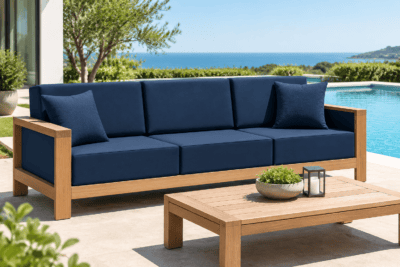
Is Sunbrella Fabric Worth It? An Honest Cost-Per-Year Analysis
Whether the Sunbrella premium pays off depends on sun exposure, horizon and color — here’s the honest math, warranty mechanics and when to skip the upgrade.
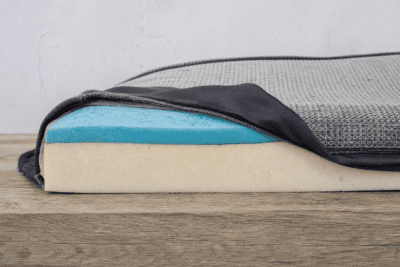
Memory Foam Topped Cushions: When Gel Layers Help (and Hurt)
Memory foam topped cushions and gel-infused layers examined — where a visco topper over HR foam genuinely helps, where it hurts, and the layer specs that separate luxury from a gimmick.
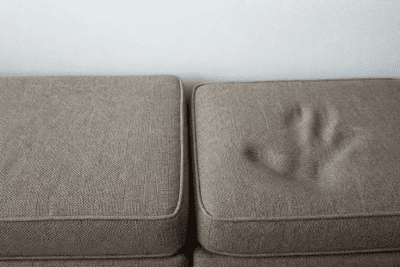
Memory Foam vs Regular Foam Cushions: What a Cushion Factory Wants You to Know
Memory foam vs high-resilience foam for seat cushions — density (35D–65D), ILD firmness, compression set and airflow explained by the people who cut foam daily.
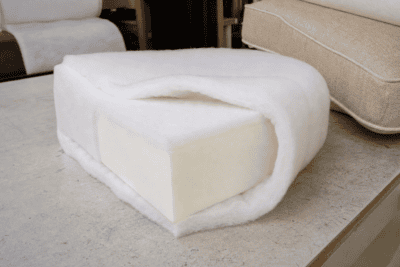
Dacron Batting: The Wrap Layer Explained (What It Does and When to Order It)
Dacron batting for cushions explained: the polyester wrap layer around foam cores, what it does for feel edges and fabric wear, thickness options, indoor and outdoor uses, and when the wrap earns its cost.
Latex Foam Cushions: Natural Rubber Seating, Honestly Assessed
Latex foam cushion guide: what natural and blended latex actually offer versus polyurethane — resilience, feel, lifespan, weight and cost — who latex seating serves, and the honest counterarguments.