
Read an American foam tag and you get one language: “1.8 lb high-density foam.” Open our order form and you get another: 35D, 50D, 60D, 65D. Both are density claims, both are legitimate, and they are not the same ruler — which is why shoppers who try converting one into the other with a calculator end up more confused than when they started. This guide settles the translation: what density physically is, why no formula converts D into pounds, and how to read across the two systems the honest way — by job and by years.
The one-line summary: PCF is a scale you measure; a D-rating is a ladder you climb. If you only need to pick a grade for tonight’s order, that decision is a separate article — how to choose foam density — and neither piece requires the other.
What Foam Density Actually Measures
Foam density is the weight of polymer packed into each cubic foot of foam — nothing more, nothing less. Not how heavy the cushion is (a 4-inch dining core and an 8-inch lounger core cut from the same bun share one density), and not how firm it feels. It is material per volume: more polymer per cubic foot means thicker cell walls, more structure sharing each sit-down, and a core that ages slower under the same load.
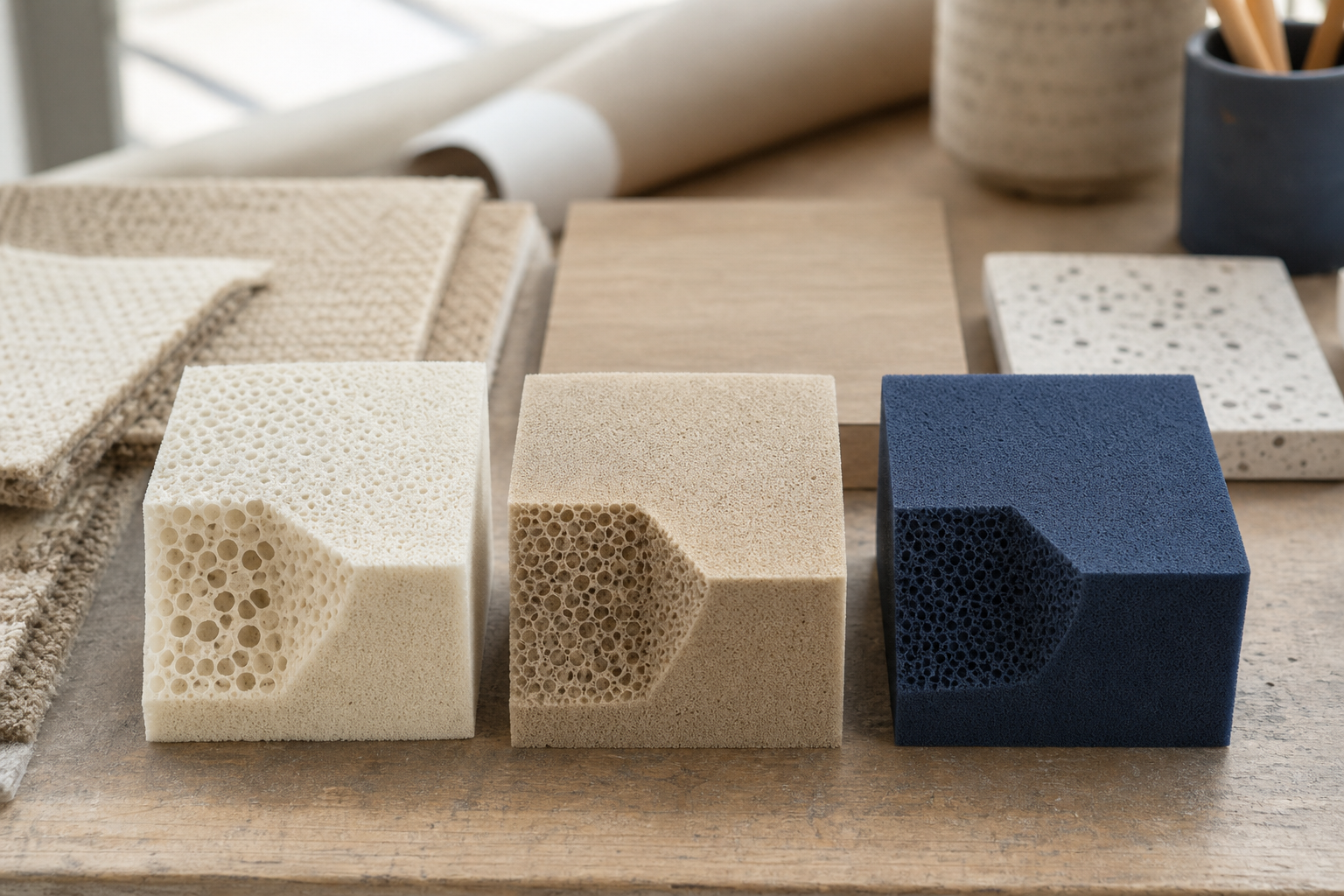
Density is invisible on the showroom floor: two cores can look identical, feel identical on first sit, and age at entirely different speeds — the difference shows up as dishing and bottoming-out two summers later. That invisibility is the commercial logic of cheap seating; under-specified cores demo beautifully and die on schedule. The failure modes are unpacked in high density foam explained.
lbs/ft³ (PCF): The Language on American Retail Tags
Pounds per cubic foot — written lb/ft³ or PCF — is the density language of American retail tags, and it is a physical measurement: weigh a block, divide by its volume. When a US seller prints “1.8 lb,” a one-cubic-foot sample of that foam tips the scale at 1.8 pounds. The bands the retail world actually uses, aggregated from the published spec sheets of independent US foam suppliers:
| Retail band (lb/ft³) | What the trade calls it | What it is specced for |
| — | — | — |
| under ~1.2 | Packaging / furniture-floor grade | The industry baseline; seats cut here dish fast |
| ~1.5 | Entry seating foam | Occasional pieces; published lives of 1–2 years of real sitting |
| ~1.8 | The “high density” of US retail tags | The mainstream daily-use band most sellers mean by the phrase |
| 2.8–3.0 | HR / premium grades | Heavy daily use; published lives of 10–16 years |
| 3.5+ | Specialty, mattress and medical specs | Jobs a patio or sofa core does not have |
Read the band structure: each step of roughly half a pound buys a visible jump in published service life — which is why density, not cover weight or pattern, is the spec that decides how many summers a cushion gives you. (Service-life figures above are aggregated from independent published specifications, September 2026; rules of thumb, not laboratory promises.)
D-Ratings: The Language on Cut Orders — and Why There Is No Conversion Formula
A D-rating is a grade, not a measurement. 35D, 50D, 60D and 65D are the rungs of the density ladder our supplier’s price list and every cutting order here is written in; each step up means more polymer per cubic foot, a tougher formulation, slower aging under load and a higher price — ending at commercial duty. On cut tickets the traditional reading is divide-by-ten for a rough pound figure (35D reads as roughly 3.5 lb/ft³) — the reading our order desk uses across our filling guides.
Now the honest part, and the reason this article exists: that divide-by-ten reading is a shop-floor convention, not an industry-wide formula, and D-ratings cannot be converted to lb/ft³ with a calculator. Two facts anchor this. First, the numbering traditions do not descend from one scale — at least one major US foam retailer runs grades numbered in the same 35/50/60 territory as firmness tiers on the same 1.8 lb/ft³ foam, where the number grades load-bearing character, not pounds. Second, a grade step is a package — more polymer, a denser formulation, a higher load class — which is why grade pricing steps up smoothly rather than in the proportions a pure density scale would dictate. Same-looking digits, different quantities, depending on whose order sheet they were printed on.
So the translation runs through the job, not the math. This is the table to bookmark:
| Our grade | The same job in retail language | Expected service life* |
| — | — | — |
| 35D | “Standard foam for occasional seating” — guest chairs, window seats, decorative pieces | ≈3–5 years if sat on daily; far longer on the light duty it is specced for |
| 50D | The tier US sellers mean by “high-density foam for daily use” — the every-evening sofa grade | ≈5–8 years of family use |
| 60D | Premium / HR duty — heavy sitters, long daily hours, light commercial | ≈8–10 years |
| 65D | Commercial and marine spec — bar stools, reception furniture, rentals | 10+ years; it outlasts the fabric around it |
* Industry rules of thumb, aggregated from independent published specifications. Hours, body weight, humidity and sun all move them, and no warranty covers how you sit.
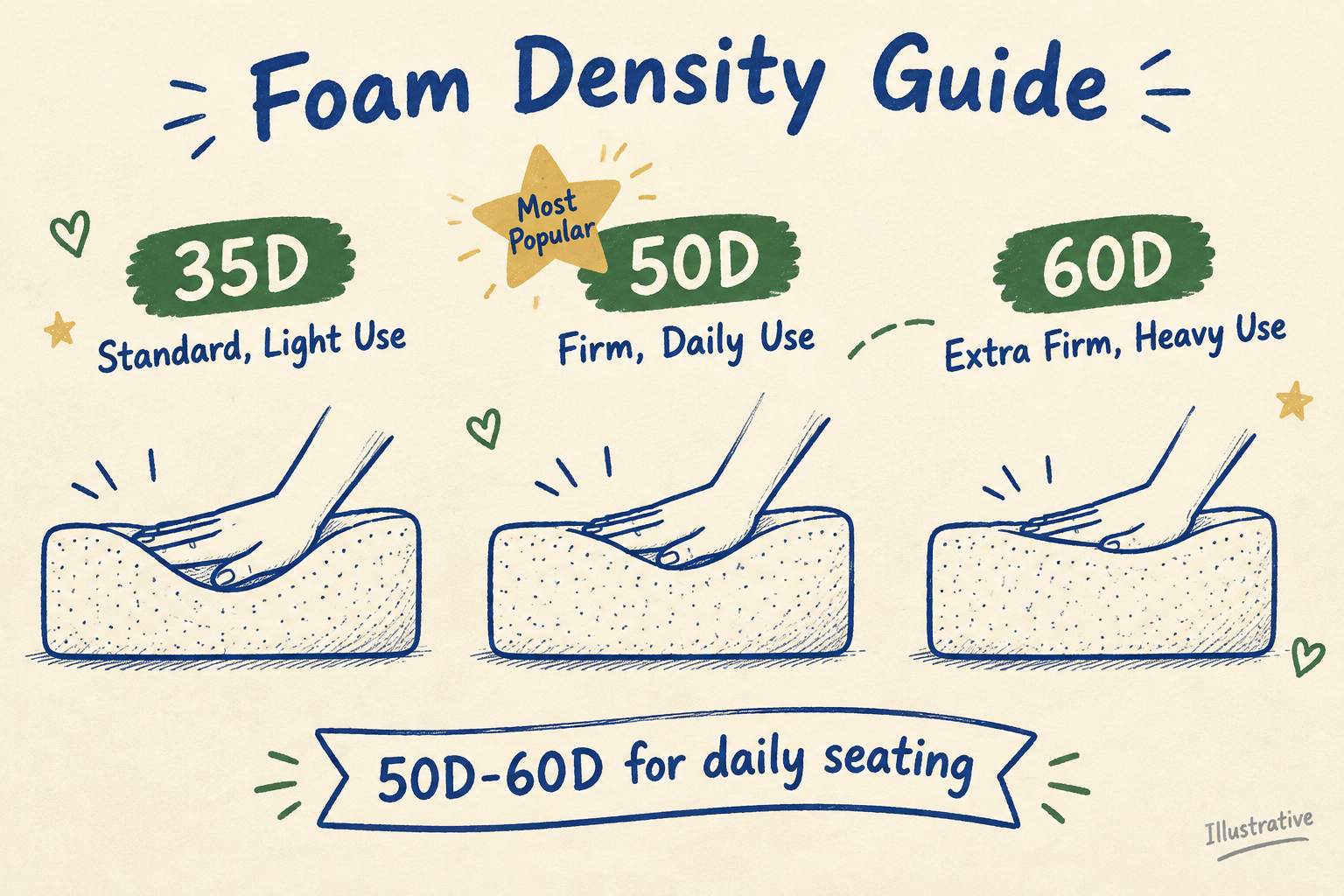
The three-grade picture in one sketch — same hand load over three cores:
And the same ladder as a fifteen-second speed check:
| If the seat is… | Order |
| — | — |
| Decorative, sat on rarely | 35D |
| The every-evening sofa, the daily dining set | 50D |
| Heavy sitters, a deep seat used as a homework desk, café duty | 60D |
| Bar stools that open at 8 a.m., marina cushions, rentals | 65D |
Density vs Firmness: Two Different Dials
Density and firmness are independent specifications — density buys years, firmness buys feel. Firmness is graded by ILD (indentation load deflection): how many pounds it takes to compress the foam a standard amount. A 60D core can be cut at a soft ILD and a low-density core can feel like a park bench; “high density means hard” is the single most expensive misconception in the category, and the full two-dial decoder is in the ILD rating guide. The retail side of the same trap: within the 1.8 lb/ft³ band you will find soft, medium and firm offerings — one density, several feels.
One note on the sketch above: the deeper dent under the same hand load in the lighter grades is material doing less work per cubic inch — less deformation and faster recovery is what more polymer buys. It is not a claim that 60D feels harder. Feel is bought separately, at every density — how to choose foam density walks that second dial.
How Density Maps to Lifespan
Density sets the schedule on which foam ages — each step up the ladder buys years, not comfort. Every polyurethane core fatigues eventually (the failure is compression set: cell walls slowly lose their spring, the cushion keeps the dent); density decides how many sitting cycles that takes. The ladder, retail bands and our grades side by side:
| Density tier | Published service life (aggregated) |
| — | — |
| ~1.5 lb entry seating foam | 1–2 years of real sitting |
| ~1.8 lb mainstream “high density” | 3–7 years |
| 2.8–3.0 lb HR / premium | 10–16 years |
| Our 35D → 50D → 60D → 65D | ≈3–5 → 5–8 → 8–10 → 10+ years |
Figures aggregated from published specifications of independent US foam suppliers, September 2026; hours, load, humidity and sun shift every row. Two consequences follow. The retail term “high density” and ours are tier claims, not identical physics — judge both by the published life, not the slogan. And at our rates the entire 35D-to-65D ladder adds roughly seven dollars to a standard 24×24 seat, so the years are nearly free — the math is in high density foam explained, the budgeting in how often to replace sofa cushions.
How We Check Density on the Mill Floor
The bench method is one sentence: weigh a block, divide by its volume. It is the same arithmetic behind every PCF tag in the retail chain, and it is how a grade gets verified instead of trusted — the card pinned above our review desk reads grade on the ticket, scale on the bench. Ten years of cutting foam and sewing covers, condensed to five steps:

- Cut a clean block from the middle of the bun — square edges, away from skins and cured edges that carry a different cell structure than the body.
- Let it relax first. A block straight out of its compression pack reads light until it rebounds — give compressed foam a day or two before trusting a number off it. (The same reason a vacuum-shipped core needs a day or two to reach full loft.)
- Measure length, width and height with light contact, once at each end, averaged. A tape pressed into the face reads the dent you just made.
- Weigh it to the ounce. Kitchen-scale precision is enough at cushion sizes — the errors that matter are geometric, not gravitational.
- Divide weight by volume. Worked example: a 12×12×4-inch block is one-third of a cubic foot; at 9.6 oz (0.6 lb), the math is 0.6 ÷ 0.333 = 1.8 lb/ft³ — the retail band table, reproduced on your own bench.
When the scale disagrees with the grade on the ticket, the ticket loses. That discipline — measurement over labeling — is the same one behind everything else we do: nothing is cut until your numbers are confirmed.
FAQs
Can you convert D-ratings to lbs/ft³?
No — there is no industry-wide conversion formula between D-ratings and pounds per cubic foot, because the two systems grade different things on different sheets. The divide-by-ten reading (35D ≈ 3.5 lb/ft³) is a cut-ticket convention, ours included, not a universal key — at least one major US retailer uses the same digits to grade firmness tiers on one 1.8 lb/ft³ foam. The honest translation is the use-tier table above: match the job and the years, and stop converting.
What density foam do I need for a daily sofa?
50D for most households; 60D if the sitters run heavy or the seat works long hours daily. That is the default our order desk quotes when a customer is torn — the three-question version (hours, load, exposure) is how to choose foam density.
Is a higher D always better?
No — match the grade to the use; on occasional furniture the money belongs in the fabric. A window seat nobody lingers on never earns back 60D; the whole ladder costs about seven dollars, and even that should follow the job, not the ceiling.
What counts as good density in lbs/ft³?
In published retail specs: ~1.8 lb/ft³ is the mainstream “high-density” daily-use band, 2.8–3.0 lb the premium HR band, under ~1.2 lb packaging grade. How those bands line up with our order-form grades is the use-tier table above — read the job, not the conversion.
Does a higher density feel firmer?
No — density and firmness are independent specs; a high-grade core can be cut soft, and “hard” is bought or avoided with the ILD number. The full explanation is in the ILD rating guide.
Next Steps
- Pick your grade by the three questions — hours, load, exposure — in how to choose foam density; ties go up, true uncertainty lands on 50D.
- Load your dimensions into the builder and flip the density option: the whole ladder moves the total by dollars, not hundreds.
- Order when the numbers look right — every set is cut and sewn on our floor in 4–7 business days, and nothing is cut until your measurements are confirmed (the process).
Flame Retardants in Cushion Foam: What Changed and What to Ask
Cushion foam flame retardants explained: why California TB117 put additive chemicals into furniture foam, what the TB117-2013 revision changed, what CertiPUR-US and GREENGUARD actually certify, how to read new-foam off-gassing, and the six questions to ask any supplier for nursery and commercial buying.
Wheelchair Cushion Foam Replacement: Measure, Order, Revive
Replace wheelchair cushion foam instead of the whole pad: three signals the core is done, W x D and thickness measuring, 50D-65D density for all-day seats, and cover fit – cores cut to your measurements.
How to Care for Polyester Cushions: Washing, Fading and Stretching Them Back
Polyester cushion care from top to bottom: what spun polyester can and can’t handle, the wash-day routine that won’t ruin fills, how to slow the fading that defines the tier, and reviving covers that have stretched out.
How to Choose Foam Density: 35D vs 50D vs 60D vs 65D (Decision Guide)
Pick cushion foam density in three questions: 35D for occasional seats, 50D as the daily-use default, 60D for heavy sitters and long hours, 65D for commercial and marine duty — with lifespan rules of thumb and what each upgrade costs.
HD Foam vs Dry-Fast Foam: The Outdoor Cushion Guide
High-density foam vs dry-fast reticulated foam for outdoor cushions — cell structure, PPI, feel, the measured price premium (+9% at one configurator), and the simple covered-vs-uncovered test that picks for you.
Foam vs Fiber Cushion Filling: Which Lasts Longer?
Foam vs fiber cushion filling compared on structure, lifespan and real price — why foam wins seats, where fiber belongs, and what a live configurator price test shows about the durability premium.