
Memory foam has a great reputation — from mattresses. Mattress marketing has leaked into cushion buying, and every week our order desk talks someone out of memory foam seat cushions that would have disappointed them, and into them when they genuinely want what memory foam does.
Here is the honest factory view. We cut both foams daily, we know their spec sheets and their failure modes, and the difference between them is not “good vs better” — it is two different materials engineered for two different jobs. Understanding three numbers — density, firmness, and compression set — tells you which job is yours.
(For the full menu of what goes inside cushions — HR foam, memory foam, fiber, down blends — see cushion filling types compared. This article is the head-to-head.)
The Two Foams, Defined Precisely
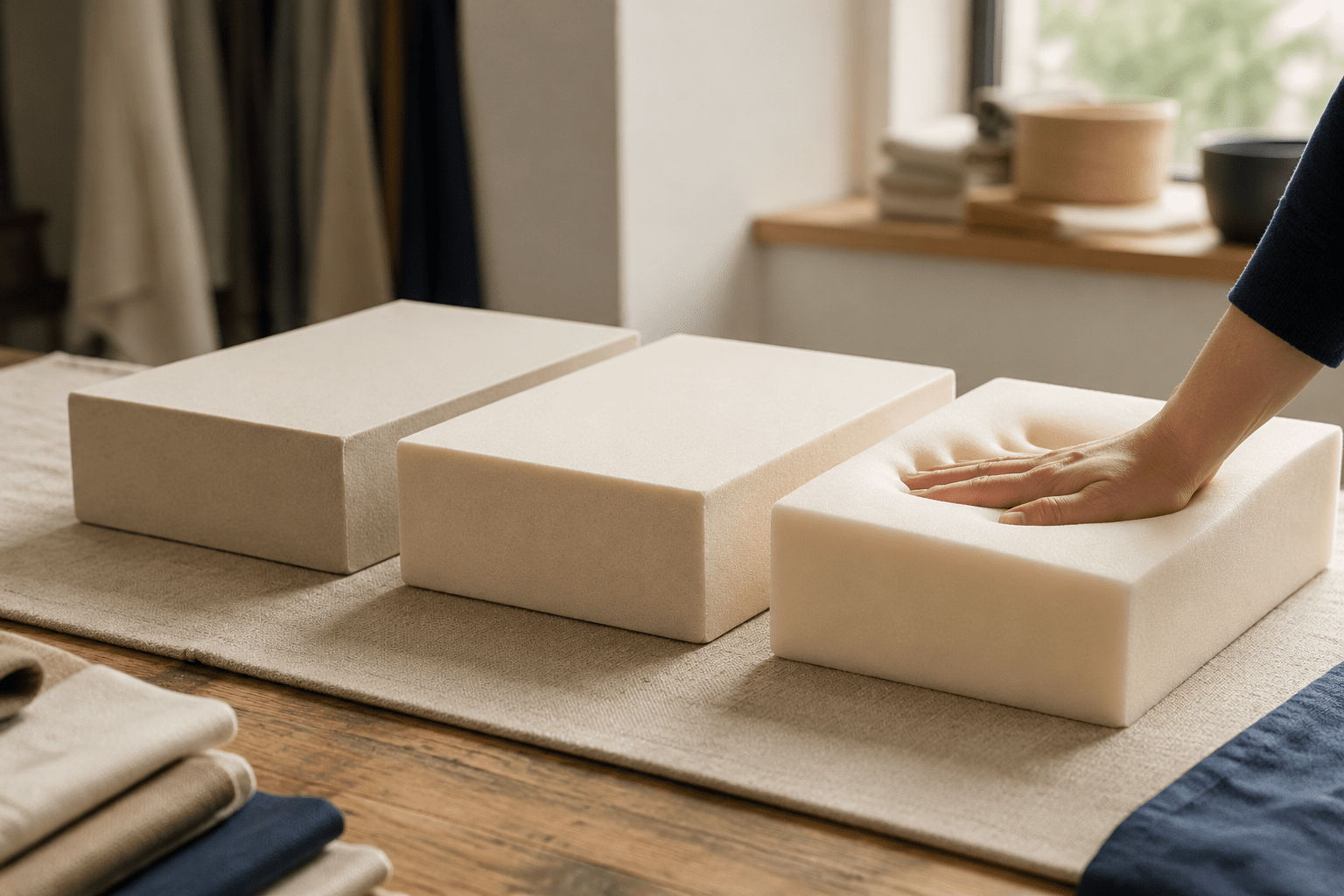
High-resilience (HR) polyurethane foam — “regular” foam in the good sense — is the workhorse of seating. Open-celled, springy, engineered to push back. Quality grades run 35D to 65D density (pounds per cubic foot ×10 convention; 35D ≈ 3.5 lb/ft³). The higher the density number, the more polymer per volume, the longer the foam holds its shape and support under repeated loading.
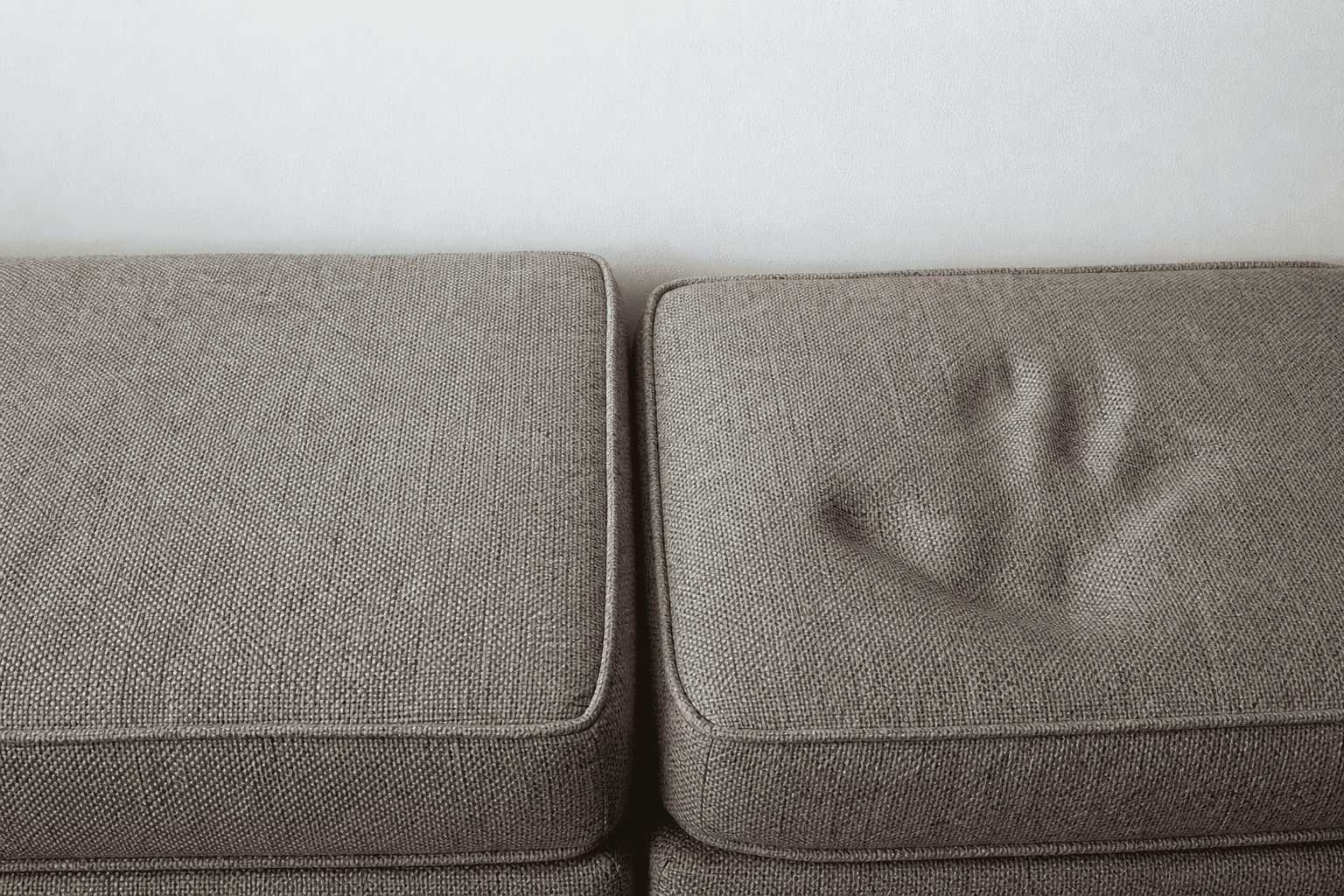
Viscoelastic memory foam (tempur-type) is polyurethane chemically modified to be temperature-sensitive and slow-recovering. Press it, and it holds the imprint; it softens with body heat and re-flows around pressure points. Densities run roughly 40D–80D. Its defining behaviors — contouring and slow return — are exactly what makes it magical in a mattress and problematic in a seat.
The Three Numbers That Actually Matter
Foam marketing hides behind vague words (“premium,” “high-density”) and reports only thickness. Three specifications predict real-world behavior, and you should ask for all three on any cushion you buy:
1. Density (the lifespan number)
How much polymer is packed into the foam per cubic foot. Density is durability, not firmness — the single most common buyer misconception.
- – 18–24D: one-season furniture-in-a-box grade. Feels fine day one, dishes permanently within a year.
- – 30–34D: acceptable light-use grade.
- – 35D–50D: the seating sweet spot — our standard grades for seat cushions.
- – 60D–65D: premium seating, daily heavy use, commercial.
A 5″-thick 24D cushion and a 5″ 50D cushion feel similarly firm in the showroom. Three summers later the 24D has a permanent body print; the 50D measures within a few percent of new. Density is why two “5-inch cushions” at a $40 price gap are not the same product.
2. ILD / firmness (the comfort number)
Indentation Load Deflection: how many pounds compress a 4″ sample by 25%. Lower ILD = softer. Seat cushions typically run 24–35 ILD; backs softer. Note: a high-density foam can be soft and a low-density foam can be rock hard — density and ILD are independent. Firmness is a comfort dial; density is how long that comfort lasts.
3. Compression set (the failure number)
The standardized test that ages foam: compress it, bake it, measure how much height it never recovers. Expressed as a percentage — under 5% is good, over 10% is the dishing you have sat in on an old sofa. Density correlates inversely: 50D foam might test 3–5% set; 20D foam 10–15%. This is the spec that separates cushions that last from cushions that look like they should last.
Memory Foam vs HR Foam: The Head-to-Head
| High-resilience foam | Memory foam | |
| Recovery | Instant, springy | Slow (seconds), temperature-sensitive |
| Support mechanism | Pushes back, distributes load | Contours, spreads pressure by immersion |
| Getting up | Easy — surface rebounds | You rise “out of” a mold; can feel trapping |
| Sitting for meals/conversation | Excellent — stable, lets you shift | Poor — every shift re-contours; “quicksand” feel |
| Long lounging/napping | Good | Excellent — pressure-point relief is real |
| Durability in seating duty | 35D+: years of daily sitting | Good grades durable in mattresses; seating-duty fatigue faster |
| Heat | Neutral | Warmer — body heat is its activation mechanism |
| Outdoor use | Firm HR grades work; quick-dry variants exist | Poor — hydrophilic, holds water, heat-softens in sun |
| Cost | Moderate | Higher per equivalent durability |
Why Memory Foam Underperforms in Seat Cushions (the Factory View)
Four structural reasons, all visible on the cutting floor:
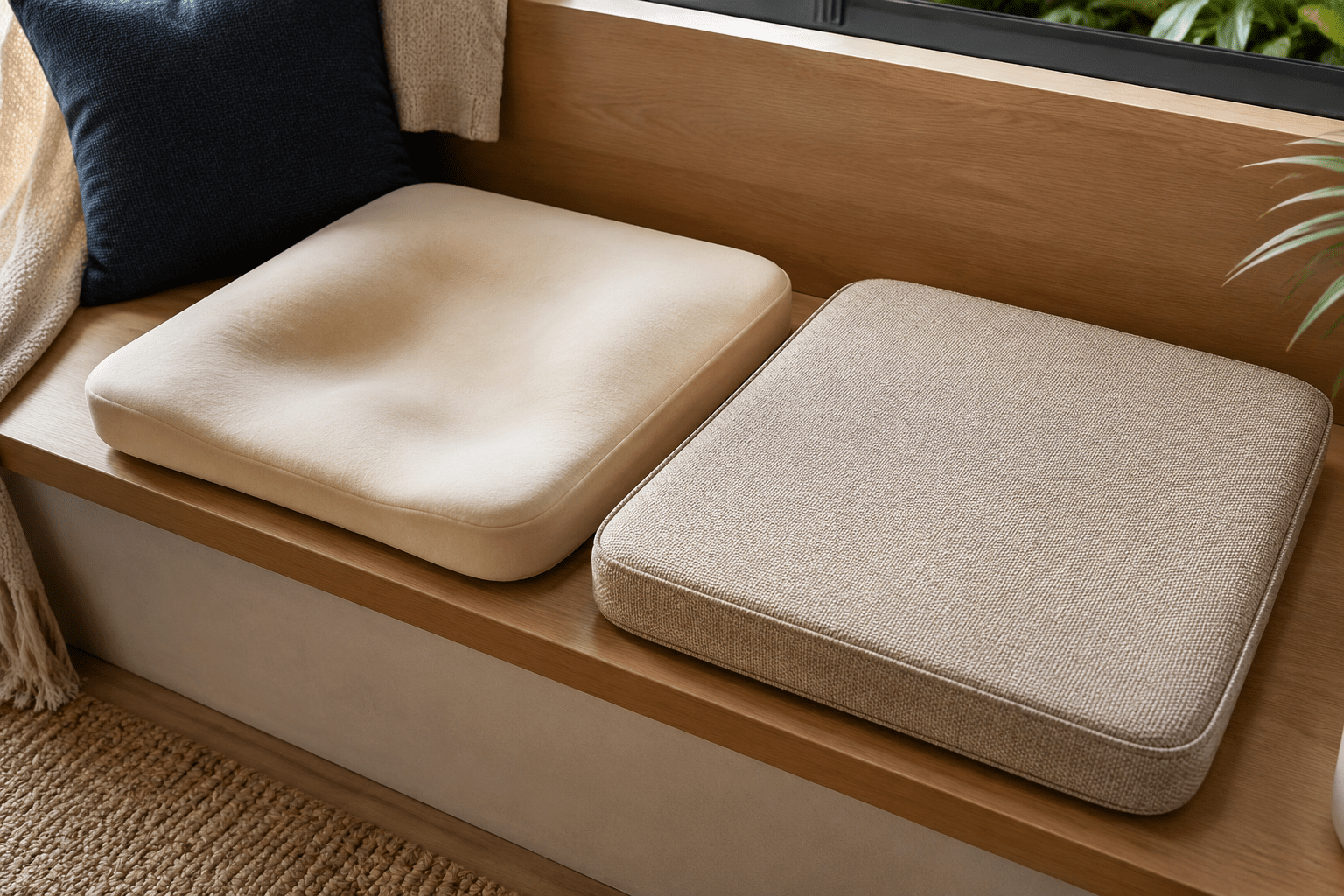
- Seats are dynamic; mattresses are static. Memory foam’s benefit is long static lying. On a seat, you shift, rise, twist every few minutes — memory foam re-flows on each movement, which reads as instability rather than comfort.
- The “get up” problem. Rising from memory foam means climbing out of a hole that closes behind you slowly. On a dining chair or bench, this is genuinely annoying; on a low deep-seat chair it can be a struggle for older knees.
- Heat in sun. Memory foam softens dramatically as it warms — a patio cushion in afternoon sun goes from supportive to sludge-firm. Its own physics disqualifies it for outdoor use, independent of water behavior.
- Water. Viscoelastic foam absorbs and holds water; it is the worst possible core for anything that gets rained on.
And one honest counterpoint: memory foam as a topper layer is excellent. The best luxury seat cushions we build are layered — a firm 50D HR base (support, height, durability) with a 1″–1.5″ memory or plush HR layer on top (surface comfort, pressure relief — the mattress-scale version is custom mattress toppers). You get contour at the skin and spring at the structure. This hybrid logic is exactly what the custom cushions builder prices — density options are priced live as you select them.
Where Each Foam Genuinely Wins
Choose HR foam (35D–50D) for:
- – Dining chairs and benches — dynamic sitting, get-up frequency
- – Deep seating you sit upright in (conversation sets)
- – Anything outdoors — sun and water rule visco out
- – Window seats and reading nooks (dense 50D+ for favorite spots)
- – Every application where “supportive” is the compliment you want
Choose memory foam (or a hybrid) for:
- – A lounger, daybed or chaise you actually nap on — the mattress use case, migrated outdoors to covered areas
- – Medical/pressure-relief needs on static seating
- – As a topper layer over HR base foam — the luxury configuration
Never choose memory foam for: outdoor cushions in weather, dining chairs, or any seat where the sitter shifts often. Not because the material is bad — because the job is wrong.
How to Buy Foam You Can’t See Inside
You cannot inspect foam through a cover, so buy on stated specs and seller transparency:
- Ask the density number. Any seller who cannot or will not state density is selling 20-something foam at whatever the market bears. Walk away.
- Thickness is not quality. 6″ of 24D is worse seating than 4″ of 50D.
- Beware “memory foam” as a premium upsell for seats — on patio furniture it is a red flag about the seller, not a bonus.
- Compression set spec on request — factories that test will share it.
- For replacements, our foam grades and layer options are listed explicitly at order time on every custom cushion; if you are re-foaming existing covers yourself, the DIY walkthrough is how to replace cushion foam.
Reading Foam Spec Sheets Like the Factory Does
Once you know the three numbers, seller spec sheets decode quickly. What each line is actually telling you:
- – “High-density foam” — meaningless without a number. Ask “what density?” and expect an answer like 35D or 3.5 lb/ft³. Sellers who test and buy by density state it; sellers who buy by price change the subject.
- – “1.8 lb / 2.0 lb / HR” — the US retail convention states density in pounds per cubic foot (multiply by 10 for the D-convention: 1.8 lb ≈ 18D, which is the furniture-in-a-box grade). “HR” (high resilience) is a real ASTM category with ball-rebound requirements, not just marketing — genuine HR starts around 2.5 lb/25D.
- – “Memory foam layer” — check where. Topper position over HR base: good design. Core position in a seat: red flag for the reasons above.
- – “Compression set: 5%” — the aging test result; anything under 5% is good, over 10% is the dishing you have sat in on dead furniture. Rarely published; factories share on request.
- – Foam + wrap listings — “foam core with Dacron wrap” is the standard good build (the wrap explained); bare foam in a cover is the economy build.
A practical decoding: a $29 big-box seat cushion and a $108 custom lounge cushion can both truthfully say “foam cushion, removable cover.” The spec sheet — density, ILD, set, wrap — is the entire difference, which is why the price guide benchmarks by spec rather than by adjective.
Foam Failure Modes and What Each One Tells You
When cushions come to us for replacement, the dead core tells us how it died — and the autopsy usually points at a buying error or a care error that the next cushion will repeat unless corrected:
- – Center dish, sides firm — low density under real loading: a spec error at purchase (upgrade density, per the table above).
- – Edge crumble, powder on unzip — foam at end of natural life (8–12+ years even for good grades) or years of UV through a light cover: simply age; time to re-foam.
- – Yellowed, brittle, musty but never flooded — long-term damp storage: a care error; the next core inherits whatever storage habits killed this one (winter storage).
- – Flat everywhere, rebound still quick — not foam failure at all: the wrap has packed. Re-wrap the core instead of replacing it — the cheapest “new cushion feel” available.
FAQs
Is memory foam good for seat cushions?
For seats you sit upright in and rise from often, no — its slow recovery reads as unstable and traps you on getting up; HR foam 35D+ is the right core, with memory foam excellent only as a thin topper layer.
What density foam is best for outdoor seat cushions?
35D–50D high-resilience foam is the sweet spot for durability and support; we cut 50D as standard for daily-use seating, and density options are priced live in the builder.
Does higher density mean firmer?
No — density is durability, firmness is ILD, and they are independent; a soft 50D foam outlasts a hard 20D foam by years.
How long should a quality foam cushion last?
35D–50D HR foam in normal use holds shape for 5–10 years; under-24D foam dishes permanently within 1–2 seasons — the price gap between them is a lifespan decision, not a comfort one.
Can I put memory foam cushions outside?
No — viscoelastic foam absorbs water, dries slowly and softens in heat, which disqualifies it outdoors regardless of cover fabric; outdoor builds use firm HR or quick-dry open-cell foam, covered in cushion filling types.
Is memory foam good for your back on seating you use daily?
Is memory foam good for your back: as a topper layer, yes; as a full seat core, no. What is a memory foam build doing is contouring — and contouring alone lacks push-back, so a cushion memory foam topper over a 60D HR core is the balanced build.
Can I get memory foam for couch cushions, or only full replacements?
Memory foam for couch cushions and memory foam for sofa cushions orders as a topped build: a 1–2 inch visco layer fused to a 60D base, sewn into a zippered, washable cover. Production runs 4–7 days.
Can you wash memory foam cushion cores?
Can you wash memory foam — no; how do you clean memory foam is spot-dab with mild soap, then air-dry fully. How to clean memory foam and how to clean a memory foam topper follow the same no-machine rule, and how to clean memory foam mats extends it to sun-deodorizing only. Zippered removable covers in 119 fabrics are what actually keep cores clean.
Best Outdoor Cushion Fabric: How to Choose by Climate, Exposure and Budget
A factory guide to outdoor cushion fabrics — solution-dyed acrylic, olefin, polyester grades and blends — ranked for fade, water, mold, comfort and cost per year.
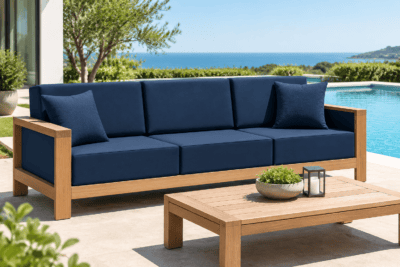
Is Sunbrella Fabric Worth It? An Honest Cost-Per-Year Analysis
Whether the Sunbrella premium pays off depends on sun exposure, horizon and color — here’s the honest math, warranty mechanics and when to skip the upgrade.
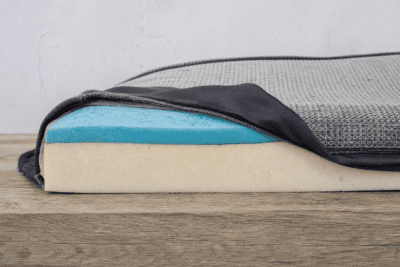
Memory Foam Topped Cushions: When Gel Layers Help (and Hurt)
Memory foam topped cushions and gel-infused layers examined — where a visco topper over HR foam genuinely helps, where it hurts, and the layer specs that separate luxury from a gimmick.
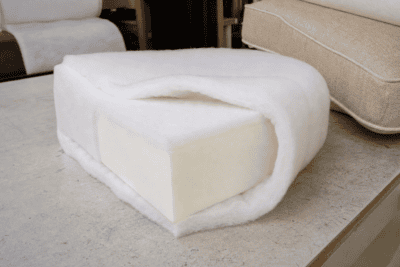
Dacron Batting: The Wrap Layer Explained (What It Does and When to Order It)
Dacron batting for cushions explained: the polyester wrap layer around foam cores, what it does for feel edges and fabric wear, thickness options, indoor and outdoor uses, and when the wrap earns its cost.
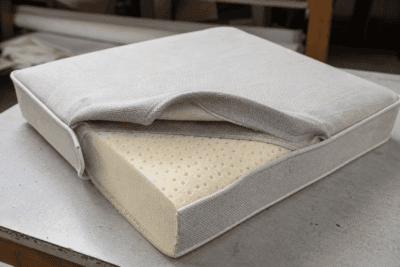
Latex Foam Cushions: Natural Rubber Seating, Honestly Assessed
Latex foam cushion guide: what natural and blended latex actually offer versus polyurethane — resilience, feel, lifespan, weight and cost — who latex seating serves, and the honest counterarguments.
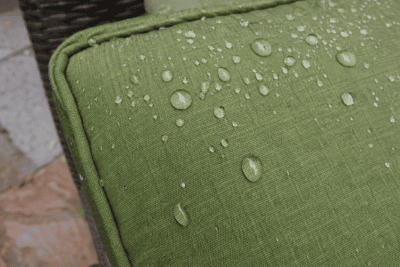
Are Waterproof Cushions Real? What Water-Resistant Actually Means
Why ‘waterproof’ outdoor cushions mostly aren’t — hydrostatic head, coated vs breathable fabrics, quick-dry foam and drainage design explained honestly.