
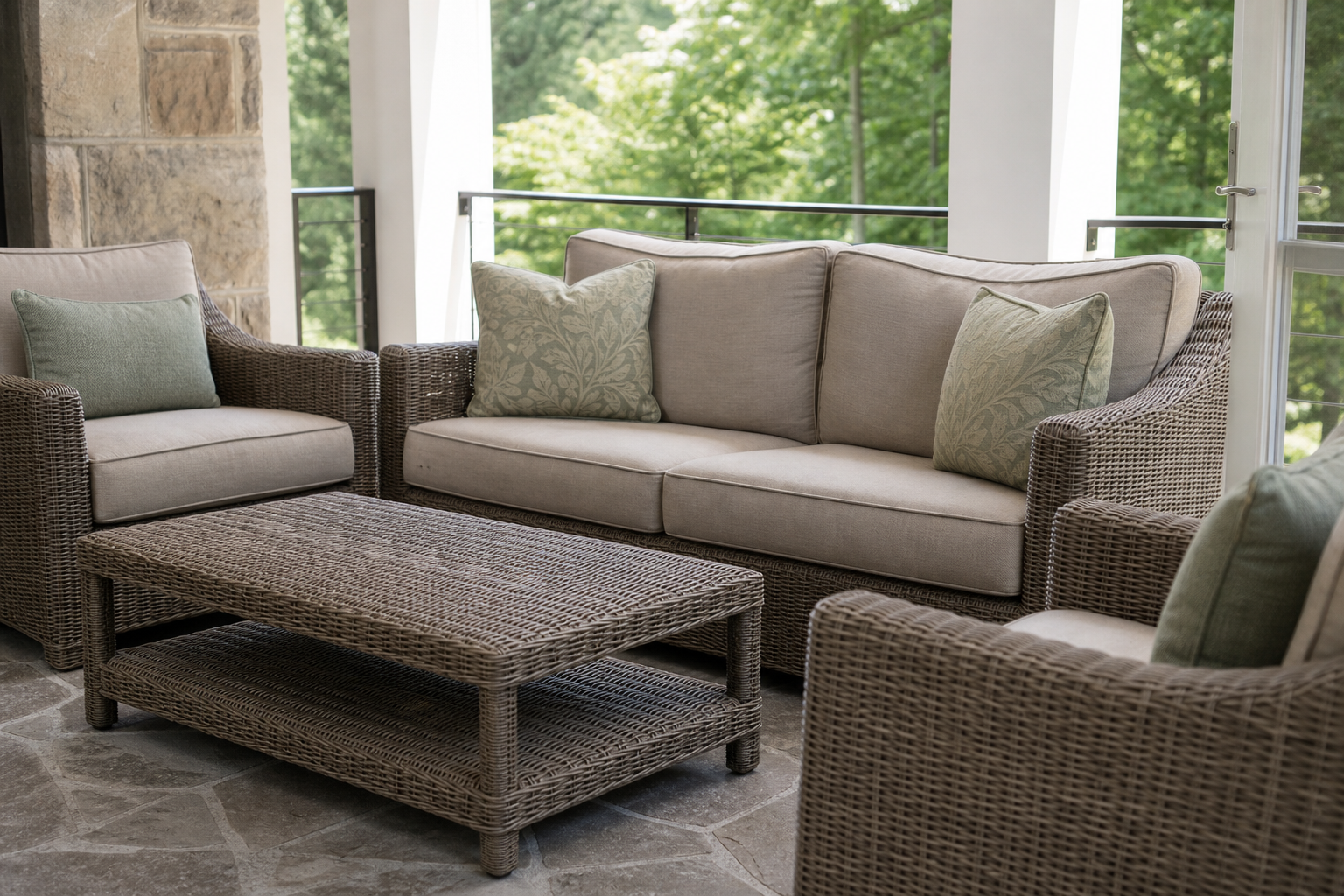
A real order from our mill log: two wicker chaise lounges, seven summers old. The cushions had faded to gray and packed flat where their owner actually sat; the woven frames were still tight, still level, still the furniture she wanted on the porch. Her order note ran six words — “curved shape, narrower at the back” — and the replacement cushions we cut from those numbers fit the weave better than the originals ever had. Re-cushioning both chaises cost about a third of what a comparable premium woven set runs at retail. This guide covers that decision — new cushions versus a new set — with the cost math by budget tier, the shapes that make wicker cushions worth ordering custom, and how to measure tapered seats and rounded corners so replacements follow the weave instead of fighting it.
Cushions or a New Set? The 30-Second Decision
If the weave is tight, the frame shows no cracks or rust, and only the fabric and foam have faded, replacement cushions win almost every time — the frame is the expensive part of the furniture, and the frame is not the part that died. Replace the whole set only when the weave or the structure itself is failing. Wicker furniture ages in two layers on different clocks: the woven frame lasts years to decades, while the cushions fade in a few seasons and flatten under regular sitting — and the checks take thirty seconds, one thumb and one look:
- Press a weave joint with your thumb. Material that flexes back is alive; material that cracks, sheds fibers or feels dry and brittle is UV-dead — no cushion fixes that.
- Sight down the seat deck. A level, unbroken weave platform carries new cushions properly; a sagging or torn deck swallows them.
- Check the frame at the legs and joints. No wobble, no rust streaks, no cracked welds or wraps — the structure passes.
- Look at the cushions honestly. Faded covers, flattened seats, mismatched replacements from three eras — all of it is cushion-layer failure, all of it fixable for a fraction of a new set.
Three passes and one fail: buy cushions. Two or more frame-layer fails: the set has earned its retirement — lifespan benchmarks by material are in how long wicker furniture lasts.
The Cost Math: New Cushions vs. a New Wicker Set
Replacement cushions for a quality woven frame typically run about $230 per chair (seat and back pair), about $320 for a full-length chaise cushion, and roughly $1,300 to re-cushion a four-chair-plus-loveseat conversation set — against roughly $350 to $1,900 for a brand-new set, depending on tier. The cushion numbers are formula prices: every cushion we cut starts from a $45 make-base plus area at per-sqft foam and fabric rates, so a 20×20×3-inch seat at 50-density foam prices out near $121 — the mechanics are laid out in how custom cushion pricing works.
The retail aisle does not mention one line: the budget set’s cushions are a hidden second decision. Two summers in they flatten exactly like the old ones did — except now the choice repeats with a whole set of furniture attached. The annual-cost arithmetic behind that trap is worked through in custom cushions vs. ready-made cost.
When Replacement Cushions Win — and When They Don’t
Replacement wins when the frame layer has years left — tight weave, sound structure, a deck that still sits level — because you are keeping the expensive layer and replacing the cheap one. A new set wins when the weave is brittle, the frame is failing, or the furniture itself is the wrong size or style for how you live now. The material facts, from our lifespan guide: woven HDPE over aluminum runs 5–10+ years outdoors, natural rattan runs 10–30+ years indoors with care, while PVC-resin weaves embrittle in roughly 2–5 seasons (lifespans by material). Match the decision to which layer died:
- Replace the cushions when: the frame passes all four checks; the cushions alone faded, flattened or mildewed; the set is a quality HDPE or rattan piece worth keeping; or you want a density upgrade — seats that packed flat in low-density fill come back as 50–60D foam that holds its loft for years.
- Buy new when: the weave cracks or sheds under a thumb press; the frame wobbles at joints re-tightening does not fix; a PVC set is seasons past embrittlement; or the layout no longer fits — nobody re-cushions their way out of a furniture-size problem.
One honest middle case: a budget PVC set with one season left in the weave. Re-cushioning furniture that is about to die is money pointed at the wrong layer — buy the new set, and this time read what its cushions are made of.
The Upgrade You Get for Free: Shapes No Catalog Stocks
Ordering replacement cushions cut to your frame buys something no boxed set offers: the taper and the curved fronts that wicker frames actually built — the quirks that make universal cushions fail become the exact numbers your cushions are cut to. Wicker bodies are woven around curving structures, so their seats are rarely rectangles. Most woven chairs and chaises run wider and straight at the front, narrower and rounded at the back — a trapezoid with softened corners, described by two widths, not one. Lay a straight-edged universal cushion on that deck and the failure modes line up: bunching at the foot edge, riding at the curve, a gap where the weave narrows.
That six-word note is the entire reason a made-to-measure shop exists for wicker. The vocabulary is small and worth knowing before you measure: a trapezoid seat (two straight widths, front and back), a bowed front (a front edge that swells outward), and corner radius (how far the corners are rounded — zero for square corners). The full field guide to those terms is in curved vs. bowed cushions.
And nothing is cut until your numbers are confirmed: dimensions sent to our mill are re-verified before cutting, and odd numbers get a phone call, not a guess. Start at custom wicker cushions for chairs and settees, or custom rattan cushions for natural-rattan pieces — the cutting is identical; what changes between indoor and outdoor is fill and fabric, not shape.
How to Measure Wicker Cushions: Front Wide, Back Narrow
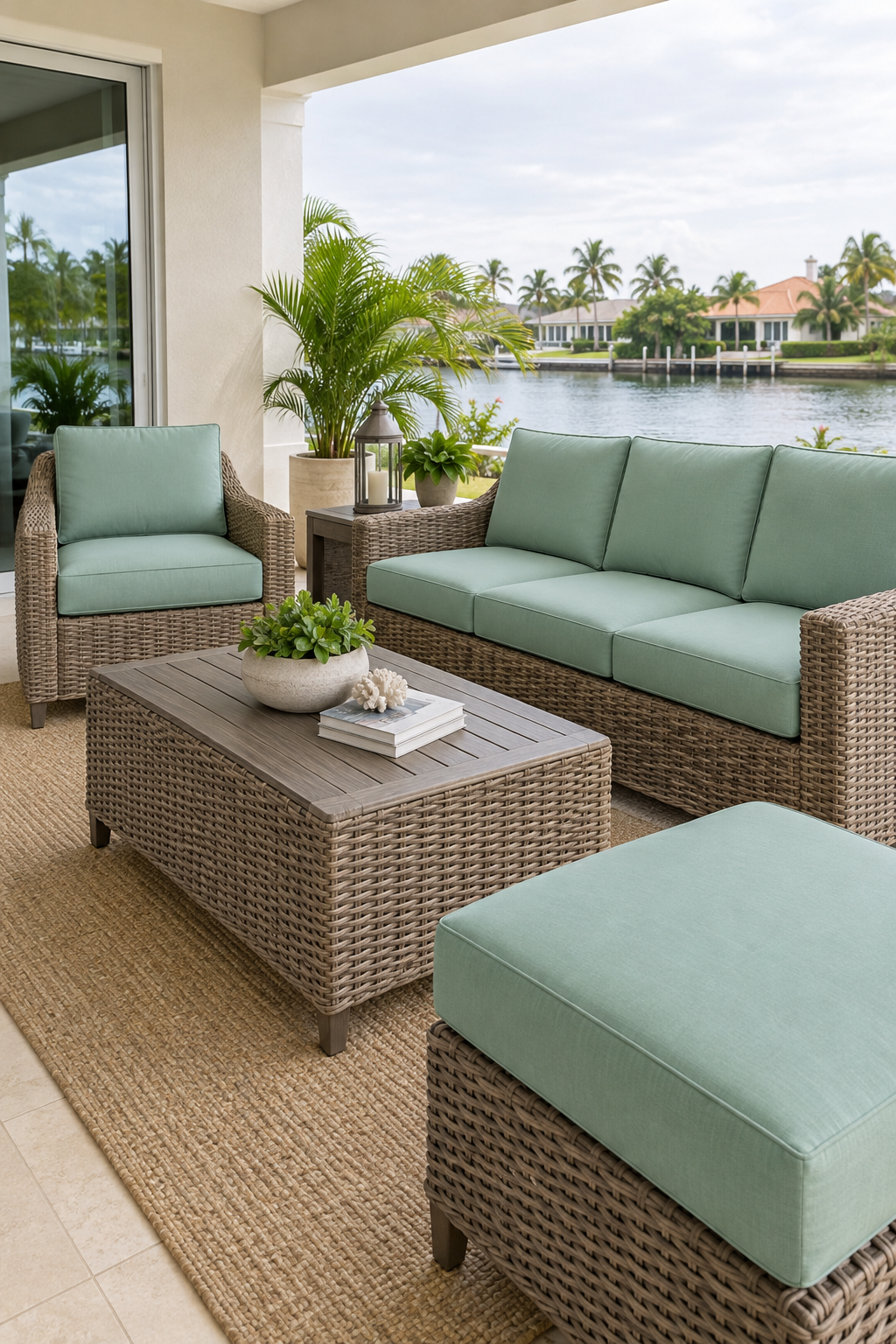
Measure the frame whenever the frame is available — measure the old cushion only when it is not — and take widths at three points down the seat: front edge, middle, back edge. If the three differ by more than an inch, you are ordering a trapezoid: front-width and back-width, both recorded to the nearest quarter inch. Old cushions lie in both directions — covers stretch wide with age, compressed foam measures thin. The frame does not lie. The method, in order:
- Front edge first — straight across. Most woven seats keep a straight line at the front. Hook the tape at one side, read the other, quarter inch.
- Back edge — follow the curve. Where the weave wraps toward the backrest, the edge is often curved or corner-rounded. Run a soft tape along the actual edge for the true length, then record the straight-line distance between the same two points — if the two differ, the back is bowed and the difference is the bow height (worked examples).
- Corners — estimate the radius. Square corners are zero. Rounded corners get a radius in inches; a coin or jar lid held against the corner gives scale. A radius guess an inch either way rarely ruins a fit; ignoring the radius does.
- Depth and thickness. Depth runs seam to seam front to back. Thickness gets measured at the edge where the seam sits — about 4–5 inches for most lounge pieces, 5–7 for deep seating, 2.5–3 for upright dining chairs.
- Multi-point check on width. Front, middle, back — three numbers, one answer. A one-width seat takes one width; a taper takes two; a severe taper takes a sketch.
Our cutting forms accept measurements down to 1/8-inch increments, so record to the nearest quarter inch and stop — do not “add a little for comfort,” the mill does any necessary easing. The full outdoor measuring walkthrough is here, and the mistakes that cause remakes — stretched covers, guessed radii, skipped middle widths — are collected in cushion measurement mistakes.
Chaise lounges get one extra discipline: their long decks taper most of all, and many change thickness between seat section and backrest. The shape logic for woven chaises is in wicker chaise cushions; orders start at custom wicker chaise cushions.
Frequently Asked Questions
How much do replacement cushions for wicker furniture cost?
About $121 for a single 20×20×3-inch seat at 50-density foam, about $230 for a full chair (seat and back pair), and roughly $1,300 to re-cushion a four-chair-plus-loveseat conversation set — priced by formula: $45 make-base per cushion plus area at per-sqft foam and fabric rates. Exact numbers scale with your dimensions and density; the mechanics are open in custom cushion pricing explained.
Is it worth replacing cushions on an old wicker set?
When the frame passes the thumb, deck and joint checks — yes: an HDPE-over-aluminum frame commonly holds 5–10+ years outdoors, so you are re-cushioning a frame with most of its life left, at a fraction of replacement cost. Brittle weave or a wobbly frame puts the money on a new set instead (lifespan benchmarks).
Will universal cushions fit wicker furniture?
Only on upright dining chairs in the 19–21-inch range — wicker conversation seating runs seats 22–28 inches wide by 23–27 deep with 4–7-inch back pillows, sizes the universal aisle does not stock, before the taper even enters the picture. The size ranges are documented in standard cushion sizes charts.
How do I measure a wicker seat that is wider at the front?
Three widths — front, middle, back, each to the nearest quarter inch — then order by front-width and back-width: that seat is a trapezoid, and a trapezoid cut to both widths drops onto the frame with no bunching and no gap. The five-step method, with curved back edges and corner radii, is in the measuring section above.
Does rattan vs. wicker change how I order?
No — shape and measuring are identical; what changes is environment: natural rattan indoors takes standard foam and any fabric family, while exposed outdoor wicker argues for quick-draining foam and solution-dyed covers. Order pages for both lines: custom rattan cushions and custom wicker cushions.
How long do replacement wicker cushions take?
Made to order in 4–7 business days, with 3–5-day rush available — 3–6 weeks delivery door to door, because the mill ships direct rather than routing through weeks-long US custom-shop queues. Nothing is cut until your dimensions are confirmed against the order.
Next Steps
- Run the four frame checks — thumb press, deck sight, joints and legs, honest look at the cushions. Three passes means the set stays; the lifespan detail is in how long wicker furniture lasts.
- Measure the frame at three widths plus corner radius, quarter inch, per the method above — chairs and settees at custom wicker cushions, chaise lounges at custom wicker chaise cushions.
- Quote the set in one run — every cushion cut together shares density, loft and dye lot: build your cushions. A real person confirms your numbers before anything is cut.
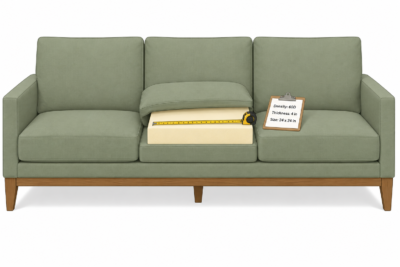
Couch Cushion Foam Replacement: Density, Cost and Buying Guide
Replace couch cushion foam in one right order: 50D vs 60D density, measuring the old core, four ways to buy, and real worked prices for one seat and a full set.
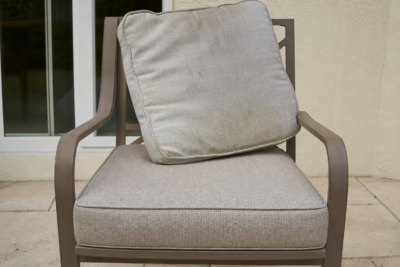
Where to Buy Replacement Patio Cushions: 5 Ways, Compared
Five ways to replace patio cushions — the set maker’s parts program, seasonal aisles, universal-fit listings, specialists and measured custom — plus the Home Depot house-line route with 31 measured collections.
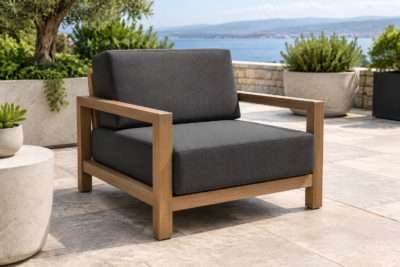
Why Is Patio Furniture So Expensive? The Cost Anatomy, Explained
What actually drives patio furniture prices — weatherproof materials, UV-stable finishes, marine-grade hardware, freight on bulky goods, and seasonal retail economics — why the good stuff costs 3-5x the box-store set, and where the value concentrates.
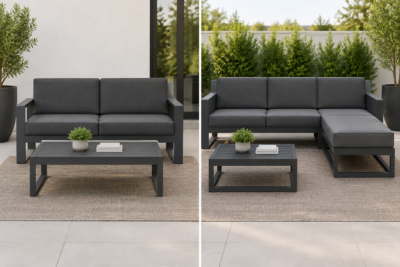
Patio Set vs Buying Separately: The Real Trade-offs
Buying a complete patio set versus assembling pieces: price coherence and one-click convenience versus fit-to-space precision, mixable quality and replacement flexibility — how to decide, and the hybrid strategy that captures both sides.
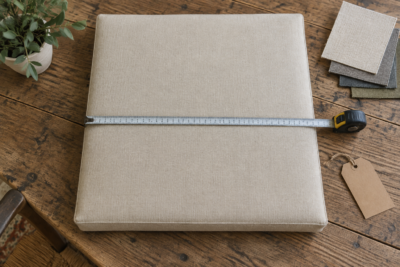
How Much Do Custom Cushions Cost? Price Ranges by Shape (2026)
Custom cushions cost USD 50-400 depending on shape, size, density and fabric. Live factory-direct price ranges for bench, window seat, outdoor, sofa and boat cushions — and how to price your own.
Outdoor Cushion Foam: Density and Thickness Guide With Real Numbers
Short answer: for a daily-use outdoor seat, order 3 inches of foam at 50D–60D; move to 4 inches and 60D