
Nobody sets out to subscribe to cushions. It happens one replacement at a time: the patio pads flatten after their second summer, the entryway bench pad goes thin, the dining chair set gets “just one more season” — and every year or two the same cart gets built again at the same big-box aisle. That is the structure of a subscription: a small recurring payment, renewed automatically by inertia, for a product designed to need renewing.
The honest way to price a cushion is not what it costs at the register. It is what it costs per year of sitting on it. Run that arithmetic on both sides of the aisle — the $25–45 universal pads and the made-to-measure cuts — and the picture inverts: a $30 pad is a one-season subscription; a $109 cut is a five-year purchase. This guide runs the full math, with the lifespan evidence, so the next replacement cart is a decision instead of a reflex.
The Cheap Pad Is Engineered to Be Replaced
The universal cushion aisle has a build recipe, and it is not a secret: a fiber fill (polyester batting, sometimes a thin low-density foam slab) inside a printed cover, cut to the sizes that fit the most common frames tolerably. None of that is a durability decision. Fiber packs flat under load — the physics is the same as a pillow, and a seat takes a pillow’s worth of compression every single sitting. Low-density foam holds its shape for a couple of years of light use at best; it sets, dishes, and stays dished.
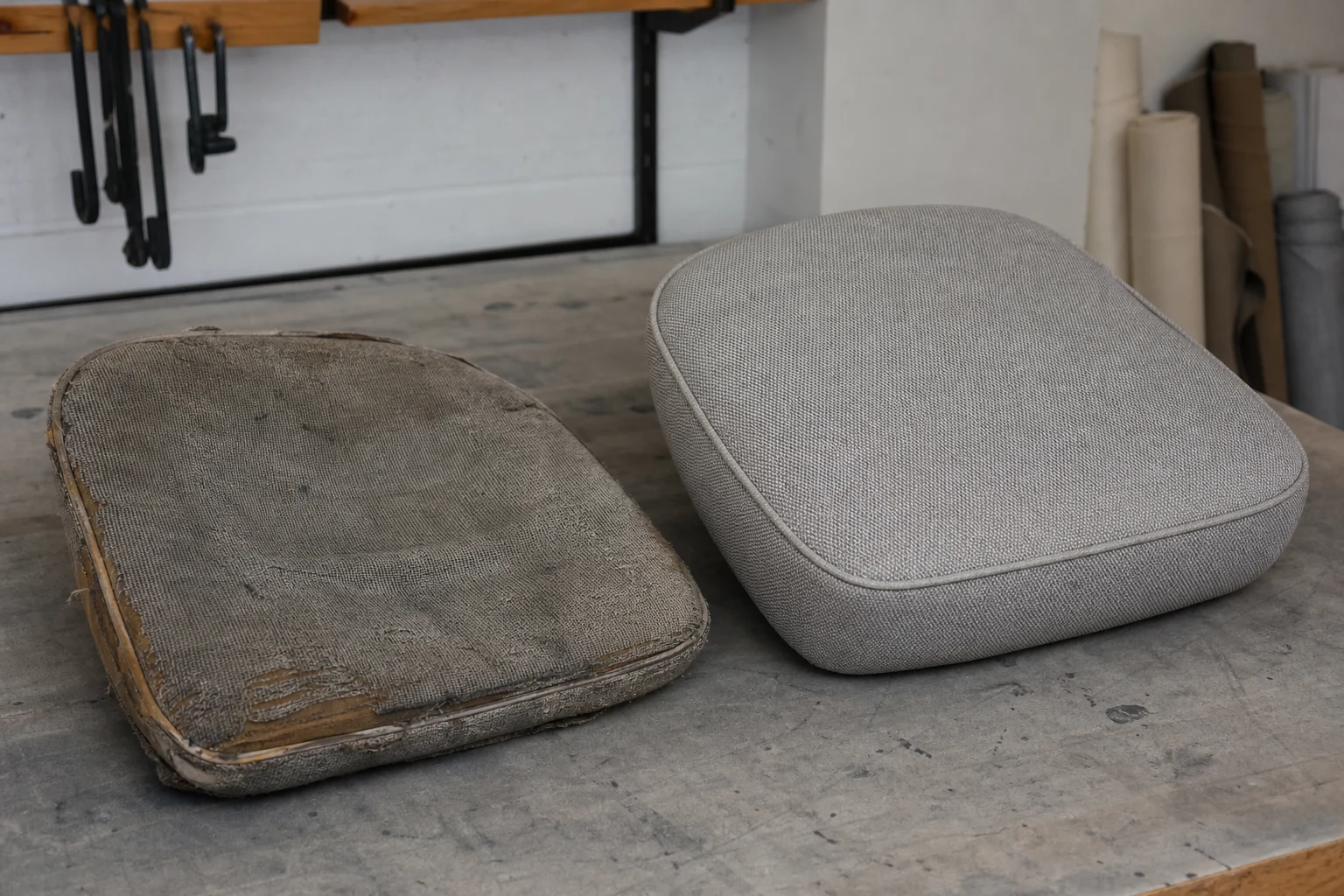
The lifespan benchmarks from our replacement guides are blunt about it: a quality build — 35D+ foam core, solution-dyed fabric — lasts 5–10 years, where a cheap pad lasts 1–2 seasons (how long outdoor cushions last); low-density foam sets in a couple of years while 50D+ takes a decade (custom vs standard cushions). The cheap pad is not a worse version of the good one. It is a different product with a different job — and its job is the reorder.
The Subscription Math, Line by Line
Take the standard universal pieces and amortize them at their real replacement rates:
| Cushion | Big-box price | Real lifespan | Annual cost |
| Dining chair pad (universal) | $25–45 | 1–2 seasons | $13–45 / yr |
| Bench pad (3 fixed lengths) | $20–60 | 1–2 seasons | $10–60 / yr |
| Patio seat pad (fiber fill) | $15–35 | 1–2 seasons | $8–35 / yr |
| Seat-and-back chair set | $30–60 | 1–2 seasons | $15–60 / yr |
Two things the table is saying. First, the annual cost of the cheap lane is not small — a six-chair dining set on universal pads runs $75–270 a year, every year, quietly. Second, the spread inside the lane barely matters: whether you buy the $25 pad or the $45 pad, the fill physics is the same and the calendar is the same. Paying up inside the disposable lane buys color and cover fabric, not years.
Now the same arithmetic on the custom lane, at our published formula prices ($45 make-base + area × fabric-tier rate, pricing explained):
| Cushion | Custom cut price | Expected lifespan | Annual cost |
| Dining chair pad, 18 × 18 × 3, 50D | $73–78 | 7–10 yr | $8–11 / yr |
| Bench pad, 48 × 18 × 3, 50D | $131–144 | 7–10 yr | $13–21 / yr |
| Sofa seat block, 24 × 24 × 5, 50D | $108–117 | 7–10 yr | $11–17 / yr |
| Foam-only refill for a cover you keep | from $42 + foam rates | 7–10 yr | from ~$6 / yr |
The two lanes cross fast. On a single dining pad the custom cut pays its difference back inside roughly two replacement cycles and then runs at a discount for years — and the refill lane (new foam into a sound cover) undercuts both. The full decision framework, including when standard sizes genuinely win, is in custom vs standard cushions.
Why the Custom Lane Gets Cheaper the Longer You Sit on It
The annual-cost crossover exists because the two products age differently, and the reason is the one spec the cheap lane never publishes: foam density. Density is lifespan — the same cell structure that gives 50D+ foam its instant rebound is what resists compression set, which is why a 50D core holds its loft for a decade while a low-density slab dishes in a couple of years (high-density foam guide).
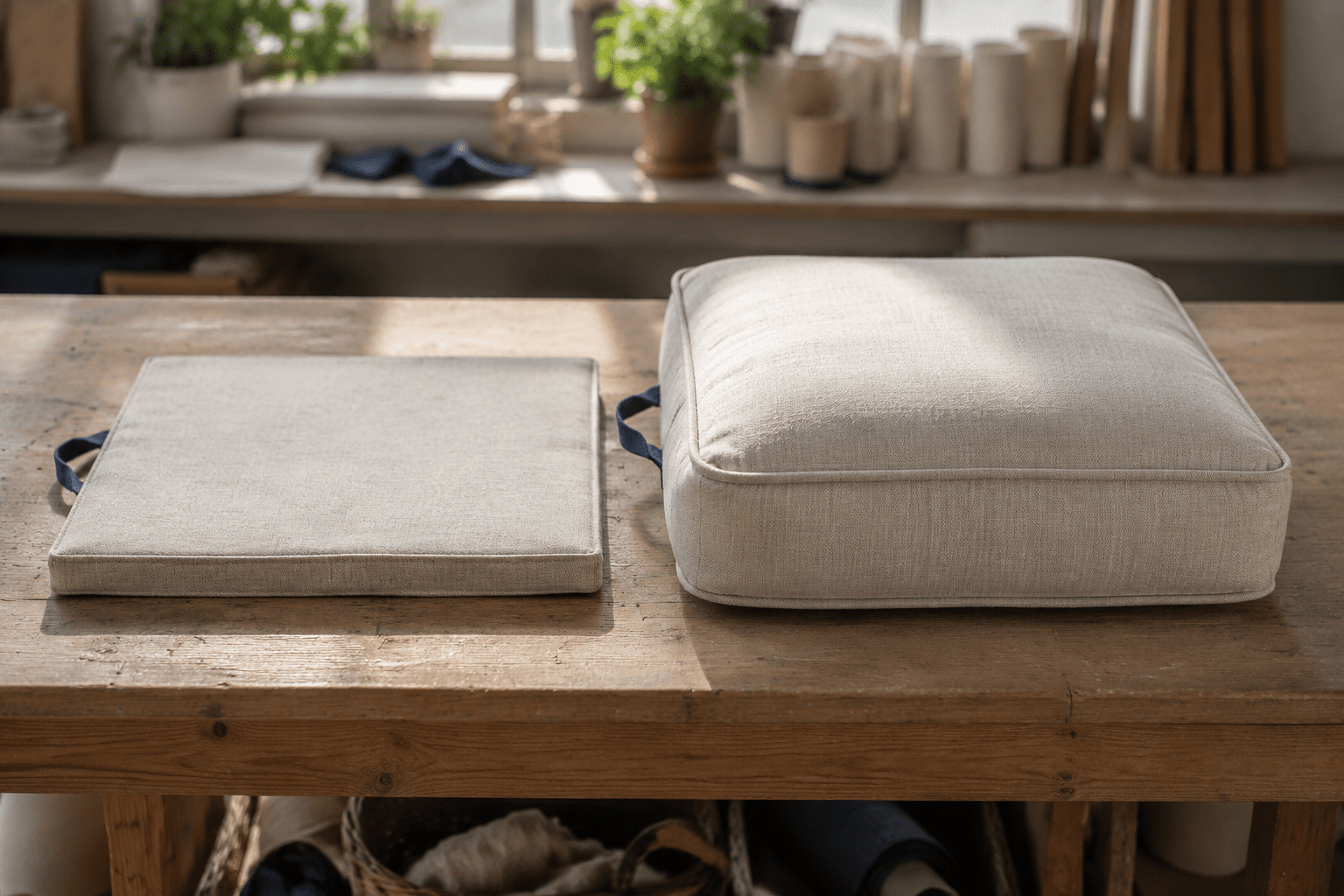
The honest framing from our comparison guide applies to the price tags too: standard and custom are not two qualities of the same product — they are two different products, and the annual cost is where the difference stops hiding. The universal pad sells fit-tolerably, replace-often. The custom cut sells fit-exactly, replace-once. Comparing their register prices is comparing a subscription’s monthly fee to a purchase’s total — the number that matters is what you pay per year of a cushion that still works.
Three structural advantages compound on top of the density math:
- – Fit that stops the collateral costs. An almost-right pad slides, gags at the arm, and gets yanked straight by everyone who sits down — tie strain and seam strain are the failure accelerators a cut-to-measure pad simply does not have.
- – The layer survives separately. A custom build is a foam core in a sewn cover; when the cover finally tires, the core is reusable and the cover is a re-covering job — not a whole-pad purchase. The disposable pad is one fused unit and dies as one.
- – One order, one dye lot, one fit. Replacing pads piecemeal as they die guarantees mismatched colors and lofts. The buy-once order ships matched — which is a comfort difference, not just an aesthetic one.
When the Subscription Is Actually Rational
The cheap lane is not a scam; it is the right product for three situations. Be honest about which one you are in:
- The furniture is temporary. A rental season, a staging stint, a bench that will not survive the move — the pad should not outlive the frame, and the disposable lane prices that correctly.
- The exposure is brutal and short. Full-sun, uncovered, salt-air duty kills even premium fabric in a few seasons; if the setting is a few months of hard use and then done, the cheap vs quality trade can honestly land on cheap.
- The sitter count is near zero. A decorative bench sat on six times a year is not loading fiber into failure; the $20 pad there runs at a dollar a year and the arithmetic holds.
The subscription becomes irrational exactly when the sitting becomes regular — daily dining chairs, the entryway bench, the couch. That is where the annualized numbers above come from, and where the next section’s comparison decides the aisle for you.
The Comparison Table: Subscription vs Purchase
Both lanes side by side, annualized, using the benchmarks above:
| Big-box universal pad | Custom cut (made to measure) | |
| Register price | $15–60 | $73–190 by area |
| Fill | Fiber / low-density slab | 35D–65D foam core |
| Real lifespan | 1–2 seasons | 5–10 years |
| Annual cost (typical seat pad) | $13–45 | $10–15 |
| Fit | Tolerably, on average frames | Exactly, on your frame |
| End-of-life | Whole pad to the bin | Cover and core separately |
| Reorder drag | Every 1–2 seasons | Once a decade |
Read the two bolded rows together: on a per-year basis the custom lane is already cheaper than the middle of the subscription band — before counting fit, matched sets, or the decade of not shopping for cushions again. The crossover point is roughly two replacement cycles on most pieces; after that the subscription is pure loss.
FAQs
How often do cheap cushions need replacing?
Every 1–2 seasons under regular use — fiber fills pack flat and low-density foam takes a compression set it does not recover from. The evidence and the failure modes: when to replace outdoor cushions.
How long do custom cushions actually last?
5–10 years for 35D+ cores in normal duty; 50D+ cores hold shape toward a decade. Density is the lifespan spec — the grading logic is in high-density foam for couches.
Is the custom cushion worth it for one chair?
The smaller the piece, the faster the crossover — a single $73 dining pad beats the subscription inside two cycles. Bench and sofa blocks take longer to pay back but still cross well inside their lifespans.
What if my covers are still good — do I need full custom cushions?
No: the refill lane is the cheapest annual cost on this page. Foam-only cores cut to your cover’s interior restore the seat at foam rates — the method is in sofa foam cut to size.
Do custom cushions cost more upfront?
Yes — always. The claim here is annual cost, not register price: $73–190 at order against $15–60 at the big box, amortizing to $10–15 a year against $13–45. The full price anatomy: custom cushion pricing explained.
Next Steps
- Count the replacement cycles you have actually run on the piece in question — that count, times the register price, is your subscription payment to date.
- Measure the deck (edge to edge, quarter inch) and pick the lane it points to: exact fit at the custom cushions builder, or the honest standard sizes typed into the same calculator.
- Browsing by piece instead? The custom seat cushions, custom bench cushions and custom sofa cushions pages carry the per-piece pricing tables — every one of them runs on the same annualized math as this guide.
Every cushion on this site is cut and sewn by the Cushion Mill workshop — ten-plus years at the cutting table, and every measurement confirmed in writing before anything is made.
Etsy Custom Cushions: What the Platform Does Well — and When a Cushion Workshop Is Better
An honest comparison of ordering custom cushions on Etsy versus a dedicated cushion workshop — maker fit, pricing transparency, fabric sourcing, tolerances, lead times and remake policy — and how to decide which channel your project belongs in.
Sofa Foam Cut to Size: How to Order Exact-Fit Foam
How to order sofa foam cut to size — measuring the core, adding the compression allowance, specifying density, thickness and shape, and the checklist to run before any foam is cut.
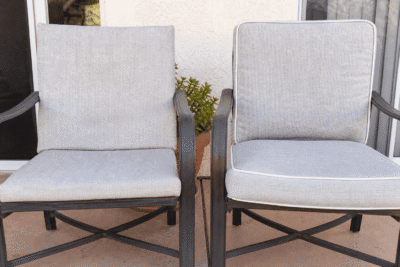
Cheap vs Quality Outdoor Cushions: Where the Money Actually Goes
What separates a $15 cushion from a $60 one and a $150 one — fabric construction, fill, stitching and covers — which upgrades matter, which are markup, and how to buy the quality your furniture actually needs without overpaying.
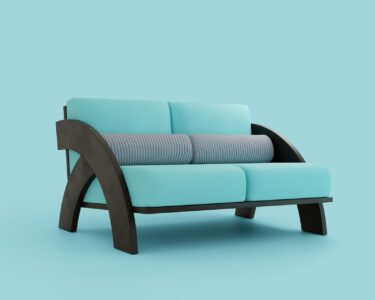
Couch Cushion Foam Inserts: Measure and Order New Cores
A foam insert replaces the flattened core inside the covers you already own. Measure seam to seam, pick 60D seats and 50D backs, and price the set in one order.
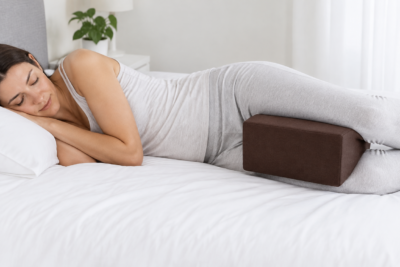
Knee Bolsters for Side Sleepers and Back Sleepers: A Firm Support Guide
A firm half-round D bolster fills the gap between the knees for side sleepers and under both knees for back sleepers. Heights, densities and lengths explained — positioning and comfort, made to order.
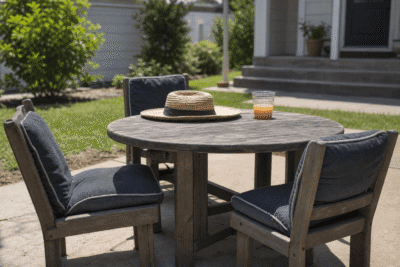
Kid-Friendly Patio Cushions: The Family-Proof Spec
Cushions that survive children — fabric families that shrug off juice and markers, construction that wipes fast, foam that handles jumping duty, attachment systems that stay put and stay safe, and the two-layer strategy that saves the good cushions.