
“Wicker chaise cushions” sounds like a rectangle with a fabric problem — until you lift the old pad off the frame. Most woven chaises taper: wide and straight where your feet go, narrower and curved where the weave wraps the backrest. This guide covers the shape, the four measurements that describe it, the thickness options, and the sizes woven frames actually run — the same numbers we ask for when cutting custom wicker chaise cushions.
What Shape Is a Wicker Chaise Cushion?
Most wicker chaise cushions are a tapered pad: one long edge straight (the front, at the foot end), the other long edge curved and narrower (the back, at the backrest). Lay the old cushion flat and look straight down at it — if the foot end is a clean straight line and the head end bows inward, you have the classic profile. Some woven chaises keep both edges straight but different widths; a few run fully rectangular. The shape comes from the frame, not the cushion: wicker bodies are woven around a tapering structure, and the cushion follows the weave or fights it.
That’s why universal “fits most chaises” pads disappoint on woven frames specifically. A rectangular pad on a tapered deck bunches at the foot edge, rides up at the curve, and leaves a visible gap where the weave narrows. The fix isn’t a better rectangle — it’s a cut with two widths.
Three profiles cover nearly every woven chaise we see: straight-front / curved-back (the classic, and the most common by far), straight-front / straight-back at different widths (a true trapezoid, common on tighter patio-set lounges), and full rectangle (rare on wicker, standard on metal and teak). Identify yours before touching a tape measure — each one changes which numbers matter in the next section.
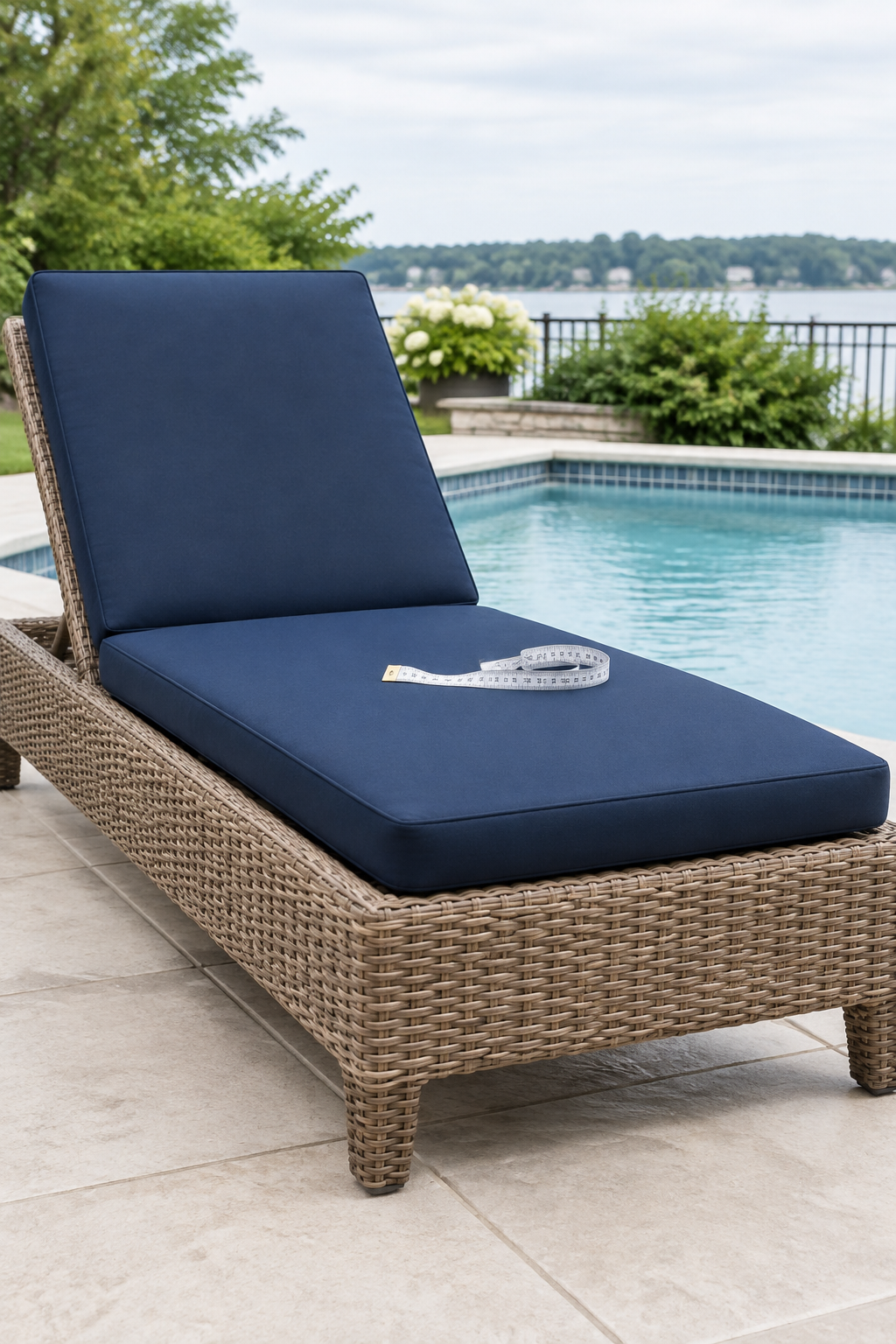
How Do You Measure a Wicker Chaise Cushion?
Measure four numbers, in this order, with the old cushion flat on a table — never on the frame: front width along the straight edge, back width along the curve, depth front-to-back, and thickness at the side seam. The order matters because each measurement tells you where to put the tape for the next one.
- Front width — along the straight edge. The foot end of a woven chaise is almost always a clean straight line. Run the tape edge to edge, seam to seam, and write that number down as “front.”
- Back width — along the curve. At the backrest end, the edge bows. Follow the arc of the curve with your tape at its widest span, and record the distance between the two back corners.
- Depth — front edge to back edge. Measure at the center of the pad, straight down its length. This is the distance the taper travels.
- Thickness. Measure at the side seam. If the pad sits thicker at the front than the back, take both numbers — see the tapered-thickness section below.
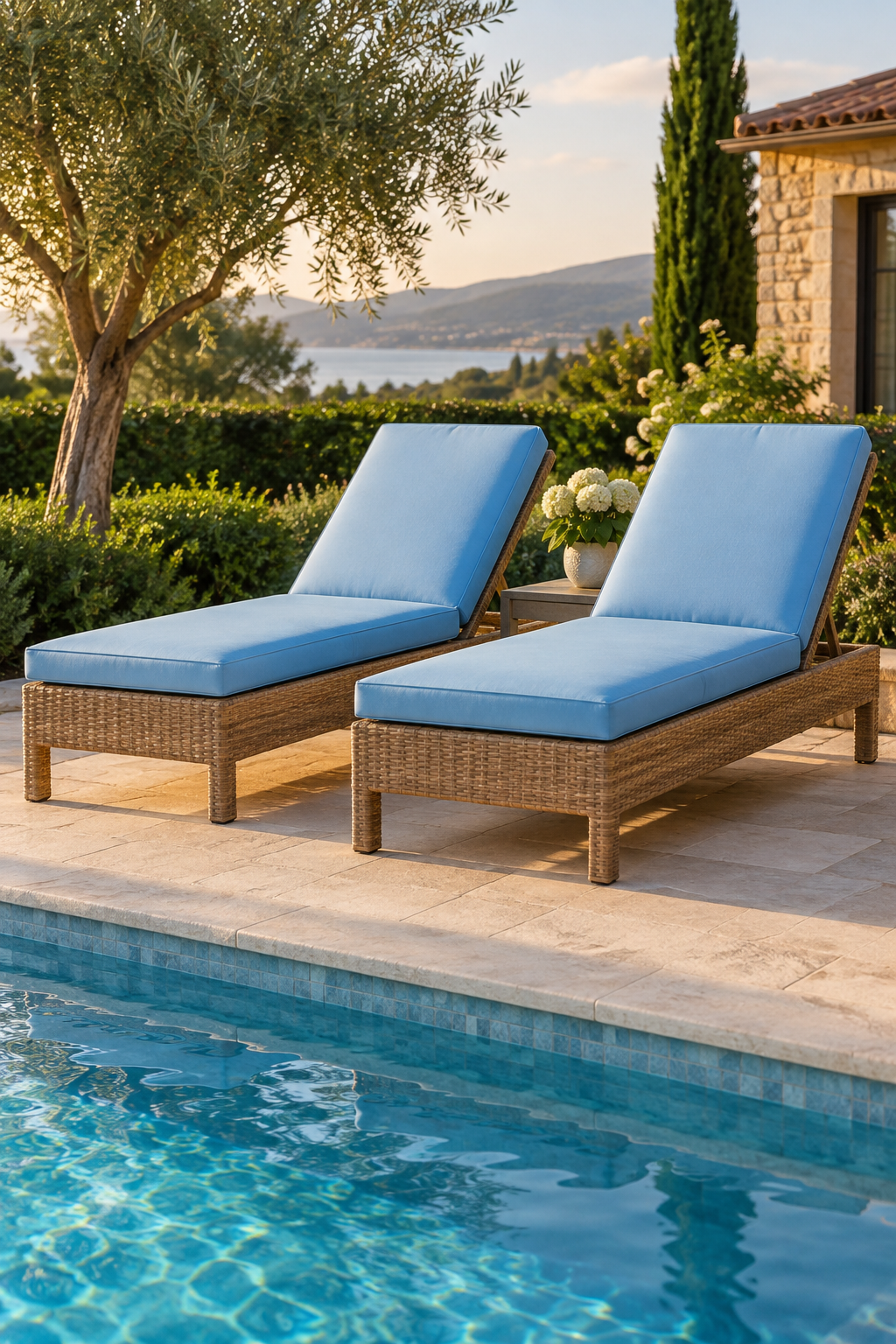
Those four numbers describe any tapered chaise cushion completely. Photo walkthroughs of each step live in the measurement guides.
“My Cushion Looks Like a Trapezoid — Did I Measure Wrong?”
No — a trapezoid silhouette is the correct, factory-original shape for most woven chaises, not a measuring error. This is the single most common message we get about wicker chaise cushions.
One customer wrote in recently, tape measure in hand, worried her numbers couldn’t be right: the front of her pad measured 19 inches straight across, the back only 16 along the curve, with 19 inches of depth between them. Three widths that don’t match feels like a mistake when every size chart you’ve ever seen is “W × D.” It isn’t a mistake — it’s the classic wicker profile: front 19″ straight / back 16″ curved / 19″ deep is a textbook tapered deck, and the replacement gets cut with both widths held exactly.
The same confusion shows up in reviews of universal pads everywhere: “fit fine except the top” is what a trapezoid frame does to a rectangular cushion. If your two widths differ by two inches or more, no single-width pad will ever sit flat — order a cut that takes both numbers.
How Do You Measure Along a Curved Back Edge?
Follow the widest span of the arc, corner to corner, letting the tape ride the curve — and if the curve is deep, add a second “rise” measurement from the chord to the peak of the bow. Two practical methods:
- Corner-to-corner along the arc. Anchor the tape at one back corner, sweep it along the belly of the curve to the other corner. This “arc width” is the number most frames want.
- Chord plus rise, for deep bows. Measure straight across the two corners (the chord), then measure how far the curve pushes out from that line (the rise). With chord, rise, and depth, a sewer can rebuild the exact arc.
Don’t stretch the curve flat and don’t measure the frame instead of the pad — the weave sits proud of the cushion line, and frame-measured widths run a half inch or more large on woven chaises.
One more habit worth keeping for every measurement on this page: read the tape at its widest honest point, not the widest flattering one. A front edge that “must be 22” because the size chart says so is how a 21.5-inch deck ends up with a pad that slides. Quarter-inch honesty beats round-number optimism — good cushion factories hold a ±½″ tolerance, and they can only hold it if you feed them real numbers.
Can the Cushion Be Thicker at the Front Than the Back?
Yes — tapered thickness (thicker at the seat, thinner at the back) is a standard build on woven chaises, typically 5 inches at the front tapering to 3 at the back. Better wicker chaises weave a rising back into the frame, and a wedge-cut cushion keeps your hips level and your eyes on the horizon instead of tilted at the backrest.
When ordering, give both thicknesses and which end is which. A pad cut 4″ flat where the frame wants 5″-to-3″ feels like a hammock; the wedge is the difference between a cushion that sits on the frame and one that disappears under you. On our wicker chaise page, tapered thickness is a checkbox, not a custom-quote conversation.
What Are Common Wicker Chaise Cushion Sizes?
Woven chaise decks cluster around a handful of profiles — but with two widths each, which is why “standard” size charts keep failing them. These are the ranges we cut most:
Use the table to sanity-check your tape work, not to replace it — two frames with the same label can differ by inches. When your numbers land inside these ranges, a made-to-order wicker chaise cushion in your exact sizes costs no more than the closest standard guess.
On one-piece hinged pads, add a fifth number: the hinge position, measured from the left edge of the cushion to the fold line. The “47/27” and “48/32” you see on universal-pad listings are exactly this — 47 inches of seat to 27 of back on a 74-inch pad, for instance. If your old one-piece cushion folded at a different spot than the listing’s, the universal pad folds where your frame doesn’t. A made-to-order cut puts the hinge where yours actually is.
Wicker Chaise vs Standard Chaise Cushions: Which Do You Need?
If your frame is metal, plastic, or teak — or a woven frame with straight, equal-width edges — a standard custom chaise cushion is the simpler order. If the frame is wicker or rattan and the pad tapers or curves, order the wicker chaise cut.
The practical split: standard chaise cushions are built around seat length, hinge position, and one width — perfect for rectangle decks. The wicker chaise build starts from the two-width taper and the curve, with tapered thickness in the mix. Ordering the standard cut for a tapered frame means the fit problems you’re replacing; ordering the tapered cut for a rectangle frame is just extra numbers for nothing. Related reading: the weave itself affects how frames age — see how long wicker furniture lasts — and matching fabric rules live on the wicker chair cushions page.
FAQs
Do wicker and rattan chaise cushions measure differently?
No. Natural rattan and resin wicker frames take the same four measurements — front width, back width, depth, thickness. The weave material changes the fabric you’ll want, never the cut.
My old cushion is gone — can I measure the frame?
Yes, with one rule: measure the flat deck between the woven rails, not across the outside of the weave, and expect frame numbers to run slightly large. Photos of the frame help us flag this before cutting.
Should I order one-piece or a seat-and-back set?
One-piece pads suit adjustable lounges where the hinge folds; two-piece sets suit fixed-back frames and stack-hole corners. Both builds take the same measurements on a woven frame.
How close to my numbers will the cushion actually be cut?
A factory holding ±½″ (±¾″ on runs over 36″) is the benchmark to expect — and every dimension should be re-checked against your order before fabric is cut, not after sewing. Ask what happens when a cut misses tolerance: remakes should be on the maker, not a negotiation.
Types of Wicker Materials: Natural, Resin and HDPE Compared
Every wicker material family ranked — rattan core, paper fiber, bamboo, willow and reed on the natural side; PVC-resin and woven HDPE on the synthetic side — with outdoor ratings, lifespans and what each means for cushions.
Patio Chair Cushions: The Complete Buying Guide (Outdoor Too)
Everything that decides a patio or outdoor chair cushion — sizes, thickness, ties, fabric tiers and where each buying route wins. Custom from $45 when grids fail.
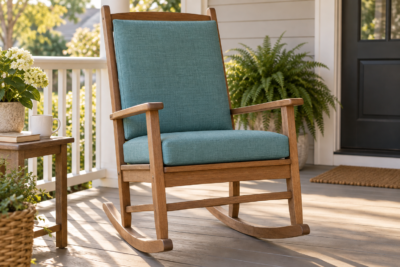
Outdoor Rocking Chair Cushions: The Weatherproof Guide to Sizes and Fabrics
An indoor rocking cushion dies fast on a porch. The sun bleaches the print in a single season, the foam
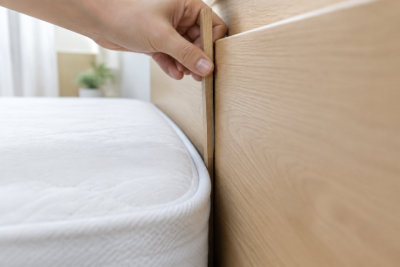
What Size Bed Gap Filler Do I Need? Thickness, Length and Density
Size a bed gap filler from three measurements, not the bed’s name: thickness equals gap width plus half an inch to one, length runs the full seam, height runs platform to mattress top. Density starts at 50D.
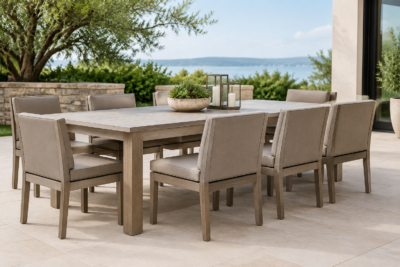
Cushion Thickness & Seat Height: Match the Pad to the Table
Cushion specs usually answer comfort questions. Thickness answers a geometry question: how high off the floor you end up sitting,

Outdoor Furniture Deep Seat Cushions: Fit by Seating Type
“Deep seating” is the label patio makers put on anything with a seat deeper than about twenty inches — and