
“10 minutes of rain, 5 days to dry.” That line has been posted in patio-cushion threads on Reddit for years, and most people read it as a complaint about the weather. Read it again, slowly. Ten minutes of rain is a passing shower. Five days of drying is not a weather event — it is a materials event. The rain ended in ten minutes; the cushion kept the water for five days. What that line actually documents is not how hard it rained, but how thoroughly a sewn cushion traps water once it gets in.
The same shower hitting the same chair with a different cushion inside can be dry by evening. That is the whole mystery this article unpacks: the death of a patio cushion is not caused by rain. It is caused by water that enters faster than it can leave. Below is the step-by-step physics of how one soak kills a cushion — the entry points, the capillary trap, the 72-hour mold clock — and a time-based triage framework for the cushion that is sitting outside, wet, right now, while you decide whether it is a rescue job or a replacement job.
The Short Answer: Cushions Don’t Die From Rain, They Die From Trapped Water
A sewn cushion is three layers doing three different jobs with water, and only one of them is the villain:
- The face fabric — solution-dyed acrylic and coated polyesters shed most falling water and dry in a few hours. The fabric is almost never what kills a cushion. Its real flaw is slower: it holds surface moisture against the seams, feeding water to the needle holes instead of letting it run off clean.
- The stitched seams — every seam is a row of perforations punched through the water-resistant face, and the zipper exists so you can wash the cover. Neither can be sealed in a sewn product. They are the permanent doors.
- The foam core — this is where the five days live. Standard polyurethane foam is a network of tiny, mostly closed cells that pull water in by capillary action and hold it against gravity. Saturate it once and it becomes a sealed water bottle wearing a jacket.
Notice the asymmetry, because it explains everything that follows. Water gets in fast: gravity, wind pressure and capillary wicking working together, minutes. Water gets out slow: evaporation and diffusion through a maze of dead-end cells, days. A cushion is ruined not when water arrives but when the out-door is too small for the in-door — and in standard foam, it is roughly a hundred times too small.
The Timeline: How a Cushion Actually Dies
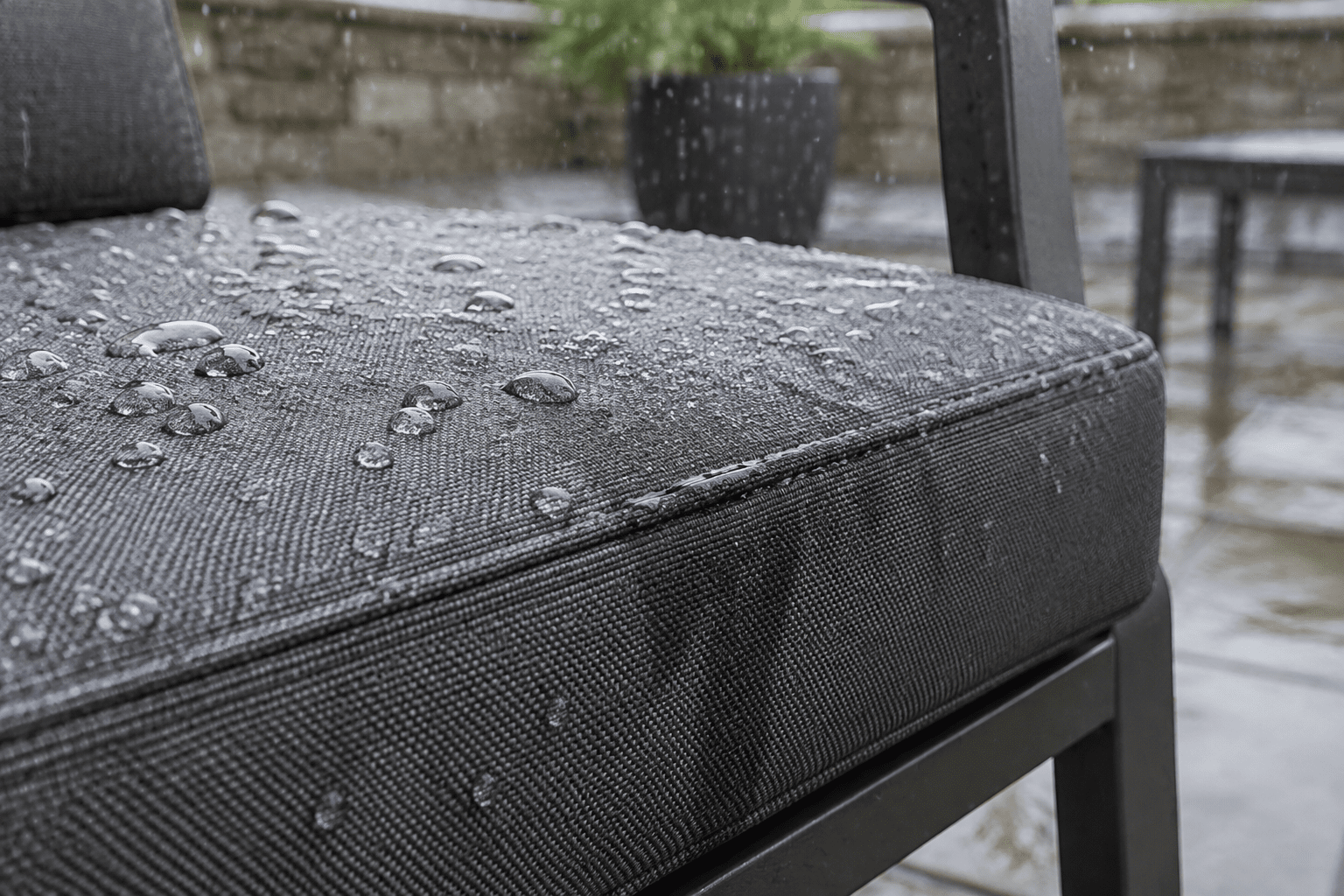
From the first raindrop to the day the cushion goes in the trash, the failure follows a fixed sequence. Where your cushion sits on this timeline decides what rescue is still possible — which is why we give the rescue framework further down in clock terms, not symptom terms.
- 0–10 minutes: surface saturation, seams open for business. The face fabric beads and sheds, but the stitch lines stop shedding immediately. Water ponds in the seam channels and starts walking through the needle holes; the zipper and the underside wick from whatever they touch. The doors are open within minutes.
- 10 minutes–1 hour: the core drinks. Once past the fabric, water meets the foam, and capillary action pulls it inward and downward through the cell structure. A seat cushion can hold a startling volume this way — a saturated 4-inch core takes on water by the pint, and no amount of surface dabbing touches it.
- 1–24 hours: the deceptive dry. Here is the stage that fools everyone. The fabric dries in 2–4 hours of breeze, the cushion looks and feels dry on the outside, and the core is still fully saturated underneath. Owners put the cushions back on the chairs at this stage — which is exactly like zipping a wet towel inside a plastic bag and calling it laundry.
- 24–72 hours: the mold clock runs. Mold spores are always in the air and always land on cushions; what they wait for is standing time in trapped moisture. Roughly 72 hours of sustained dampness inside the core is the established window for spores to germinate and colonize. A saturated standard-foam core in still air delivers that window precisely — the fabric being “dry” is irrelevant, because mold in the core feeds on the moisture in the core.
- 3–7 days: visible colony. The first gray-black dots appear at the seams and corners, and the musty smell arrives — the volatile compounds mold releases as it digests. From the factory side, this is what water-damaged returns look like when they come back to us: the smell almost always shows up before the stains do.
- 2–4 weeks: structural ruin. Persistent moisture and microbial action start breaking down the polyurethane itself. The foam loses resiliency — press it and the dimple stays — cells collapse, the cushion compacts unevenly, and edges crumble when flexed. This is the stage nobody reverses. Dry it, clean it, wish on it: the foam is chemically changed and the cushion is dead weight with a cover.
Read the timeline again and one thing jumps out: the cushion was effectively lost at hour 24–72, long before anything looked wrong. Everything before the first black dot is a rescue operation, and everything after it is damage control. The full drain method that interrupts this clock mid-run is in how to drain waterlogged cushions; this article’s job is the clock itself.
Why Five Days: The Capillary Trap Inside Standard Foam
The Reddit number — five days — is not an exaggeration or a lazy owner. It is roughly what standard closed-ish foam actually takes to release its water in still, humid air, and the physics are worth sixty seconds because they tell you what does and doesn’t speed it up.
Capillary force scales inversely with pore size: the smaller the tube, the harder it holds the water. Standard upholstery foam is millions of small, irregular, poorly connected cells — millions of tiny tubes each gripping its share of water against gravity. Gravity cannot pull the water out; only evaporation can, and evaporation only works on water with a path to moving air. Deep in the core, that path is a maze. Worse, the drying is self-slowing: the outer cells dry first and their empty husks insulate the wet interior, which is why day three of a “drying” cushion is the danger zone — it looks done and is anything but.
Now the comparison that redeems the whole product category. Reticulated (quick-dry) foam is processed so every cell window is removed, leaving one large, fully connected lattice. Water pours through it rather than being gripped by it — capillary hold drops to near zero because there are no small tubes left. Same rain, same ten minutes, and the core drains in seconds and air-dries in hours, which is why pool furniture and marina seating built on it shrug off storms that kill living-room foam left on a patio. The material science, PPI specs and honest pricing for that fill are covered in quick-dry foam explained.
Ambient conditions stack on top of the material. The five-day figure assumes mild, moving air; in humid coastal climates or during a rainy week, the air is already near saturation and evaporation slows to a crawl — a soaked cushion can stay wet for a week and a half while the owner insists it “should be dry by now.” If your region gets summer rain episodes rather than single showers, that humidity math alone should push you toward draining cores and daily-standing habits.
Rescue Triage: Match the Response to the Clock
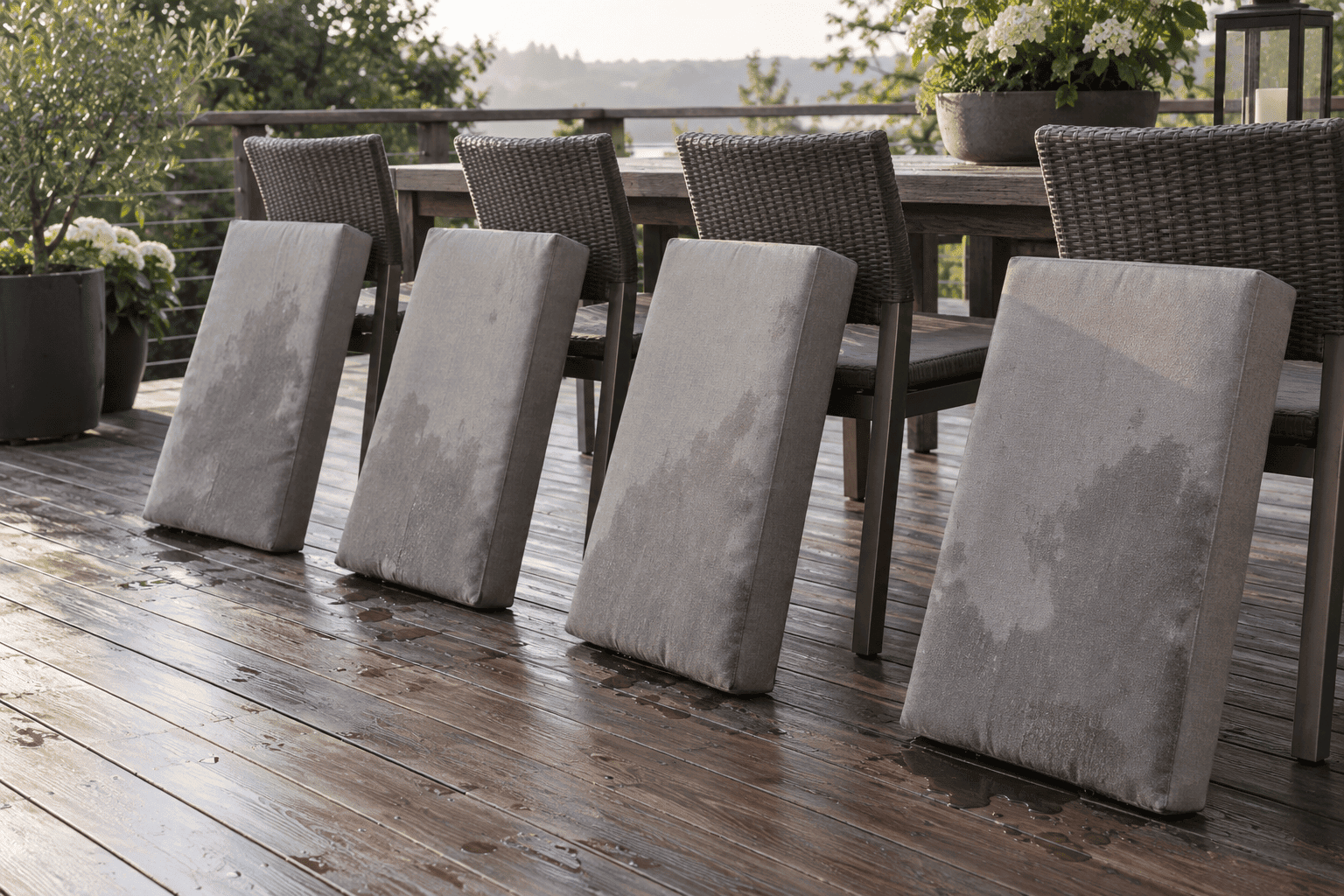
One rain event, three possible situations, and the difference between them is measured in hours since the rain stopped — not in how the cushion looks. Here is the decision framework; the step-by-step hand work for each branch is detailed in the drain guide linked above.
- Level A — soaked today, handled today (0–24 hours). The clock is at minutes-to-hours and mold has not started. Stand the cushions on edge, lowest seam down, somewhere with airflow; press the water out of the core in slow firm cycles; let moving air finish. Handled the same day, a soaked standard-foam cushion recovers essentially completely — no smell, no stain, no structural loss. Same-day response is the entire game.
- Level B — soaked, discovered two or three days later. The fabric dried, fooled someone, and the core has now been wet for 48–72 hours — the mold window is closing or just closed. Escalate: unzip and pull the core out if the cover allows, stand everything separately, press systematically, and put real airflow on it (a fan does more than a whole day of still sunshine). Sniff the core before you declare victory — smell is the early instrument that tells you whether Level B slipped into Level C while nobody was looking.
- Level C — black dots, gray patches, or that smell. Stop drying and start diagnosing, because “mold on a cushion” is two different problems: surface mildew on the fabric (a cleaning job, recoverable in an afternoon) versus mold that has colonized the foam core (a biology problem no brush reaches). The triage test for telling them apart — and the honest verdict for the core cases — is in how to clean mold off outdoor cushions.
The red lines in one breath: just wet — always worth saving, at any age of cushion. Smell with no visible colonies — probably saveable, but dry it fully and verify the smell is gone after two complete dry cycles. Interior staining of the core, a smell that survives repeated drying, or foam that keeps a dimple when pressed — the cushion is done, and continuing to dry it is just delaying the replacement order. The longer version of those foam-death signs is in when to replace outdoor cushions.
Prevention: The Only Fix That Doesn’t Cost a Weekend
Every level of the triage above is cheaper than the one below it, and all of them are more expensive than never soaking in the first place. Three moves, in order of leverage:
- Buy the core for drainage, not the label for promises. “Waterproof” on a sewn cushion is mostly marketing — the honest target is a cushion where water that gets in gets back out fast, which means a draining core under a shedding face. What those labels actually mean, decoded, is in waterproof cushions explained, and the fill that solves this at the material level is in the quick-dry guide above.
- Stand cushions on edge before and after rain, not after thought. Vertical cushions shed a shower mostly intact and drain the rest at the lowest seam; cushions left flat pool water on the face and feed the seams all night. It costs ten seconds and it moves you out of the top of the failure timeline entirely.
- When the soaked ones are beyond saving, replace into a system, not another sponge. Specify by your real exposure: a roofed patio and fair-weather winters run fine on high-density foam under a waterproof wipe-clean face; furniture that takes every storm needs a draining core. Our patio cushions are cut to your measurements, sewn in the fabric you pick, and made in 4–7 days — the builder starts at custom patio cushions.
FAQs
How long can patio cushions stay out in the rain before they are ruined?
Hours, not days. The fabric is fine after a shower; the risk is the foam core staying wet. Mold needs roughly 72 hours of trapped moisture to establish, so a saturated standard-foam cushion left unattended for three or more days is already inside the danger window even if it looks dry on the surface. Handle it the same day and the exposure is a non-event.
Can one rainstorm really ruin outdoor cushions?
Yes — if the core is standard closed-cell-style foam and the cushion sits undrained afterward. The storm itself is only the delivery mechanism; the ruin comes from water held in the core for days afterward. Cushions with reticulated quick-dry cores can take the same storm without damage because the water drains through in seconds instead of being stored.
Why do my cushions feel dry outside but stay wet inside?
Because the cover and the core dry on completely different schedules. The fabric dries in 2–4 hours of moving air while the foam core underneath is still saturated — capillary cells deep inside have no path to the air. Press the cushion firmly at the center and feel for coolness or seepage at the seam; the outside-touch test tells you about the jacket, not the sponge wearing it.
How do I know if a soaked cushion is worth saving?
Use the clock and the nose. Soaked within the last day: save it, always. Two to three days: still likely saveable — dry it actively and check for smell. Any black spotting, gray patches, or a musty smell that survives two full dry cycles: the foam core has been colonized or chemically degraded, and no drying method reverses that. When in doubt, the foam-death signs are listed in the red lines above.
Does standing cushions upright actually dry them faster?
Yes, for two mechanical reasons: the lowest seam becomes a drain point for loose water, and both faces get airflow instead of one face sealed against a chair or table. It is the single highest-return habit in outdoor cushion care — before rain to shed most of it, after rain to start the clock running in your favor.
What kind of cushions survive rain without all this rescue work?
Cushions built on drainage rather than on blockade: reticulated quick-dry foam under a water-shedding face fabric. Water enters through the seams — it always will in a sewn product — but it exits in seconds instead of days, so the 72-hour mold window never gets the standing moisture it needs. That build is standard at pool decks and marinas for exactly this reason.

POLYWOOD Cushions: Fabric, Waterproofing, Cleaning and When to Replace
POLYWOOD frames are famous for outliving everything around them — the recycled HDPE lumber shrugs off rain, salt and sun
Insect-Proofing Patio Cushions: What Works on Bugs, Without Ruining Fabric
Why insects target outdoor cushions (nesting sites, food residue, moisture), the prevention stack — cleaning, storage, covers, placement — what sprays and repellents are fabric-safe, and the honest limits of keeping a patio bug-free.
Pollen Season on the Patio: Protecting Cushions and Furniture
What pollen actually does to outdoor cushions (it’s not the color — it’s the chemistry), the spring protection playbook from covers to placement, cleaning pollen off fabric without grinding it in, and fabric choices for the perpetually dusty patio.
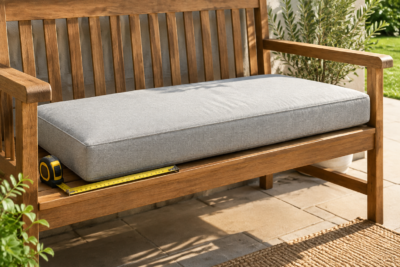
How to Clean Mold Off Outdoor Cushions (and When It’s Too Late)
How to tell salvageable mold from a dead cushion, the vinegar-and-oxygen-bleach method that works, and what to buy so it never comes back.
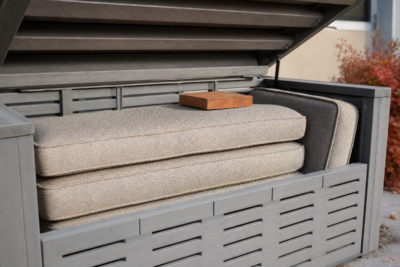
How to Store Outdoor Cushions for Winter: The Complete Method
The right way to winterize outdoor cushions — deep clean, bone-dry, ventilated storage, what never to do — and which climates need indoor storage at all.
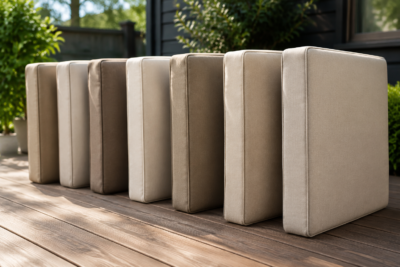
How to Drain Waterlogged Cushions (and When Foam Is Done)
How to rescue a waterlogged outdoor cushion fast — free drain, pressing, air-drying and verifying the core — plus the honest signs that the foam is past saving.