
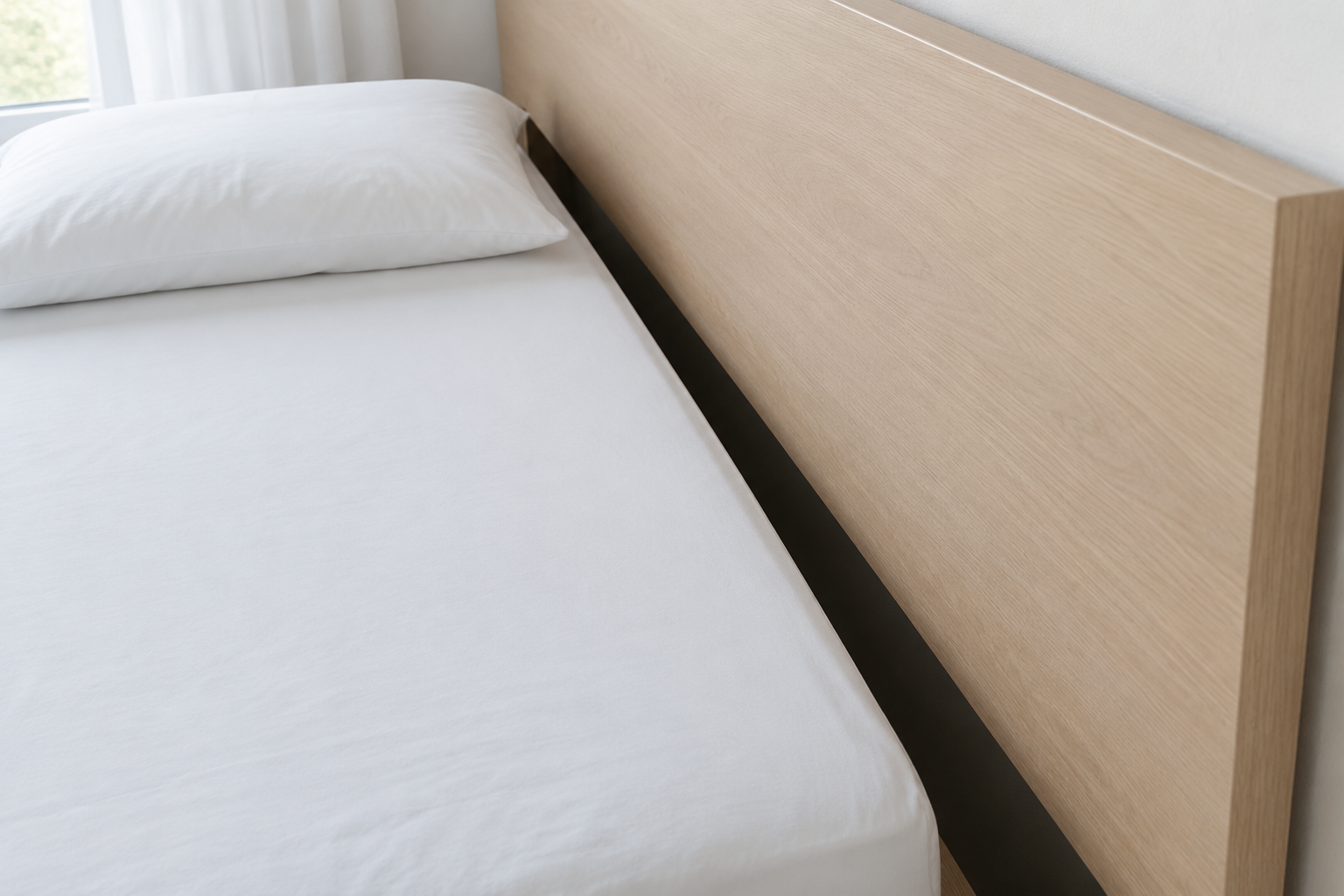
The gap behind your mattress swallows phones, swallows pillows, and drafts cold air across the bed at 2 a.m. Most people fix it by ordering whatever wedge shows up first; the result either won’t press in or slides back out within a month. The fix that lasts is not a better product — it is three measurements, taken first.
The short answer: measure the gap’s width, depth and length, then fill it with a high-density foam strip cut to those numbers — ordered half an inch to an inch wider than the gap so it holds by compression, run the full length of the seam, in 50-density foam or firmer. One long strip cut to size beats a bag of short filler sticks every time.
This guide covers why the gap exists, the three ways people close it, how to measure a gap so the filler fits once, and when a stock wedge is a reasonable buy instead. If you already have your numbers, the rectangle card in our custom cushion builder takes them directly — any length, 2 to 8 inches thick.
Why the Gap Is There in the First Place
Most headboard gaps are a size mismatch that shipped with the bed, or one that developed as the mattress aged — not a defect you can adjust away.
The frame is longer than the mattress. Mattress sizes are nominal, and frames are built with running clearance: the well formed by the rails and headboard is commonly one to four inches longer than the mattress it nominally fits (industry-tolerance arithmetic, consistent across major US frame makers). A California king is 72 by 84 inches on paper; the frame’s interior often is not.
The mattress shrank. Foam loses loft under years of sleeping load, and a mattress that has given up half an inch of height has also given up length — the corners pull away from the headboard and the seam opens. A gap that appeared in year six is usually this, and it keeps widening.
The mattress walks. Sleeping motion pushes a mattress toward the foot of the bed a little every night, and most people only shove it back when the gap eats something. Even a frame that fit on day one shows a seam by month three.
The Reddit threads ranking on this query read like a shared incident report: phones in the gap, remotes in the gap, pillows migrating into it within an hour.
Three Ways to Close It, and the One That Usually Wins
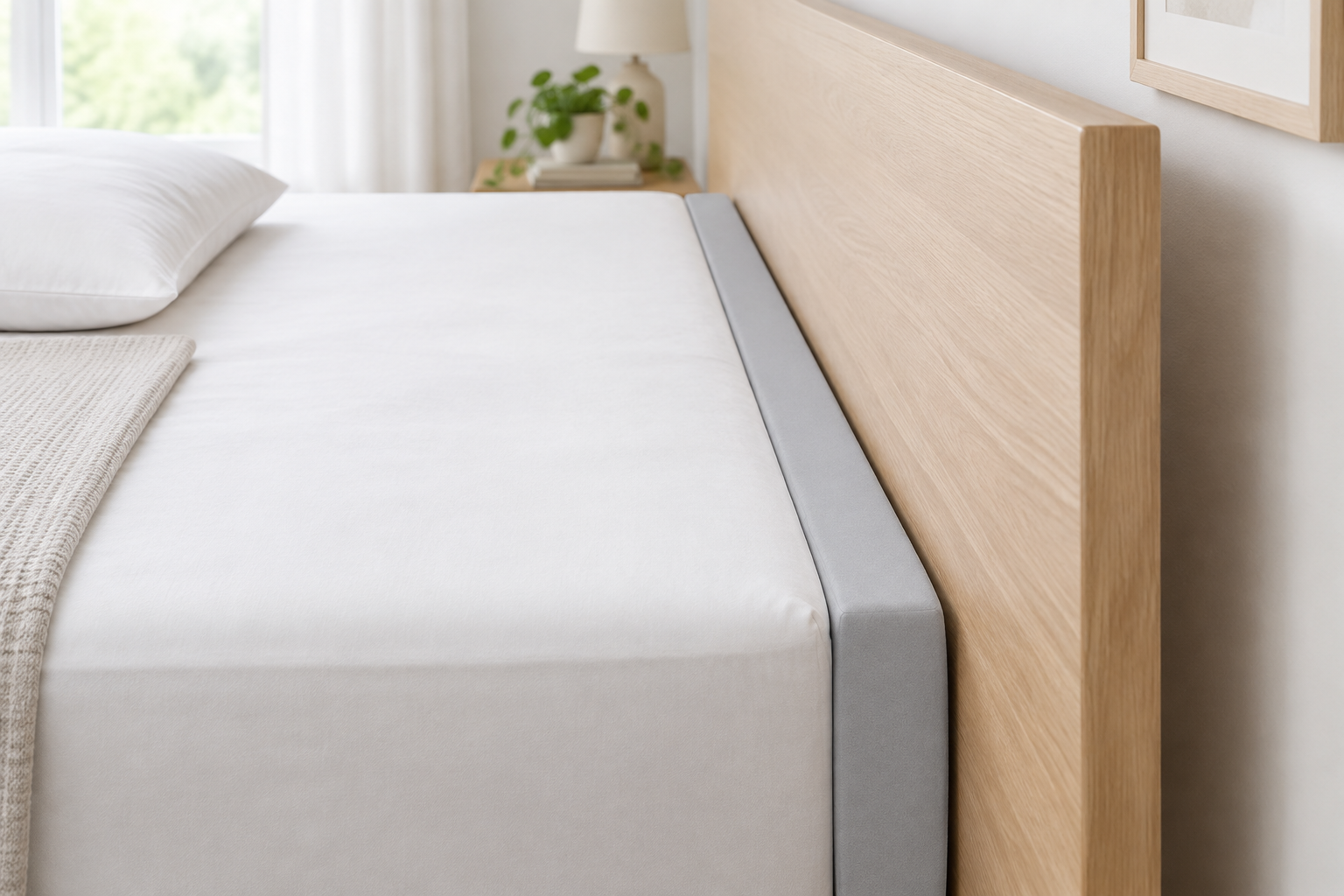
| Route | What it is | Where it fits | Where it fails |
| Foam gap filler strip | A high-density foam bar standing in the seam, cut to the gap’s three numbers | Any gap 1 to 8 inches wide, full or partial seam | Gaps wider than the thickest foam, or a wedge wanted for medical elevation — different product, not ours to advise on |
| Bed bridge / mattress connector | A panel spanning two mattresses into one surface | Split bases: two twins made into a king, adjustable pairs | Wrong tool for a headboard seam — it joins mattresses, it does not fill a void |
| Live with it | A rolled towel, a body pillow shoved down | One night, a rental you leave next week | Compacts within weeks, collects debris, re-opens |
Quick decision. A filler strip makes sense if the gap runs 1 to 8 inches wide and you want it gone permanently. A bridge makes sense if your real problem is two mattresses meeting in the middle. Living with it makes sense for exactly as long as you have not measured the gap yet.
Measure the Gap: Three Numbers, No Guessing
A filler that fits is a filler that was measured. Three numbers, a rigid tape, five minutes — the same discipline we run for rectangle cushion orders, applied to a gap instead of a seat.
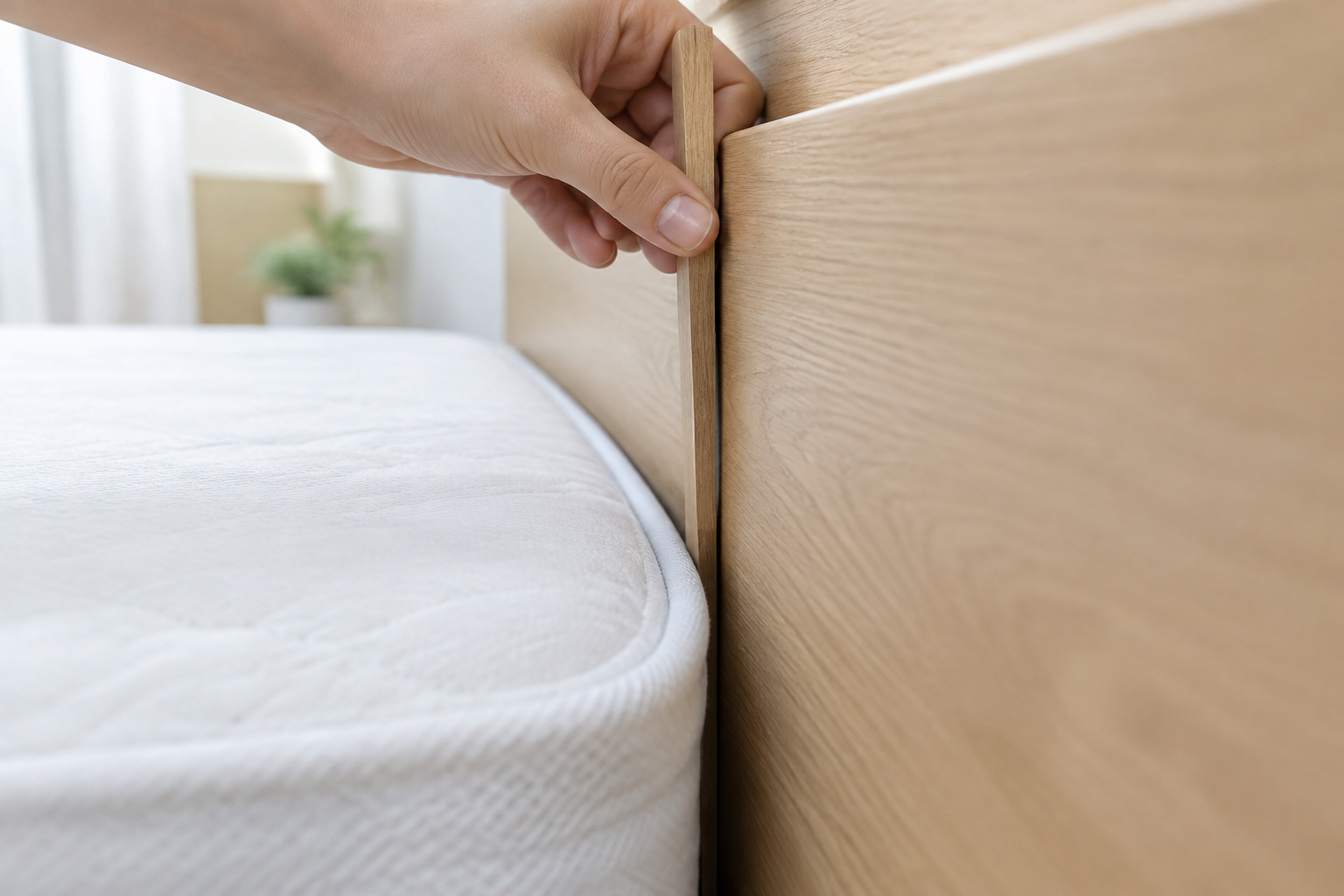
Gap width — where the filler’s thickness comes from. Measure horizontally from the mattress’s back edge to the headboard face. Three readings — left, center, right — keep the largest. Read to the nearest quarter inch; our cutting forms accept eighth-inch increments.
Gap depth — where the filler’s height comes from. Measure vertically from the platform or slats up to the mattress top; add two to three inches if you also want a lip that stops pillows sliding in. Mattress heights typically run 8 to 14 inches (industry-typical range), so strip heights commonly land between 8 and 16.
Seam length — where the filler’s length comes from. Measure along the headboard, rail to rail, inside the frame. This is the dimension stock products get wrong most often: a “king size” filler at 76 inches in a 78-inch frame leaves a gap at each end — the very problem you were solving.
The trap: gaps that are not uniform. Headboards sit slightly crooked and aging mattresses shrink unevenly; the same seam can read 2 inches left and 4 right. Never average. Record the largest, note the smallest, and if they differ by more than an inch the strip wants a tapered cut — wider at one end. It is the same class of error as averaging two widths on a seat, and it is on our list of common measurement mistakes for good reason.
One Long Strip or a Bag of Short Ones?
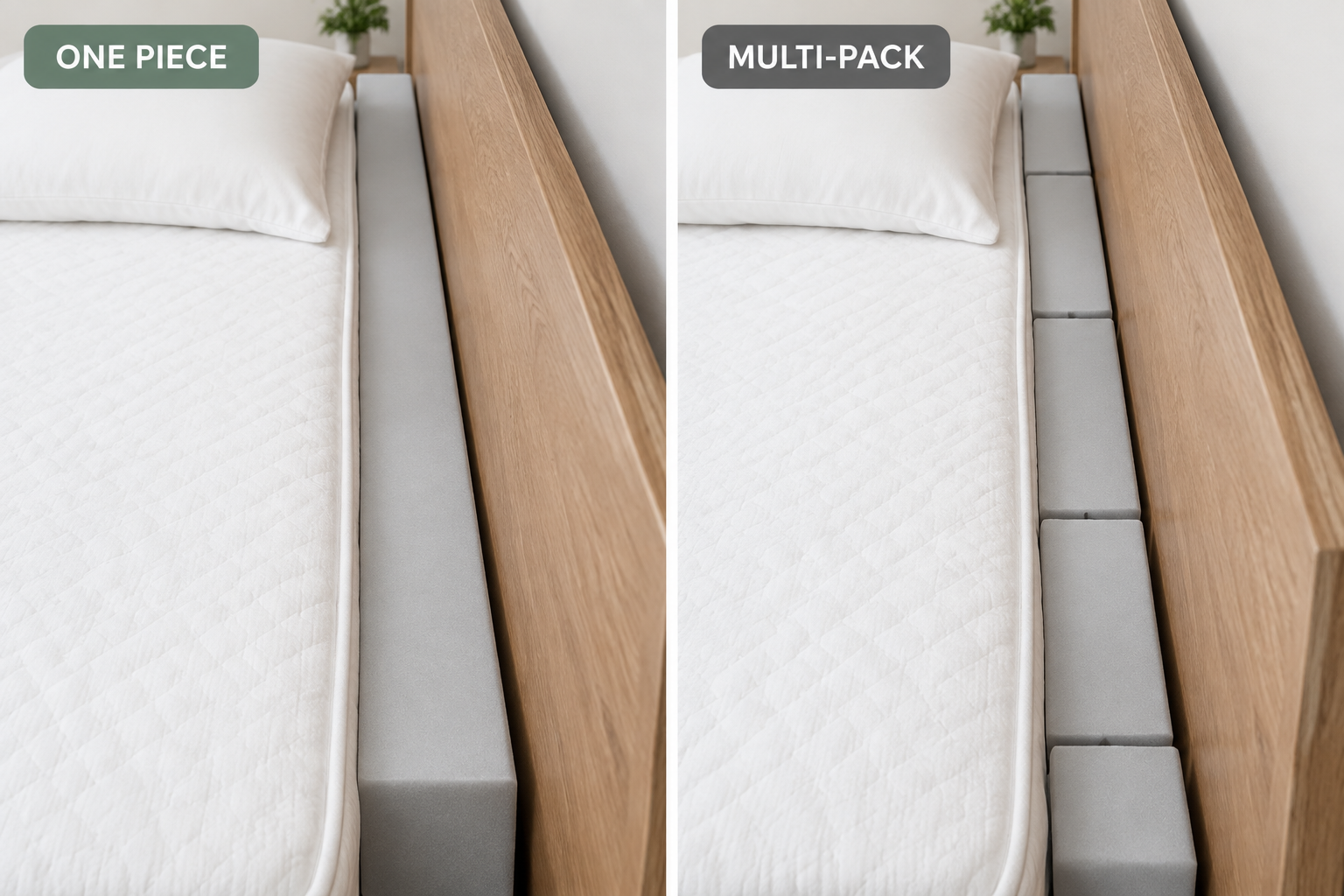
The cheapest listings sell gap filler as multi-packs of short sticks — 20-piece foam stick sets on eBay, 16-piece strips on AliExpress (US listings observed September 2026). The format is the problem: pieced-together segments leave a seam every few inches, and every seam is a hinge.
Each joint moves. A pillow pressed against the headboard pushes on the top of the filler; on a joint, that rotation walks the pieces apart and drops half of them flat by morning. A continuous bar has no joints to hinge on.
Each joint leaks. A single strip butted against both rails closes the whole channel where crumbs and charger cables disappear; eight short sticks leave seven leak points along it.
Heights never match. Multi-pack sticks come in one standard height; against an 11-inch mattress a 6-inch stick leaves the top half of the gap — the half the pillow occupies — still open.
A multi-pack costs less and gets replaced; one strip cut to the three numbers costs more once and stays. We cut continuous bars to any seam length on the same order form our cushion production runs on.
Stock Wedge or a Strip Cut to Your Numbers?
Stock fillers are sized by bed type, not by gap: this niche’s headline product ships as king 76 by 6 by 10 inches, queen and twin at the same fixed 6-inch thickness (product listings observed September 2026). That works when your gap runs about 5 inches and exactly bed-length. The failure modes are arithmetic:
- A 2-inch gap meets a 6-inch wedge: it will not press in, and forcing it bows the wedge up out of the seam.
- An 84-inch seam meets a 76-inch king strip: an 8-inch hole at one end.
- An L-shaped corner, curved panel or post inside the seam meets a rectangle-only catalog: no answer at all.
A strip cut to your numbers inverts the logic: thickness set to gap width plus interference, length set to the seam, shape cut around what the bed actually is. Most headboard gaps take a straight rectangle; a tapered profile earns its keep when the gap is narrow at the platform and opens toward the top — common with mattresses that have shrunk most at the top edge.
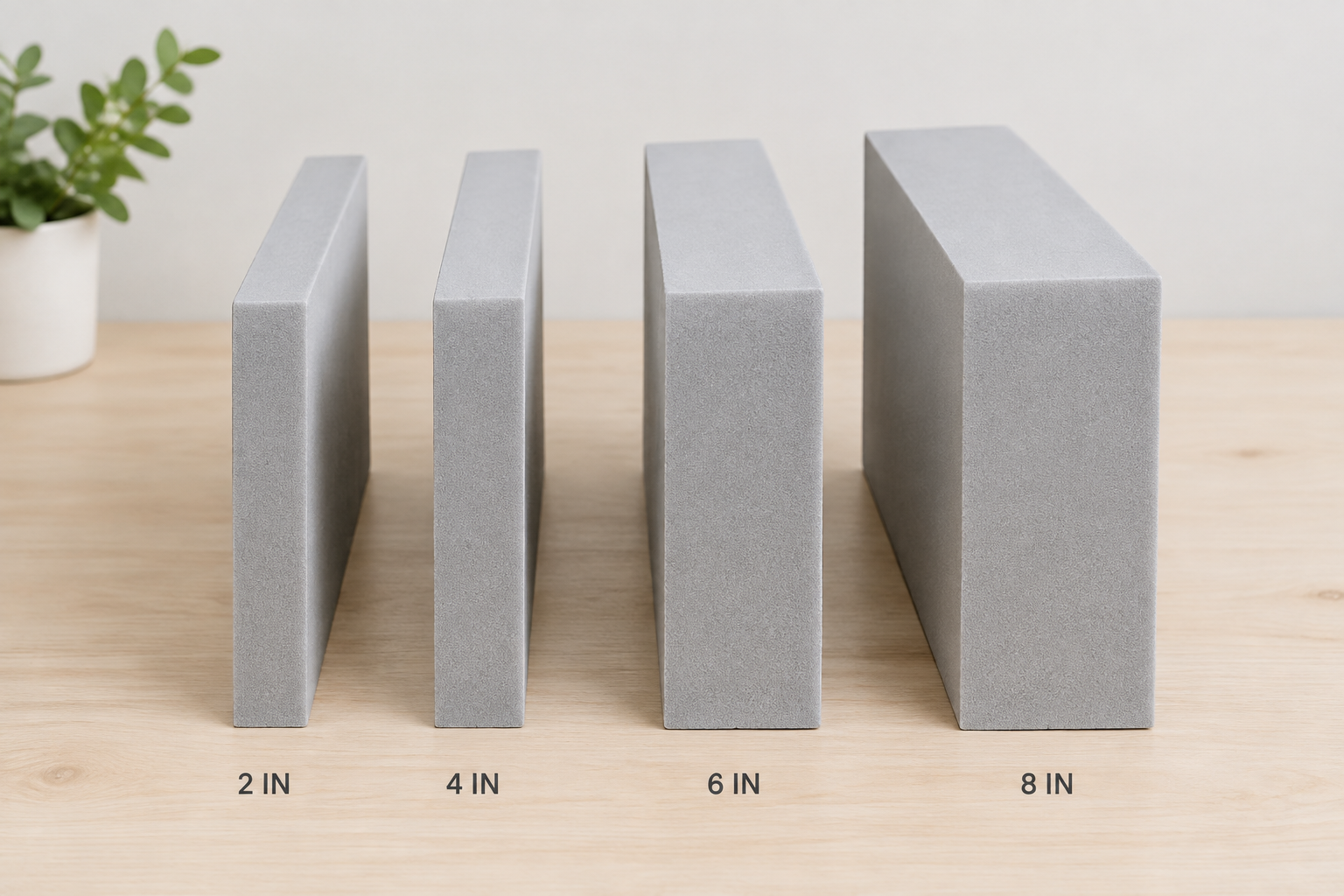
Density: the Number That Decides Year Three
A gap filler is loaded every night — pillows pressed into it, heads braced against it, the shear of turning over. That is seating duty, and density carries it. Density is how much foam substance sits in each cubic foot; it sets service life, not firmness — the two are independent, unpacked in foam density explained: D ratings vs lbs.
- 50D — the correct default. Supportive with give; the honest grade for a gap that takes nightly pillow load.
- 60D — for heavy nightly load. Adjustable bases, reading against the board, a sleeper who braces there all night.
- 65D — maximum structure. When the strip must hold its exact height year over year.
The grade to refuse is the unnamed one. Commodity 1.8 lb (18D) foam — the grade inside most boxed filler multipacks — dishes back within one to two years of nightly load; re-buying the grade that just flattened is scheduling this project again. Each density step from 50D up costs single digits on an order this size.
For the sizing rules — exactly how much thicker than the gap to order, and how tall to run the strip — the companion guide, what size bed gap filler do I need, works the three numbers into a spec. Foam rates by density are published up front on our couch foam cushions page.
Odd Gaps: Corners, Curved Boards and the Wall Side
L-shaped seams. Winged headboards and corner posts turn the seam a corner; one strip ordered as an L — long leg, short leg, one piece — keeps the corner sealed where two butted rectangles open a leak.
Curved headboard panels. Upholstered boards with a bowed face need the strip’s front edge to follow the curve. Trace the panel face onto cardboard, cut it true, send the pattern — the factory cuts to the pattern, and the pattern, not a formula, is what the headboard is.
The wall side. A floating bed shows the same gap against the wall; the fix is identical, and nothing presses on a wall-side strip, so 35D carries it.
Rails and posts inside the seam. A bracket crossing the gap needs a notch cut around it — a rectangle with a corner removed, a standard cut on the same order form.
FAQ
How thick should a mattress gap filler be?
The gap’s width plus half an inch to an inch — the interference is what holds the strip in. Compression against the two faces creates side pressure, and side pressure is the retention. The full logic, with a width-to-thickness table, is in what size bed gap filler do I need.
Will a foam gap filler stay in place without adhesive?
Yes — when the thickness is right, the foam’s own compression against mattress and headboard does the holding. That is physics, not a coating. A strip that needs glue was cut too thin.
Can I just roll up towels and stuff the gap?
For one night, yes; for a bed you keep, no. Terry compacts under pillow load within weeks and holds the dust the gap was collecting. It is the test drive, not the vehicle.
My gap is wider at one end. Do I split the difference?
No — record the largest reading and note the spread. Under an inch, normal interference hides it; over an inch, order a tapered cut, wider at the big end.
Can the filler be cut around my bed rails or posts?
Yes — notched corners for rails and brackets are a standard cut. Note the obstruction’s position along the seam and how far it intrudes, and the strip arrives with the clearance in it.
Next Steps
- Measure the three numbers: width at three spots keeping the largest, depth from platform to where you want the wall to stop, length rail to rail.
- Enter them on the rectangle card — length, height, thickness — and watch the price update as you type.
- Pick 50D for a nightly-loaded gap, 60D for heavy use; the reasoning is in foam density explained. More furniture guides live in the furniture guides library.
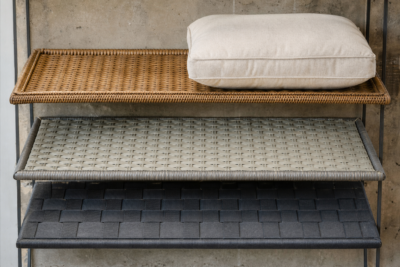
Types of Wicker Materials: Natural, Resin and HDPE Compared
Every wicker material family ranked — rattan core, paper fiber, bamboo, willow and reed on the natural side; PVC-resin and woven HDPE on the synthetic side — with outdoor ratings, lifespans and what each means for cushions.
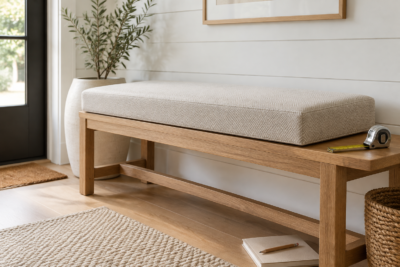
Bench Cushions: The Complete Guide to Sizes, Types and Custom Fit
A bench cushion is only as good as three numbers: the length and depth of the seat deck it sits

How to Buy Patio Furniture Online Without Regret: The Complete Method
The online patio-furniture method that prevents the classic regrets — dimension-verification discipline, photo-evidence buying, material questions to ask, shipping and return reality, and why custom cushions solve online’s worst problem: fit.
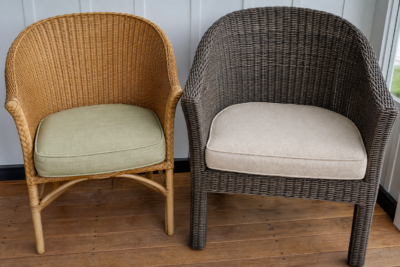
How to Tell Indoor from Outdoor Wicker: The Identification Guide
Five practical tests to classify any wicker piece — strand snap-test, frame magnet check, weave and weight inspection, tag and price decoding — and why getting this wrong is the most expensive wicker mistake there is.

Patio Furniture Sets: How to Choose Seating Sets, Dining Sets and Modules
The patio-set decoder — set types by use pattern (dining, conversation, sectional, bistro), what set pricing bundles and hides, the OEM cushion problem, and the set-versus-separate decision made honestly.

Wicker vs Rattan vs Cane: What Each Word Actually Means
The three most-confused words in woven furniture, sorted properly — rattan is a material, wicker is a weaving method, cane is a specific weave and fiber — and what each distinction means for cushions, care and outdoor use.