
Short answer: for a daily-use outdoor seat, order 3 inches of foam at 50D–60D; move to 4 inches and 60D for a deep seat you sit in for hours, and stay at 2 inches with 35D–50D only for decoration or short meals. Thickness sets how deep you sink; density sets how many years before you sink to the frame. They are two separate dials, and most bad cushion decisions come from turning one while reading the other.
There is a complaint that shows up in nearly every outdoor-furniture thread: “No one gives specific numbers so you can’t compare.” Retailers say “premium comfort foam” and “plush seating,” which are adjectives, not specifications. We cut and sew custom cushions all day, so this guide is nothing but numbers: which thickness for which seat, which density for which sitter, how many years each grade survives, and the one honest tradeoff at the top of the density ladder. For how the two rating systems (D-ratings and lbs/ft³) read against each other, see our companion piece on D-ratings vs pounds per cubic foot — this article is the next step: what to actually order.
Thickness: the Comfort Dial
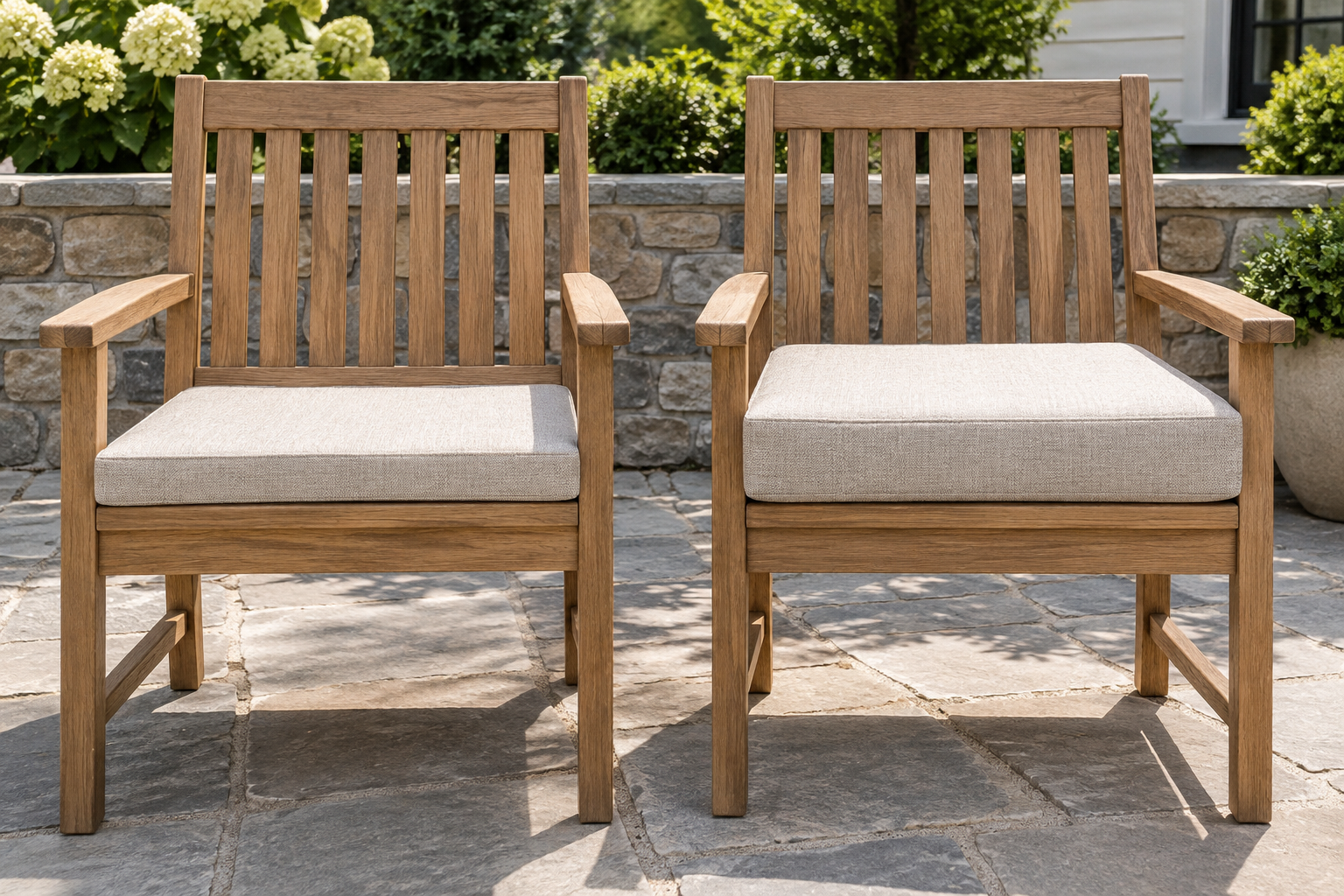
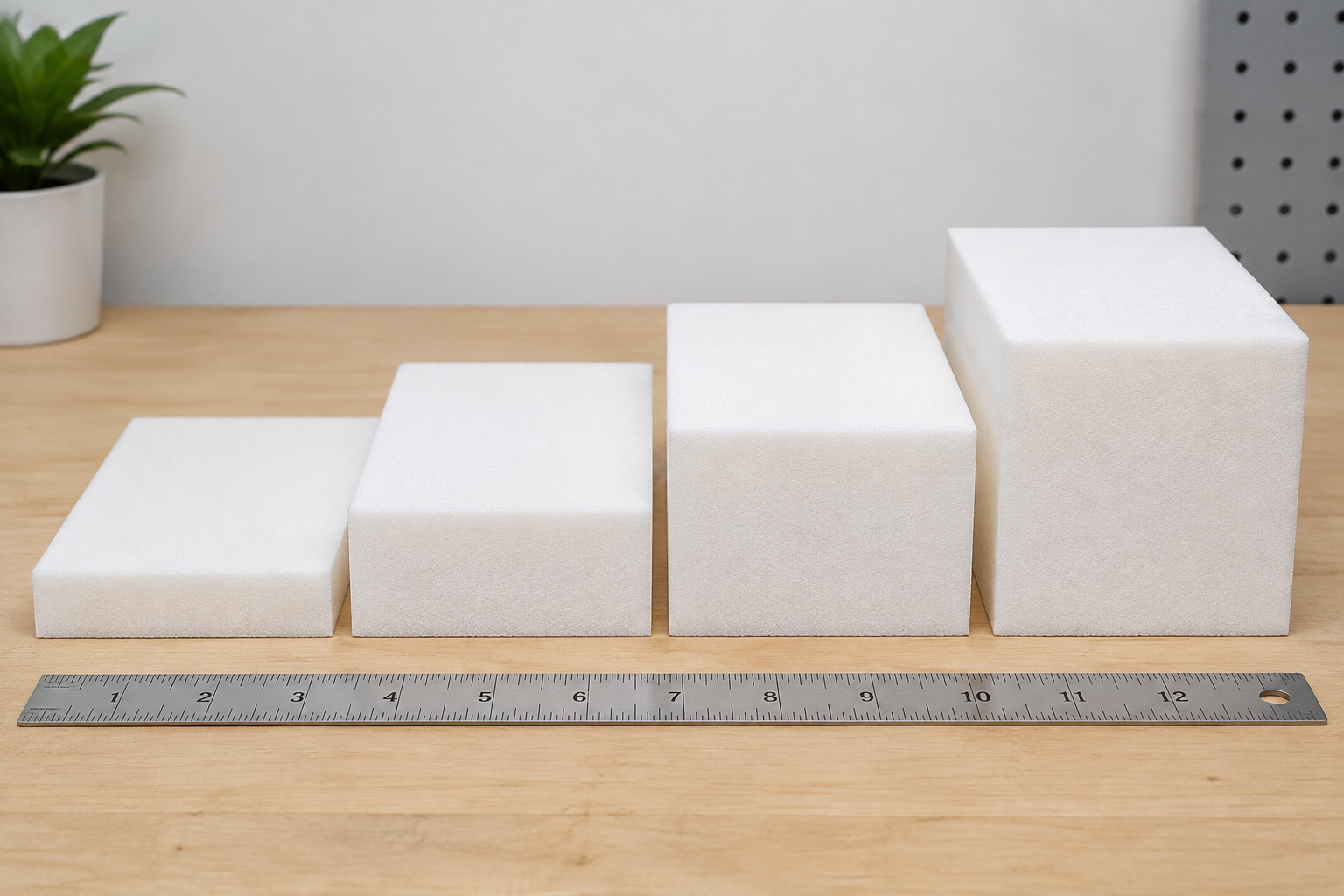
Thickness does not change the material — it changes how far your body travels before it stops. Thin foam bottoms out: your weight runs out of foam and lands on the seat frame, which is why a worn or undersized cushion feels like sitting on plywood. Thicker foam of the same density spreads the same load over more material, which reads as plusher even though nothing about the foam itself got softer. What thickness costs is straightforward: foam is priced by volume, so going from 3 to 4 inches adds roughly a third again to the foam line on your quote.
| Thickness | Order it for | What it feels like | What it costs you |
| 2″ | Decoration and short sits: accent chairs, dining chairs used for meals, bench styling, back cushions | Firm and close to the frame — fine for 30 minutes, tiring for hours | Lowest foam volume; the budget-honest choice when seats are genuinely occasional |
| 3″ | The daily standard: patio dining sets, standard-depth chairs, benches with regular use | Balanced — cushioning without hoisting you above the armrest line | The reference build; most orders land here |
| 4″ | Deep seats, main outdoor sofas, lounge chairs you occupy for whole afternoons | Proper sink; the thickness where “comfortable for hours” starts | Roughly +33% on the foam line versus 3″; also raises seat height, so check arm and table clearances |
| 5″+ | Commercial settings, heavier sitters, daybeds, marina and rooftop exposure | Deep, double-layer comfort that stays composed under repeated heavy load | Premium foam volume; only worth it if hours-per-day or body weight justify it |
One measurement caution before you upgrade thickness: your seat height rises by exactly the difference. If your chair arms already sit flush with the current seat, a 4-inch core can leave the arms below your elbows and push your knees above the table edge. Measure the current stack, then decide how much height the furniture can absorb — our outdoor cushion measuring guide walks the exact sequence.
Density: the Lifespan Dial
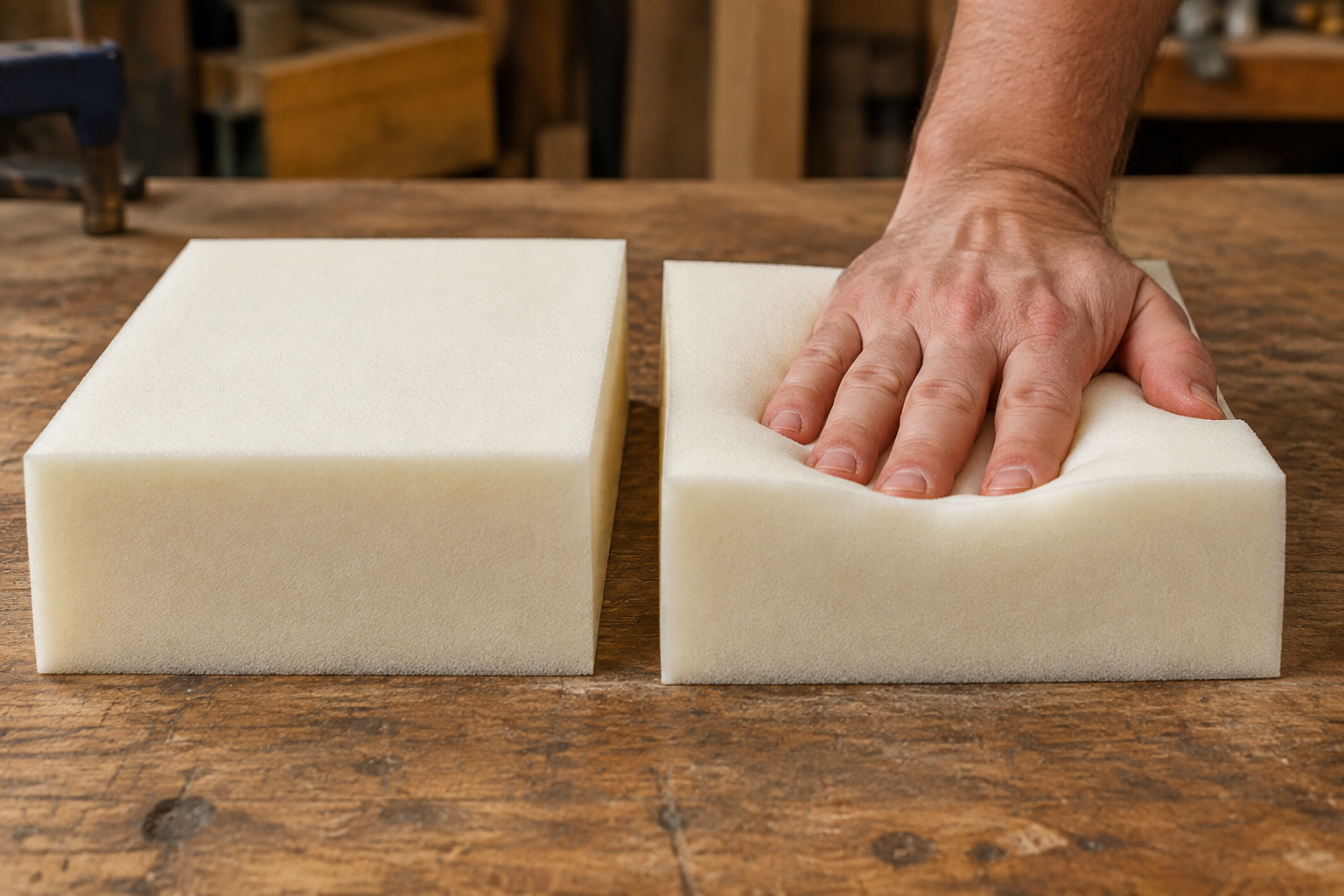
Density is polymer per cubic foot — more material in the same space, which means each cell wall is thicker and slower to collapse under your weight, year after year. Density is not firmness in disguise (firmness is a separate formulation choice, the third dial in how to choose foam density), but in practice each step up the density ladder also firms up the feel somewhat. Here is the full ladder with the numbers that matter — expected service life under daily use:
| Grade | Order it for | The feel | Expected service life* |
| 35D | Occasional furniture: decorative chairs, guest seating, back cushions, budget-first projects | Soft-medium, yielding | ≈3–5 years |
| 50D | Daily-use seating: dining chairs, patio sets, standard sofas — the grade most mixed indoor-outdoor orders land on | Medium; holds loft through years of nightly use | ≈5–8 years |
| 60D | Long daily hours, heavier sitters, deep seats used as everyday furniture, light commercial — our default recommendation for a seat cushion that gets sat in daily | Medium-firm under load; slow to age | ≈8–10 years |
| 65D | Heavy commercial duty: bar stools, reception furniture, boat cushions, full-season outdoor sets that live under covers | Solid; nearly impossible to bottom out | 10+ years |
*Service life assumes a covered or reasonably sheltered setup and a cover-friendly climate; seats that take weeks of standing water age faster regardless of density. For genuinely soaked settings — uncovered patios in rainy climates, poolside, marine — the outdoor-correct core is reticulated dry-fast foam, which drains in seconds instead of holding rain for days; the tradeoffs between that and high-density foam are in our HD vs dry-fast comparison. And stepping up the ladder costs less than most buyers fear: between adjacent grades the move is measured in dollars per seat, not hundreds — which is why our standing advice is simple: seat cores at 60D, back cushions at 50D, because backs carry no body weight and seats carry all of it.
The Cross-Chart: Thickness × Density
Each dial alone is easy; the decision is the combination. This is the table nobody publishes — which pairing suits which person, read row by row. Bold rows are the three pairings that cover the overwhelming majority of real orders.
| Combo | Who it is for | The one-line logic |
| 2″ × 35D | Styling-first seats, guest chairs | Lowest cost; comfort budget spent elsewhere |
| 2″ × 50D | Daily dining chairs | Meals are short, so thickness is optional but lifespan is not |
| 3″ × 50D | The default patio build | Daily use, standard depth, balanced budget — where most orders land |
| 3″ × 60D | Daily-use seat cushions, our house recommendation | Same comfort footprint, years added for dollars |
| 4″ × 50D | Deep seats on a budget | Buy the sink first, accept the shorter clock |
| 4″ × 60D | Main outdoor sofa, all-day lounge chairs | Hours per day + years of them; the comfort-plus-longevity build |
| 4″ × 65D | Heavier sitters, light commercial | Bottoming-out stops being a failure mode |
| 5″+ × 60D/65D | Commercial, marine, daybeds | Maximum stack for maximum duty |
The Honest Tradeoff: Density Can Go Too Far for You
This guide would be an ad if it stopped at “more density, more years.” The real trade: 60D and 65D sit firm, and firmness is a preference, not a universal virtue. If you like sinking into a lounge chair, or an older sitter needs an easier surface to rise from, a 50D core at 4 inches will feel kinder than 60D at 3 — you trade a couple of years of theoretical lifespan for comfort you actually enjoy every day. That is a good trade. Our floor’s rule of thumb: order by hours and load, not by the spec sheet’s biggest number — the full three-question version is in how to choose foam density. What density cannot do, for anyone, is waterproof a cushion; that is a foam-type question (HD vs dry-fast) and a cover question, never a density number.
FAQs
Why did my outdoor cushions go flat after only one year?
Almost always a density problem: the core was packaging-grade stock in the 35D-and-below family, and its cell walls collapsed under repeated sitting — foam’s failure mode called compression set. It is not repairable by fluffing; the cure is a replacement core at 50D or 60D, which changes the quote by dollars per seat, not hundreds. We open up the full price anatomy in why outdoor cushions cost what they cost.
Is thicker foam always better?
No — thickness buys sink depth, and sink depth is only valuable for the hours you actually sit. A 2-inch core at 50D serves a dining chair used for meals perfectly well, while adding thickness there mostly raises your seat height toward the armrests. Order 4 inches and up when the seat hosts afternoons, not meals.
What density should outdoor seat cushions be?
Daily-use seat cores: 60D is our standing recommendation, with 50D acceptable for lighter use and tighter budgets. Back cushions: 50D, since they carry no body weight. For uncovered seats in rainy climates or poolside, switch the question from density to foam type — reticulated dry-fast foam is the outdoor-correct core there.
Is 65D foam too firm for home use?
For most homes, yes — 65D exists for bar stools, reception furniture, boats, and heavy commercial duty where bottoming-out is the enemy. A residential daily seat at 60D already delivers 8–10 expected years; the further step to 65D mostly buys firmness you may not want to sit on.
Does a higher density mean the cushion is waterproof?
No. Density measures polymer per cubic foot and governs longevity under load; water behavior is governed by cell structure. Standard high-density foam absorbs and holds rain for days, while reticulated dry-fast foam drains in seconds at similar seating grades. An uncovered, rained-on seat needs the dry-fast family — density alone will not save it.
How much more does 60D cost than 50D?
Adjacent grades differ by dollars per seat, not by percentage points worth hesitating over — on a typical dining seat the step is smaller than the fabric upgrade from polyester to acrylic. That narrow gap is exactly why our recommendation defaults seats to 60D: the cheapest years of service life you can buy are the ones between 50D and 60D.
Next Steps
- Match your seats to the cross-chart above — hours per day and sitter load pick the row; your furniture’s arm and table heights confirm the thickness column.
- Load your dimensions into the custom patio cushion builder and flip between 3″ and 4″, 50D and 60D — the totals move by the small margins this guide promises, in the open.
- Order when the combination reads right — cores are cut and sewn on our floor in 4–7 days, delivered inside 3–6 weeks.
Couch Cushion Foam Replacement: Density, Cost and Buying Guide
Replace couch cushion foam in one right order: 50D vs 60D density, measuring the old core, four ways to buy, and real worked prices for one seat and a full set.
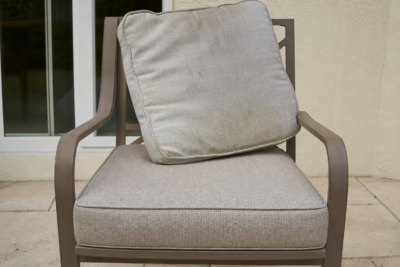
Where to Buy Replacement Patio Cushions: 5 Ways, Compared
Five ways to replace patio cushions — the set maker’s parts program, seasonal aisles, universal-fit listings, specialists and measured custom — plus the Home Depot house-line route with 31 measured collections.
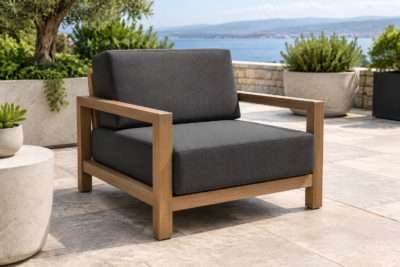
Why Is Patio Furniture So Expensive? The Cost Anatomy, Explained
What actually drives patio furniture prices — weatherproof materials, UV-stable finishes, marine-grade hardware, freight on bulky goods, and seasonal retail economics — why the good stuff costs 3-5x the box-store set, and where the value concentrates.
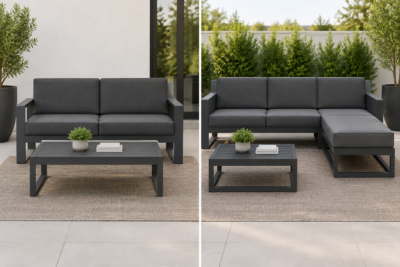
Patio Set vs Buying Separately: The Real Trade-offs
Buying a complete patio set versus assembling pieces: price coherence and one-click convenience versus fit-to-space precision, mixable quality and replacement flexibility — how to decide, and the hybrid strategy that captures both sides.

How Much Do Custom Cushions Cost? Price Ranges by Shape (2026)
Custom cushions cost USD 50-400 depending on shape, size, density and fabric. Live factory-direct price ranges for bench, window seat, outdoor, sofa and boat cushions — and how to price your own.
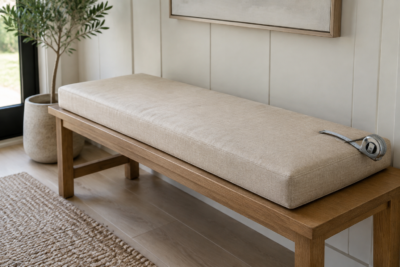
Local Upholsterer vs Online Custom Cushion Shop: Cost, Lead Time & How to Choose
Deciding where to get custom cushions made? The honest comparison of a local upholsterer versus an online custom cushion shop — cost stacks, lead-time clocks, fabric selection and who should choose which.