
Short answer: you are not paying for sewing — you are paying for materials that survive three summers of rain and ultraviolet, plus small-batch labor and bulky-freight shipping. A performance fabric costs three to five times what a printed polyester costs, outdoor-grade foam costs roughly double the packaging grade per seat, and every custom piece is cut and stitched one at a time instead of flowing down a mass-production line. We make these cushions on our own floor, so instead of defending the price, we can simply open the books and show you where each dollar goes.
The sticker shock is real, and it is not your imagination. One buyer on Reddit, comparing custom quotes against just sewing his own, put it this way: “The custom quote was enough to buy a sewing machine, full materials, and a round-trip ticket to Costa Rica.” He was joking — mostly. But his thread is one of hundreds where people ask the same question and get answers that dance around numbers. This article does the opposite: a line-by-line cost anatomy of an outdoor cushion, with real ranges, so you can judge any quote — ours included — on evidence instead of vibes.
Where the Money Actually Goes
A finished outdoor cushion is four cost stacks stacked together: fabric, foam, labor, and freight. The table below shows what each stack costs at the budget end versus the premium end, per average dining-chair seat (roughly 17 × 17 inches of top surface). The ranges come from our own 2026 material purchasing and a scan of the retail market.
| Cost stack | Budget (big-box cushion) | Premium custom | What drives the gap |
| Fabric (per yard) | $3–8 printed polyester | $15–30 solution-dyed acrylic | Color lives inside the fiber, not printed on top; UV stabilizers; 5-year fade warranties |
| Foam (per seat) | $4–8 (low-density roll stock) | $15–35 (50D–65D HD or dry-fast) | Density roughly doubles polymer per cubic foot; reticulated outdoor foam adds drainage engineering |
| Labor (per piece) | $2–5 (minutes on a line) | $25–60 (one cutter, one sewer, one QA pass) | Custom shapes cannot be batched; every piece is measured, cut, stitched, and inspected alone |
| Freight (per order) | Near zero (container freight baked into shelf price) | $20–60 bulky-freight fee | Foam is light but voluminous — carriers bill by dimensional weight |
| Total, per dining seat | $18–30 shelf price | $75–135 quote range | Custom benchmarks: our 2026 rate for a custom dining chair in 50D sits at $76 |
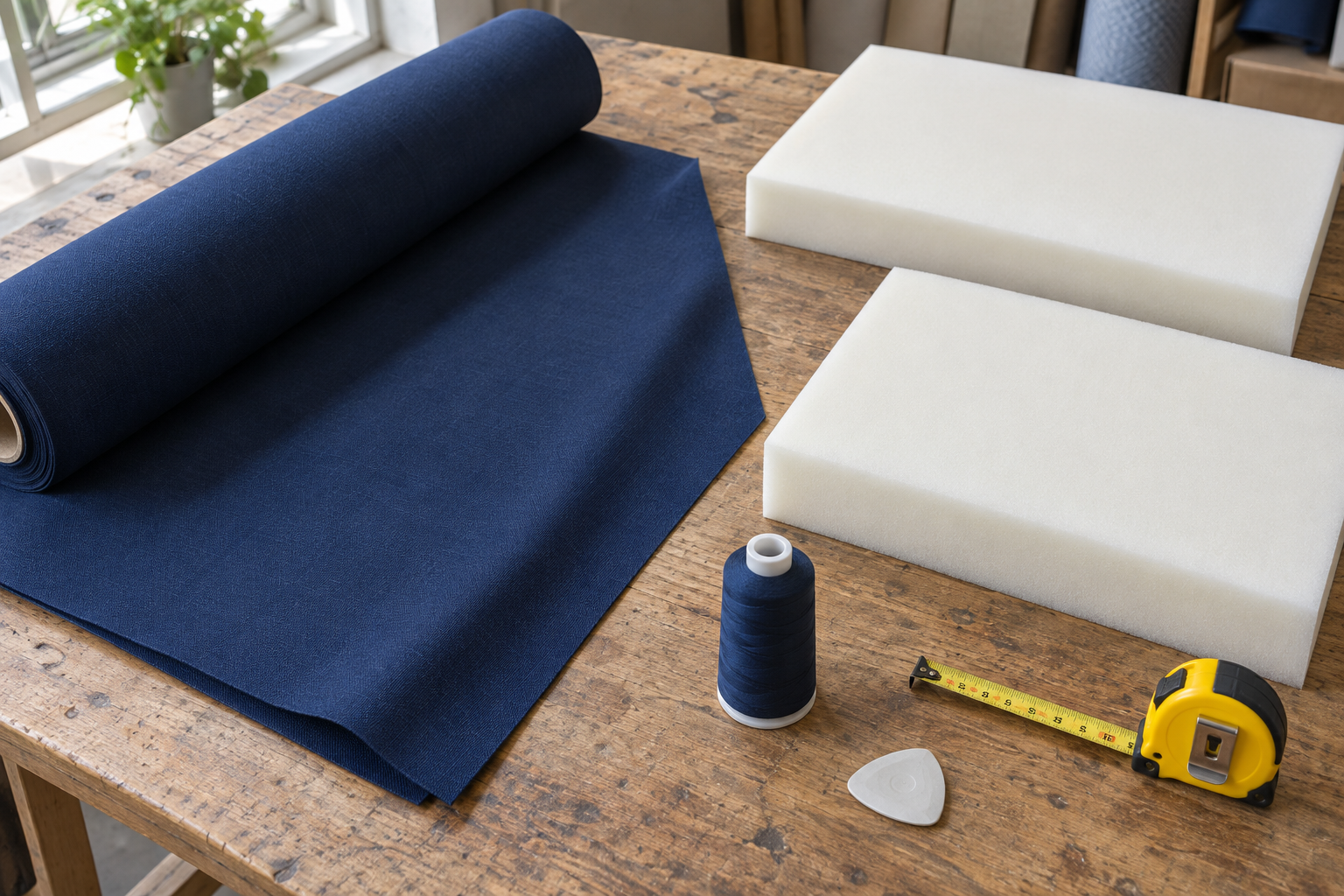
Read the last row twice: the four-to-one gap between a $22 shelf cushion and a $90 custom quote is not markup — it is the arithmetic of the four rows above it. Now let us open each stack, because that is where you can actually tell a fair price from a padded one.
Stack One: Fabric — the 3–5× Line Item
Fabric is where cheap and expensive cushions diverge hardest, because the two fabric families are chemically different products. Printed polyester starts as a pale weave and gets its pattern printed on the surface, like ink on paper. Solution-dyed acrylic — Sunbrella is the best-known brand, and there are peers like Tempotest and Outdura — starts as a colorless polymer, gets the pigment melted into the resin before the fiber is extruded, and becomes yarn that is colored all the way through. Cut it in half and the color is still there.
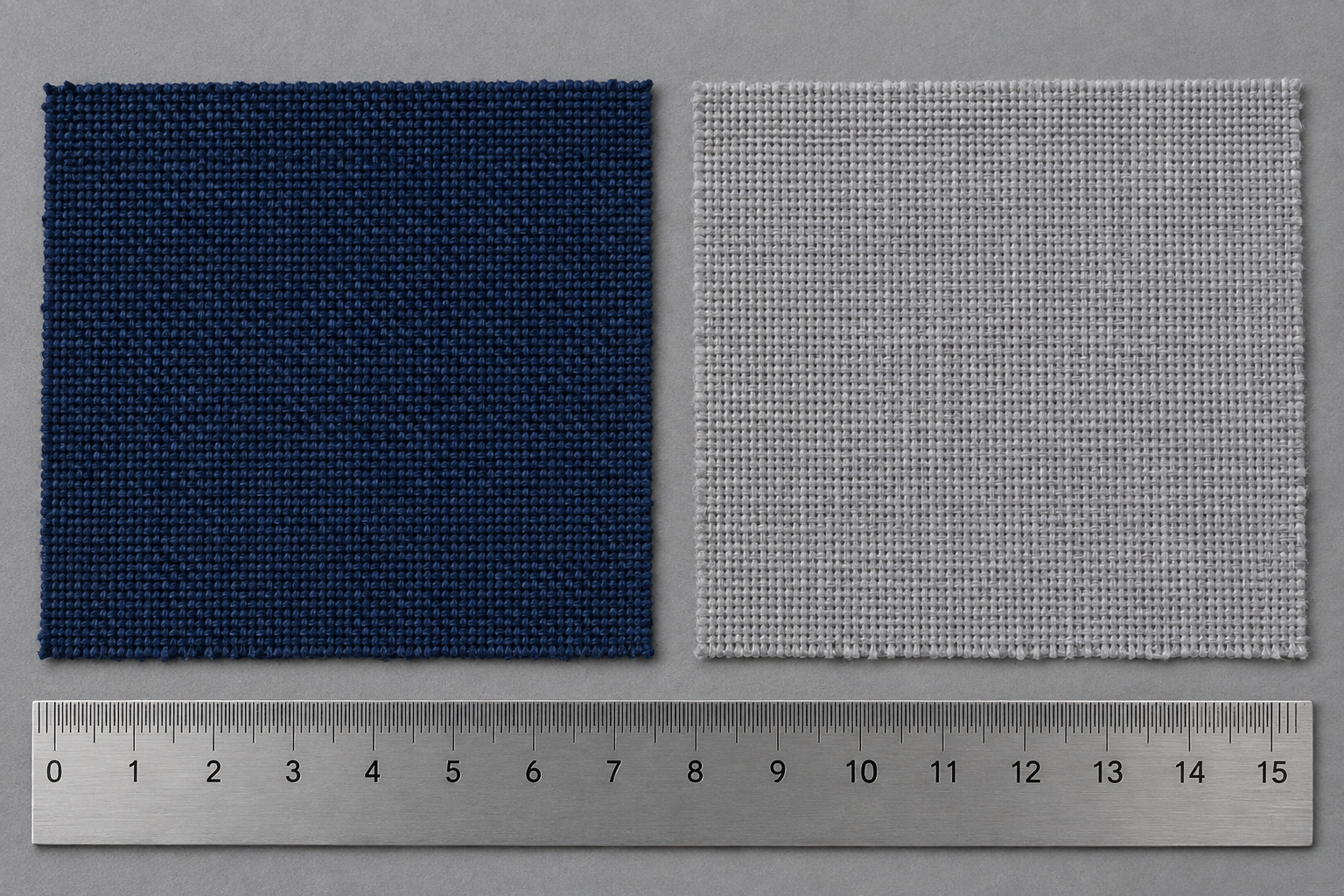
That difference in chemistry is what you are buying at $18–28 per yard against $4–7: acrylic resists ultraviolet degradation structurally, carries years-long fade warranties, and dries without the mold-friendly dampness cotton blends hold. Our full matchup of the two families — including olefin, the third player — lives in the Sunbrella vs outdoor fabric comparison. For this article the point is narrower: on a single dining seat you might use 1.2 yards, so premium fabric adds perhaps $20–25 to the quote. On a full patio set of six, it is the difference between $30 and $180 of cloth — the moment “why is this so expensive” becomes a fair question with a concrete answer.
Stack Two: Foam — Density Is Priced Like Concrete
Foam is sold by density, and density is simply how much polymer is packed into each cubic foot. The trade measures it two ways — D-ratings on cut orders in Asia, pounds per cubic foot on American retail tags — and there is no clean conversion between them; we unpack both systems in D-ratings vs lbs/ft³. What matters for price is linear: roughly twice the polymer, roughly twice the bill, plus a firmness bump for free.
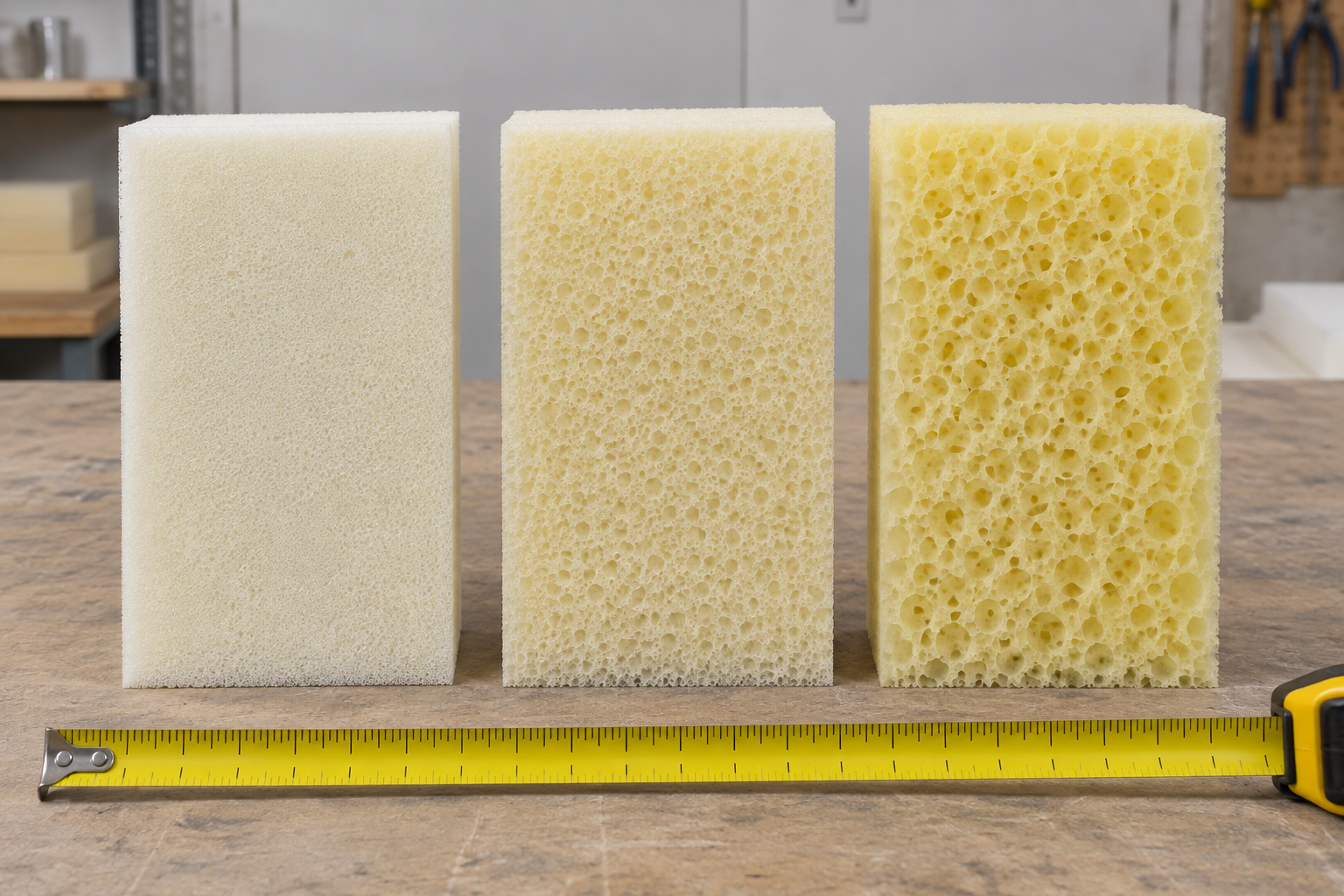
A budget cushion is filled with whatever the factory could source cheapest that season — commonly the low end of the scale, the grade our floor would call 35D-adjacent, the same family spec’d for packaging and guest-room furniture. It feels fine in the store because freshness masks density. Outdoor moisture makes the difference worse: standard foam holds rain for days, and every soak-and-dry cycle eats a little more of the cell walls. That is why genuinely outdoor-grade builds step up to 50D–65D high-density or to reticulated dry-fast foam that drains in seconds — and why the foam line on a serious quote is $15–35 a seat instead of $5. If you want the full decision table — which density for which sitter and how many years each grade survives — that is our foam density and thickness guide.
Stack Three: Labor — the Part That Scales Badly
A mass-market cushion is made in batches of thousands: one setup, minutes of handling per piece. A custom cushion is made in a batch of one. Somebody prints your cutting ticket, lays out panels by hand, cuts the foam to your inch fractions, sews each face as a single flat panel with knife-edge seams stitched flush, inserts the core, inspects it, and packs it — 30–45 minutes of skilled touching for a straightforward seat, more for a chaise. Labor is the stack that barely shrinks even when shops compete on price, which is why quotes from sew shops sound like upholstery money: they are.
Stack Four: Freight — You Are Shipping Air
Foam is light for its size, and carriers bill the larger of actual and dimensional weight — a four-seat set parcels out to a big box of mostly air, so a $30–60 bulky-freight line on a custom order is normal, not a scam. Big-box retail pays near-zero effective freight because containers of flat-packed goods ride ocean freight at fractions of a cent per unit. If a quote shows free shipping, the shipping is inside the item price — a habit we examined in free shipping and hidden fees.
Why the $22 Cushion Dies in One Season
The budget cushion is not a worse version of the same product; it is a different product that fails by a different route. Patio threads on Reddit repeat the arc every spring: cushions bought with the furniture in May are flat and faded by the following May. Three mechanisms, in order of appearance:
The foam takes a set. Low-density cells collapse under repeated load and stay collapsed — the dishing you see when nobody is sitting on it. Foam engineers call it compression set; buyers call it “it went flat.” Higher density is the direct cure, which is the entire argument of the foam price gap above.
The fabric loses its color, then its strength. Surface-printed polyester fades in a season of full sun, and as the UV works past the pigment the weave itself embrittles — the seat looks tired, then the seams shred because the cloth at the stitch line has no strength left.
The thread gives out first. Budget cushions are often sewn with thread never rated for outdoor UV; the seam pops while the fabric still looks passable. On our floor the thread is UV-resistant polyester for exactly this reason — a dollars-per-piece upgrade a price-first factory skips.
Run the math honestly and the cheap cushion is not even cheap: $25 replaced yearly is $150 over six years — the price of a custom seat in 50D still holding its loft in year six, with better fabric the whole way. The premium is prepayment of the replacement cycle you would otherwise make four more times.
The Three-Question Value Check
Whatever quote you are judging — ours or anyone’s — three questions separate the fairly priced from the padded. Ask them verbatim; a good shop answers in specifics, and a bad one changes the subject.
1. “What is the foam density?” You are listening for a number — a D-rating or a lb/ft³ figure. “High-density” with no number means nothing; 50D or higher for a daily-use seat means someone chose a core that survives. Silence on density is the single strongest predictor of a one-season cushion.
2. “Is the fabric solution-dyed acrylic, olefin, or printed polyester?” The first two are the outdoor families; the third is the one-season family. If the answer is a brand name you recognize, check the warranty length — a five-year fade warranty is the fabric maker putting money behind the chemistry.
3. “What thread, and what seam construction?” UV-resistant polyester thread and flat knife-edge seams stitched flush are the honest answer for an outdoor piece. Complicated edge treatments are a style choice, not a durability one; the thread spec is the durability one.
Our Pricing Logic, Stated Plainly
We are the factory, which changes the shape of the price rather than the existence of it. There is no showroom layer and no distributor between our cutting tables and your porch, so the quote you see is material plus labor plus freight, built by a published formula — top area times a foam rate plus a fabric rate, on a flat per-order base — with the worked examples and current rates in how custom cushion pricing works. We will not claim to be the cheapest quote on the internet; we claim that every dollar in it traces to a row you just read. If comparing against ready-made instead of custom, our cost-by-cost breakdown of custom vs ready-made uses the same anatomy.
Sunbrella fabric sits at the top of that material stack — it is what most of the “worth it” answers are quietly describing. Sunbrella replacement cushions cut to your measurements start around USD 105 at the factory-direct tier.
FAQs
Why do custom outdoor cushions sometimes cost more than the furniture itself?
Mass-produced furniture is built from cut lumber or extruded frames on a line, at thousands of units per setup. A custom cushion is a one-off sewing project wrapped around performance materials: solution-dyed fabric at $15–30 a yard and 50D-plus foam, cut to your specific inch fractions by a person. The furniture scales; the cushion cannot.
Is Sunbrella fabric actually worth the money?
If the cushion lives in sun or rain, yes — the pigment is built into the fiber rather than printed on it, which is why the fabric carries multi-year fade warranties when printed polyester visibly fades in one summer. In a covered sunroom the calculus softens; our full comparison sits in the Sunbrella vs outdoor fabric guide.
How much should I expect to pay per seat?
At our 2026 rates, a custom dining-chair seat in 50D runs $76; lounge chairs run $108–135, and a full custom sofa lands near $469. Budget shelf cushions run $18–30 per seat and budget on replacing them annually instead of every five to eight years.
Why is shipping so expensive on cushion orders?
Foam is voluminous and light, so carriers bill by dimensional weight — you are effectively shipping air. A bulky-freight fee of $20–60 on a multi-seat order is market-normal, and “free shipping” offers have the freight baked into the item price.
Do more expensive cushions really last longer, or is that just marketing?
The two line items that carry a price premium — fabric family and foam density — are exactly the two that fail on a cheap cushion. Stepping from packaging-grade foam to 50D moves expected service life from roughly 3–5 years of light use to 5–8 years of daily use, and acrylic fabric outlasts printed polyester by several seasons. The durability claim is the testable one.
Can I get the durability without the custom price?
Sometimes, if your furniture matches a mass-cut universal shape well — measure first, because the cheap end of that market is fit-by-luck. The tradeoffs are laid out in custom vs ready-made: you give up exact fit and typically get a lower foam grade in exchange for the shelf price.
Next Steps
- Run the three-question check on any quote you are holding — density number, fabric family, thread spec — before comparing prices with each other.
- Pick your foam grade against how the seat is actually used, with the decision tables in the foam density and thickness guide.
- Price your own dimensions directly in the custom patio cushion builder — the formula is published, so the number you see is the number we explained above, made 4–7 days after you order and delivered inside 3–6 weeks.
Couch Cushion Foam Replacement: Density, Cost and Buying Guide
Replace couch cushion foam in one right order: 50D vs 60D density, measuring the old core, four ways to buy, and real worked prices for one seat and a full set.
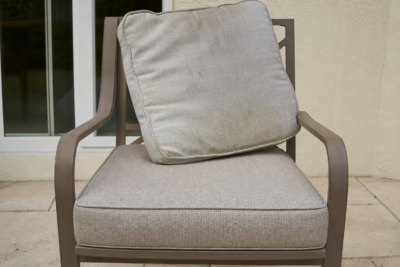
Where to Buy Replacement Patio Cushions: 5 Ways, Compared
Five ways to replace patio cushions — the set maker’s parts program, seasonal aisles, universal-fit listings, specialists and measured custom — plus the Home Depot house-line route with 31 measured collections.
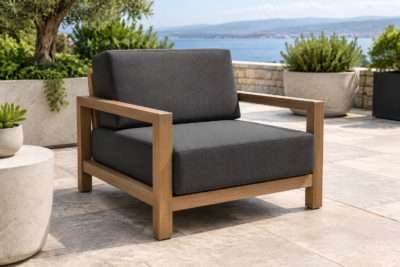
Why Is Patio Furniture So Expensive? The Cost Anatomy, Explained
What actually drives patio furniture prices — weatherproof materials, UV-stable finishes, marine-grade hardware, freight on bulky goods, and seasonal retail economics — why the good stuff costs 3-5x the box-store set, and where the value concentrates.
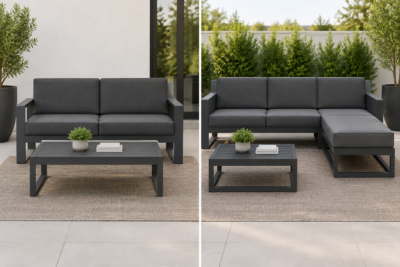
Patio Set vs Buying Separately: The Real Trade-offs
Buying a complete patio set versus assembling pieces: price coherence and one-click convenience versus fit-to-space precision, mixable quality and replacement flexibility — how to decide, and the hybrid strategy that captures both sides.
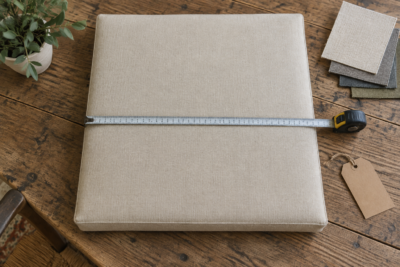
How Much Do Custom Cushions Cost? Price Ranges by Shape (2026)
Custom cushions cost USD 50-400 depending on shape, size, density and fabric. Live factory-direct price ranges for bench, window seat, outdoor, sofa and boat cushions — and how to price your own.
Outdoor Cushion Foam: Density and Thickness Guide With Real Numbers
Short answer: for a daily-use outdoor seat, order 3 inches of foam at 50D–60D; move to 4 inches and 60D