
Replacing the foam in couch cushions comes down to three numbers and one fork in the road: the density (which buys the years), the thickness (which sets the height), the cut size (which decides the fit) — and whether you order the bare core or rebuild the whole cushion, core and cover together. For a daily-use couch the short version is: 50D or 60D foam, the same thickness as the old core, the old core’s dimensions plus half an inch of compression allowance on width and depth. If your covers are still sound, that order revives the couch for a fraction of a full re-cushion; if the covers are part of what failed, the same measurements price a complete replacement. This guide is the buying side — what to order, in what size, at what price, from which kind of seller. The hands-on work of swapping cores is covered step by step in our DIY replacement guide.
First, Make Sure It Is Actually the Foam
Sixty seconds of diagnosis before any money moves:
The press test. Push hard into the center of a seat. Living foam springs back in a second or two; dying foam stays dished. One slow cushion means one replacement; a whole couch of them means the set.
The cover test. If the fabric is split, stretched out, or just hated, new cores only fix half the problem — the fresh foam goes back inside the same tired bag. Full cover-or-core thinking belongs in the decision.
The frame test. Sagging that comes from broken webbing or a cracked deck mimics dead foam, and no replacement core fixes furniture. The full diagnostic sequence is in how to fix sagging couch cushions.
Foam replacement is the right buy when covers are sound, the frame is sound, and the cores press flat. That describes a lot of couches — which is why an entire industry exists for exactly this order.
Density: The Spec That Buys Years
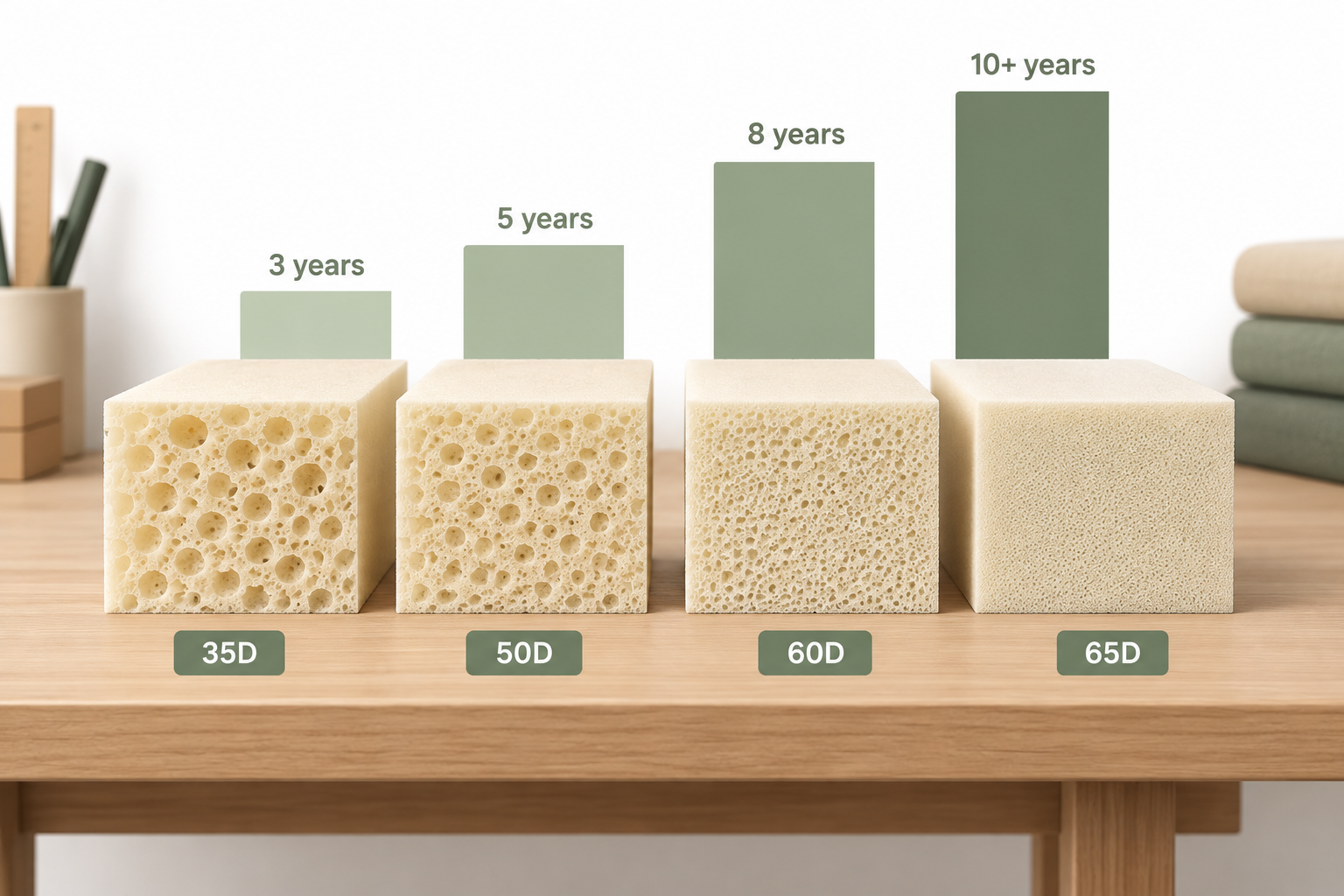
Density is the number that decides how many years the new core holds its shape — firmness is a separate dial. The four grades we cut, and what each one is for:
| Grade | Order it for | Expected service life | Cost vs 35D |
| 35D | Guest-room pieces, decorative seats, lightly-used couches | ≈3–5 years if sat on daily; much longer rarely sat on | — |
| 50D | Daily-use seating — the grade most orders ship in | ≈5–8 years of family use | A few dollars per seat |
| 60D | Long daily hours, heavier sitters, the main couch in the house | ≈8–10 years | A few dollars more again |
| 65D | Heavy commercial duty, reception furniture, marine work | 10+ years — outlasts the fabric | Still single-digit dollars per seat |
Our cutting-floor recommendation for a couch that is the household’s everyday furniture: 60D in the seats. The upgrade over 50D costs single-digit dollars per seat on most blocks and buys eight-to-ten years instead of five-to-eight — the cheapest durability in the whole order. The full decision table, including how each grade fails, is in how to choose foam density; what the D system physically measures is unpacked in D-ratings vs lbs/ft³ and the high density couch guide.
Thickness and Cut Size: Spec the Order in Four Numbers
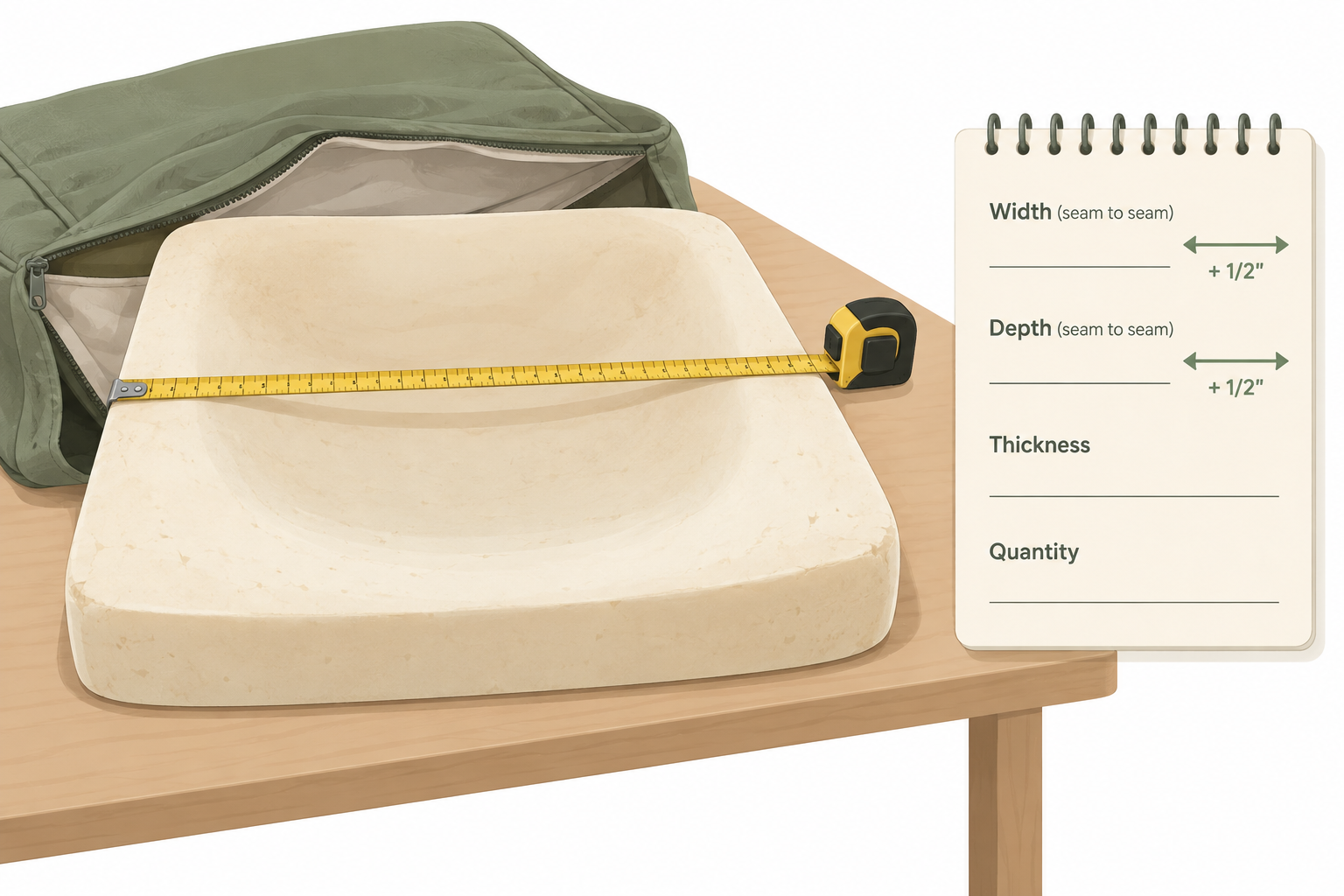
A foam order is four numbers: width, depth, thickness, quantity. Getting them right:
Measure the old core, not the cover. Unzip, pull the core out, and measure it seam to seam at its tightest points, to the nearest quarter inch. The cover’s loose outer dimensions lie; the old core’s cut is what fit.
Add the compression allowance. Half an inch to width and depth (a quarter inch for very firm grades), thickness exactly as measured. Foam compresses into covers — the squeeze is what keeps the cushion filled out and corners sharp.
Count the blocks. A standard three-seat couch is usually three seat cores plus two or three back cores. Seats and backs are different orders: seats take the beating, backs mostly need loft. Many households replace seat cores only and get the couch back.
Sketch anything not rectangular. T-cushions and notched corners take a labeled drawing rather than three numbers — inside corners are exactly where specifications go wrong. Our measuring walkthroughs for T-cushions and straight rectangles cover both cases, and the full cut-to-size method is in sofa foam cut to size.
Four Ways to Buy, Compared
Every seller of replacement foam is one of four animals:
| Channel | Best for | Watch out for |
| Cushion workshops (cut core, sew cover, one order) | Dead foam plus tired covers; odd shapes; whole sets | Higher entry price than a bare core — but one order rebuilds everything |
| Online foam warehouses (bare cores, cut to your numbers) | Sound covers, DIY finishers, exact known dimensions | Nobody checks your numbers; a typo becomes your new cushion |
| Local upholstery suppliers (walk in with the old core) | Match-while-you-wait, no measuring confidence needed | A dished original copies its own death into the new block; prices run higher |
| Foam sheets from craft chains (cut it yourself) | Bench cushions, thin pads, patient DIY hands | Stocked grades are craft weights, not 50–65D seating cores |
The channel-by-channel deep comparison — including what each seller type charges per cubic foot — is in where to buy foam for couch cushions, and the home-cutting route is walked in how to cut foam. We sit in the first row: a cushion workshop that cuts cores to order and can build the complete core-plus-cover unit in the same order — couch foam cushions is the product page.
What Replacement Foam Actually Costs
Rather than ranges, a worked example at our real rates — a typical 24 × 24 × 3 seat cushion, formula and current sheet explained in custom cushion pricing explained (one flat $45 order base, plus top area × a foam rate set by the density-thickness grade, plus fabric at a flat $7.43 per square foot):
| One 24 × 24 × 3 seat, any fabric | The math | Total |
| 50D | 4.0 sq ft × ($19.94 + $7.43) + $45 | ≈ $154 |
| 60D | 4.0 sq ft × ($24.56 + $7.43) + $45 | ≈ $168 |
| 65D | 4.0 sq ft × ($26.37 + $7.43) + $45 | ≈ $180 |
Notice what the density upgrade actually costs: about fourteen dollars per seat from 50D to 60D. On a three-seat couch the whole set lands near $509 in 50D or $559 in 60D — because the $45 base is charged once per order, not per cushion. Bare cores from foam warehouses price differently, by the cubic foot (published 2026 factory sheets run roughly $17–35 for standard grades and $47–59 for high-resilience seating foam), and stop making sense once more than two blocks are dead or the covers have failed too — that crossover math is worked in sofa foam replacement cost and replacement cushions vs a new couch.
The Pre-Order Checklist
Before submitting any foam order, to anyone:
1. Press test done — the cores, not the frame or covers, are what died.
2. Density chosen by the hours the couch actually serves (50D default, 60D for the everyday main seat).
3. Old core measured seam to seam, not the cover’s outer edge.
4. Half-inch allowance added to width and depth; thickness exact.
5. Every block counted — seats and backs listed separately.
6. Non-rectangular shapes sketched and labeled.
7. One decision made: bare core, or core plus cover as one order.
And pick a seller who asks about your odd numbers instead of cutting them. We re-verify every dimension against our database before anything is cut — odd numbers get a phone call, not a guess. That policy costs us a day sometimes and saves a re-buy always.
FAQs
How much does it cost to replace couch cushion foam?
For a complete 24 × 24 × 3 seat cushion — new core, new cover, sewn and fitted — expect roughly $154 in 50D, $156 in 60D and $160 in 65D at our current rates, with one flat $45 order base shared across the whole set. Bare foam cores bought by the cubic foot run cheaper per block but assume your covers are staying and you finish the job yourself.
What density foam is best for couch cushions?
50D for most households; 60D where the couch carries long daily hours or heavier sitters — on most seats the 60D upgrade is about fourteen dollars and doubles the expected service life from 5–8 years to 8–10. 35D belongs in rarely-sat furniture and 65D in commercial duty.
Can I buy just the foam without a new cover?
Yes — foam-only orders are a real category, and online foam warehouses specialize in them. We cut bare cores to your numbers, but the same measurements can also price a complete core-plus-cover cushion, which is the better buy once more than two blocks are dead or the fabric has failed.
Should I replace all seat cushions at once?
Matched pairs and sets should move together — mixing a fresh firm core beside a tired one both looks and feels wrong, and the old blocks keep aging faster. If the budget forces a sequence, replace paired seats first and backs later; a full set ordered together also shares one order base instead of paying it twice.
How do I measure foam for existing cushion covers?
Unzip and remove the old core, measure it — not the cover — seam to seam at the tightest points to the nearest quarter inch, then add half an inch to width and depth (a quarter inch for very firm grades) and order thickness exactly as measured. The compression is what keeps the new core filling the cover out.
Will new foam make my couch firmer?
Not necessarily — density and firmness are independent specs. A 60D core can be cut softer than a 35D one; what density buys is years, while firmness (the ILD rating) is a separate dial explained in our ILD guide. If the old couch felt right, matching the old core’s grade and firmness reproduces it; if it always felt too soft, say so when ordering — foam is specified, not guessed.
How long does a replacement cushion order take?
Our current lead times: standard production runs 4–7 days, rush production 3–5 days, and shipping adds 3–6 weeks — cut and sewn on our floor, shipped factory-direct with nothing resold in between.
Is replacing the foam worth it, or should I buy a new couch?
If the frame is sound and the covers are sound or replaceable, re-foaming wins on economics nearly every time — a full set of new cushions costs a few hundred dollars against four figures for a quality replacement couch. The honest crossover points, including when a new couch is the right call, are worked through in replace sofa cushions vs buying a new sofa.
Next Steps
1. Run the three tests — press, cover, frame — and confirm the cores are the failure (diagnosis here).
2. Measure each core seam to seam, add the allowance, and pick the density the couch’s hours deserve.
3. Price it both ways — bare core or complete cushion — at custom cushions, or start from the couch foam cushions product page. Nothing is cut until your numbers are confirmed.
Where to Buy Replacement Patio Cushions: 5 Ways, Compared
Five ways to replace patio cushions — the set maker’s parts program, seasonal aisles, universal-fit listings, specialists and measured custom — plus the Home Depot house-line route with 31 measured collections.
Why Is Patio Furniture So Expensive? The Cost Anatomy, Explained
What actually drives patio furniture prices — weatherproof materials, UV-stable finishes, marine-grade hardware, freight on bulky goods, and seasonal retail economics — why the good stuff costs 3-5x the box-store set, and where the value concentrates.
Patio Set vs Buying Separately: The Real Trade-offs
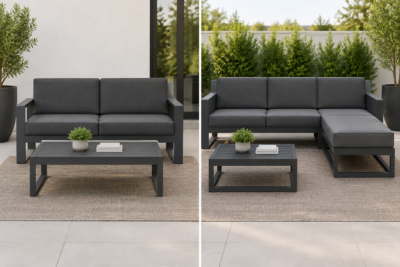
Buying a complete patio set versus assembling pieces: price coherence and one-click convenience versus fit-to-space precision, mixable quality and replacement flexibility — how to decide, and the hybrid strategy that captures both sides.

How Much Do Custom Cushions Cost? Price Ranges by Shape (2026)
Custom cushions cost USD 50-400 depending on shape, size, density and fabric. Live factory-direct price ranges for bench, window seat, outdoor, sofa and boat cushions — and how to price your own.
Outdoor Cushion Foam: Density and Thickness Guide With Real Numbers
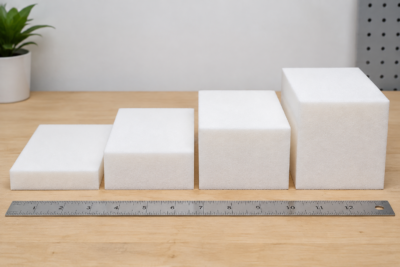
Short answer: for a daily-use outdoor seat, order 3 inches of foam at 50D–60D; move to 4 inches and 60D
Local Upholsterer vs Online Custom Cushion Shop: Cost, Lead Time & How to Choose
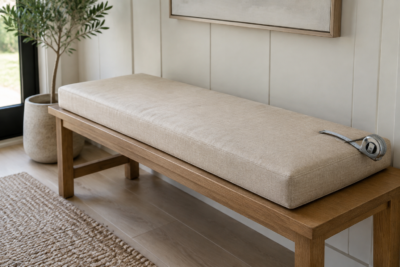
Deciding where to get custom cushions made? The honest comparison of a local upholsterer versus an online custom cushion shop — cost stacks, lead-time clocks, fabric selection and who should choose which.