
Every foam seller says “high density.” Almost none of them say a number — and a density claim without a number is not a specification, it is a mood. This guide is the antidote: what density physically is, how to read it, what each grade does on a real couch, and what the grades cost. It is written from the cutting floor, where density is the first number on every work order and the last thing you can upgrade after the cushions are sewn.
The stakes are simple. Furniture brands discontinue indoor series every few years, and replacement channels die with them — so couch foam gets replaced on measurement, not on model numbers, for as long as the frame holds (how that works). Measured replacement means you choose the density. Choosing it blind is how people end up re-foaming the same couch every three years; choosing it on the numbers is how a one-afternoon project buys a decade.
What Density Actually Measures
Foam density is the weight of polymer per cubic foot of foam. More polymer per cubic foot means thicker cell walls, more material doing the work of carrying you, and slower aging under the same load. The industry writes it two ways:
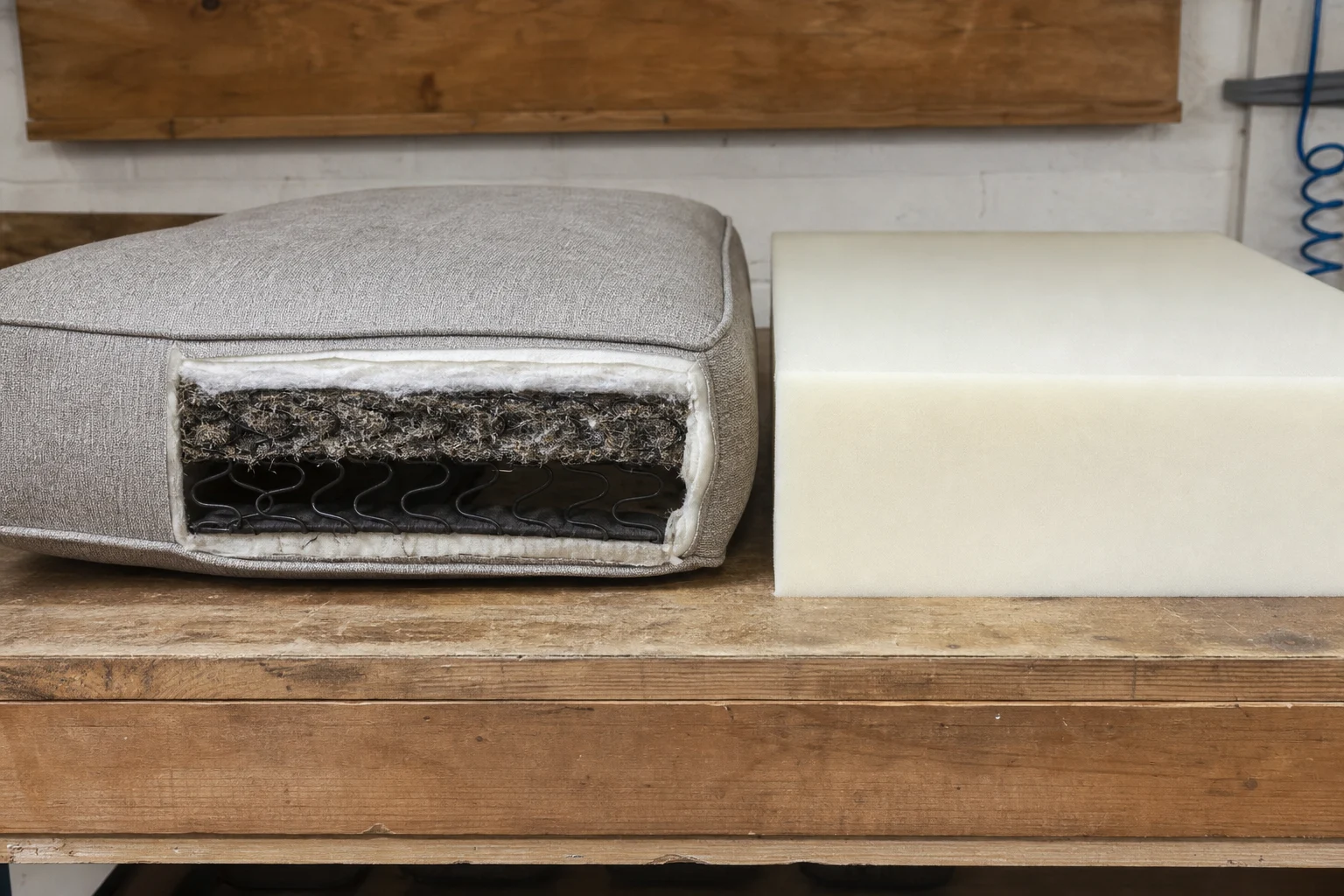
- – The ×10 convention: 35D, 50D, 60D, 65D — divide by ten for pounds per cubic foot (35D ≈ 3.5 lb/ft³). This is the convention on cut-to-size order forms and the one this guide uses.
- – Direct pounds: 3.5 lb/ft³ — same number, different dress.
Two foams can look identical, feel identical in the showroom, and age at entirely different speeds, because density is invisible at first sit. It only shows up as dishing, body prints and bottoming-out two summers later. That is the entire commercial logic of cheap couches: under-specified cores demo beautifully and die on schedule.
One clarification that saves confusion later: memory foam uses its own density scale, read directly in pounds, and its grades do not translate line-for-line to seat foam — the two materials are compared properly in memory foam vs regular foam.
Density Is Lifespan. ILD Is Comfort. They Are Independent.
The single most expensive misconception in this category is that “high density” means “hard.” It does not. Density and firmness are two separate dials:
- – Density (the D number) — how much material is in the foam. Sets lifespan and load recovery. A high-density foam can be cut soft.
- – Firmness (ILD, indentation load deflection) — how many pounds it takes to compress the foam a set amount. Sets the feel: lower ILD is softer, higher is firmer, at any density.
So you can have a 60D core that yields like a favorite chair and a 30D core that feels like a park bench — the first one lasts a decade, the second one dishes in seasons. When a couch felt “too hard,” the problem was usually an ILD mismatch, not too much density; when it went flat, that was always density. The full two-dial explanation lives in cushion filling types and memory foam vs regular foam; the working rule for couch seats is roughly 24–35 ILD for comfort, with density chosen by who sits on it and how often.
This is also why “firm cushion” and “supportive cushion” are not synonyms. Support is the foam’s ability to push back under load, year after year — that is density plus correct thickness. Firmness is the first-second impression. Buy the impression with ILD; buy the years with density.
The Grades, Ranked: 35D to 65D
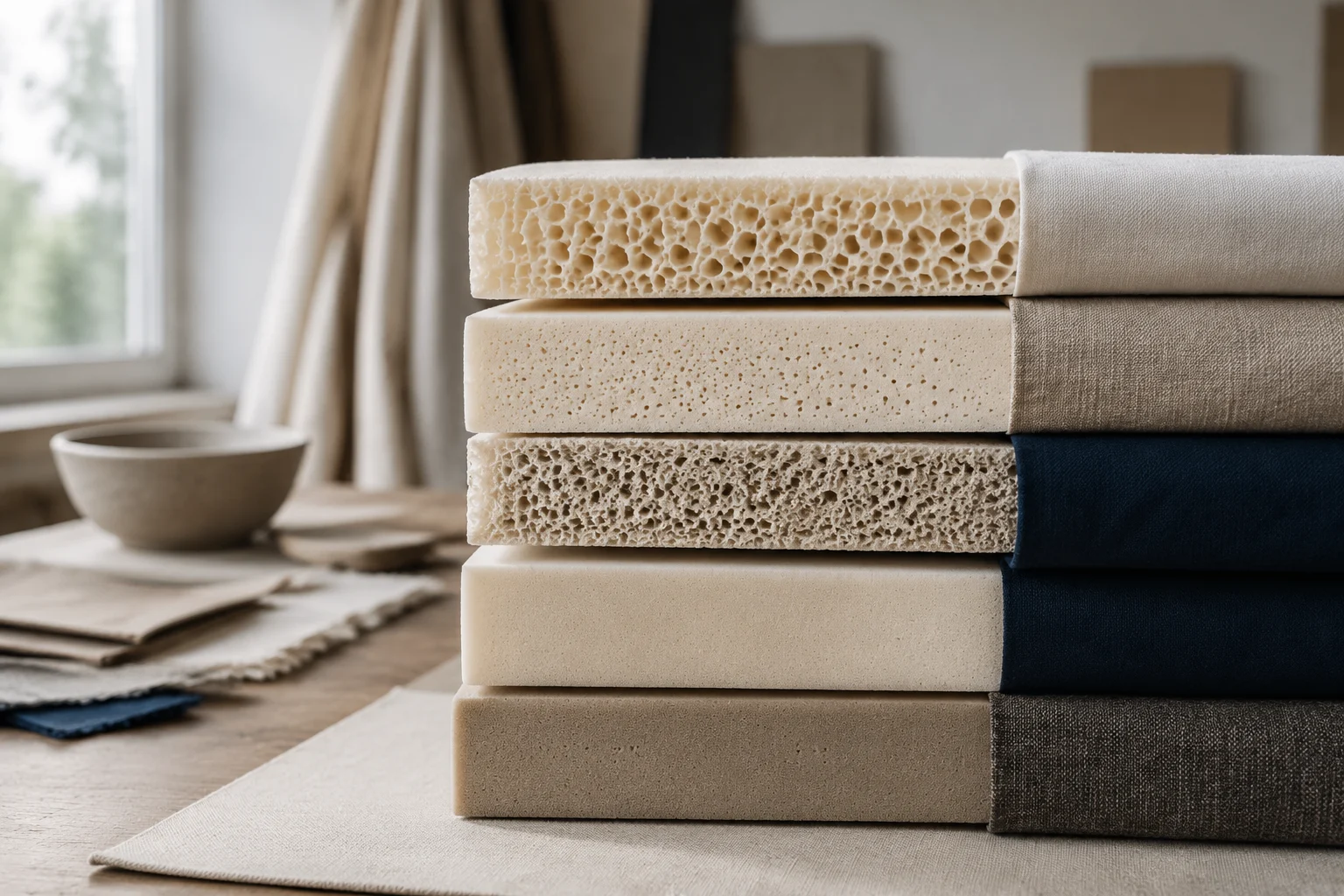
Foam for couch seating spans a wide band; here is how the grades actually behave in a living room, from the lightest spec we cut to the heaviest:
| Grade | Class | What it does on a couch |
| 35D | Standard seating grade | The entry spec for daily-use seating. Comfortable, honest, and the right economy for guest rooms and lightly-used furniture; an every-evening couch in this grade will slowly lose loft years before a 50D core does. |
| 50D | Frequent-use seating | The default for the couch that gets sat on nightly. Holds loft and rebound for years of family use; the grade most replacement cores should be. |
| 60D | Heavy seating | For big frames and heavier loads — tall households, deep-seat couches used as everyday furniture, anyone tired of re-foaming. Noticeably slower aging than 50D under the same load. |
| 65D | Commercial heavy-duty | Bar stools, reception furniture, rentals and trampoline-grade households. On a home couch it reads as a tank: nearly impossible to bottom out, and it will outlast the fabric around it. |
Two reading notes. First, the seating-band convention you will see across guides — premium seating grade around the mid-30s to low-40s, commercial heavy-duty grade above that — describes the same territory: the honest daily-use band is 45–60D, which on our cutting list means 50D and 60D. Second, below the table entirely sit the 18–24D craft-store grades, which dish within a season or two of real sitting; they exist for projects nobody sits on, and they are the reason “foam” has a reputation for dying young.
The failure that separates these grades is compression set: cells collapse under repeated load, the cushion keeps the dent, and loft does not come back. Higher density means more polymer per cell wall resisting exactly that collapse. The failure mode and its five-second home test — press hard, release, count the seconds to rebound — are covered in how to fix sagging couch cushions; cores that stay dented are dead at any age, and no rotation schedule revives them.
How to Match Density to Your Couch
Three questions, in order:
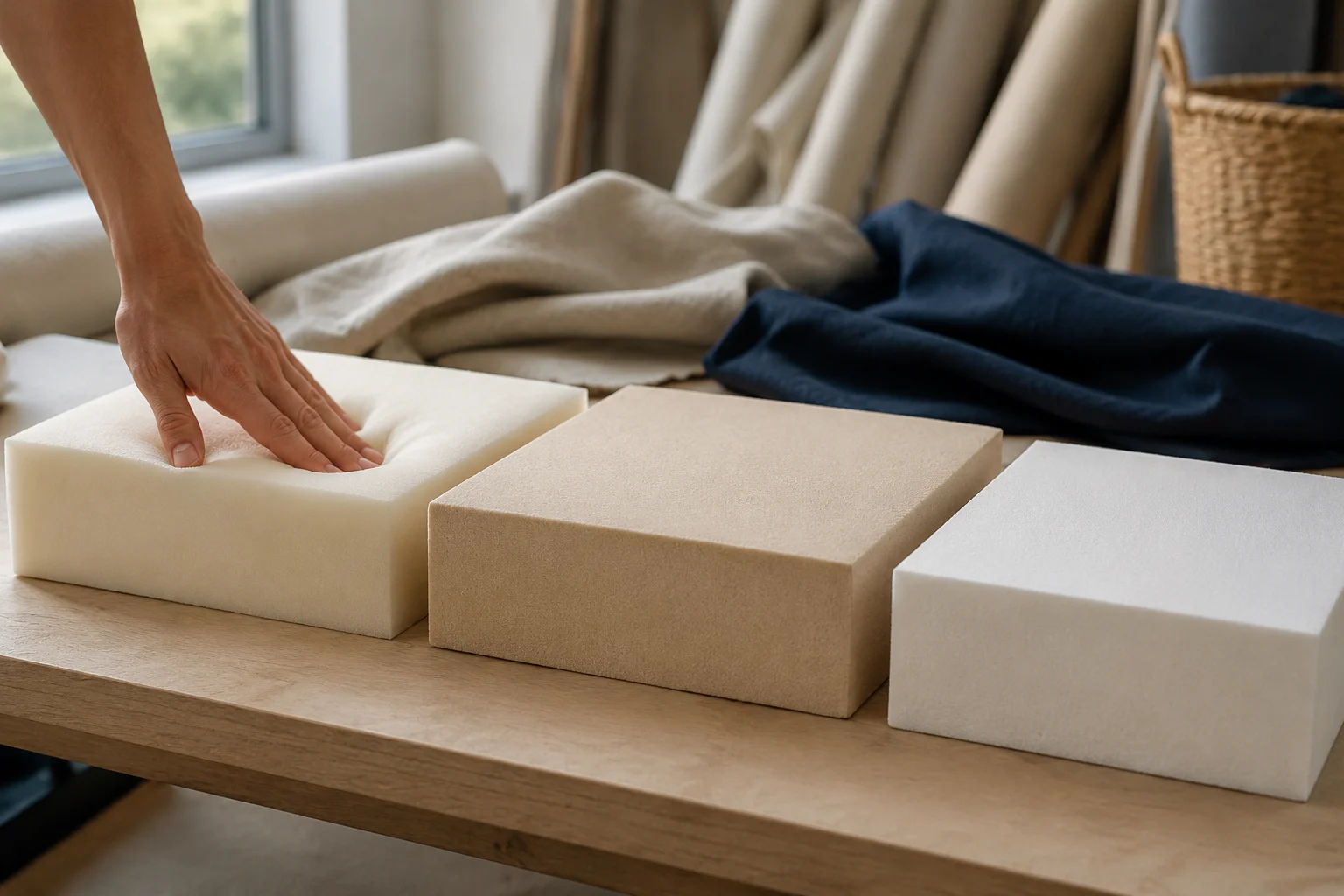
1. How many hours a day does it get sat on? A den couch used every evening wants 50D minimum; a formal living room nobody enters wants 35D and will never know; a family-room couch that doubles as a homework desk, dining bench and wrestling ring wants 60D.
2. Who sits on it? Load matters more than hours. Higher loads concentrate wear — for heavy sitters or tall households, one grade up from your instinct (50D instinct, 60D order) is the cheaper decision every time, because the upgrade costs dollars and a re-do costs the whole project.
3. How long are you keeping the frame? Measured replacement exists because frames outlive brands (discontinued furniture). If the frame is good for another decade, feed it 50–60D cores and the cushions age at the frame’s pace instead of the industry’s.
Thickness interacts with density, and thickness is the more visible spec: standard seats run 4–5″ and deep seats 5–7″, and new cores should match the old thickness — a thinner core leaves baggy covers, a thicker one fights them. The measurement walkthrough, including the 1/2″ compression allowance, is in sofa foam cut to size.
What Density Costs
Density is the cheapest durability money can buy. Our cushions price from a $45 make-base plus area at per-sqft rates — foam rate by density and thickness grade, one flat fabric rate — with no surcharge for shape. The foam rate moves in a band from $15.99 to $31.47 per square foot across the list; the density dimension of it looks like this at a 24×24 seat (4 sq ft, any of the 119 fabrics at $5.94/sq ft):
| Core | Foam rate | Cushion math | Price |
| 35D, 4″ | $19.52/sq ft | $45 + 4 × (19.52 + 5.94) | ≈ $144 |
| 50D, 4″ | $20.57/sq ft | $45 + 4 × (20.57 + 5.94) | ≈ $148 |
| 60D, 4″ | $21.21/sq ft | $45 + 4 × (21.21 + 5.94) | ≈ $151 |
| 65D, 4″ | $22.27/sq ft | $45 + 4 × (22.27 + 5.94) | ≈ $155 |
Read the band, not the line items: going from 35D to 65D — the entire ladder — costs about seven dollars on a standard seat. Upgrading one grade costs about the price of a coffee. Thickness moves the rate faster than density does (an 8″ 65D core reaches the $31.47/sq ft top of the band), the flat fabric rate moves the total just as visibly, but density is nearly free. When a seller’s “high density” costs dramatically more than their standard grade, you are paying for marketing, not polymer.
This is also the honest answer to “why did my couch cushions die so fast”: they were almost certainly cut at a grade below what the couch’s real use demanded, and the brand counted on you not asking. The fix going forward is not a better brand — it is a number on the order form.
The Same Grades, Other Furniture
The ladder is not couch-specific. Dining chairs take the same foam at 2.5–3″ thickness and usually the standard grade — seats used an hour a day do not need nightly-use specs (dining chair cushion replacement). Window seats and banquettes, sat on casually, sit at 35D–50D; reading nooks and deep loungers follow the couch logic (window seat cushions; indoor bench cushions). The method never changes: hours and load pick the grade, the frame picks the shape, and the tape measure does the rest.
Density Claims to Disbelieve
- – “High density foam” with no number. Meaningless; ask for the D grade or the lb/ft³. A seller who knows their foam states it.
- – “Firm foam is better foam.” Firmness is ILD, quality is density — a rock-hard 25D core dies young while feeling expensive in the showroom.
- – “Memory foam is the highest density.” Memory foam uses its own scale and makes a poor seat core on its own; its proper seat role is a 1–1.5″ topper over an HR base (the comparison).
- – “Density above 65D is even better for couches.” Above the heavy-duty band you pay for mattress-grade and marine-grade specs a couch cannot use; the band exists because loads exist in bands.
FAQs
What density foam is best for a couch?
45–60D for a couch used daily — which lands on our 50D and 60D grades; 35D is the honest economy grade for lightly-used furniture, and 65D is commercial heavy-duty. Density is lifespan, not firmness, so it is chosen by hours and load, not by preferred feel.
Is high density foam worth it for sofa cushions?
Yes, because density is nearly free: moving from 35D to 65D — the entire ladder — adds roughly seven dollars to a standard 24×24 seat at our rates, while doubling-plus the years before the core dishes.
What does 50D foam mean?
About 5.0 lb of polymer per cubic foot in the ×10 convention — the standard grade for nightly-use couch seating; the number predicts lifespan and rebound, while the separate ILD number predicts softness.
Does high density foam feel hard?
No — density and firmness are independent; a 60D core can be cut at a soft ILD and a low-density core can feel like a board. “Hard” is an ILD question, “lasts” is a density question.
How long does high density couch foam last?
Daily-use cores in the 45–60D band hold their loft for many years of nightly use — the mid-30s grades run roughly a 5–10 year service window in seating, with 18–24D craft grades dishing within a season or two; above the band, 65D outlasts the fabric around it.
Where can I buy high density foam for couch cushions?
Three real options: local foam suppliers (walk in, cut while you wait), online foam cutters (you send measurements), and cushion factories like this one — we ship foam-only cores cut to your numbers in 4–7 business days, 50D from $45 make-base plus area. What you are actually comparing is tolerance and grade: a core cut to ±¼ inch beats a sheet you trim yourself with a bread knife.
Is high density foam the same as high density polyurethane (PU) foam?
Yes — in furniture, high density foam is polyurethane foam by default. “HD” describes the density (we quote 35D–65D); “PU” describes the material. The two labels point at the same block of foam from two directions.
What is high density furniture foam used for beyond couches?
Seat cushions, bench pads, window seats, dining chairs, RV and boat seating — any core that carries weight on a frame. Rule of thumb: daily seating wants 50D or better, occasional and decorative pieces can run 35D.
Is high density foam the same thing as upholstery foam?
Upholstery foam is the trade name for the same family — polyurethane seating grades from roughly 1.5 to 3.0 lb/ft³, which is exactly where our 35D–65D cores sit. Marketing labels differ by supplier; the number that predicts lifespan is density.
Next Steps
- Test your current cores — the five-second rebound test in how to fix sagging couch cushions tells you whether density already let you down.
- Pick the grade by hours and load using the table above, then measure every block with how to measure.
- Price your cores — the density ladder costs dollars, not hundreds, at custom cushions; every order is re-verified against your numbers before anything is cut. Custom sofa cushions is the category page for couch work, with the density grades and indoor fabric tiers laid out together.
Patio Chair Cushions: The Complete Buying Guide (Outdoor Too)
Everything that decides a patio or outdoor chair cushion — sizes, thickness, ties, fabric tiers and where each buying route wins. Custom from $45 when grids fail.
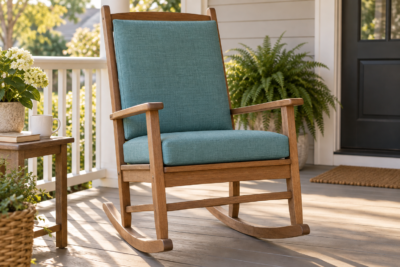
Outdoor Rocking Chair Cushions: The Weatherproof Guide to Sizes and Fabrics
An indoor rocking cushion dies fast on a porch. The sun bleaches the print in a single season, the foam
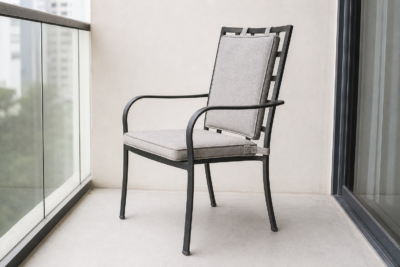
Cushions for Metal Patio Chairs: Frame Types, Grip and the Heat Question
Cushions for metal patio chairs guide: wrought iron, aluminum and steel frames and what each means for pads, sliding on slick metal, heat absorption in sun, sizing across mixed metal sets, and the outdoor duty spec.
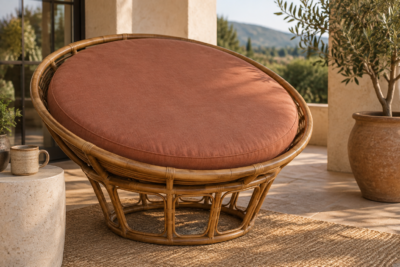
Outdoor Papasan Cushions: Weathering the Big Round
Outdoor papasan cushions fail in a known order — fabric, fill, bowl. The overhang-vs-inset diameter decision, fiber vs foam outdoors, and the honest line between a flat round and the concave original.
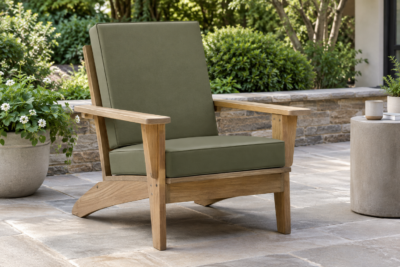
Adirondack Chair Cushions: Sizes, Selection & Replacement Guide
Adirondack cushion sizes decoded: 20×20 seats, tall-back options, tie patterns, best fabrics — plus fitting odd or vintage chairs.
Double Chaise Lounge Cushions: Two-Position Geometry and Shared Lounging
Double chaise lounge cushion guide: back-to-back and side-by-side layouts, measuring two lounging positions in one piece or two, fill for shared daily lounging, and outdoor fabric for a full-sun centerpiece.