
A window seat is the one cushion in your house where the fit is the whole point. There is no arm to hide a sloppy edge, no skirt to forgive an inch of error — just a long, visible rectangle sitting in a frame of wood or drywall. When it fits, it reads like millwork. When it does not, everyone who walks in the room sees it.
The measurement challenge is also different from patio cushions: window seats are often longer than any stock cushion, frequently have radius corners or angled bays, and have a hard constraint patio furniture does not — the sill above. Here is how to measure one the way our order desk likes to receive them. For general width/depth/thickness basics, see how to measure outdoor cushions; the same three-number discipline applies indoors.
Step 1: Measure the Seat Width (Three Readings, Always)
- Measure the clear width of the seat deck wall to wall (or frame to frame), at the very back where the seat meets the wall.
- Measure again at the middle and at the front edge.
- If all three match within 1/8″, you have a straight seat — record one width.
Why three readings: interior walls are rarely square, and alcoves are often narrower at one end. A cushion cut to the back measurement will bind at the narrow end; a cushion cut to the average will gape at one end. When readings differ:
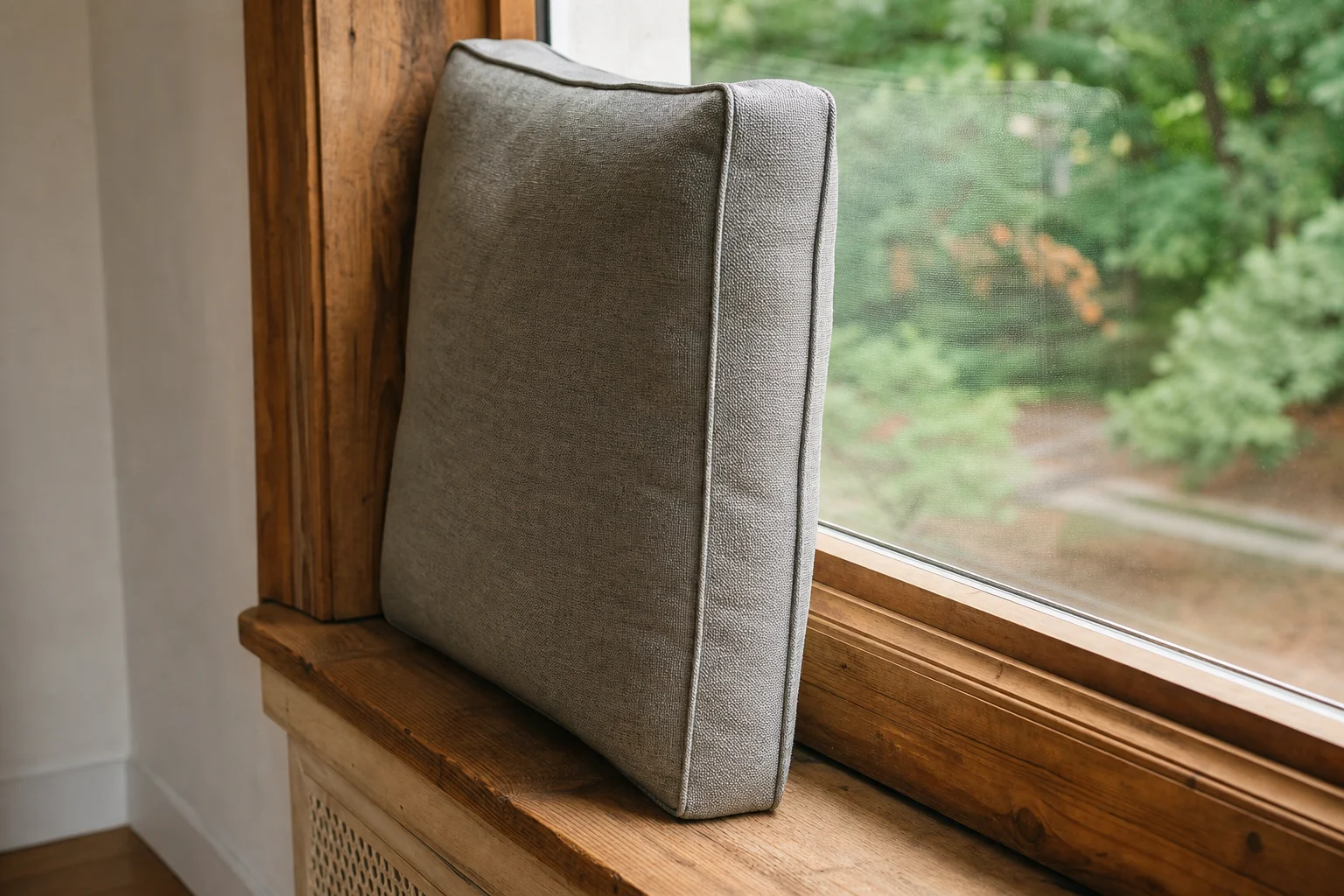
- – Difference under 1/2″: order the smallest width. Foam eases outward slightly and will fill the wider end naturally.
- – Difference over 1/2″: record front and back widths separately — that is a trapezoid, and our cutting forms take both numbers.
Step 2: Measure the Seat Depth
Measure from the wall (or the inside face of any back panel) to the front edge of the seat deck.

- – Keep the tape level and flat, especially on seats with a slight slope.
- – Do not include any front lip or apron below the deck — measure to where the cushion actually ends.
- – Typical window seat depths run 16″–24″. Deeper than 24″ usually means the seat was built for storage below rather than sitting, and worth noting because a very deep cushion (26″+) wants a firmer foam grade to stop it from compressing into a valley in the middle.
Step 3: Choose Thickness — the Sill Is the Ceiling
Thickness on a window seat is governed by the window sill above:
- Measure from the seat deck up to the bottom of the sill (or the window frame if there is no sill projection).
- Subtract the height you want between cushion top and sill. Most people want 3″–5″ of clearance — enough that the cushion does not visually crowd the glass, and enough headroom to sit without the sill hitting your shoulder.
- What remains is your maximum thickness.
Common outcomes: a 36″ clearance with a 30″ seat height target leaves a 5″–6″ cushion, which is the plush, reading-nook feel. A low 12″ sill-to-deck span forces a 3″ cushion, which is fine with dense foam (a 3″ layer of 50D+ high-resilience foam feels firm and supportive, where 3″ of soft foam feels like a pad).
Foam density matters more on window seats than almost anywhere, because people sit on them for long stretches and always in the same spot. The density grades we cut with and how they differ are covered in memory foam vs foam cushions — the short version: 35D minimum for a seat you will actually use, 50D+ for a favorite reading spot.
Step 4: Check the Corners
Window seat decks are frequently finished with rounded or bull-nosed front corners:
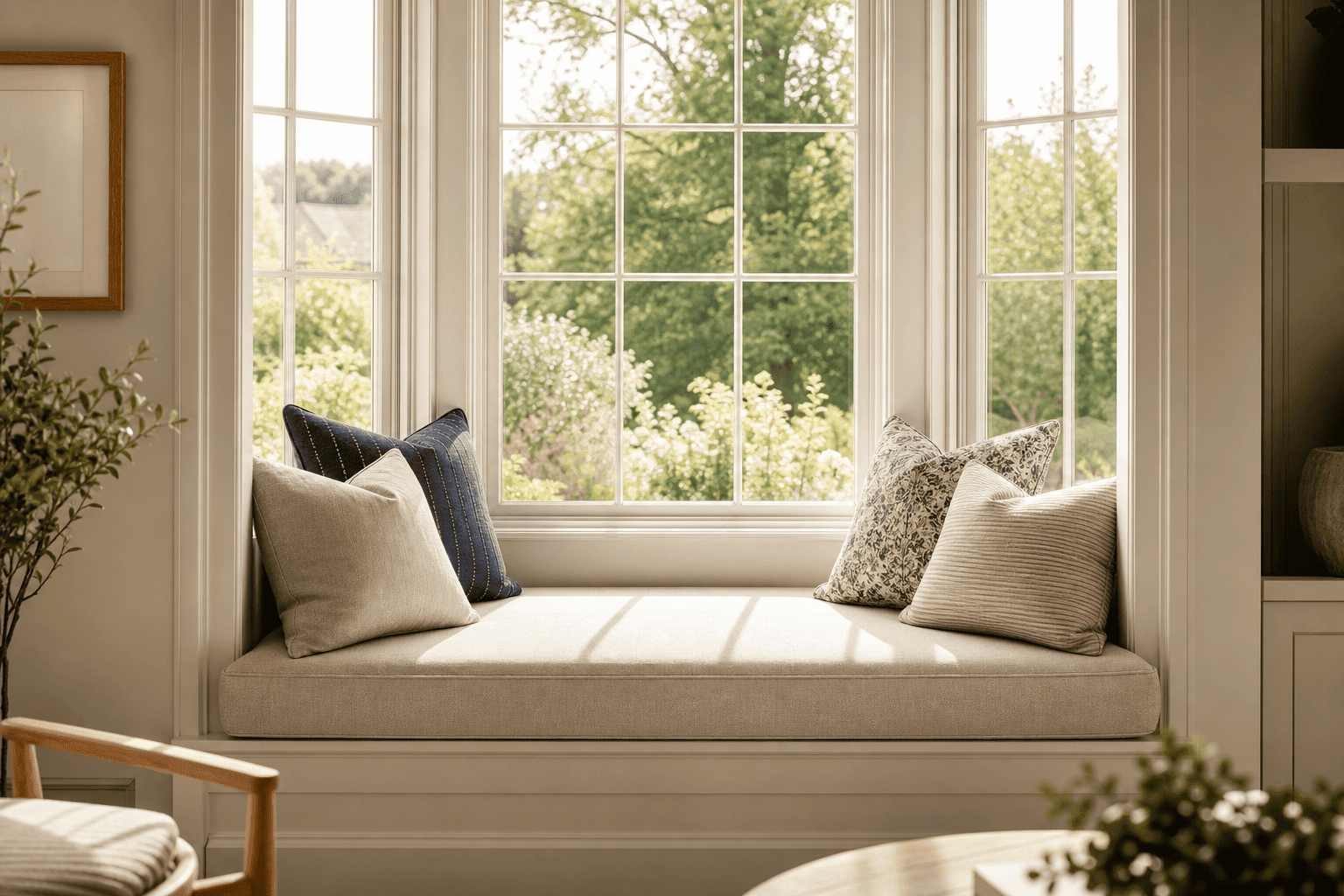
- Slide a rigid card into the corner until it touches both the side wall and front edge.
- The distance from the card corner to first contact with the curve is the radius.
- Record the radius for the front corners; back corners against the wall are almost always square.
If you skip this, a square-cut cushion on a rounded deck will show 1″–2″ of bare deck at each corner — the most common reason we re-cut window seats.
Step 5: Special Case — Bay Window Seats
Bay windows are three (or five) angled segments, not one cushion:
- Measure each segment’s width separately, wall junction to wall junction.
- Measure the angle between segments if you can (a cheap angle finder, or photograph the joint with the tape laid across it).
- Decide: one cushion per segment (cleanest look, easiest replacement), or one continuous cushion (comfortable for lying across, requires a template).
For continuous bay cushions, a paper template is mandatory, not optional — the angles vary bay to bay, even in the same house. Tape kraft paper over the whole deck, trace every edge and junction, fold and mail it. Templates go straight to the cutting floor and are traced, not converted to numbers, which is why odd geometry is no obstacle for custom cushions orders — bay-specific builds start at custom bay window cushions.
Step 6: Practical Details That Affect the Sewing
- – Non-slip or ties: window seats have no frame to hold a cushion, and our cushions ship with neither sewn on. The working retrofits: a loose non-slip underlay beneath the pad, ties added from the pad to screw eyes under the deck ( how to add ties to cushions ), or a wrapped “cover with boxing” style that grips. Most customers go with the underlay.
- – Fabric choice: indoor sun exposure through glass is real — UV fades upholstery fabric faster than most people expect. Solution-dyed acrylic (the construction behind Sunbrella) is colorfast against it; see best outdoor cushion fabric for why the dye method matters.
- – Cleanability: pick the family for how the seat lives — wipe-clean weaves keep the spot-cleaning routine a cloth-and-minute job.
What Does a Window Seat Cushion Cost?
Priced by top area like everything we cut. A common 60 × 18 seat at 4″ thick lands around $158–$163 in standard fabric; a bay of three segments at 90″ total runs proportionally more. The pricing logic — area × fabric tier — is explained in the outdoor cushions price guide, and the custom cushions builder gives live numbers as you enter dimensions; the scenario page is custom window seat cushions.
Design Decisions That Follow the Measurements
Once the numbers are right, three style choices shape how the finished cushion reads — decide them before ordering, because they change the spec:
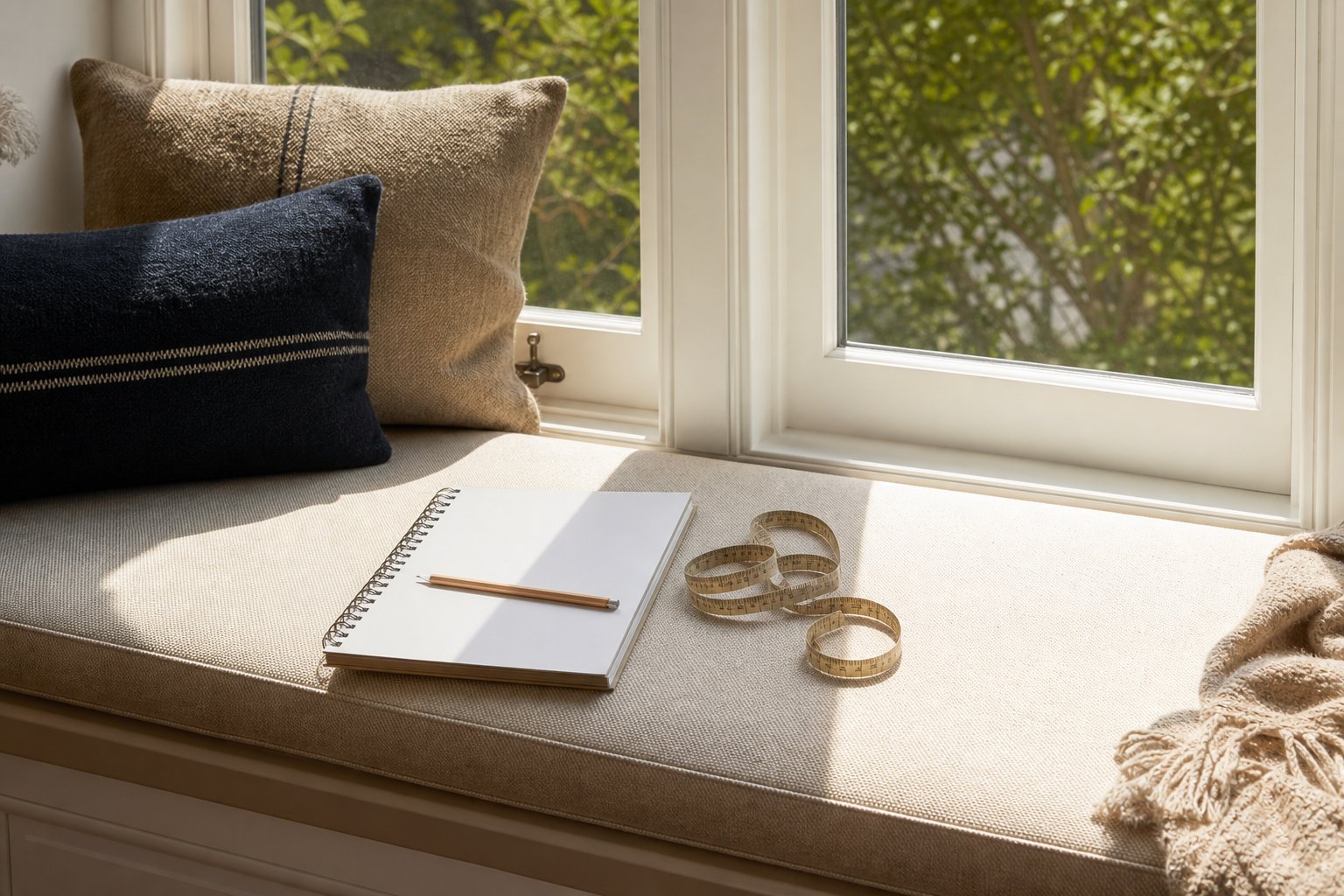
- – Boxed vs knife-edge. A boxed cushion (side panel all around) sits square-shouldered and substantial — the built-in millwork look. Knife-edge (top and bottom sewn directly together) is thinner-looking and suits a minimal profile. At 4″+ thickness, boxed is the only choice that holds its shape; knife-edge works at 3″ and under.
- – One-piece vs split. A 90″ window seat can be one cushion or two 45s. One piece looks cleaner and has no center gap; two pieces is easier to flip, rotate and carry for cleaning (the rotation habits), and survives single-piece damage. Over about 72″, most orders split — handling and seam-stress both argue for it.
- – Piping or no piping. Welt trim gives an edge a crisp line that reads “upholstered” — the difference between “a pad on a bench” and “a built seat.” Our covers come self-finished, without sewn welt; the upholstered read on our builds is carried by stitch choice and true cutting, or by trim a local sewist adds afterward. Visually, it is the highest-leverage design decision in the category.
And the indoor-specific note: window seats adjoin living space, so fabric choice follows interior logic — any upholstery fabric works, but sun-drenched sills still argue for solution-dyed acrylics, which no longer look outdoor-only (color coordination with interiors).
Common Window Seat Dimensions Reference
Sanity-check numbers from real orders — typical alcove and bay geometry:
| Seat type | Typical range | Notes |
| Alcove single | 36–60 × 16–22 | Most common; rectangle + radius corners |
| Bay segment (each) | 24–40 × 16–22 | Three segments typical; angles vary per bay |
| Landing/stair landing | 30–48 × 12–16 | Thin (2–3″) to keep stair code clearance |
| Built-in with storage below | Up to 72 × 24 | Split over 72″ for handling (design notes) |
| Reading nook (thick plush) | Any + 5–6″ thick | 50D+ foam; check sill clearance first |
The measurement method in Steps 1–5 is identical for every row — the table only sets expectations before you measure.
FAQs
How thick should a window seat cushion be?
Whatever leaves 3″–5″ of clearance below the sill — commonly 4″–6″; use denser foam (50D+) at 3″ where a low sill caps thickness.
How do I measure a bay window seat cushion?
Measure each angled segment separately, junction to junction; for one continuous cushion, make a full paper template of the deck and send it with your order.
Should the cushion be exactly as wide as the seat?
Yes — within 1/8″. A window seat has nothing to hide a gap or squeeze a bulge, so order the smallest of your three width readings on slightly out-of-square alcoves.
Can I get a cushion with rounded front corners?
Not cut here — our cushions are square-cornered. Measure the corner radius anyway (card method or template): an oversized square cut can be trimmed and rounded locally, or the numbers travel to a sewist who rounds corners.
Do you make indoor window seat cushions too?
Yes — same cutting floor, any firmness and fabric, including solution-dyed acrylics for sun-drenched sills; start at custom cushions.
How do I measure the radius of a rounded corner?
Rest a carpenter’s square (or any rigid L) against the corner so both legs touch the curve, and measure from the inside corner of the square to the point where the curve first leaves the leg — that distance is the radius. Typical window-seat and bench corners run 1–4 inches. Tighter than 1 inch reads as a square corner to the knife; past 6 inches it is really a curve — see the curve question below.
How do I measure the radius of a curve — bay windows and bowed seats?
For a bowed or bay front, take three depths: measure from a straight edge (a level or taut string) across the seat to the front edge at both ends and at the deepest point of the bow. If the bow is within ±½ inch, numbers alone are enough; beyond that, trace the curve on cardboard and mail the template — we cut to the template.
Depth Runs Glass to Front Edge
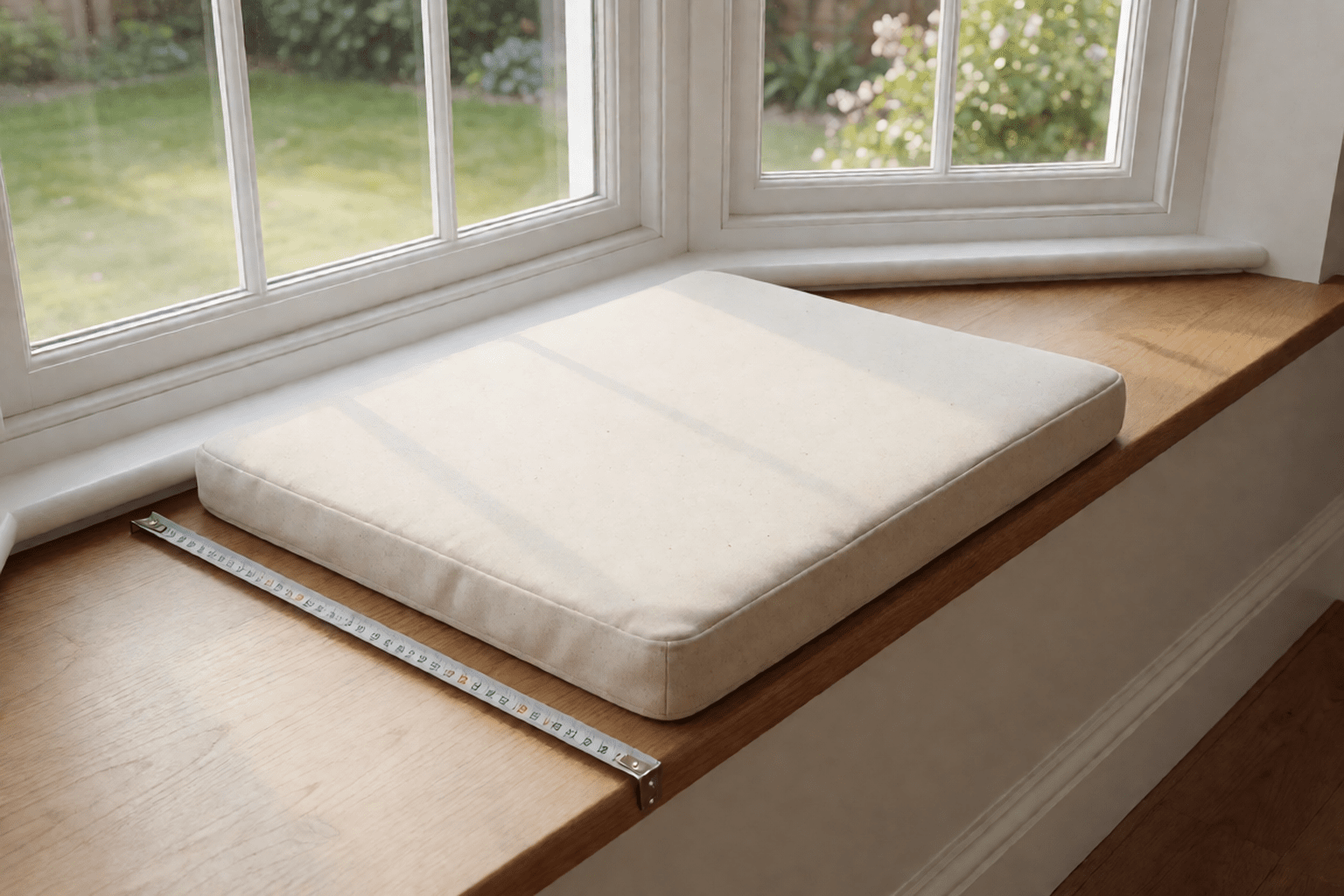
Seat depth on a window seat is one clean reading: from the glass (or the sill wall) straight out to the front edge of the bench — the number that decides whether the pad tucks fully into the alcove or leaves a reading lip.
Reading Nooks and Corners, Cushioned
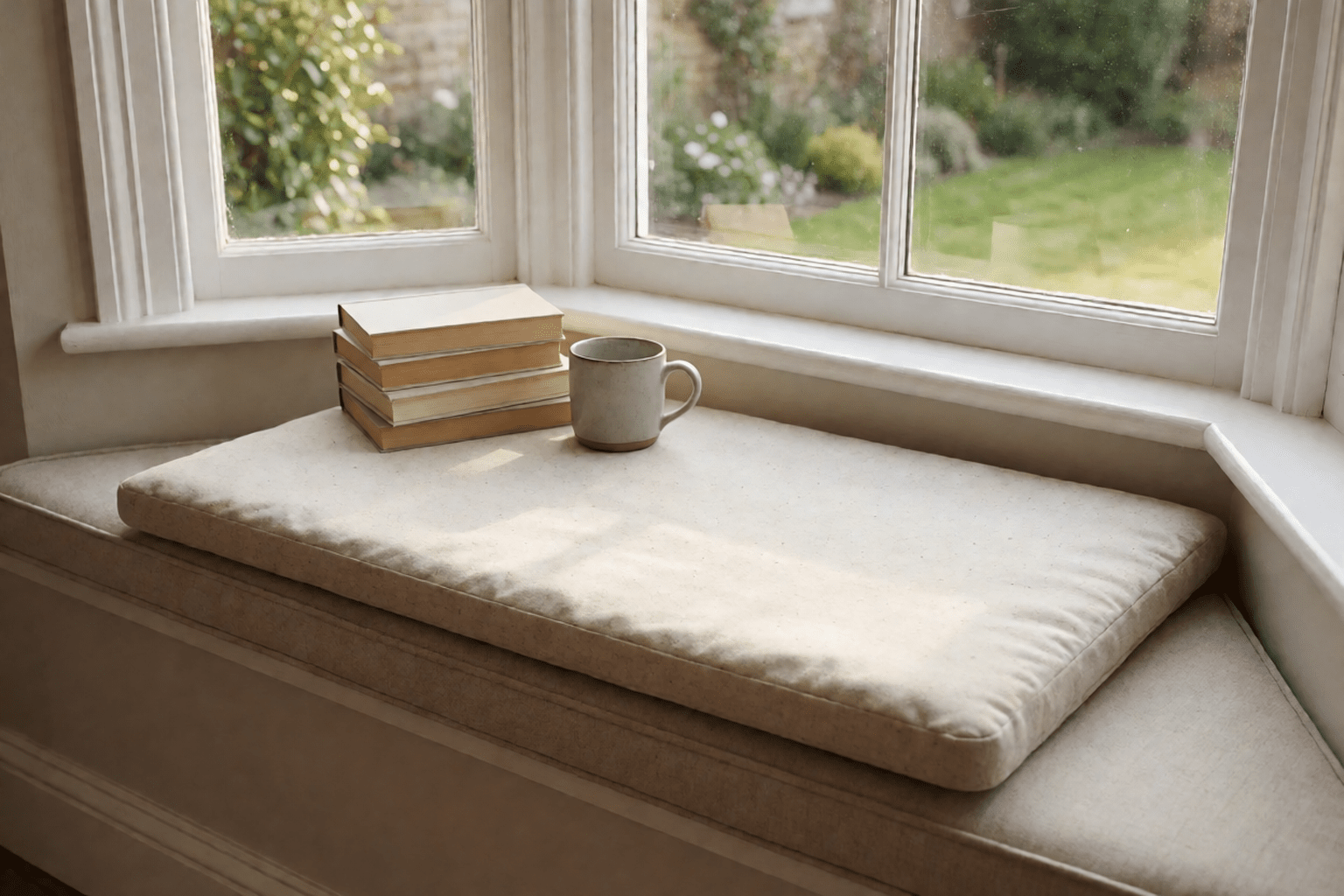
A bay window wants a thick pad and a reason to stay: books stacked at one end, a mug, morning light. The pad top stays one smooth plane of fabric from edge to edge, cut to follow the bay’s angled sides instead of leaving wedge gaps at the frames.
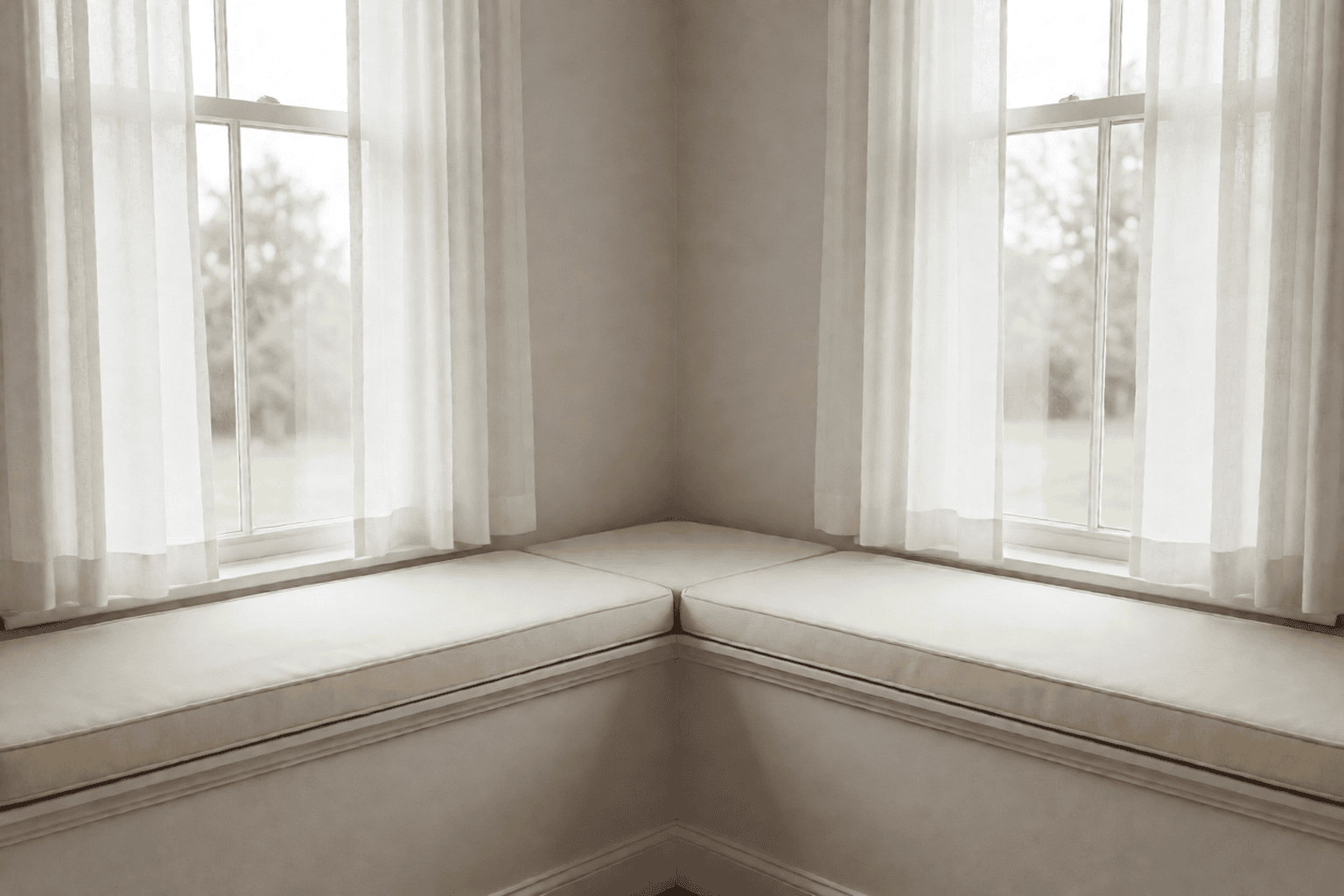
Corner windows are really two window seats meeting: measure each straight run separately, note where the two pads meet at the corner, and order them as one set so the heights match. Two plain pads meeting cleanly read as one continuous built-in bench.
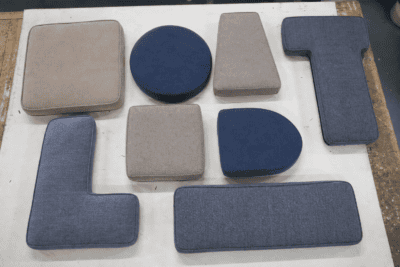
Cushion Shapes Guide: All 11 Shapes, What They Fit, and How to Measure Each One
A field guide to every cushion shape we cut — rectangle, chaise, L-shape, T-cushion, bowed, notched, round, oval, half-round and wedge — which furniture each one belongs to, how to measure it in inches, and exactly which shape to pick in our custom cushion builder.
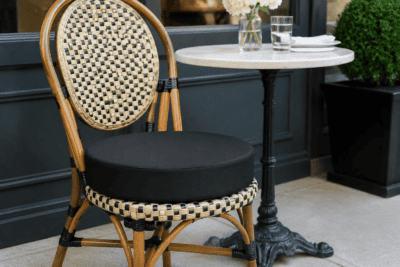
Round Outdoor Cushions: Diameter Duty on the Patio
Round outdoor cushion guide: round patio dining sets, fire-pit seating and round loungers; diameter measuring with the two-axis check, thickness bands, weather specs for circular pads, and ordering rounds.
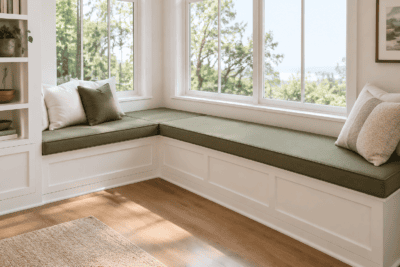
U-Shaped Cushions: Measuring the Wraparound Seat
U-shaped cushion guide: the three-arm geometry of wraparound seating, inside versus outside radius measuring, seam placement at the corners, continuous versus sectioned builds, and ordering U-runs to template.
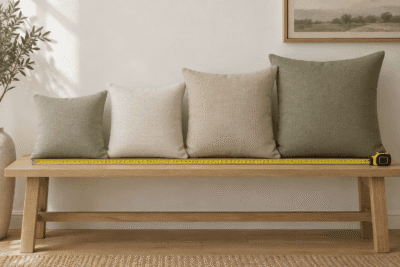
Throw Pillow Sizes: Standard Chart and How to Measure
There is no industry law, but there is a firm convention: throw pillows cluster at 16, 18, 20 and 22
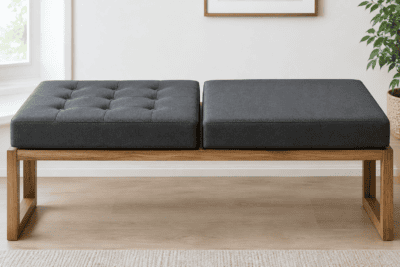
Tufted vs Unbuttoned Cushions: The Stitch Decision
Tufted versus plain cushion tops compared: what tufting and stitched patterns actually do to fill, feel and lifespan, button versus stitch construction, the market’s custom stitch styles, and when plain wins.
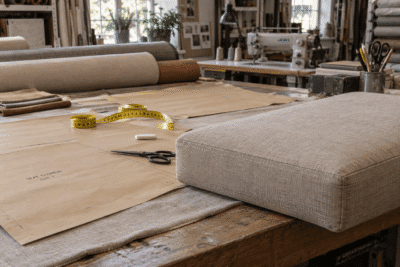
How Much Fabric Do You Need for Custom Cushions? (Yardage, Math and a Reality Check)
Two very different people ask how much fabric a cushion needs. One is sewing it herself and standing at a