
The sticker shock is reliable: a dining set that would cost $400 indoors costs $1,800 on the patio, and a single lounge chair crosses four figures before cushions enter the conversation. Outdoor furniture isn’t priced arbitrarily — it’s priced by a stack of requirements indoor furniture doesn’t have, and by an economics of seasonality and freight that inflates everything on top. Understanding the stack doesn’t make the prices smaller, but it changes what you’re judging when you compare a $300 set with a $2,000 one — and it tells you exactly where the money is worth it.
For the cushion-side of this analysis (fabrics, fills, pricing mechanics), see the outdoor cushions price guide and cheap vs quality outdoor cushions. This is the furniture frame around them.
Requirement Stack #1: Materials That Survive Weather
Indoor furniture is built to hold a person and look good. Outdoor furniture is built to hold a person while being attacked daily.
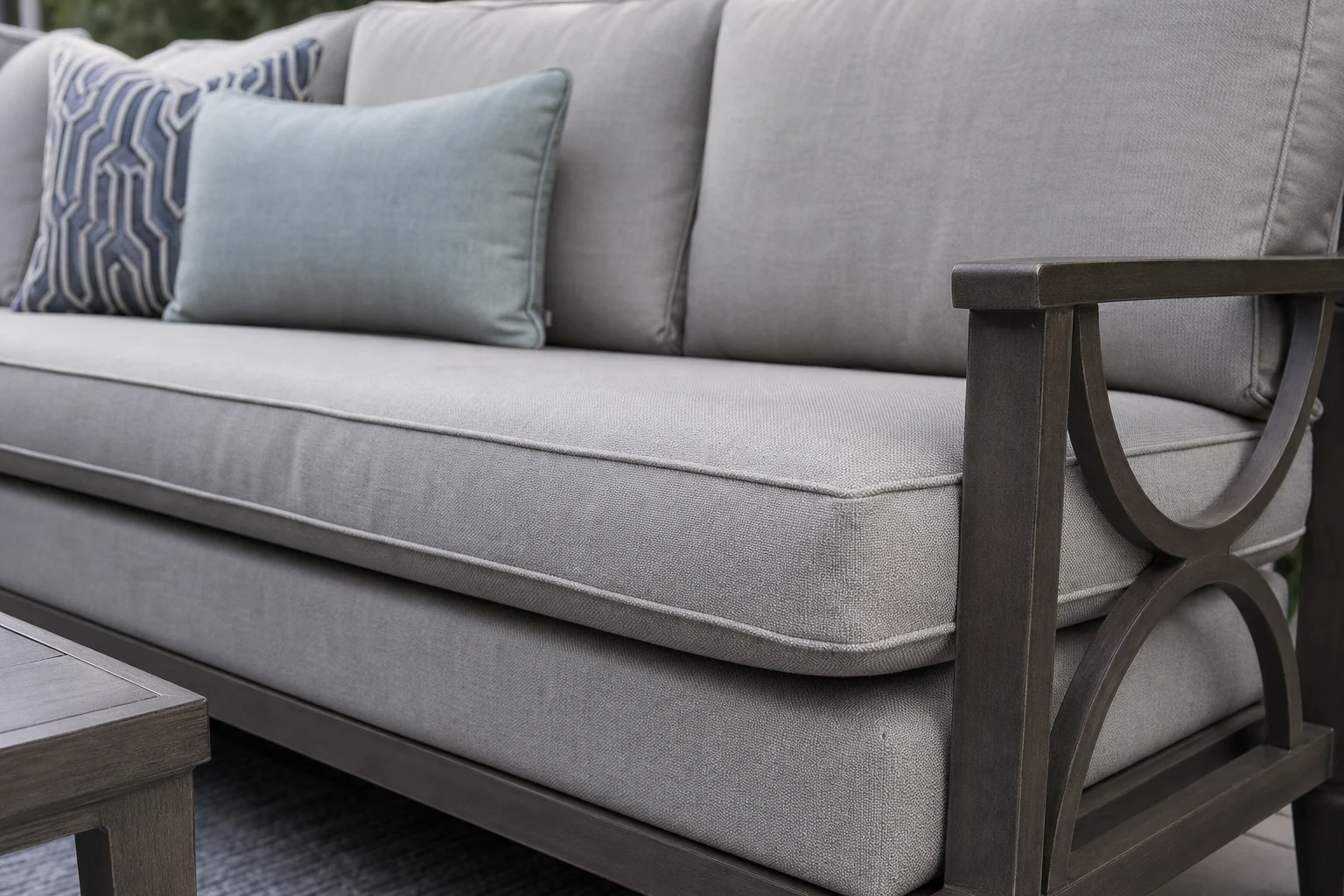
Wood. The shortlist of woods that survive outdoors unfinished is short: teak (its own oils and silica — the maintenance reality is how to care for teak furniture), certain ipe and cumaru hardwoods, and cedar/eucalyptus at the economy end (with treatment). Weatherproof hardwoods are slow-grown, imported, and priced accordingly. The box-store alternative — soft pine or acacia — is cheaper precisely because it isn’t in the same durability class; it survives with maintenance and luck.
Metals. Outdoor steel needs powder-coating, galvanizing, or both; aluminum avoids rust but needs structural wall thickness to make up for the metal’s softness; wrought iron (genuine) is labor-priced. Marine-grade stainless hardware — the fasteners that don’t bleed rust streaks in year two — costs multiples of indoor zinc screws. Nobody sees the fasteners; everybody eventually sees their absence.
Wovens and synthetics. Quality wicker-look furniture is HDPE (high-density polyethylene) weave over aluminum frames — the weave is UV-stabilized, color-through, and warranted for years. Cheap versions are PVC or nylon weave over steel frames, and the difference shows up as cracking weave and rusting frames in seasons. The material logic extends to wicker furniture cushions, which pair with the frame class they sit on.
The pattern: every “outdoor” material spec is a premium version of an indoor material spec — denser, stabilized, coated, or naturally oily. The stack is the price.
Requirement Stack #2: UV and Moisture Engineering
Beyond materials, outdoor furniture needs engineering against two specific attackers. UV breaks down plastics, dyes, finishes and even wood lignin — so outdoor-grade polymers carry UV stabilizer packages (a real cost additive), outdoor fabrics are solution-dyed (the construction and its economics: solution-dyed acrylic explained), and outdoor finishes are engineered for flexibility through thermal cycling rather than indoor scratch-hardness. Moisture demands drainage paths in frames and slats, breathable joints that don’t trap water against wood, and cushion systems that drain rather than absorb (waterproof cushions explained). None of this engineering is visible at purchase; all of it is why the premium piece still works in year six.
The Economics Layer: Season, Freight and Shelf
Even before materials, outdoor furniture carries structural economic penalties:
- Seasonal demand, year-round costs. Selling seasons concentrate in spring; manufacturing, warehousing and retail floor costs run all year. The four months of sales carry the twelve months of overhead — seasonal goods price like insurance, amortizing the slow months.
- Freight on bulk. Patio furniture is large-volume, low-density freight — the same physics that makes cushion logistics nontrivial (the price guide’s freight discussion). Shipping a dining set across an ocean and then a country costs real multiples of shipping a bookshelf, and that cost sits in the sticker.
- Retail floor economics. Outdoor sets consume enormous floor space per dollar of margin. Big-box offsets this with flat-pack, self-assembly designs (cheap freight, cheap warehousing, your Saturday afternoon); premium brands offset it with higher prices on better-engineered goods. The premium isn’t only quality — it’s the price of furniture that arrives assembled, aligned, and wobble-free.
- The clearance cycle’s shadow. Seasonal markdowns (the clearance calendar) mean retailers price for the margin they’ll keep after the fall discounts — list prices carry the planned markdown inside them. This is why patience is genuinely a discount strategy in this category.
Where the Money Concentrates (and What It Buys)
Put together, the $2,000 set versus the $300 set differs in five compounding places:
| Difference | What it costs the maker | What it buys you |
| Weatherproof material class | Hardwood/HDPE/aluminum vs pine/PVC/steel | Furniture that survives 10+ years vs 2–4 |
| UV-stable finishes and dyes | Stabilizer packages, solution dyeing | Color that holds vs fade and chalk |
| Frame engineering and hardware | Marine-grade fasteners, wall thickness | No rust-bleed, no wobble, safety at load |
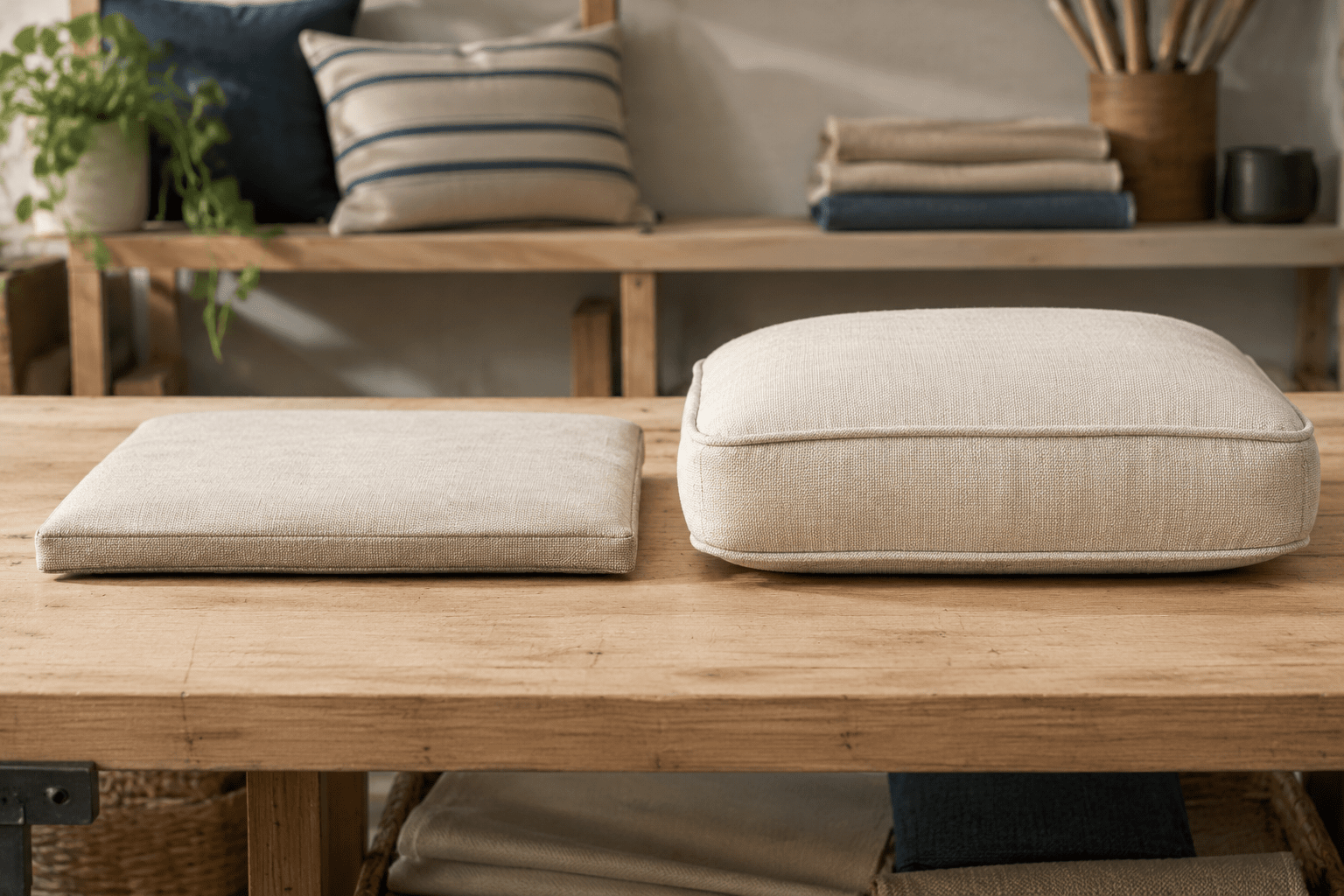
| Cushion system quality | Foam cores, performance fabrics, zippers | Comfort that lasts vs annual replacement |
| Assembly and alignment | Labor and QC at the factory | A set that’s true and tight on delivery |
The honest summary: outdoor furniture is expensive because outdoor furniture is temporary at the cheap end and permanent at the quality end, and permanence is priced in every layer. The $300 set is a two-to-four-season rental; the $2,000 set is a decade-plus asset. Per-year-of-use, quality outdoor furniture frequently wins the comparison — the same math that governs custom vs standard cushions.
Where to Spend and Where to Save
Not every layer deserves the premium:
- – Spend on structure and cushions. Frames, hardware, and the cushion system (fabric + fill + covers) are the layers that fail and define daily experience. These are also where the longevity math concentrates.
- – Save under cover. Covered porches and sunrooms relax the weather stack meaningfully — mid-tier materials serve for years without UV and rain contact. Match the price to the actual exposure, per the tier logic in the best outdoor cushion fabrics.
- – Save by timing. The clearance cycle applies to furniture as much as cushions — August-September buys the same set at 40-60% off, with the same fit-and-quality disciplines.
- – Spend on fit at the cushion layer. Quality furniture deserves cushions cut to its actual dimensions — the one premium that compounds with the furniture premium instead of justifying it. The flow starts at custom outdoor cushions.
The Cushion Subsidy in Cheap Sets
One structure worth naming, because it explains a pattern buyers see without understanding: cheap complete sets (frame plus cushions at a startling price) are often priced below the honest sum of their parts by economizing precisely where buyers look last — the cushion layer. Thin fiber fill and entry fabric are nearly invisible next to an attractive frame, and the set’s price reads as furniture value. The consequence arrives next season as flattened cushions, and the remedy cycle — annual pad replacement — quietly closes the price gap with the quality set over two or three years. When a set’s price seems too good, audit the cushions first: squeeze the fill, check for a zipper, look at the fabric tier. If all three are at the bottom, the honest comparison is the set price plus a cushion re-spec (cheap vs quality outdoor cushions) against the quality alternative — and run that comparison before buying, not after.
FAQs
Why does patio furniture cost so much more than indoor furniture?
Because every layer — wood, metal, weave, finish, fabric, hardware — needs a weatherproof premium version of itself, and seasonal demand with year-round costs plus bulky freight stacks economics on top. The anatomy is above; per-year-of-use, the premium often wins.
Is expensive patio furniture worth it?
For furniture that lives outdoors and stays with you: yes — the durability layers (materials, UV stability, hardware) are exactly what the cheap set lacks, and they’re what turns a 2-year purchase into a 10-year one. Under cover, or for short-horizon use, the premium buys less.
Where does the money go in a premium outdoor set?
Structure (weatherproof materials and frames), engineering (UV and moisture management), hardware, the cushion system, and assembly quality — five compounding layers, each invisible at purchase and decisive by year three.
How do I save on patio furniture without buying junk?
Three levers: buy the coverage-matched tier (under cover, mid-tier serves), time the clearance cycle (August-September, with fit disciplines), and put the saved money into the cushion layer — exact-fit, density-graded cushions upgrade any frame class.
Do better cushions really matter on cheap furniture?
They matter most there: a density-graded, exact-fit cushion set (see how to choose foam density) is the fastest way to elevate a modest frame, and it’s the layer you can replace without replacing the furniture. Start at custom outdoor cushions.
Next Steps
- Classify your space honestly — uncovered, covered, or indoor-adjacent — and let the exposure set the material budget rather than paying weather premiums you won’t use.
- Put your money where failure lives: structure, hardware, and the cushion system, in that order.
- Price the cushion layer at custom outdoor cushions — exact dimensions, density grades and washable covers, the upgrade that compounds with whatever frame it sits on.
Every cushion on this site is cut and sewn by the Cushion Mill workshop — ten-plus years at the cutting table, and every measurement confirmed in writing before anything is made.
The $30 Cushion Subscription: The Real Annual Cost of Cheap Cushions
A $25–45 big-box cushion is not a purchase, it is a subscription — $13–45 a year for pads that flatten every season or two. The annualized math versus custom cuts that run $10–15 a year.
Etsy Custom Cushions: What the Platform Does Well — and When a Cushion Workshop Is Better
An honest comparison of ordering custom cushions on Etsy versus a dedicated cushion workshop — maker fit, pricing transparency, fabric sourcing, tolerances, lead times and remake policy — and how to decide which channel your project belongs in.
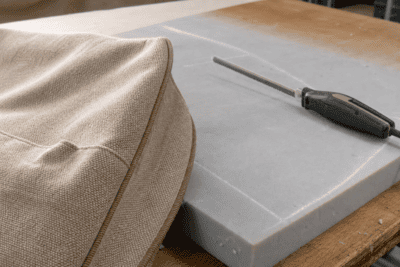
Sofa Foam Cut to Size: How to Order Exact-Fit Foam
How to order sofa foam cut to size — measuring the core, adding the compression allowance, specifying density, thickness and shape, and the checklist to run before any foam is cut.
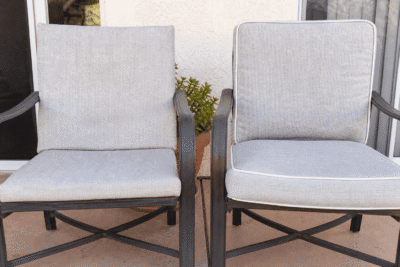
Cheap vs Quality Outdoor Cushions: Where the Money Actually Goes
What separates a $15 cushion from a $60 one and a $150 one — fabric construction, fill, stitching and covers — which upgrades matter, which are markup, and how to buy the quality your furniture actually needs without overpaying.
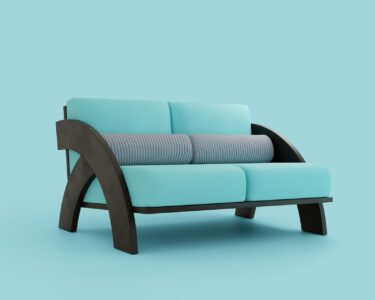
Couch Cushion Foam Inserts: Measure and Order New Cores
A foam insert replaces the flattened core inside the covers you already own. Measure seam to seam, pick 60D seats and 50D backs, and price the set in one order.
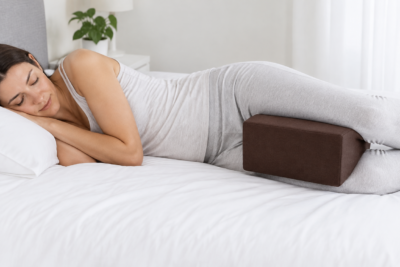
Knee Bolsters for Side Sleepers and Back Sleepers: A Firm Support Guide
A firm half-round D bolster fills the gap between the knees for side sleepers and under both knees for back sleepers. Heights, densities and lengths explained — positioning and comfort, made to order.