
The office chair is the most-sat-upon object most people own. Eight hours a day, five days a week, the same foam cells take the same load in the same pattern — and foam is a fatigue material: after 2–4 years of full-time duty, the seat that started supportive bottoms out, the sitter sinks to the hard pan, and the posture problems follow (ergonomic cushions and posture covers the geometry). The chair’s mechanism, base and casters are usually fine — it’s the foam that died. And foam is replaceable.
This is the replacement guide: why task-chair foam fails, what to replace it with, how to measure, and the routes from DIY cut-to-size to full custom seats. It pairs with couch cushion support options (the residential sibling) and how to replace sofa cushion foam (the same operation at sofa scale).
Why Office Chair Foam Dies Young
- – Duty: 40 hours weekly × 50 weeks = 2,000 hours yearly of continuous load — 10–20× a residential dining chair’s duty (how to choose foam density maps the hours-to-density ladder).
- – The commodity spec: most task chairs ship with foam graded for showroom appeal, not decade duty — the “high density” adjective problem (buy foam for couch cushions covers the number-vs-adjective issue).
- – The failure signature: a butt-shaped depression that doesn’t recover, edges that roll, and the sitter’s hips dropping below the neutral sitting height (how to fix sagging couch cushions catalogs the same stages residentially).
- – Why it matters beyond comfort: dead foam changes sitting geometry — the pelvis drops, the knee-hip relationship breaks, and the lower back rounds. The chair you bought for ergonomics quietly became an ergonomic hazard when the foam failed.
The Density Spec for 8-Hour Duty
The replacement spec that outlasts the chair’s mechanism:
- – 50D minimum for full-time single-shift duty — the daily-use grade holding its form through years of 8-hour loads.
- – 60D for heavy use — heavy sitters, multi-shift environments, and anyone who’s replaced seat foam before and never wants to again (how to choose foam density‘s heavy-daily tier).
- – Thickness: 2–3″ typical over the seat pan — matched to the original spec, not exceeded; the chair’s height range and desk geometry were designed around the original loft (the one-way-ratchet warning in how to measure couch cushions).
- – The comfort-layer option: a thin memory topper over the firm core adds pressure distribution for long sessions without bottoming (memory foam topped cushions explains the layer physics, and memory foam vs regular foam the trade-offs).
Measuring the Seat
The office-chair version of frame-first measuring (how to measure outdoor cushions is the base method):
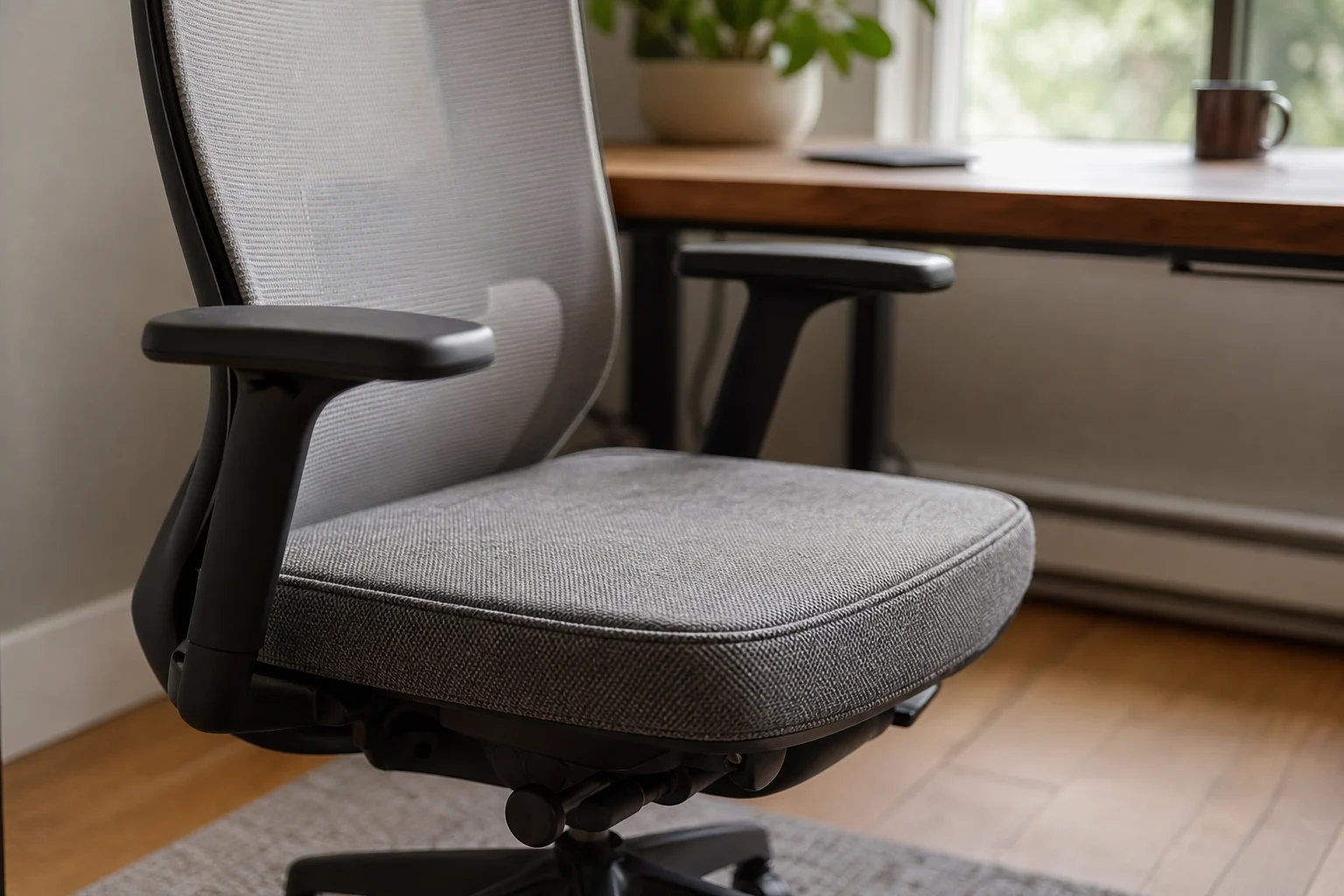
- Remove the seat cushion from the mechanism — typically 4 screws from underneath the seat pan.
- Measure the pan, not the old foam: width and depth of the rigid pan surface (old foam has compressed and spread; it lies, per the corrections table in how to measure couch cushions).
- Match the original thickness unless deliberately re-spec’ing: stand the old uncompressed edge against a ruler, or check the manufacturer’s spec.
- Note the shape: most pans are rectangles with rounded or waterfall front edges — the front radius matters for thigh comfort (how to measure radius corners covers radius geometry).
- The cover question: if the original cover is intact and washable-grade, foam-only replacement reuses it; if the cover is worn or was the cheap OEM fabric, the full-cushion route (below) upgrades both at once.
The Three Replacement Routes
Route 1: Foam-only replacement (the DIY standard). Cut-to-size foam at the measured dimensions in 50–60D — ordered from foam suppliers or cushion workrooms — installed into the existing cover (the cover’s closure is opened and re-sewn, the method in how to replace sofa cushion foam). Cost: modest; result: the chair you liked, with a seat that outlasts its predecessor. The cutting-foam-yourself option (how to cut foam) exists for the fully DIY route.
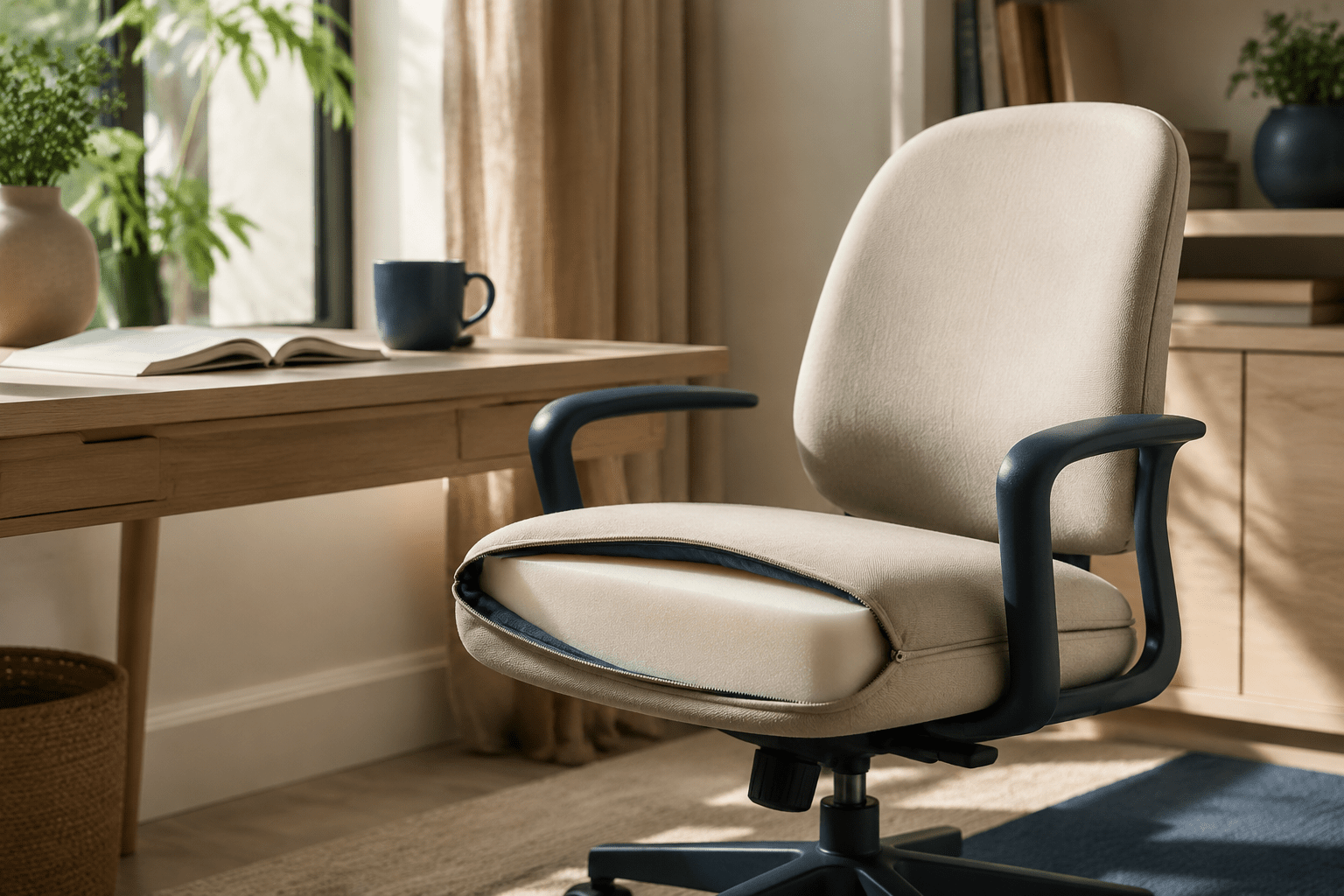
Route 2: Full custom cushion replacement. A complete new seat — foam at grade, chosen fabric, proper construction — built to the pan’s measured dimensions at ±½” — ±¾” over 36″ — (Cushion Mill: $45 base per cushion plus area × fabric rate). This is the route for worn covers, sit-stand desks where a standing mat / seat hybrid is wanted for break areas, and bench- and stool-format seating in studios where the chair is fully custom anyway.
Route 3: Commercial fleet programs. Multi-chair offices measuring the same model across dozens of seats: per-piece verification still matters (fleet chairs vary less than mixed furniture, but mechanism upgrades and repairs introduce variance — the per-piece discipline from chair cushion sets), and bulk orders price per-piece transparently. The commercial-duty logic from restaurant booth cushions (60–65D grades for multi-shift duty) applies to call centers and 24-hour operations.
The Honest Chair-Replacement Question
When dead foam is the only problem, re-foaming wins the economics easily — a fraction of a quality task chair’s price. When the mechanism also fails (piston, tilt, casters), the honest math shifts: re-foaming a chair with a dying gas lift buys two years of good sitting on a failing frame. The decision framework is reupholster vs replace cushions at desk scale: replace the component that failed when the platform is sound; replace the platform when it isn’t.
Standing Desks and the New Chair Duty
The sit-stand era changed office-chair foam duty in two directions at once:
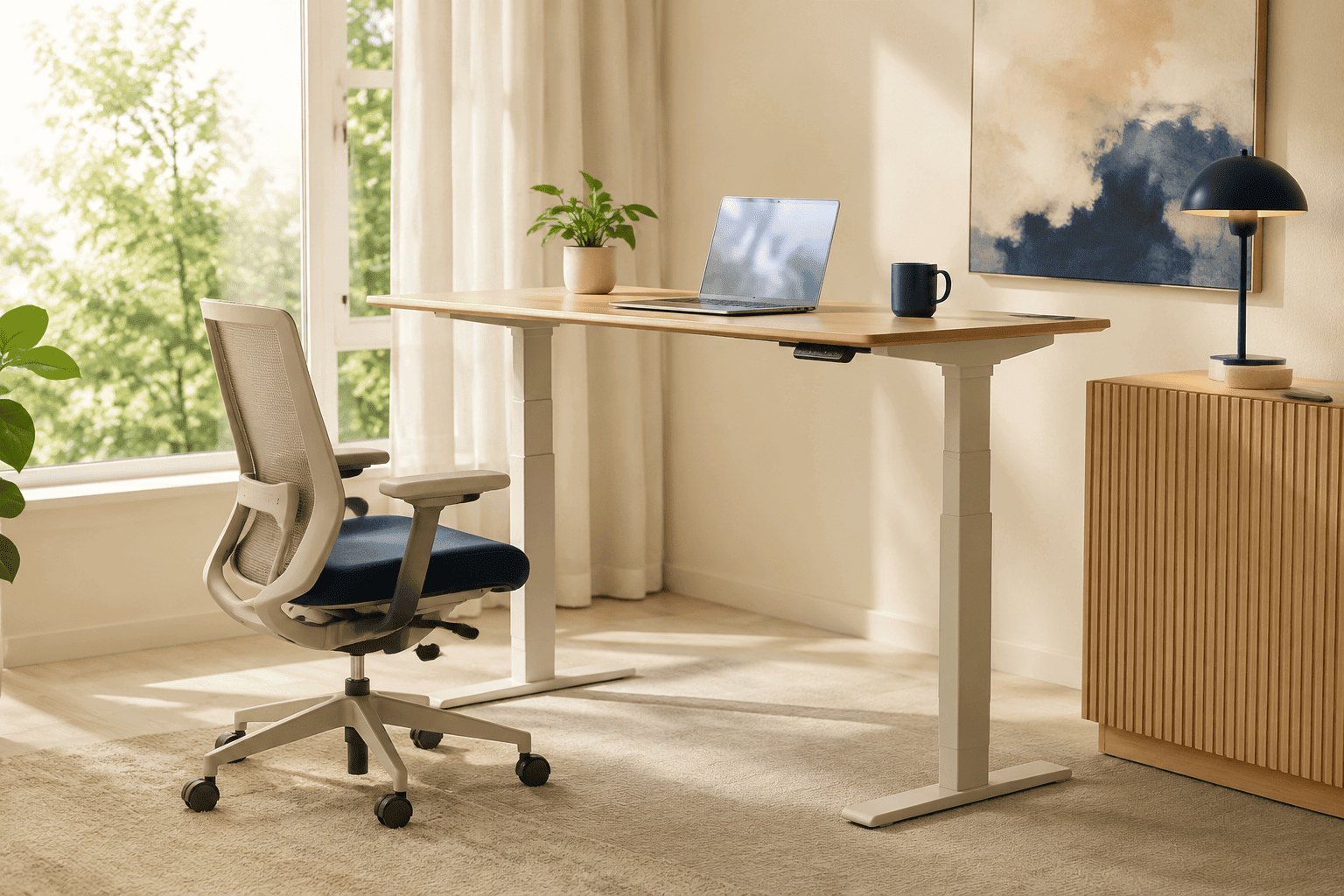
- – Fewer sitting hours per chair at standing-interval workplaces — foam lasts longer, and the chair becomes a perching and leaning surface as much as a sitting one (the ergonomics in ergonomic cushions and posture).
- – Harder concentrated load in the hours it is used — all-day sitters who never adopted standing concentrate their previous duty into fewer chairs, and hot-desking offices put multiple users’ loads on single chairs.
Both patterns still land on the same spec answer — 50D minimum, honest thickness — but they change the replacement cadence: standing-heavy offices re-foam less often, concentrated-use and hot-desk environments check foam annually against the fatigue signs in how to fix sagging couch cushions. The chair that gets measured by its worst daily user, not its average one, is the one that stays comfortable.
The two-chair workspace. Remote workers running a desk chair plus a reading chair benefit from fleet logic: the task chair gets the 60D full-day spec, the reading chair the 50D with a comfort layer — two chairs, two duties, two specs (seat and back cushion sets logic applied to rooms). The mistake is one-spec-fits-both.
The hot-desk fleet math. Offices with shared seating multiply the variance problem: fifty identical task chairs include the forty-nine that are fine and the one whose mechanism has been quietly failing for a year. Annual fleet checks — sit-test sampling plus the compression signs from how to fix sagging couch cushions — catch the outliers before the complaints do, and per-piece replacement at the measured pan keeps the fleet uniform.
FAQs
Why did my office chair cushion go flat?
Foam fatigue — 2,000 hours yearly of continuous load on showroom-grade foam bottoms out in 2–4 years. The mechanism is usually fine; the foam is a consumable you can replace.
What foam density should office chair seats use?
50D minimum for full-time duty, 60D for heavy sitters and multi-shift use — density is the lifespan spec, and the number is the spec, not the adjective.
How do I measure for replacement seat foam?
Measure the rigid pan, not the compressed old foam — width, depth, original thickness, and the front-edge shape — with the methods in the measuring guides.
Can I just replace the foam and keep the cover?
Yes — foam-only replacement into the intact cover is the standard economical route; full custom cushions (new fabric and all) upgrade worn covers at $45 base plus fabric area.
Is it worth re-foaming instead of buying a new chair?
When the mechanism is sound — absolutely, at a fraction of a quality chair’s price. When the gas lift and tilt are also failing, replace the platform instead.
What about memory foam seat cushions on top of the chair?
They add pressure distribution as a layer over sound foam — they can’t rescue bottomed-out foam underneath. Fix the base first, then consider the comfort layer.
Can you re-foam an office chair with firmer cores?
Chair cushion foam at 60D rebuilds flat office seats; foam padding for chairs ordered to your pan’s dimensions cuts the side-to-side wobble of loose store pads. Covers sew zippered in 119 fabrics on a 4–7 day build.
Next Steps
- Pull the seat off the mechanism and measure the pan per piece — width, depth, thickness, front shape.
- Set the grade by duty: 50D full-time, 60D heavy or multi-shift, comfort layer optional on top.
- Order the replacement at custom cushions — cut to your measured pan at ±½” (±¾” over 36″), fabric chosen for the real hours it serves, 4–7 business days.

Church Pew Cushions: The Complete Specification Guide
Pew cushions are a long-cycle institutional purchase — density for multi-service weekly duty, fabric for hymnal-and-quiet durability, fastener systems that survive decades, and the measuring method for pews, communion rails and pulpit seating.

Restaurant Booth Cushions: Specifying for Dinner-Rush Duty
Commercial restaurant booth cushions live under a duty profile residential cushions never see — all-day turn rates, cleaning chemicals, food-zone fabric demands, fire-code awareness — this is the spec: density, fabric, construction, and the replacement-cycle economics.