
Washing cushion covers is where good cushions go to die — shrunk in a hot dryer, crushed by an agitator, bleached by a well-meant mildew treatment. It’s also where tired cushions come back to life: a washed cover on a healthy core looks nearly new, and a regular washing schedule adds years to fabric that would otherwise accumulate the grit, oils and organic debris that age it. The difference between the two outcomes is knowing what you’re washing, washing it the way that fabric wants, and drying it like it’s fragile — because it is.
This is the covers-specific routine. The full outdoor cleaning arsenal (including the foam side and mildew treatment) is how to clean outdoor cushions; acrylic-specific care, including the bleach protocol, is Sunbrella fabric care; polyester’s particular rules are in polyester cushion care.
Before Anything: Read the Label, Then Read Past It
Care labels tell you the manufacturer’s liability position, which is usually more conservative than the fabric requires — and occasionally less. Two adjustments worth internalizing:
- “Spot clean only” often means “we didn’t test zipper durability,” not “this fabric can’t be washed.” Delicate-cycle cold washing is right for many covers labeled spot-clean. The risk you’re taking is the zipper and the seams, not the fabric — wash in a mesh bag, zip the zipper first, and inspect seams after.
- No label at all (custom and older covers): identify the fabric family and wash to its rules — the family-by-family table is below. When you genuinely can’t identify the fabric, hand-wash cold. It’s slower than any machine cycle and safe for everything this guide covers.
The Universal Sequence
Every wash, machine or hand, follows the same five beats:
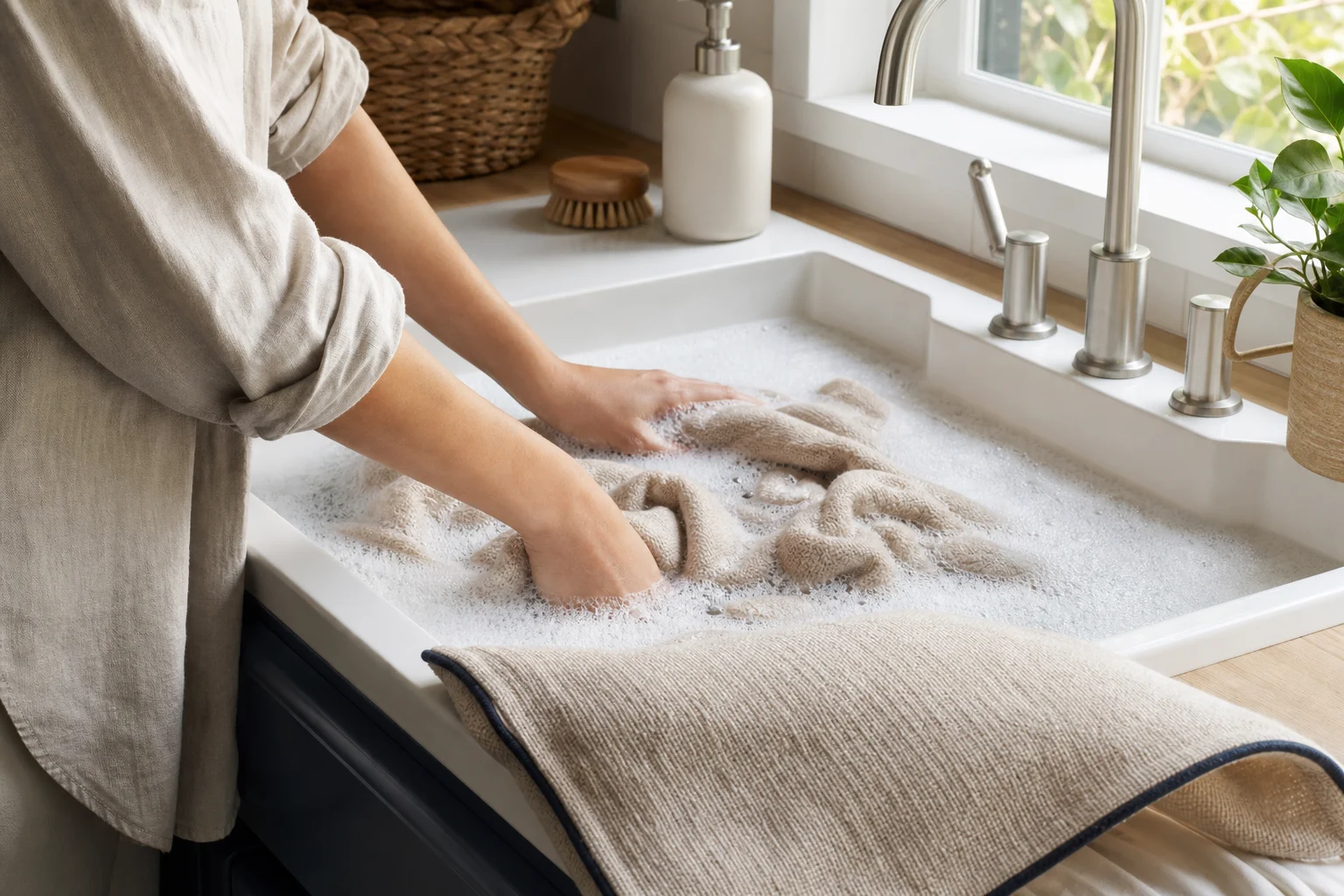
- Zip zippers closed. Open zippers are the #1 machine casualty — teeth catch other covers and tear seams. A zipped cover also keeps its shape better in the drum.
- Pre-treat real stains. Oil-based spots (sunscreen, food) get a drop of dish soap worked in; organic stains (grass, pollen, bird droppings) get pre-soaked in cold water with detergent for 30 minutes. How to clean outdoor cushions has the stain-by-stain table.
- Wash to the fabric’s rules (below) — cold or warm water, gentle cycle, mild detergent.
- Never use fabric softener. It coats fibers, reduces the moisture-wicking that performance weaves depend on, and attracts dirt. This rule has zero exceptions.
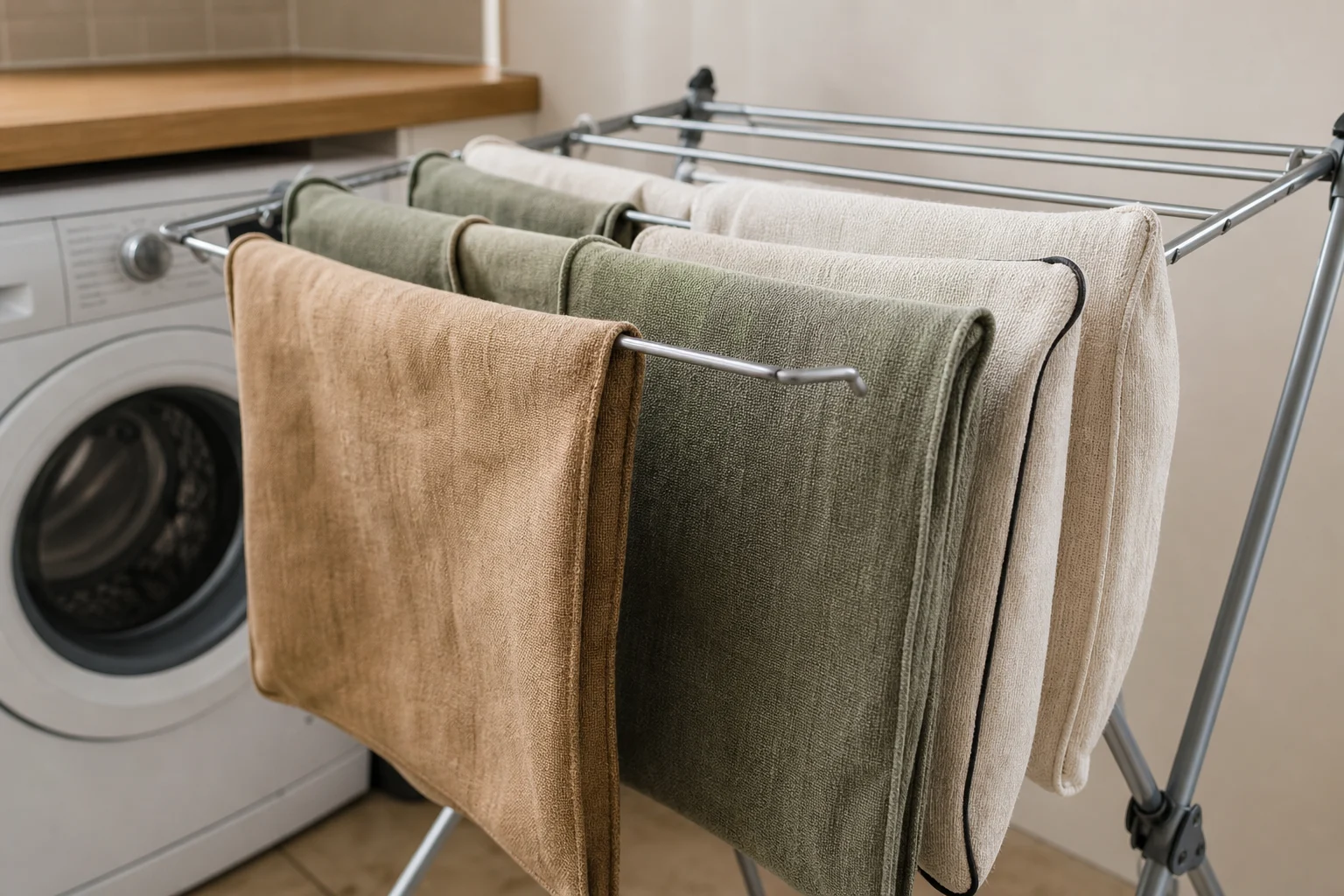
- Air dry. The dryer is where covers shrink. Nearly all cushion-cover shrinkage is heat shrinkage, and it’s irreversible. If you must use a machine, the no-heat tumble setting only.
Machine Washing by Fabric Family
| Fabric family | Water | Cycle | Detergent | Notes |
| Solution-dyed acrylic (Sunbrella-class) | Cold–warm | Gentle | Mild | The most wash-tolerant family; bleach-safe per the acrylic protocol when mildew strikes |
| Polyester / spun poly | Cold–warm (≤30°C/86°F) | Gentle | Mild | No bleach ever — strips surface dye; no softener; see polyester care |
| Cotton / linen blends | Cold | Gentle/hand | Mild | Expect some wrinkling; reshape warm; iron later if the fabric allows |
| Olefin / polypropylene | Cold–warm | Gentle | Mild | Heat-sensitive — keep water warm-max; air dry flat |
| Velvet, chenille and pile fabrics | Cold | Hand or mesh-bag gentle | Mild | Pile crushes: never wring; dry flat, brush pile gently with your hand |
| Unknown / blended | Cold | Hand | Mild | The safe default for everything unlabeled |
Load discipline: wash covers with similar fabrics, in loads that give the drum room — a drum packed with covers rubs seams against everything. Two covers per load is typical; mesh laundry bags add seam protection for anything you’re nervous about.
Covers That Don’t Come Off: In-Place Washing
Fixed covers — sewn-on pads, zipless cushions, tufted pieces — get cleaned in place:
- Dry first. Vacuum or brush off all loose dirt. Wetting dry grit makes mud; mud is the abrasive that ruins fibers.
- Work a small zone at a time with a soft brush or cloth and warm soapy water (mild detergent). Overlap zones slightly.
- Rinse completely. A second cloth in clean water, wrung hard, wiped over the washed zone. Detergent residue is a dirt magnet and a mildew nutrient — rinsing is not optional.
- Extract water without crushing: press with dry towels (the towel pulls water out), never wring or twist a fixed cover — the foam under it distorts.
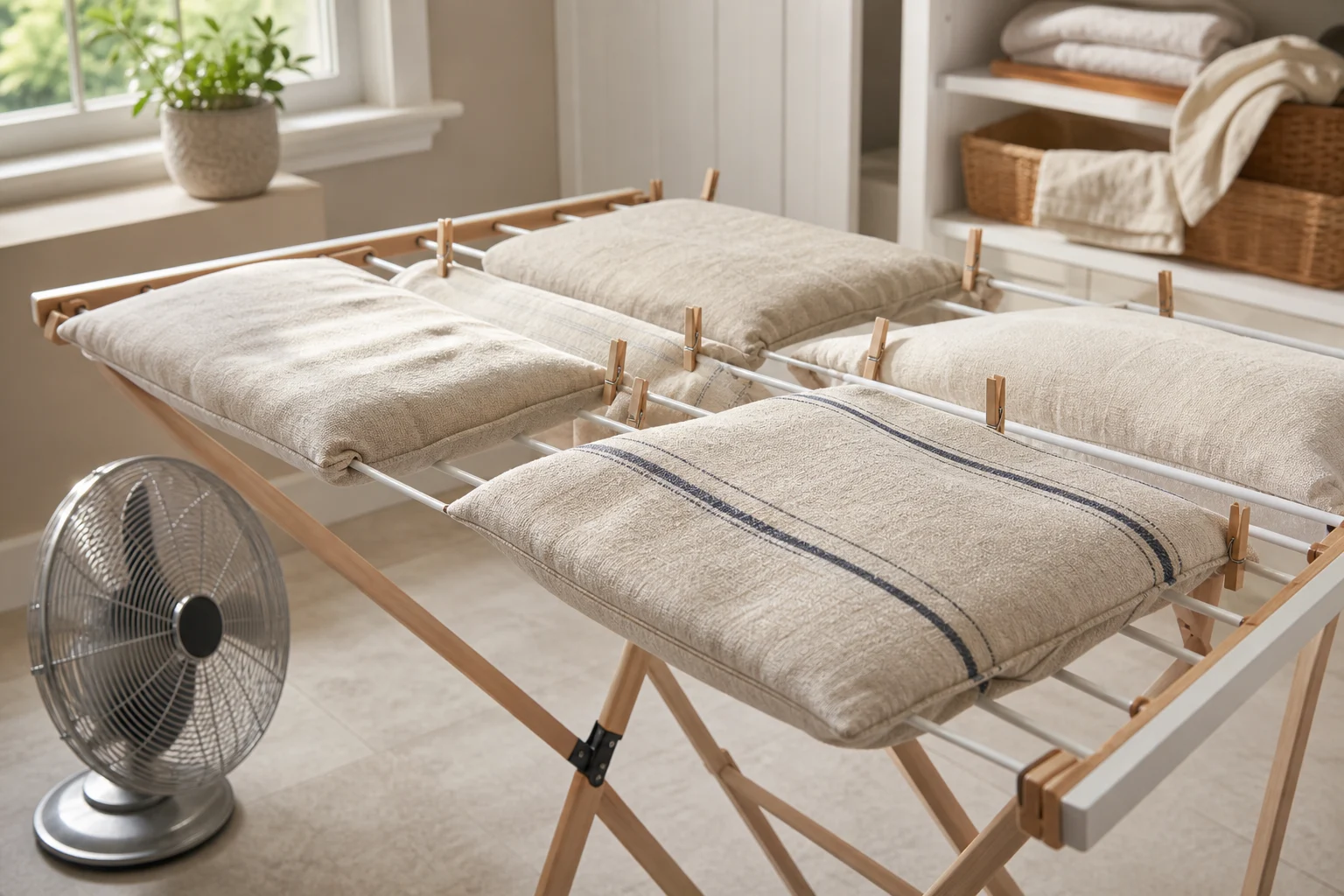
- Dry fully before use: prop the cushion on edge in airflow, both sides, until the core is dry — fabric-dry is not cushion-dry. The drainage-drying discipline in how to drain waterlogged cushions is the deep version of this step.
The Drying Rules (Where Covers Actually Die)
- – Air dry, laid flat or hung, smoothed roughly into shape. Gravity and heat are the two shrinkage engines; air drying eliminates both.
- – Reshape warm. If a cover comes out of the wash misshapen, tug it back to square while damp — damp fabric holds a re-shaped set as it dries.
- – Sun-drying: fast but two-edged. A few hours of sun is fine and antibacterial; a full day of direct UV on wet fabric is accelerated fading (the mechanism is in solution-dyed acrylic explained — wet fibers can uptake degradation differently, and dyed polyesters fade fastest of all). Shade with airflow is the premium drying environment.
- – Fully dry before re-covering foam. A damp cover over foam is a humidity tent — the mildew analysis in prevent mold on outdoor cushions starts exactly here.
Frequency: How Often to Wash
Scheduled washing beats emergency washing, and both beat never:
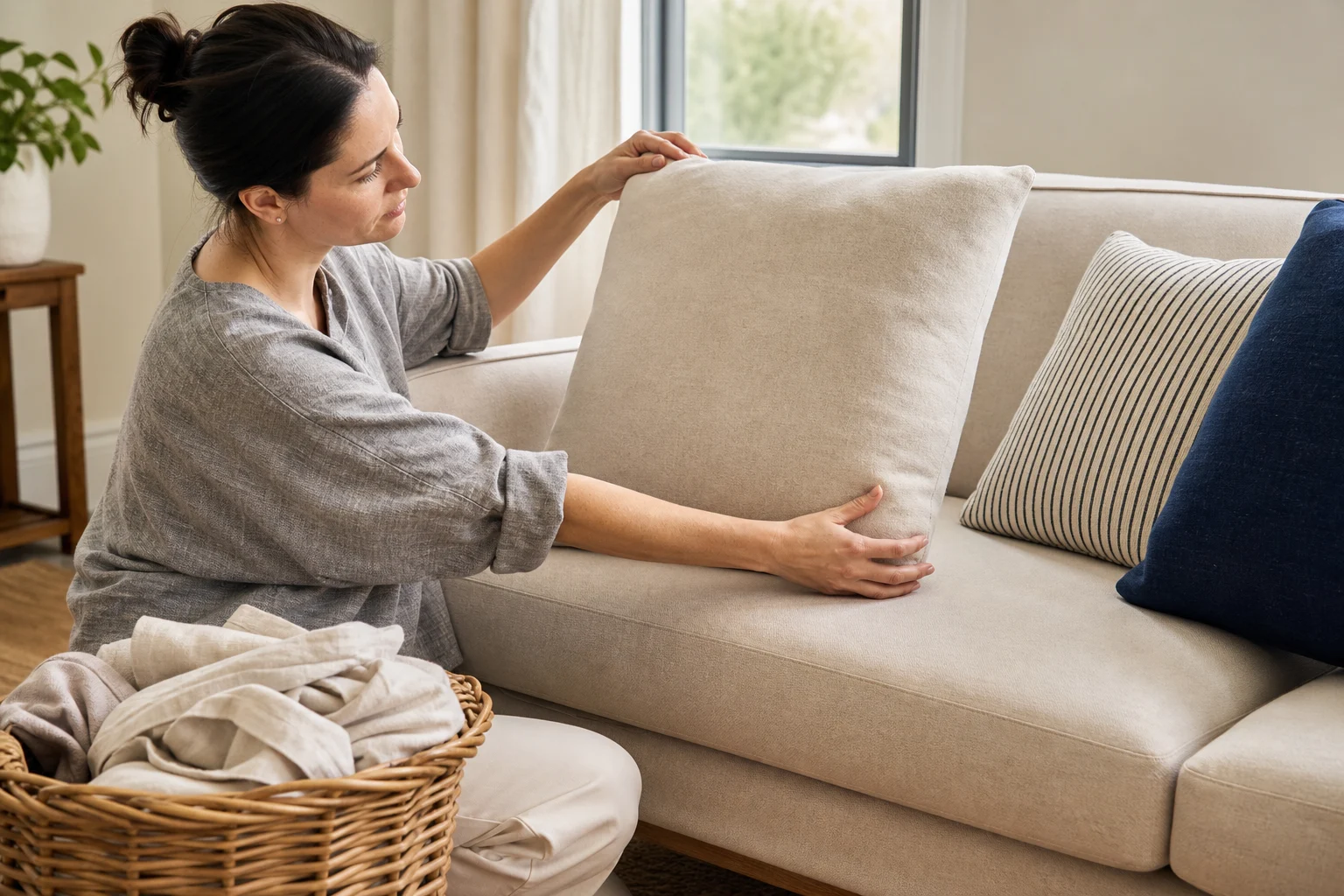
- – Indoor everyday cushions: 2–4 times a year, plus spot treatment as spills happen.
- – Dining and kitchen seating: monthly in heavy-use seasons — food proximity is the driver.
- – Outdoor cushions in season: monthly, plus after any pollen dump, bird event, or spill; before storage in fall, always (storing outdoor cushions for winter begins with clean-and-dry).
- – Floor cushions and kids’ furniture: monthly or more — they live at the floor’s dirt level.
When Washing Isn’t the Answer Anymore
Washing restores fabric; it can’t restore fabric that’s gone. Replace covers when: the weave is visibly thinning at seat edges (light passes through when held to a window), seams have split at stress points twice already, the fabric has permanent gray-ing or yellow-ing that survives washing (UV death of the dye — the tier discussion in the best outdoor cushion fabrics), or the cover has shrunk and fights the foam (the stretched-shrunken cover lifecycle is covered in replacement cushion covers). A sound core deserves a new cover; a dead core deserves nothing — check both before spending on either (the diagnosis routine is in when to replace outdoor cushions).
A final word on schedule discipline: washing is maintenance, and maintenance works when it is boring. The households with clean, long-lived cushions are not the ones with the best products — they are the ones who ran the boring quarterly wash for the fourth year running. Every method above reduces to that habit wearing different fabrics.
Troubleshooting: When Washing Goes Wrong
The cover shrank. Heat happened — dryer, hot water, or a car-dashboard drying session. Recovery is partial: re-soak in cool water, then stretch steadily by hand back toward the foam’s dimensions while damp, and air dry flat. You’ll typically recover half the loss. The rest is a lesson in air drying — or a new cover, sized properly, from the route in replacement cushion covers.
The colors bled. Mixed-fabric loads or a dye that was never washfast (common on imported dark covers). Re-wash the affected pieces separately in cold water with a dye-catcher sheet immediately — fresh bleeds re-release partially. Set bleeds need new covers, and a note for next time: wash darks and lights separately, always.
The cover came out more wrinkled than before. Natural fibers (cotton, linen) wrinkle; the fix is reshaping while damp — smooth the cover flat on a towel, tug to square, let it finish drying flat. Ironing covers is possible (per the fabric’s ironing temperature) with the foam removed, but reshaping-while-damp gets you 90% there with zero risk of scorching.
The zipper stopped working mid-cycle. Salt and grit from outdoor use jam sliders. Rinse the zipper track, work the slider gently back and forth, and lubricate with graphite pencil on the teeth (not oil — it stains fabric). A zipper that’s failed closed is a repair-shop or replacement-cover matter; a zipper that’s failed open is at least washable until you replace it.
It still smells after washing. The smell isn’t in the cover — it’s in the foam beneath, or in the wash’s residue. Re-wash with an extra rinse cycle, dry fully in airflow, and treat the foam per the baking-soda-and-sun method in how to clean couch cushions.
Spot Treatment Between Washes: The Six Common Stains
Full washes are seasonal; spots are weekly. Work these cold unless noted, blot-don’t-rub, and rinse the treatment out fully — residue re-soils: coffee and wine (cold water immediately, then mild detergent); grease and sunscreen (dish soap in warm water — the emulsifier is the point); grass and pollen (pre-soak cold 30 minutes, then detergent — and dry-brush loose pollen first, per pollen protection); blood (cold only — heat sets protein permanently); mud (let it dry fully, brush off, then wash — wet mud smears into the weave); mystery yellow (UV damage or old oil — try the detergent route, but expect this one to be permanent: the fabric’s dye is gone, not dirty, which is a tier lesson from the best outdoor cushion fabrics).
FAQs
Can you machine wash cushion covers?
Most zip-off covers, yes: zipped, mesh-bagged, cold–warm water, gentle cycle, mild detergent, no softener, air dry. The exceptions are pile fabrics (velvet, chenille — hand wash), truly delicate blends, and anything the seam inspection after a first gentle wash doesn’t survive.
What temperature should I wash cushion covers at?
Cold is the universal safe answer; warm (≤30°C/86°F) is fine for acrylics and polyesters. Hot water shrinks natural fibers, distorts elastics, and can set stains. When in doubt: cold.
How do I wash cushions that don’t have removable covers?
In place: dry-brush, then work small zones with soapy water, rinse with a clean damp cloth, towel-press the water out, and dry the whole cushion on edge until the core is dry. The full in-place sequence is above; the deep-dry logic is in draining waterlogged cushions.
Can I put cushion covers in the dryer?
No-heat tumble only, if at all — heat is where covers shrink, and shrinkage doesn’t come back. Air dry flat or hung, reshaping while damp. Everything else about cover care is recoverable except this one mistake.
How often should outdoor cushion covers be washed?
Monthly in season, after spills and pollen events, and always before winter storage. Clean-and-dry before storage is the whole game — the routine is in how to store outdoor cushions for winter.
My covers shrank in the wash. Can I fix them?
Partially: re-soak, and while damp, stretch steadily by hand back toward the foam’s dimensions, then air dry flat. You’ll recover some of the loss. The durable fix is new covers on the existing cores — sized properly this time — or a fabric family that tolerates your washing habits better.
Next Steps
- Sort your covers by fabric family using the table above and run the first scheduled wash this week — most covers in most houses are overdue.
- Fix the two habits that kill covers: softener in the wash, and heat in the dry.
- When covers reach end-of-life with sound foam underneath, replace just the covers — sized to the core, in a family matched to how the seat lives — the full route is replacement cushion covers, and for whole-cushion replacement the flow starts at custom outdoor cushions.
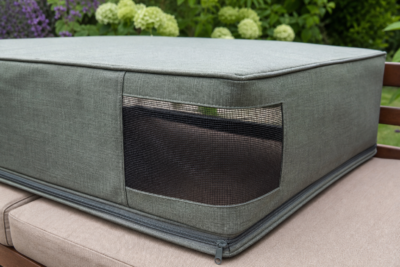
Insect-Proofing Patio Cushions: What Works on Bugs, Without Ruining Fabric
Why insects target outdoor cushions (nesting sites, food residue, moisture), the prevention stack — cleaning, storage, covers, placement — what sprays and repellents are fabric-safe, and the honest limits of keeping a patio bug-free.
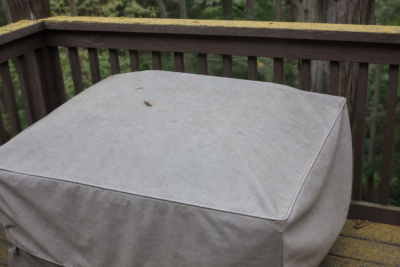
Pollen Season on the Patio: Protecting Cushions and Furniture
What pollen actually does to outdoor cushions (it’s not the color — it’s the chemistry), the spring protection playbook from covers to placement, cleaning pollen off fabric without grinding it in, and fabric choices for the perpetually dusty patio.
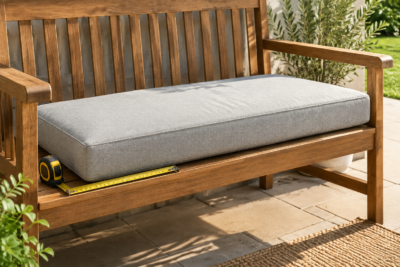
How to Clean Mold Off Outdoor Cushions (and When It’s Too Late)
How to tell salvageable mold from a dead cushion, the vinegar-and-oxygen-bleach method that works, and what to buy so it never comes back.
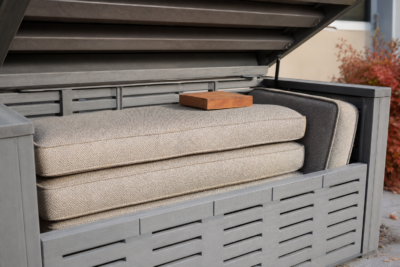
How to Store Outdoor Cushions for Winter: The Complete Method
The right way to winterize outdoor cushions — deep clean, bone-dry, ventilated storage, what never to do — and which climates need indoor storage at all.
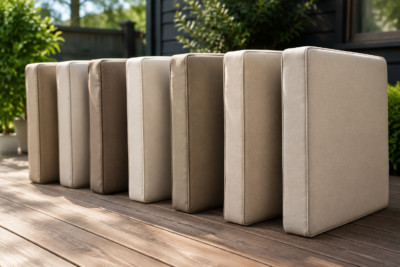
How to Drain Waterlogged Cushions (and When Foam Is Done)
How to rescue a waterlogged outdoor cushion fast — free drain, pressing, air-drying and verifying the core — plus the honest signs that the foam is past saving.
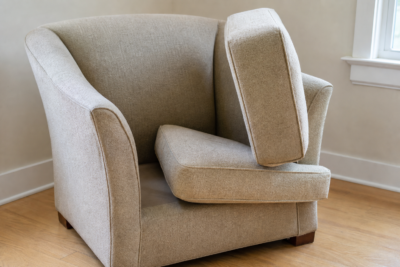
Indoor Cushion Care: Keeping Fabric, Foam and Shape Alive for Years
The indoor counterpart to outdoor cushion maintenance: rotation discipline, sun and humidity management indoors, cleaning by fabric family, foam revival between deep cleans, and the seasonal calendar that keeps inside cushions out of the replacement cycle.