
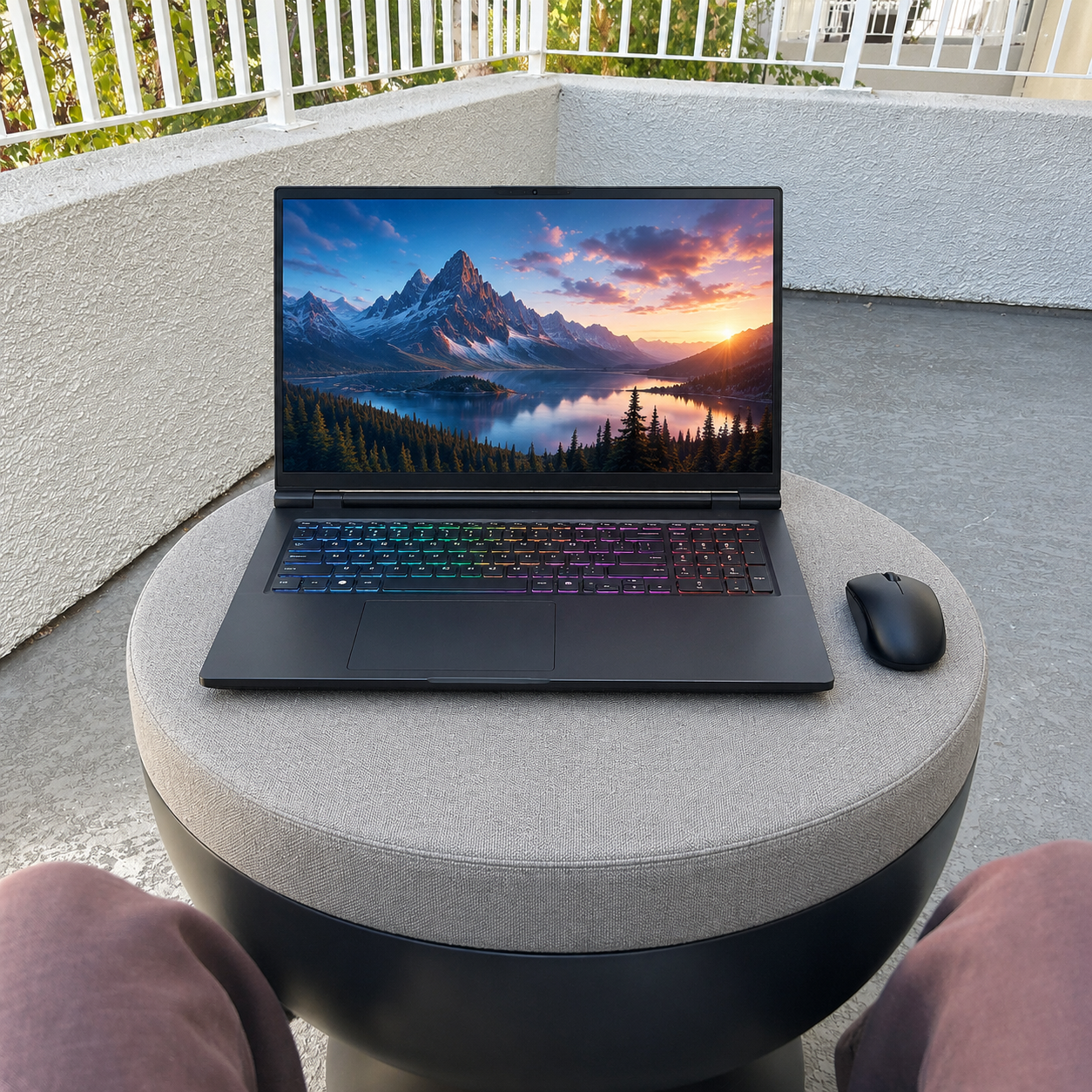
Last spring a customer wrote our order desk with an odd request. She had propped her laptop on a pouf at her side table, liked the extra height, and hated everything else — the screen tipping as the beans shifted, the wobble with every keystroke. Could we cut the same shape, but firm? She is not an outlier: forum threads going back to at least 2020 repeat the same two complaints from people working from sofas, ottomans, and beds — soft things sag, hard things sit too low. This is our factory-floor answer: the height math, the sizing, the density spec, and where a custom-cut foam platform beats every lap desk on the market.
Why Pillows, Poufs, and Bean Bags Fail Under a Laptop
A desk has one structural job: hold its surface flat under load. Every popular “soft” alternative fails it in a predictable way, written into the material, not the brand.
Bean fill has no shear strength. Poufs and bead-bottom lap desks are thousands of loose particles. Set a 4-lb laptop on top and the load doesn’t compress the beads — it pushes them sideways. The center sinks, corners mound, the surface re-tilts with every keystroke. A pouf feels fine under a magazine and unusable under a keyboard.
Polyfiber and low-grade foam fail by migration and creep. Loose fiber clumps and shifts, so the high spot moves week to week. And the “high-density” foam in most retail cushions — often around 1.8 lb/ft³ by the time you read the tag closely — is seating grade, engineered to dish out slowly under a person. Under a concentrated laptop-and-wrists load it develops the same permanent hollow, in the middle of your new desk.
One solid block of high-density foam behaves differently. Nothing to migrate, nothing to flow. A 65D block carries a laptop, wrists, and a coffee mug with almost no immediate compression — the top face stays flat because the load travels straight down through a continuous material. We cut it with squared, clean edges and a flat top face, wrap it in a tight cover, and you have the geometry of a desk with the footprint of a cushion: keep the one thing soft seating does well — adding height gently, without scratching the furniture underneath — and delete the softness.
The Height Math: How Thick Should the Platform Be?
Standard desks stand 28–30 inches tall. The surfaces people actually work from at home sit far lower: sofa seats run roughly 17–19 inches, coffee tables 16–18, ottomans 15–17, side tables 20–24. The gap between your existing surface and a comfortable typing height is exactly the thickness your platform needs to add — the whole calculation, and why a one-size riser never fits anyone.
A worked example: a 22-inch side table. To land where a desk would, around 28 inches, that is a 6-inch-thick cushion. Prefer a lower, lap-style angle? Target your seated elbow height — forearm level, measure floor to elbow; on a sofa that lands 24–27 inches, so a 3–5 inch platform hits the sweet spot for most people, and on a bed 4–6 inches brings the screen to eye level. And thick does not mean tippy: a single 6-inch block has a full-width base and its own weight pressing it into the upholstery. Height with a wide footprint is stable; height on stilts is not.
Sizing the Platform for Where You Actually Sit
Side table or ottoman (the riser case)
Measure the top of the furniture — length and width — and order the platform cut to that footprint. A squared block uses the whole top, which matters: a 16-inch laptop has a footprint of roughly 14 × 10 inches, a 17-incher about 15 × 10.5, and an inch of margin per side puts you at a 17 × 12 working face before you even think about a mouse. On a small ottoman that is the entire top — which is why we cut to your measurement rather than a size chart. Our rectangle measuring guide covers the three dimensions and tolerances we cut to.
Sofa arm or sofa seat (the wide-platform case)
Sofa arms run 6–9 inches wide — too narrow for a laptop footprint, and a cushion overhanging both edges will teeter. What works is a wide platform laid across the seat, laptop toward the front edge where the seat is firmest. Measure the seat width between the arms, decide how deep the block should reach toward the backrest, keep it rectangular: the seat does the supporting, the foam does the leveling.
Bed (the eye-height case)
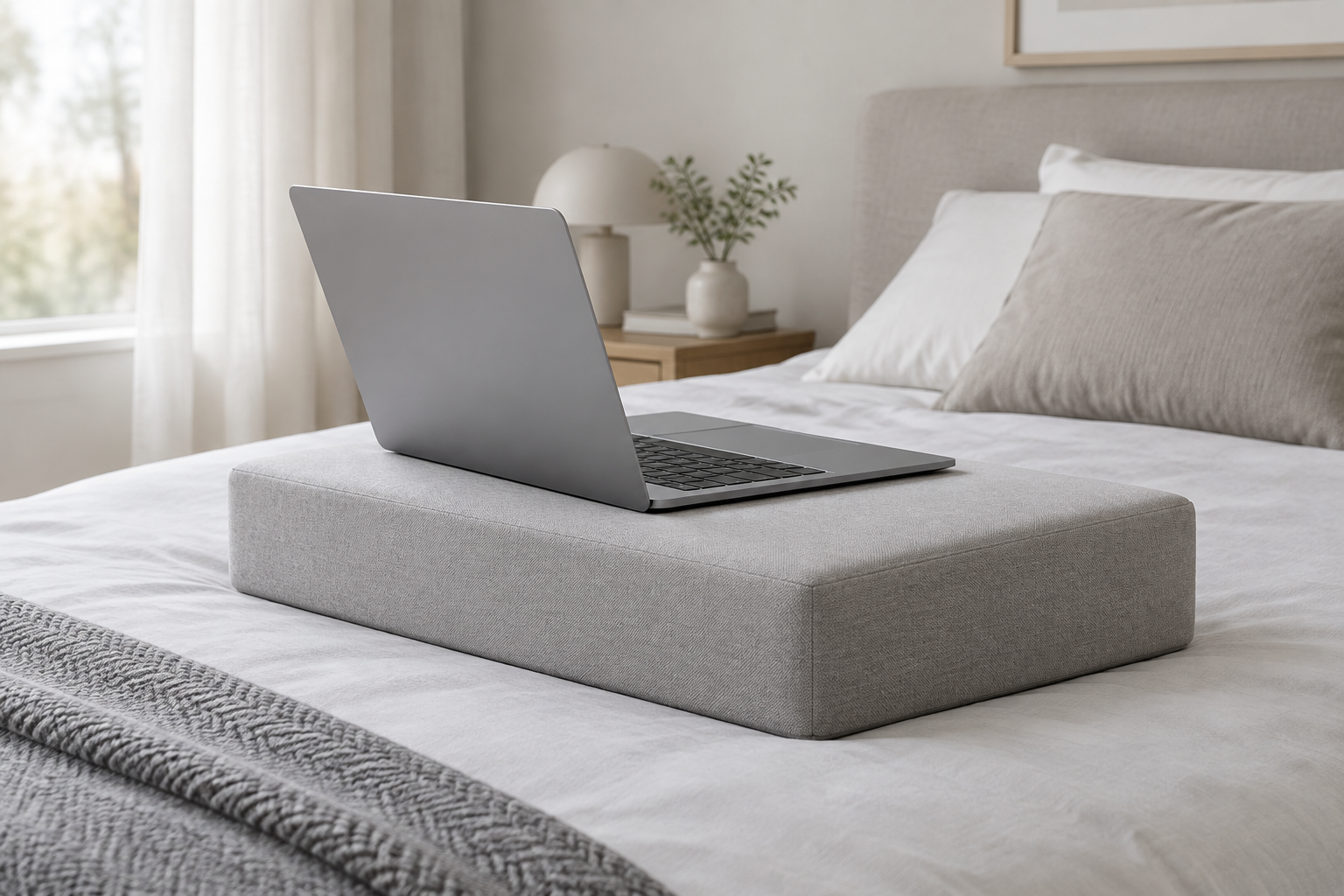
A mattress is the softest base in the house, so the platform does double duty: holding the laptop flat while the surface underneath gives. Two rules from customers who have made this work: go bigger than the machine — 2–3 inches of margin per side keeps the block level as the bedding compresses unevenly — and go thicker than feels necessary, since 4–6 inches typically brings a 16-inch screen to a comfortable eye line propped up. A closed laptop on a 5-inch flat-topped block is also, not coincidentally, a decent breakfast table.
Which Density: 65D for Platforms, 60D for Dual-Duty
Foam grades in our shop run by density — 35D, 50D, 60D, 65D — and density is how much polymer is packed into the block, which drives how it carries load and for how many years. (Our full guide to D-ratings covers why there is no honest conversion to the lbs/ft³ figures on US retail tags.) For a pure laptop platform we quote 65D: under a laptop, wrists, and the occasional elbow it shows almost no immediate give — the surface you set up at 9 a.m. is still there at 6 p.m. If the block doubles as a spare seat, 60D is the compromise grade — firm enough to type on, with a little give. Whatever you buy, press a corner of any “firm” cushion between thumb and forefinger first: if it crushes flat with finger pressure, the center will crush under a laptop.
Fabric for a Work Surface, Not Just a Seat
A laptop platform asks things of a cover a seat doesn’t: keyboards drag across it eight hours a day, coffee happens, wrists rest on the edge for months. Our covers come in five fabric families; for desk duty we steer people toward the performance weaves — tight, low-pile surfaces that wipe clean with a damp cloth and don’t grab a mouse the way deep texture does. A taut cover over squared foam also keeps the top face reading flat, which is the whole point.
Custom Foam Platform vs. Lap Desks and Gaming Trays
| Custom foam platform | Retail lap desk | Gaming lapboard (Couchmaster) | Pouf / pillow | |
| Size ceiling | Cut to any footprint, incl. 27-inch screens | Mostly caps at ~17-inch laptops | Built around a 17-inch ceiling | None — no structure |
| Added height | You specify the thickness | Fixed, usually 1–2 inches | Fixed by the frame | Uncontrolled, shrinks with use |
| Firmness | Your spec — 65D standard | Bead or fiber base packs down | Firm, but rigid frame on soft furniture | None |
| On soft furniture | Full-base contact; weight settles it in | Small feet pivot on upholstery | Same pivot problem, higher stakes | Is the problem |
| Price logic | Priced by size and grade, quoted upfront | Cheap, replaced often | Over 100 euros for the good ones | Cheap, fails as a desk |
Read the size-ceiling row twice if you use an external screen. The 27-inch monitor plus keyboard layout desk workers take for granted does not exist in the lap-desk aisle — the biggest “XL” trays bottom out at a 17-inch laptop, and the good gaming lapboards start over 100 euros. Yet that setup needs only a flat working face of about 26 × 14 inches, an ordinary cushion size when foam is cut and covered to order: a premium tray with the size ceiling deleted.
How Ordering Works
The order is three decisions: dimensions (top length, width, thickness — measured off the furniture with a tape, not guessed), density (65D unless the block doubles as seating), and fabric family (wipe-clean weaves for desk duty). Configure it all in the custom cushion builder and see the price before anything is cut. Everything is made to order: production runs 4–7 business days, shipping typically 3–6 weeks. When it arrives, give the block an hour to finish expanding after the box, set it on the surface you measured — and enjoy the side effect customers report most: the room reads it as a cushion, and only you know it is a desk.
FAQs
Can a cushion really work as a couch laptop desk for a 27-inch monitor?
Yes. A 27-inch screen plus keyboard needs a working face of roughly 26 × 14 inches, well within ordinary cushion sizes. Because we cut to your measurement, there is no ceiling: you specify footprint and thickness, and 65D foam holds the surface flat.
Is a pouf a good laptop stand?
No — the reason is mechanical, not quality. Bean fill has no shear strength, so a concentrated load pushes the beads aside — the surface tilts with every keystroke. A pouf can suggest the right height, which is how several customers arrive at our order desk: they test the height on a pouf, then order that height cut in firm foam.
What foam density should a laptop riser cushion be?
65D for a pure platform — almost no immediate compression under laptop and wrists. Choose 60D only if the block also doubles as a seat or floor cushion and you want some give.
Will the platform slide around on a sofa or ottoman?
Less than a hard tray: the full fabric base sits in contact with the upholstery and the block’s own weight settles it in — no small pivoting feet. We do not add grip backings; on slick leather, a bigger footprint is the practical lever.
Can I use it as a bed laptop desk?
Yes. Order the footprint 2–3 inches larger than your laptop per side and 4–6 inches thick; over a mattress that brings the screen to a comfortable eye line propped up. Off the clock, the block reads as a floor cushion or breakfast tray.
How do I clean it after desk duty goes wrong?
That is what the performance weaves are for: coffee and keyboard grime wipe off with a damp cloth — the reason we steer desk platforms away from deep-pile covers. Removable covers in those families go further — see our washable cushions guide.
Next Steps
Measure the top you want to turn into a desk — length, width, and the height gap to close — and take those three numbers to the custom cushion builder. Sixty-five density, wipe-clean weave, your footprint: the couch laptop desk every aisle told you doesn’t exist.
Couch Cushion Foam Replacement: Density, Cost and Buying Guide
Replace couch cushion foam in one right order: 50D vs 60D density, measuring the old core, four ways to buy, and real worked prices for one seat and a full set.
Where to Buy Replacement Patio Cushions: 5 Ways, Compared
Five ways to replace patio cushions — the set maker’s parts program, seasonal aisles, universal-fit listings, specialists and measured custom — plus the Home Depot house-line route with 31 measured collections.
Why Is Patio Furniture So Expensive? The Cost Anatomy, Explained
What actually drives patio furniture prices — weatherproof materials, UV-stable finishes, marine-grade hardware, freight on bulky goods, and seasonal retail economics — why the good stuff costs 3-5x the box-store set, and where the value concentrates.
Patio Set vs Buying Separately: The Real Trade-offs
Buying a complete patio set versus assembling pieces: price coherence and one-click convenience versus fit-to-space precision, mixable quality and replacement flexibility — how to decide, and the hybrid strategy that captures both sides.
How Much Do Custom Cushions Cost? Price Ranges by Shape (2026)
Custom cushions cost USD 50-400 depending on shape, size, density and fabric. Live factory-direct price ranges for bench, window seat, outdoor, sofa and boat cushions — and how to price your own.
Outdoor Cushion Foam: Density and Thickness Guide With Real Numbers
Short answer: for a daily-use outdoor seat, order 3 inches of foam at 50D–60D; move to 4 inches and 60D