
A one-piece chaise cushion is a single pad that folds: a seat panel running out to the front edge, a back panel rising to the top of the backrest, joined at a hinge line where the lounger articulates. Universal versions exist, and they guess where that fold falls — mostly wrong, because no two decks hinge in the same spot. This guide covers the five numbers a one-piece chaise order needs (width, seat depth, back height, hinge position, thickness), how to find the hinge line on a pad whose fold has flattened out, how to tell a one-piece pad from a two-piece set before you measure, and the four mistakes that make hinged orders miss. For the general width-depth-thickness protocol, start with how to measure outdoor cushions; the photo walkthroughs for every shape live in the measurement guides.
What Is a One-Piece (Hinged) Chaise Cushion?
Pick the old pad up by one end. If the whole thing comes off the lounger as a single sheet — seat and back connected, one continuous cover — you have a one-piece hinged pad, and this is your page. If it comes apart in your hands as a seat cushion and a back cushion, you have a two-piece set, and your measurements are simpler ones covered further down.
One-piece pads dominate the patio-lounger world: metal, teak and resin frames with a flat rectangular deck and an adjustable back that flops down flat for sunbathing. The hinge in the cushion exists to follow that flop. Indoors you meet the same construction on chaise longues and daybed benches with a raised end.
The hinge line is also what makes this measurement different from every other cushion on the site. It is the only datum both panels share. Seat depth starts there; back height starts there; get the line itself wrong and both numbers are wrong together, in opposite directions. Which is why the first job is not the tape measure — it is finding the fold.
One boundary before we start: woven frames. A wicker or rattan chaise that tapers — wide at the foot end, narrower and curved at the back — needs a two-width method that is its own article. If your two side edges differ by two inches or more, or the back panel curves to follow the weave, the correct protocol is the wicker chaise cushions guide. This page is for straight, equal-width decks.
The Five Numbers a One-Piece Order Needs
In our cushion builder, the Chaise (Hinged) card draws the pad in profile with a dashed line across it — that dashed line is the hinge, and the five fields carry the same letters used below.
| Letter | Field | What to measure | A typical order |
|---|---|---|---|
| A | Width | Widest span, side to side | 23.5″ |
| D | Seat depth | Hinge line to the front edge | 50″ |
| E | Back height | Hinge line to the top of the back | 26″ |
| F | Hinge position | Left edge of the cushion to the fold line | 12″ |
| C | Thickness | Seam to seam | 5″ |
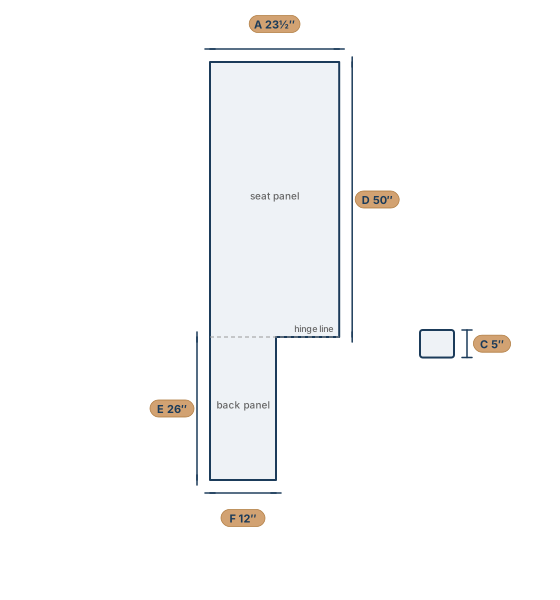
A — Width, at the Widest
- Lay the old pad flat on a table, opened out to its full L shape.
- Measure side to side at the widest point — not where you sit, not where your shoulders go, but the widest span the pad offers anywhere along its length.
- Most one-piece pads run the same width in both panels. If yours flares — a backrest wider than the seat, or vice versa — measure both and record the larger; note the difference when you order and the photos will settle it.
D — Seat Depth: Hinge Line to the Front Edge
- Find the hinge line first (the next section and the first FAQ both cover how). On an opened-out pad it is the crease — or the seam — running the full width of the cushion.
- Lay the tape flat on the pad from that line to the front edge of the seat panel.
- Read to the nearest quarter inch. That number is D, and it is the depth your hips actually get.
The discipline is the start point. D does not start at the back edge of the seat panel, at a row of piping, or “where the back cushion starts to look like a back.” It starts at the fold, because that is the one line the seat and back share.
E — Back Height: Hinge Line to the Top
- From the same hinge line, run the tape along the back panel to its top edge.
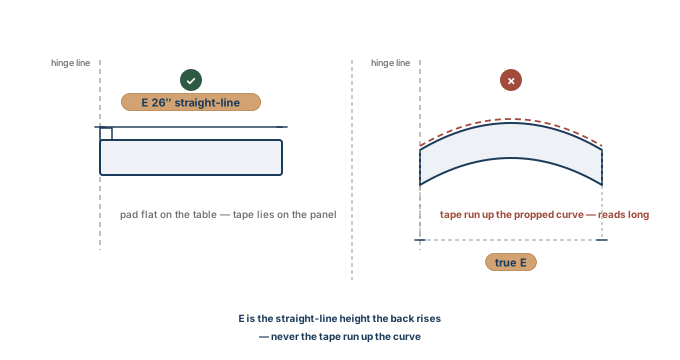
- Keep the pad flat on the table while you do it — E is a straight-line height, the distance the back rises, measured flat.
- If the top of the back arches — plenty do — measure to the highest point of that arch, not to the shoulders of the curve.
E is the number people get wrong most often, and wrongly in one specific direction: they measure the curve of the back instead of its height. The section on mistakes below shows why that overruns the order.
F — Hinge Position: Left Edge to the Fold
- With the pad still lying flat, measure from the left edge of the cushion to the hinge line.
- Record it to the nearest quarter inch. That is F.
F is the number nobody expects and no universal pad carries. On most decks the fold is not centered — it sits closer to one end — so F tells the cutting floor which end the fold belongs to. The “47/27” style figures on universal-pad listings are exactly this: 47 inches of seat to 27 of back tells you where the listing’s fold falls, and if your frame folds at a different spot, the universal pad hinges where your lounger does not.
When in doubt about which side is left: photograph the pad from directly above, tape in the frame, and the order desk reads left from right off the photo. A real person replies within one business day.
C — Thickness
Stand the relevant panel on its edge and measure seam to seam — the seam is the cut, the puff above it is just fill. One-piece pads are almost always a single uniform thickness; chaises are lounge seating and 4″–5″ is the tier we cut every week. The builder accepts 2″ through 8″. A pad that is thicker under the seat than at the back — a wedge — is a wicker-frame feature, and it belongs to the wicker page, not this card.
Four Mistakes That Ruin One-Piece Chaise Orders
These four belong to hinged pads. The shape-blind classics — measuring the frame, reading a sagging tape, rounding up “for luck” — are collected in cushion measurement mistakes, and they apply to every number on this page.
1. Measuring D and E from the outer edges instead of the hinge. The instinct is to measure the seat panel from its back edge to its front edge, and the back panel from its bottom to its top. Both readings sweep in piping, seam allowances and the curve where the fabric turns at the fold — on both panels, in opposite directions. The hinge line is the only datum both panels share; start anywhere else and you have baked seam furniture into both numbers. A quarter inch of error at the fold is a quarter inch of seat depth the order no longer has.
2. Leaving F out. Without hinge position, the cutting floor can only fold the pad in the middle or guess. Most decks hinge off-center — that is the entire reason the field exists — and a centered fold on an off-center deck means the back rises at the wrong line: the pad buckles where the frame’s hinge bar sits, or the seat comes up short at the front rail. One extra measurement, taken in ten seconds, puts the fold where your frame actually folds.
3. Measuring a two-piece set as one piece. If the seat and back come apart in your hands, there is no hinge line, and D and E have nothing to start from — the five-number card does not describe your order. What arrives is one rigid L-shaped pad on a lounger whose parts move independently. Two-piece sets get the two-rectangle method in the next section. Count the pieces before you count anything else.
4. Measuring the back’s curve instead of its height. Prop the old pad up the way it sits on the lounger and run the tape up the face of the backrest, and you have measured an arc. An arc is always longer than the height it rises — the more the back bows, the bigger the gap between the two numbers. E is a flat-on-the-table height. Order the arc and the back panel arrives too long: it crowns above the backrest top, or wrinkles at the fold where the surplus has to go somewhere.
One-Piece or Two-Piece: Which Are You Measuring?
A two-minute audit before the tape comes out:
You are measuring a one-piece pad if: it lifts off as a single sheet; seat and back are joined by a crease or a continuous seam you can trace with one finger from one side to the other; the backrest adjusts by folding at that same line.
You are measuring a two-piece set if: the pads come apart in your hands; the back is a fixed frame the pad merely leans against; each piece carries its own ties.
For a two-piece set, order two rectangles: each panel gets its own width (A), its own depth (B — for the back panel, from its bottom edge to its top, measured flat), and its own thickness (C). The builder’s rectangle card with a quantity of two is the whole order. Both builds price the same way — by the square foot, no shape surcharge either way — so choose the construction that matches the frame, not the one that sounds simpler.
What Real One-Piece Chaise Cushions Measure
Sanity-check numbers from the chaise collections in our measured database — 24 Hampton Bay and 7 Martha Stewart patio collections, 195+ verified sizes. Series-page dimensions; treat owner-measured figures as approximate.
| Collection | A width | D seat depth | E back height | C thickness |
|---|---|---|---|---|
| Spring Haven | 23.5″ | 50″ | 26″ | 5″ |
| Middletown | 24″ | 46″ | 32″ | 5″ |
| Pembrey | 23″ | 42″ | 26.5″ | 5″ seat / 4″ back |
| Verrado | 22″ | 48″ | 28″ | 5″ |
| Pacific Grove | 23.5″ | 45″ | 30″ | 5″ |
Pacific Grove is worth a second look because it teaches the D/E split: the listing describes a 23.5″ × 75″ one-piece with a 45″ seat depth — 75 inches of total fold-out length, of which 45 is seat. Read straight off the listing, that is D = 45″ and E = 30″, and the hinge line is where the one becomes the other.
Across the collections, widths cluster at 22″–24″, seat depths at 42″–50″, back heights at 26″–32″. The builder’s placeholder numbers (23.5″ × 50″ × 26″) sit squarely inside those ranges — which is the point of a placeholder. Use the table to sanity-check your tape work, not to replace it: two loungers with the same label can differ by inches, and your pad is the spec.
FAQs
How do I find the hinge line if the fold has flattened out?
Look for the seam, not the crease. Age and storage flatten creases, but the construction seam — where the seat panel’s fabric meets the back panel’s — runs the full width of the pad and never moves. Open the pad flat and run a finger across it: the line where two panels meet, often finished with a row of piping or topstitching, is the hinge. A photo from directly above settles any residual doubt.
The old one-piece cushion is gone — can I measure the lounger itself?
Yes — measure the flat deck between the frame rails, not the outside of the frame. For the hinge, use the axis of the frame’s hinge bar, where the backrest pivots. Expect frame numbers to run slightly large, and photograph the deck from directly above with a tape in the frame so the order desk can sanity-check before anything is cut.
What thickness should a one-piece chaise cushion be?
4″–5″ is the lounge tier we cut every week. Thinner reads as a dining pad on seating built for reclining; 6″ and up is deep-seating territory that can lift you past the arm line. The builder takes 2″–8″ for exceptions.
How close to my numbers will the cushion actually be cut?
A shop holding ±½″ is the benchmark to expect — ±¾″ on runs over 36″, which most chaise depths are — with every dimension re-checked against your order before fabric is cut, not after sewing. Shop-error remakes belong to the shop.
I entered a wrong number — what now?
Free cancellation inside 24 hours of ordering. After that the backstop is process: nothing is cut until your numbers are confirmed, and odd numbers get a phone call, not a guess. If the error is ours, the remake is ours.
Next Steps
- Lay the old pad flat, opened out, and record A, D, E, F and C to the nearest quarter inch — with one photo from directly above, tape in the frame.
- Open the builder with the chaise card preselected and type your numbers in: custom chaise lounge cushions.
- Want the walked-through version with fabric choices alongside the same five numbers? That is the chaise lounge cushions product page. Either door, nothing is cut until your numbers are confirmed — made to measure in 4–7 business days, rush 3–5, a fraction of the wait of typical US custom shops.
The one-sentence version: five numbers — width at the widest, seat depth and back height both starting at the hinge line, hinge position from the left edge, thickness at the seam — and the discipline that both depths begin at the fold, never at an outer edge.
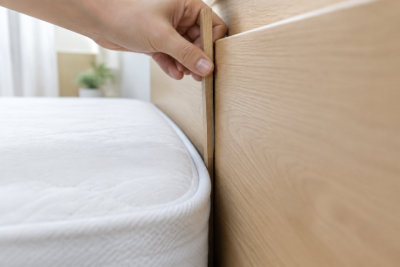
What Size Bed Gap Filler Do I Need? Thickness, Length and Density
Size a bed gap filler from three measurements, not the bed’s name: thickness equals gap width plus half an inch to one, length runs the full seam, height runs platform to mattress top. Density starts at 50D.
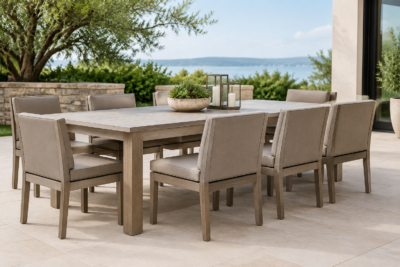
Cushion Thickness & Seat Height: Match the Pad to the Table
Cushion specs usually answer comfort questions. Thickness answers a geometry question: how high off the floor you end up sitting,

Church Pew Cushion Sizes: Standard Dimensions and How to Measure
Standard pew seats run 19-21 inches deep; cushions are cut 2-3 inches thick to measured runs at plus-or-minus half inch tolerance. Dimensions table, taper rules, and the pew-by-pew measuring method.
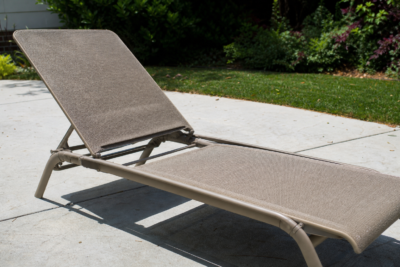
Chaise Lounge Cushion Measurements: A Complete Guide to Getting the Fit Right
How to measure a chaise lounge cushion correctly — seat depth, back height, thickness, hinge points and one-piece vs two-piece styles — with real Hampton Bay chaise dimensions.
How to Measure Rocking Chair Cushions: Seats, Backs and Tie Positions
How to measure rocking chair cushions — tapered seats, curved backs, slat-gap tie maps and rock clearance — with the three-number protocol for both pieces of a rocker set.
Window Seat Cushion Measurement: How to Get a Perfect Fit
Measure a window seat cushion correctly — width across alcoves, depth front to back, thickness vs sill height, radius corners and bay window angles — with tips from the cutting floor.