
A mattress topper is the cheapest two to four inches of sleep improvement money can buy — provided those inches are the right thickness, the right density, and the right size for the bed they land on. Two of those three decisions are usually made badly. Shoppers buy thickness by folklore (“thicker is better”), density by whatever the box says, and size by the nearest standard label — then spend a year sleeping on a topper that bunches, bottoms out, or hangs off the mattress like a dropped tablecloth. This guide is the specification sheet: what a custom topper actually is, how to match 2, 3 or 4 inches to the job you need done, how to grade density honestly, and how to measure width and depth so the factory cuts exactly what your bed asked for. If you already know your numbers, the custom mattress topper page takes them directly.
What a Custom Mattress Topper Is
A topper is a separate layer of foam that sits on top of a mattress — or a sofa bed, or an RV platform — and becomes the surface you actually sleep on. The word matters: a topper is not a mattress. It carries no mattress certification claims, because it is a component, not a finished bed. That distinction is also what makes a custom topper the cheapest renovation in the bedroom: you keep the structure underneath and replace only the two to four inches that went dead.
A custom topper goes one step further than the retail aisle: it is cut to your measurements rather than to one of six standard sizes. That matters more often than people expect. Short queens in RVs, three-quarter bunks in vintage trailers, antique frames built before size charts existed, split kings for adjustable bases, sofa beds whose decks obey no standard at all — none of these are served by a Twin/Full/Queen/King shelf. A factory that cuts to order treats a 60 × 74 short queen and a 76 × 80 king as the same job: one rectangle, three numbers, one cut.
The construction is deliberately boring. A flat slab of high-density foam, uniform thickness edge to edge, square corners, optionally wrapped in a tailored cover with a side panel and a zipper. No tufting, no sculpted zones, no gel swirls — those are marketing surfaces. What a topper does for your sleep happens in the foam itself: its thickness, its density, and its fit.
Thickness: 2, 3 or 4 Inches, Decided by the Job
Thickness is not a quality ranking — it is a job description. Buy the thickness the job needs:
| Thickness | The job | What it does |
| 2 inches | Soften a firm bed | Takes the edge off a healthy-but-hard mattress without changing sleep height or fighting the support underneath |
| 3 inches | Replace a worn topper | Like-for-like renewal of an old 2–3 inch topper that compressed into felt; the standard grade of renewal and the most-ordered option |
| 3–4 inches | RV and sofa bed upgrade | Turns a thin factory pad or a bar-across-the-back sleeper into a real bed; 4 inches for heavier sleepers or daily use |
Three notes on reading the table. First, two inches is an adjustment, not a rescue — if the mattress underneath is sagging, foam on top of a valley makes a slightly softer valley. Fix the deck or accept the topology. Second, three inches at a real density beats four inches of the low-grade foam most boxed toppers use; inches are only comparable within the same density. Third, above four inches you are no longer topping a mattress, you are replacing one — a different product, a different conversation.
The one physical limit worth knowing: every inch of topper raises the sleep surface an inch. Check the fitted-sheet depth, and if the topper shares the bed with a partner who runs hot, remember that a solid foam layer sleeps warmer than the quilted pad it replaces.
Density: 50D to 65D, Graded by Body Weight and Use
Density is the number that decides what the topper feels like in year three. A topper lives under a full body weight for eight hours a night, every night — so the density floor is higher than for seat cushions. The honest grades:
- 50D — the every-night standard. Supportive with give, and the grade roughly 80% of topper orders should ship in. If you are renewing a worn topper or softening a firm bed and sleep at average weight, this is the honest answer, not the budget one.
- 60D — for heavier sleepers, or when the topper is the bed: an RV bunk, a guest-room daybed, a futon doing mattress duty. Firmer, slower to take a body set, and the upgrade most buyers regret skipping.
- 65D — maximum structure and longevity. Sofa-bed duty over a frame bar, frequent RV folding, or sleepers who want the topper to add real, lasting height.
The full logic — what density physically is, how it maps to body weight, and why low-density foam feels fine in the store and dies in a year — is in how to choose foam density. The short version: density is how much foam substance sits in each cubic foot. More substance per foot means the cell structure takes longer to fatigue. Price tracks density almost linearly, which is why the cheapest topper on a shelf is usually the most expensive per year of good sleep.
Sizing: Measure Width × Depth, Then Run the Diagonal Check
A custom topper is only as custom as the numbers you send. Three measurements, taken properly:
Width and depth, edge to edge. Measure the surface the topper will sit on — mattress top, sofa-bed deck, RV platform — with the tape square to the edges, to the nearest quarter inch. One number runs head-to-foot, the other side-to-side; which is “width” and which is “depth” is a labeling question, not a measuring one (in the Cushion Mill calculator, enter the longer side as Width, since it caps the second dimension at 72 inches). Never measure corner to corner: a diagonal tape reads long on both axes at once.
Replacing an old topper? Measure the deck, not the pad. A compressed old topper under-reads at its center and over-reads across any crown. The surface underneath it is the truth.
Then the 60-second diagonal check. Measure both diagonals of the rectangle, corner to corner, tape taut. Within a quarter inch of each other: a true rectangle, and width × depth is enough. More than a quarter inch apart: the corners are not square or an edge bows — photograph the deck from directly above with a tape along each edge, and let the factory cut to what the piece actually is rather than to a formula. The full walkthrough with photos is how to measure a rectangle cushion; the general method is the same one in our measuring guides.
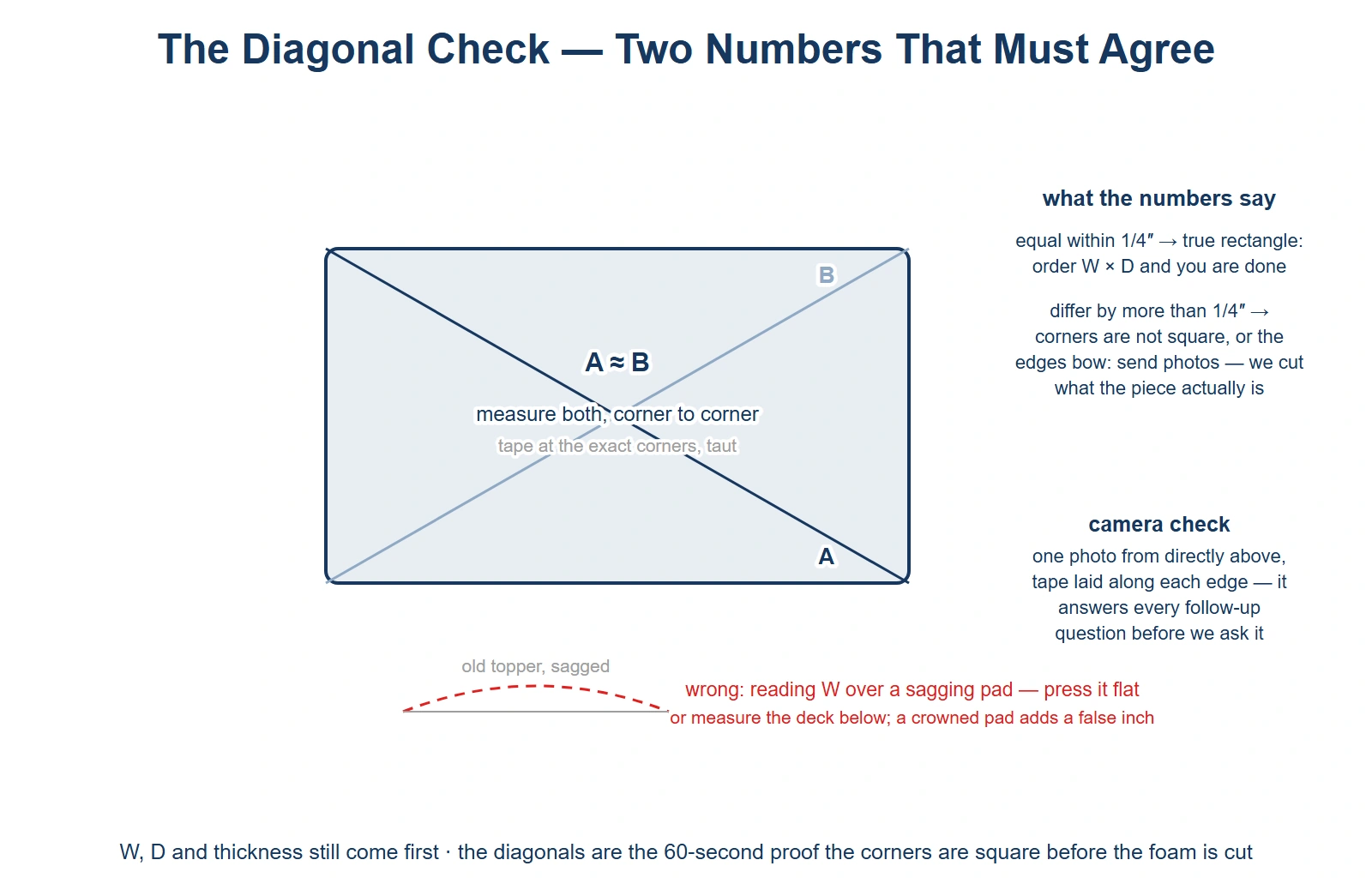
Thickness is the fourth number, measured at the edge, seam to seam: 2, 3 or 4 inches. If the topper is going inside a cover you already own, measure the cover’s interior with the closure open — seam to seam — and deduct a nominal quarter inch per side so the core sits in without fighting the fabric.
Foam-Only or With a Cover
The last specification is what wraps the foam. Two order types exist, and factories that cut to size usually run both:
- The complete topper — foam core plus a tailored cover: a continuous side panel, a zipper along one edge so the core can be aired or rotated, sewn in your fabric. The default order, and what an instant calculator prices: at Cushion Mill, any of 59 fabrics at one price, from breathable cotton linens through tech fabrics to velvets.
- The foam-only core — the bare cut slab, for going straight under a fitted sheet or inside a cover you keep. Foam-only pricing is quoted on request rather than calculated live, because it is the refill side of the business: send size, thickness and density, and the core is quoted at foam rates.
Which lane you want depends on one question — which layer are you keeping? If the cover is sound and only the foam inside it died, a foam-only core is the renewal (that is the same job as a futon or sofa cushion refill). If you want a new layer on a surface that stays, order the complete topper. Both start on the custom mattress topper page.
FAQ
Do standard sizes cost less than custom?
No — a custom-cut shop prices by area and density, not by label. A Twin and an odd 63 × 77 antique cut from the same 3-inch 50D foam cost the same per square foot. There is no size chart to fit and nothing to be out of stock.
How much does a custom topper cost?
By area, thickness and density — one formula, published on the product page. As a concrete anchor: a Twin 38 × 75 at 2 inches and 50D with a cover starts around $544, and a Queen 60 × 80 at 3 inches runs about $957. Every size recalculates instantly in the calculator.
Is a denser topper firmer?
Yes, and that is the point. Within the same thickness, stepping 50D to 60D produces a firmer, slower-to-fatigue layer. If you want softness, choose thickness; if you want longevity under weight, choose density.
How long does a custom topper take?
Each one is cut and sewn after ordering — expect 4–7 business days of production. Shipping is free past $158, which every topper clears.
Can a topper fix a sagging mattress?
Honestly: no. Foam on top of a valley makes a softer valley. Toppers adjust feel; they do not restore structure. Replace the mattress, or accept the topology.
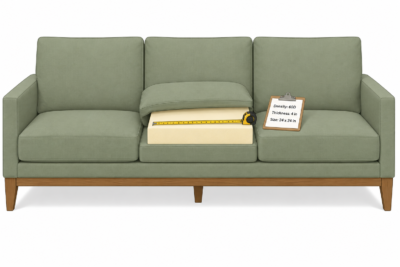
Couch Cushion Foam Replacement: Density, Cost and Buying Guide
Replace couch cushion foam in one right order: 50D vs 60D density, measuring the old core, four ways to buy, and real worked prices for one seat and a full set.
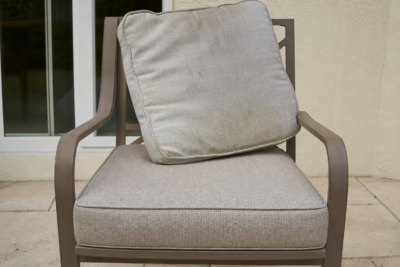
Where to Buy Replacement Patio Cushions: 5 Ways, Compared
Five ways to replace patio cushions — the set maker’s parts program, seasonal aisles, universal-fit listings, specialists and measured custom — plus the Home Depot house-line route with 31 measured collections.
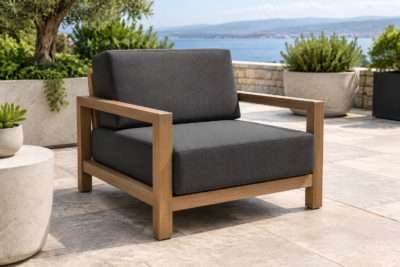
Why Is Patio Furniture So Expensive? The Cost Anatomy, Explained
What actually drives patio furniture prices — weatherproof materials, UV-stable finishes, marine-grade hardware, freight on bulky goods, and seasonal retail economics — why the good stuff costs 3-5x the box-store set, and where the value concentrates.
Patio Set vs Buying Separately: The Real Trade-offs
Buying a complete patio set versus assembling pieces: price coherence and one-click convenience versus fit-to-space precision, mixable quality and replacement flexibility — how to decide, and the hybrid strategy that captures both sides.

How Much Do Custom Cushions Cost? Price Ranges by Shape (2026)
Custom cushions cost USD 50-400 depending on shape, size, density and fabric. Live factory-direct price ranges for bench, window seat, outdoor, sofa and boat cushions — and how to price your own.
Outdoor Cushion Foam: Density and Thickness Guide With Real Numbers
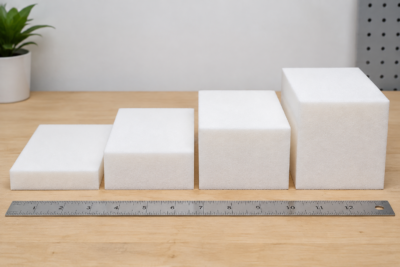
Short answer: for a daily-use outdoor seat, order 3 inches of foam at 50D–60D; move to 4 inches and 60D