
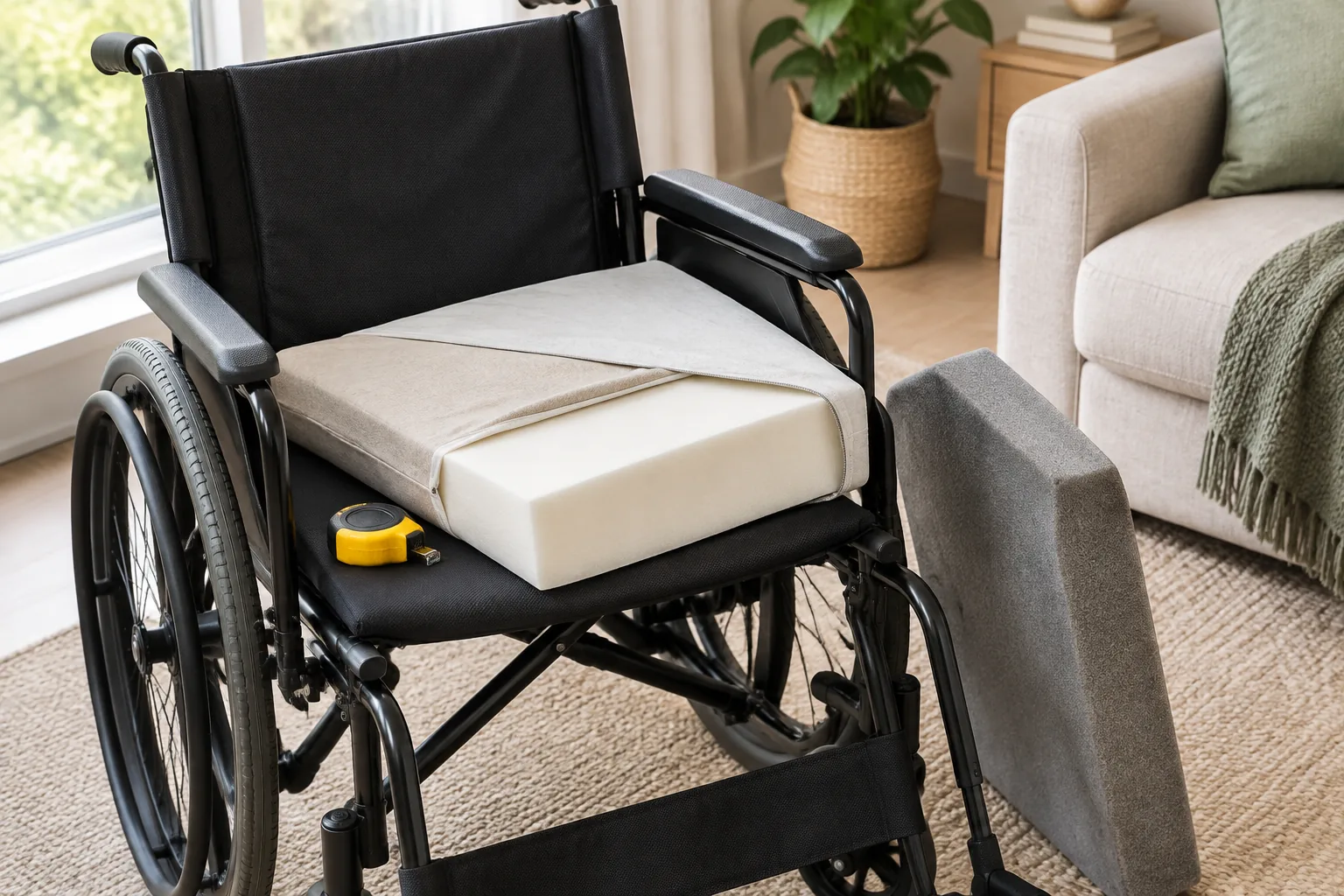
A wheelchair seat is the hardest-working seat in the house: loaded for hours at a stretch, every day — a duty cycle no sofa cushion ever sees. And when that seat goes flat, the part that died is the cheapest part of the assembly: the foam core inside. The pan beneath is fine, the cover usually is too — the fix is a fresh core, cut to the same three numbers the old one was.
This guide covers the signals, the measuring, the density pick, and the cover question. If you already have your numbers, the rectangle card in our custom cushion builder takes them directly — any seat from 8 by 6 inches up to 120 by 72, thickness 2 to 8.
Why Replace the Foam, Not the Whole Cushion
Replacement-seat shopping usually starts in the wrong aisle. Retail wheelchair cushions come in a handful of stock sizes — 16 by 18, 18 by 16, 18 by 20 — and if your seat, or your cover’s interior, is a 17 by 17 or a 15.5 by 18, nothing on the shelf fits. The result is a pad that gapes at one edge and bunches at another, which compiles into the same uneven wear that killed the first core.
A core cut to your measurements ends that. It costs a fraction of a complete new cushion, drops into the cover you already own, and restores the seat’s height and feel in one afternoon. The economics are the same ledger we run for couches in the sofa foam replacement cost guide: a dead core on a live frame is a small-parts problem wearing a big-ticket costume.
One straight answer up front. If the cover is also finished — zip failing, fabric shiny and thin at the front edge — a foam-only refill is a rebuilt engine in a rusted hood, and a complete cushion is the better buy. If the cover is sound, the refill wins, and the rest of this guide is how to specify it.
Three Signals the Core Is Done
Foam does not fail all at once; it fatigues, and the fatigue is readable. Run all three checks in one sitting, in daylight.
The dish that stays. Look across the seat from the side in raking light: a spent core shows a shallow bowl where the load sits, deeper than an inch at the center. Press a flat hand into the worst spot for five seconds — healthy foam springs back almost immediately, tired foam leaves a crater that fades over seconds or stays.
Edges that lean. Run a hand down the side of the pad. A sound core keeps its front edge square; a failing one has rolled into a shoulder, the sides taper inward, and the pad no longer fills its cover at the corners. Front edges carry the load on entry and exit, and they go first.
Thickness that left. Measure the old core seam to seam and compare it to what the pad shipped as, or to the cover’s interior. Foam that has lost half an inch of loft has lost the substance that did the work. A seat that bottoms out — you feel the pan through the pad on an ordinary sit — is this signal in its final form.
Any one signal justifies a look; two together are a verdict. All three, with a sound pan and cover, is the textbook refill case.
How to Measure: Width, Depth and Thickness
Three numbers, one rigid tape, five minutes. The full orthogonal method — three stations per dimension, the diagonal squareness check, every habit that reads long — is in how to measure a rectangle cushion; the seat-specific version is here.
Measure the bare core, not the cover. Unzip, slide the foam out, and measure it resting flat: width left to right, depth front edge to back edge, each at two or three spots with the largest reading kept. Covers add up to half an inch of puff the foam does not have. No surviving core? Measure the seat itself — side rail to side rail, back bar to front edge of the pan — and the workshop cuts to fit the opening.
Square, taut, edge to edge. A rigid steel tape held level and pulled tight, read to the nearest quarter inch, running along the edges — never corner to corner: the hypotenuse runs long on both axes at once. Most wheelchair seats land between 15 and 20 inches on a side; a quarter inch of care is the difference between a core that drops in and one that fights the zipper.
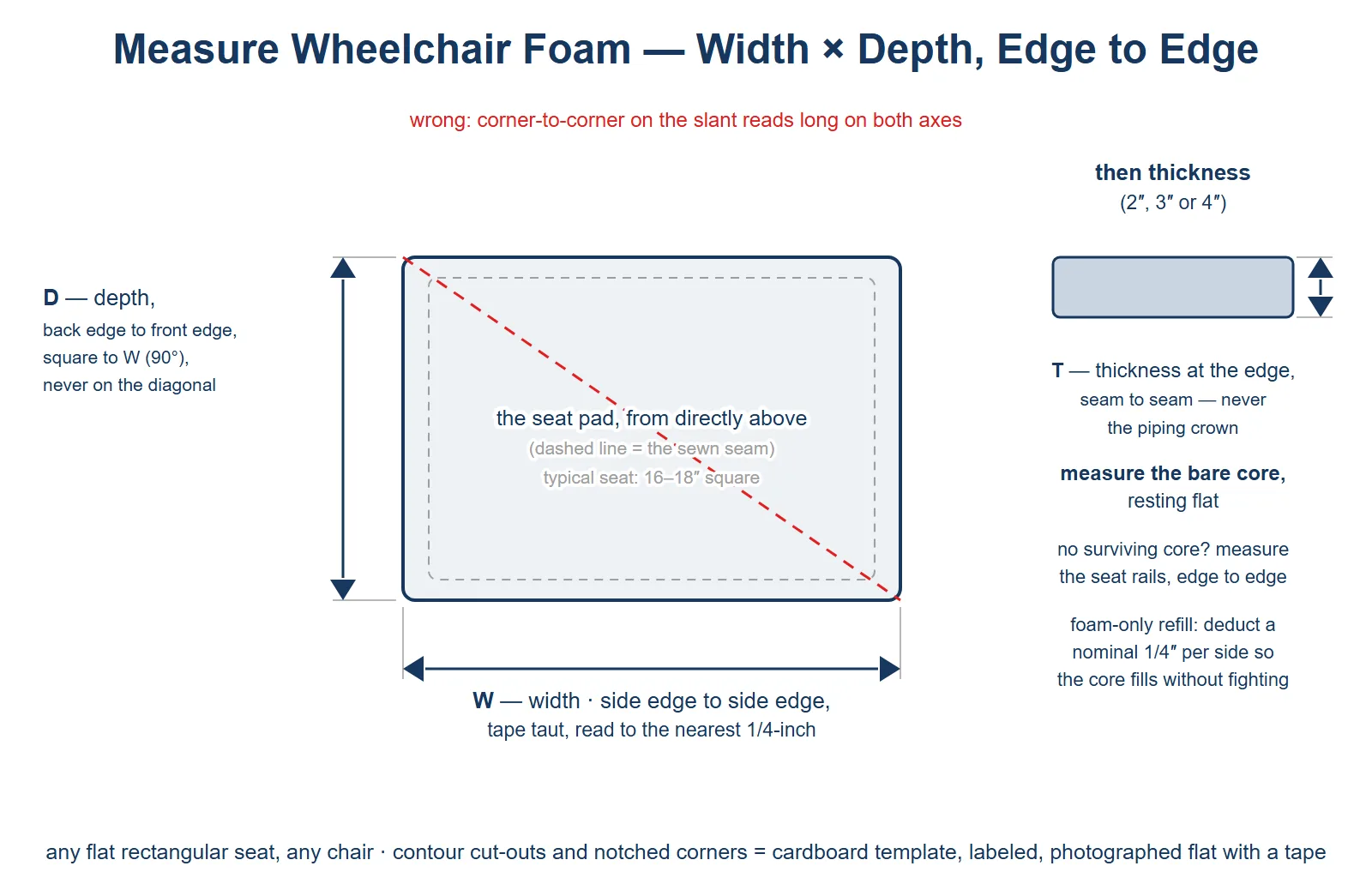
Thickness, seam to seam. Stand the core on edge and measure straight up the side, bottom seam to top seam. Never measure across piping or a stitched crown — that half inch is finish, not foam. Common refills run 2, 3 and 4 inches.
Not a plain rectangle? Contoured cut-outs, notched corners and tapered seats happen. Trace the seat outline on cardboard, cut it true, label the dimensions on it, and photograph it flat from directly above with a tape in the frame — the factory cuts to the pattern, and the pattern, not a formula, is what the seat actually is.
Density for an All-Day Seat: 50D to 65D
Density is the number that decides how an all-day core reads in year three. It is not firmness — it is how much foam substance sits in each cubic foot, and it sets exactly one thing: how many years the core holds its loft under load.
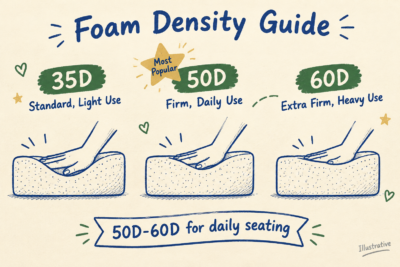
- 50D — the all-day standard. Supportive with give, and the honest default for a seat in daily, hours-at-a-time use. This is not the budget pick; it is the correct one.
- 60D — for heavier loads or maximum hold. A firmer, slower-to-fatigue core when the user runs heavier or the refill should outlast the last core by years. The upgrade most buyers regret skipping.
- 65D — maximum structure. When the seat must hold its exact height, year over year, under constant use. It sits firm; a fresh, thick cover keeps the seat reading solid rather than hard.
The number to refuse is the low one. Commodity 1.8 lb (18D) foam — the grade inside most boxed cushions — holds one to two years under daily load before the dish returns; buying the same grade that just died is scheduling this project again. The full ladder is unpacked in how to choose foam density.
Cover Fit: Reuse the Old, or Order New
Refill into the original cover when it is genuinely sound — zip running clean, fabric unblown at the edges. Deduct a nominal quarter inch per side so the foam fills the cover without fighting the fabric, and the seat reads tailored, not stuffed.
Order new when the cover has thinned, the color is being refreshed anyway, or the refill is really a re-spec — different thickness, firmer grade, a fabric that wears better. Our custom seat cushions line runs cores and covers together, a choice of 59 fabrics at one price, sewn in one production run so everything matches. The measurements stay on file for a later re-order in a new fabric.
Ordering and Lead Time
The rectangle shape card is the whole order form: enter W, D and thickness, pick the density grade, and the footprint price updates as you type. Every dimension is re-verified before anything is cut — if a number looks off, production stops and asks rather than cuts. Cutting tolerance is ±½ inch; it protects the cut, not the measurement. Production runs 4–7 business days, with rush service at 3–5.
One habit from workshops that keep seats in service: order a spare. A second core from the same run costs a fraction of the first, matches it exactly in grade and height, and lets you rotate the two on a schedule — foam recovers between shifts, so two cores in rotation outlast two bought back-to-back by years. When core one finally fatigues, the swap is an afternoon, not a project.
FAQ
What tolerance should I expect on the cut?
±½ inch per dimension — foam relaxes slightly after cutting. The tolerance protects the cut, not the measurement: a reading taken wrong by an inch arrives cut wrong by that same inch, accurately. Round once, to the nearest quarter inch, and stop.
My seat has contoured edges, not square corners. Can it still be cut?
Yes. Lay cardboard over the seat, trace the true outline, label the dimensions, and photograph it flat from directly above with a tape in the frame. The factory cuts to the pattern — the pattern, not a formula, is what the seat actually is.
Should I order two cores?
If the seat is in daily service, yes — a spare from the same run lets you rotate, and rotation is the cheapest longevity there is in foam. Two cores alternating outlast two bought sequentially by a wide margin.
Foam-only refill, or a complete new cushion?
Foam-only when the cover is sound and you want the seat back, this week, for the least money. A complete cushion when the cover is also finished or you are re-speccing the seat. Our line is complete cushions cut to order; if your cover is honest-good, a cut-to-size core refill is the better use of your money, and we will say so.
Next Steps
- Run the three checks — dish, edges, thickness — and let two of them decide.
- Measure the bare core flat, or the seat rail to rail, keeping the largest reading on each axis.
- Enter W, D and T in the custom cushion builder, pick 50D or firmer for an all-day seat, and add a spare while the machine is set up. More material guides live in the material guides library.
Foam Density Explained: D-Ratings vs lbs/ft³
What foam density actually measures, why D-ratings and lbs/ft³ (PCF) are two different languages with no direct conversion formula, and how to translate between them honestly — by use tier and lifespan, with the 35D–65D grades decoded.
Flame Retardants in Cushion Foam: What Changed and What to Ask
Cushion foam flame retardants explained: why California TB117 put additive chemicals into furniture foam, what the TB117-2013 revision changed, what CertiPUR-US and GREENGUARD actually certify, how to read new-foam off-gassing, and the six questions to ask any supplier for nursery and commercial buying.
How to Care for Polyester Cushions: Washing, Fading and Stretching Them Back
Polyester cushion care from top to bottom: what spun polyester can and can’t handle, the wash-day routine that won’t ruin fills, how to slow the fading that defines the tier, and reviving covers that have stretched out.
How to Choose Foam Density: 35D vs 50D vs 60D vs 65D (Decision Guide)
Pick cushion foam density in three questions: 35D for occasional seats, 50D as the daily-use default, 60D for heavy sitters and long hours, 65D for commercial and marine duty — with lifespan rules of thumb and what each upgrade costs.
HD Foam vs Dry-Fast Foam: The Outdoor Cushion Guide
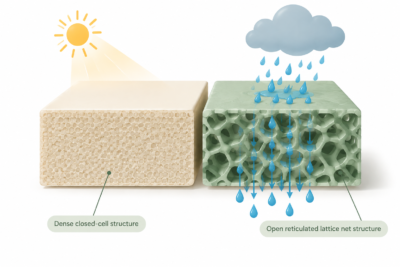
High-density foam vs dry-fast reticulated foam for outdoor cushions — cell structure, PPI, feel, the measured price premium (+9% at one configurator), and the simple covered-vs-uncovered test that picks for you.
Foam vs Fiber Cushion Filling: Which Lasts Longer?
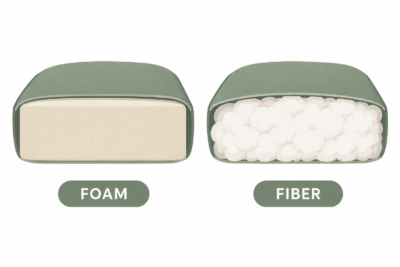
Foam vs fiber cushion filling compared on structure, lifespan and real price — why foam wins seats, where fiber belongs, and what a live configurator price test shows about the durability premium.