
Half the cushion sets sold at big-box stores every spring share one secret: there is no foam inside. The plush-looking slab in a budget four-piece patio set is usually densified fiber — polyester fiber carded into a web, needled and pressed into a firm pad. It is a legitimate material with a legitimate job, and it is also the fill behind most “my cushions went flat after one summer” complaints. We cut foam for a living and sell none of the sets this article defends, which is exactly why we can afford to be fair to it: here is what densified fiber is, how it ages, when buying it is rational, and when it is money set on fire.
Background on where this fill sits among the others — HR foam, down, memory, quick-dry — is in cushion filling types compared.
What “Densified Fiber” Actually Is?
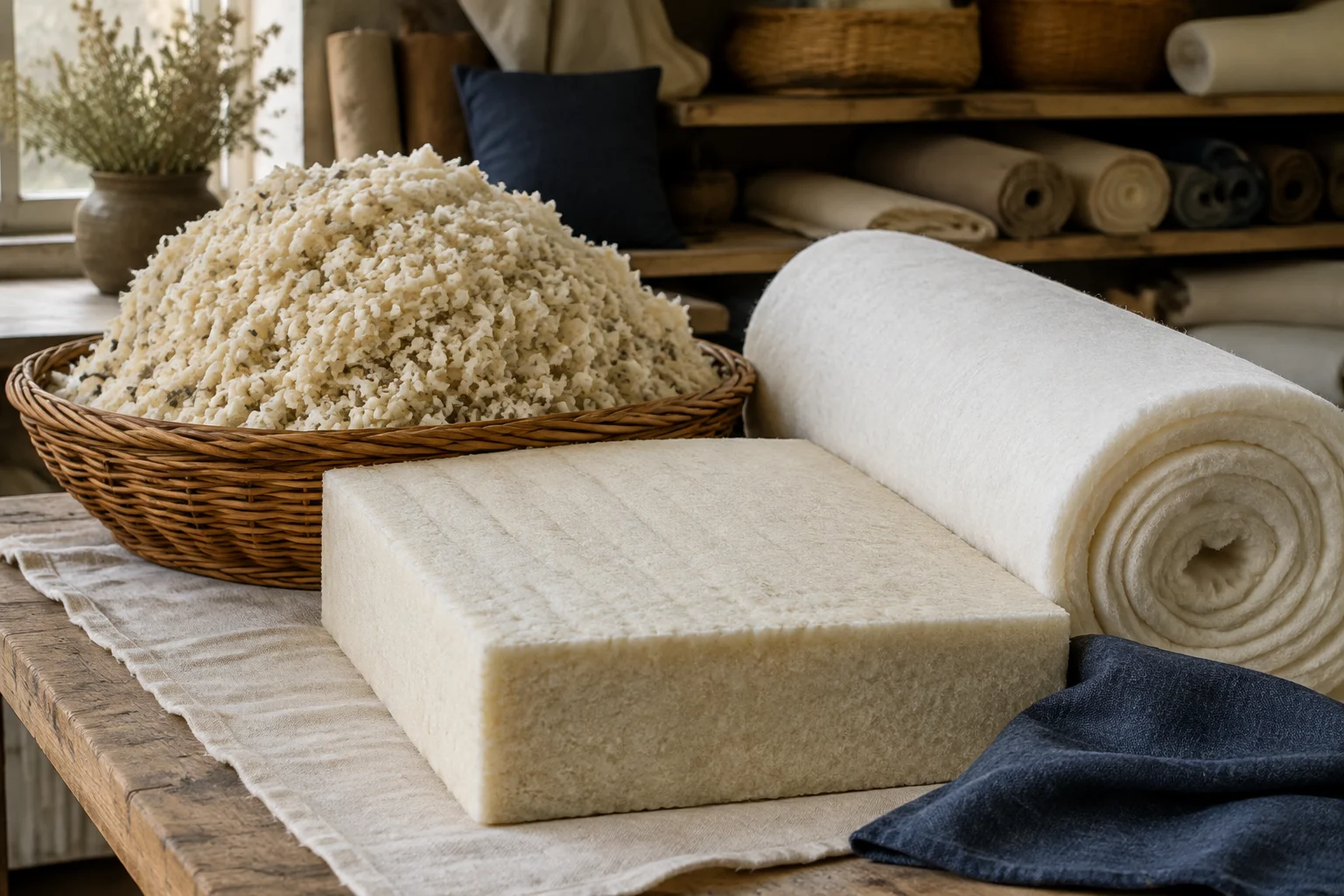
Polyester fiber, on its own, is what fills throw pillows: loose, springy, shapeless. To turn fiber into something that can pretend to be a seat, manufacturers card it (comb the strands into a parallel web), layer the webs, then needle and heat-compress the stack into a dense pad — the same family of processing that makes mattress insulator pads and furniture wrap. The result is a slab with initial firmness and loft that machines well, ships flat, and costs a fraction of polyurethane foam.
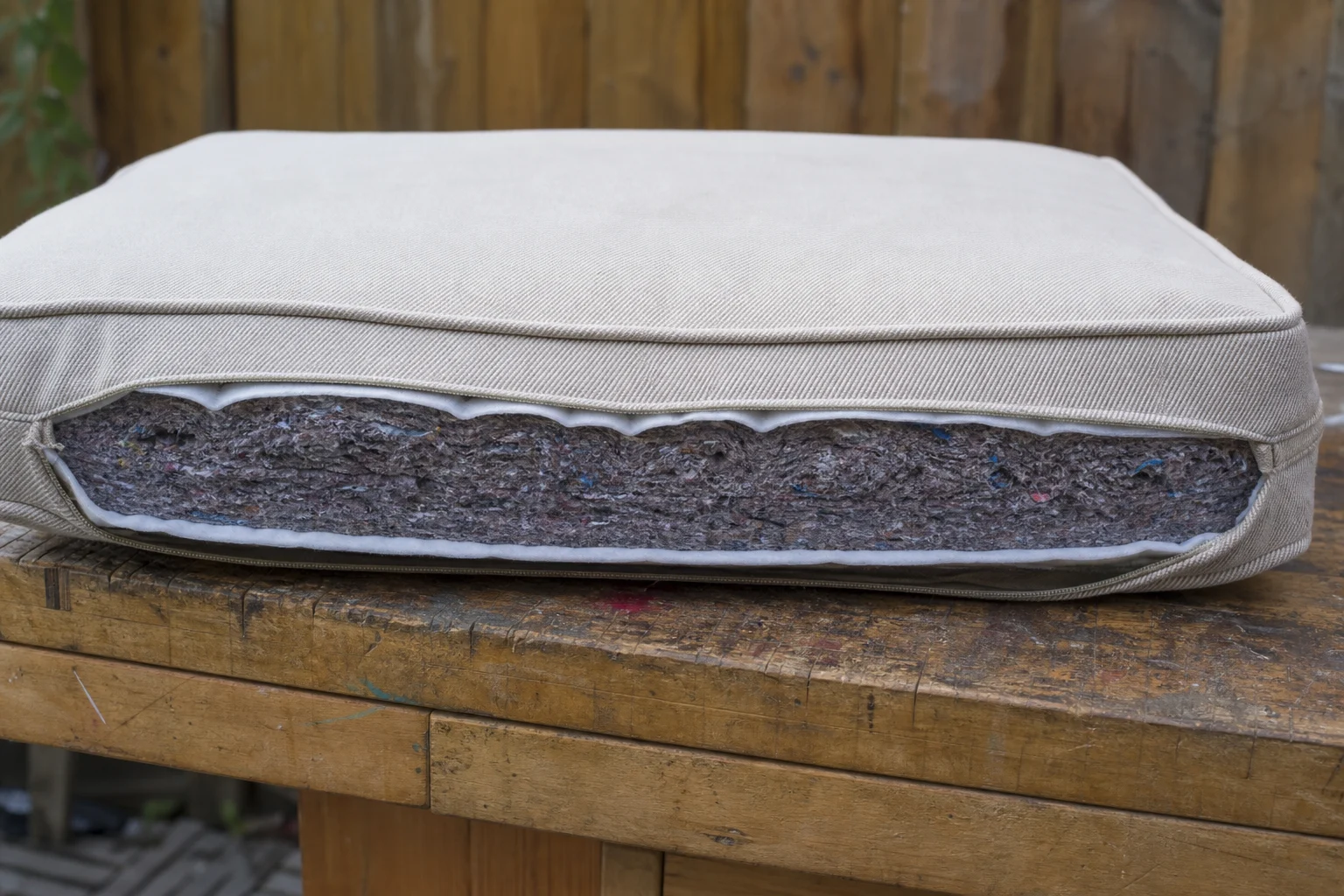
The spec that governs it is not density in the foam sense — there are no D numbers. Fiber fills are graded by weight (ounces per square yard) and loft thickness. That is the first buying insight: when a listing says “densified fiber seat cushion” and gives no weight number, there is no number to give, and the fill is graded by hope.
Why It Exists: The Economics of the Budget Set
Fiber pad costs substantially less than foam at market prices — often a fraction per cushion — and that difference is the business model of budget patio sets. A four-seater conversation set at a big-box price point cannot contain 35D+ foam and still clear the retailer’s margins; it contains fiber, and the calendar reflects it. This is not a scandal; it is a coherent product for a specific customer — more on who below. The scandal is only when the same fill is sold without disclosure at prices that imply foam.
How the Two Fills Age, Mechanically
Foam ages by fatigue: cells compress and eventually take a set (dishing), and density predicts the schedule. Fiber ages by packing: there is no cellular structure to fatigue — the pad loses loft as strands settle and matt under load, and unlike down, which re-lofts when fluffed, packed polyester fiber largely stays packed. Fluffing helps a fiber cushion for a day; it does not restore the pad.
The practical difference, stated plainly:
| Densified fiber | High-density foam (35D–65D) | |
| Day one | Soft, inviting, plump | Firm, supportive |
| Season one, covered patio, light use | Thinner, still serviceable | Measures near new |
| Season two, daily use | Flat, folded edges, “chair-shaped” | Near new at 35D+ |
| Recovery when flattened | Minimal — packing is close to permanent | None needed — rebound is instant and ongoing |
| Water behavior | Drains fast (nothing holds water like open cells), dries fast | Absorbs; must be drained and stood on edge |
| Weight | Very light | Substantial |
| Fill cost at market prices | Lowest | The value-per-year benchmark |
Note the water row — it is the one axis where fiber genuinely beats conventional foam, and it explains why fiber survives outdoors in a way its durability numbers alone would not predict. (The fill that wins both drainage and durability is reticulated quick-dry foam: quick-dry foam explained.)
Where Fiber Sits on the Triangle
On the softness–support–durability triangle, densified fiber parks between down and foam — closer to down than its slab shape suggests:
- – Softness: medium-high at first, decaying. The entry feel is genuinely plush on day one; it is the retention that fails.
- – Support: low-to-medium, and structural. The pad gives a flat, even sit that bottoms out under full body weight — no push-back.
- – Durability: the weak axis. One to three seasons of light use under a covered patio; one season of daily use or real rain exposure.
Foam owns the support–durability edge; fiber buys initial softness by spending durability. That trade is rational exactly once — when the buyer plans to replace, not keep.
Density Is Lifespan — and Fiber Has No Dials at All
The rule this site applies to every foam decision: density is lifespan, ILD is comfort, and the two are independent — with the full mechanism (cell structure, compression set, the dishing calendar) in memory foam vs foam cushions. Densified fiber is what a fill looks like with neither dial. You cannot order a “higher density” fiber pad the way you step 35D to 50D; you can only order a heavier or thicker pad, which postpones packing without changing the mechanism. This is why fiber cushions cannot be “upgraded” the way foam ones can — there is no spec ladder to climb.
When Densified Fiber Is the Right Buy
Rules, not vibes:
- Buy fiber when the set is seasonal by design. A rental property, a stage set, a first patio before you know your habits — cushions you plan to replace in two years do not need ten-year fill.
- Buy fiber for lightly-used, covered seating. A porch bench sat on weekly lasts respectably under fiber; the same bench sat on daily does not.
- Buy fiber where water is constant and budgets are hard. Fiber sheds rain fast and dries fast; on an uncovered bench by a pool, a cheap fiber cushion you expect to replace can outperform a neglected foam one — mildew in foam is a worse death than flat fiber (prevention here).
- Do not buy fiber for daily seating, deep seating, or anything you want in year three. The math is unforgiving: two fiber sets over four seasons cost more at market prices than one mid-density foam set that is still going in year eight — the replacement-cycle arithmetic is laid out in when to replace outdoor cushions.
- Never confuse fiber’s softness with foam’s softness. Foam softness is calibrated (ILD) and durable; fiber softness is a starting condition.
Our Menu, Stated Plainly
We are the factory — ten years of cutting foam and sewing covers — and our menu is high-density foam in four grades (35D–65D). Here is when that is the right answer, and when another fill serves you better.
Right answer: any outdoor seating you intend to keep — when the frame is good and the dead cushions are fiber, re-cutting the seats in 35D+ at your exact measurements (the builder) converts a disposable set into a durable one at a fraction of replacing the furniture, made to order in 4–7 days of crafting and delivered in 3–6 weeks. This is the single most common order our desk sees from owners of big-box sets: the wicker survived, the fiber did not.
Another fill serves you better: a genuinely seasonal, replace-by-plan set — buy the cheap fiber set deliberately, from anyone, including not-us, and replace it when it flattens. Budget fill for a budget plan is coherent; budget fill for a keep-forever plan is not.
Thickness and Price in the Builder
In the builder, fill grade and thickness price together: every shape takes a thickness field (the C dimension, 2″–8″ in 1/8″ increments), and the quote combines footprint at per-sqft foam and fabric rates, times a shape factor, on a $45 make-base. When replacing flattened fiber cushions with foam, measure the frame, not the dead pad — fiber cushions flatten unevenly, and re-ordering “what the old cushion measures now” bakes the sag into the new set. Typical replacements run 2.5″–3″ for dining chairs and 4″–5″ for lounge seating.
FAQs
Are densified fiber outdoor cushions any good?
For covered, lightly-used seating you plan to replace within a few seasons, yes — they are plump, cheap, dry fast; for daily seating you want to keep, no — the fiber packs flat and stays flat while foam of real density holds its shape for years.
How long do densified fiber cushions last?
One to three seasons under cover with light use, one season of daily sitting or regular rain exposure — packing is close to permanent, so a flattened fiber cushion is a replacement, not a candidate for revival.
Can you fluff fiber cushions back to shape?
Only briefly — shaking and fluffing restores some loft for a day, but unlike down, polyester fiber does not re-loft structurally; when packing sets in, the fill is spent.
Is densified fiber better than foam for rain?
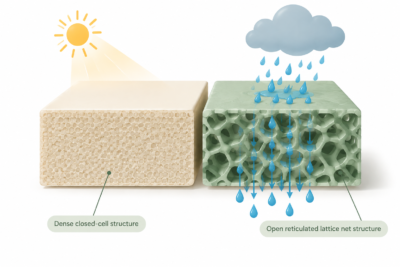
It drains and dries faster than standard open-cell foam, which is fiber’s one genuine outdoor advantage — but it pairs it with the shortest lifespan of any seat fill; for cushions that live in rain, reticulated quick-dry foam is the fill that wins both axes (explained here).
Can I replace fiber cushions with foam?
Yes, and it is the standard upgrade — measure the frame opening, order high-density foam cut to those numbers, and the set’s usable life resets from “one more season” to years; measure per how to measure rather than copying the flattened pad.
Next Steps
- Check what is inside your current cushions — unzip and look: a fiber pad reads as pressed batting, foam as a solid cellular slab.
- Measure the frames following how to measure — not the flattened pads.
- Rebuild the seats in the custom cushion builder — pick a density grade and thickness, and the quote reflects the spec, not an adjective.
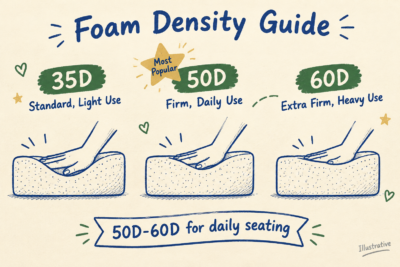
Foam Density Explained: D-Ratings vs lbs/ft³
What foam density actually measures, why D-ratings and lbs/ft³ (PCF) are two different languages with no direct conversion formula, and how to translate between them honestly — by use tier and lifespan, with the 35D–65D grades decoded.
Flame Retardants in Cushion Foam: What Changed and What to Ask
Cushion foam flame retardants explained: why California TB117 put additive chemicals into furniture foam, what the TB117-2013 revision changed, what CertiPUR-US and GREENGUARD actually certify, how to read new-foam off-gassing, and the six questions to ask any supplier for nursery and commercial buying.
Wheelchair Cushion Foam Replacement: Measure, Order, Revive
Replace wheelchair cushion foam instead of the whole pad: three signals the core is done, W x D and thickness measuring, 50D-65D density for all-day seats, and cover fit – cores cut to your measurements.
How to Care for Polyester Cushions: Washing, Fading and Stretching Them Back
Polyester cushion care from top to bottom: what spun polyester can and can’t handle, the wash-day routine that won’t ruin fills, how to slow the fading that defines the tier, and reviving covers that have stretched out.
How to Choose Foam Density: 35D vs 50D vs 60D vs 65D (Decision Guide)
Pick cushion foam density in three questions: 35D for occasional seats, 50D as the daily-use default, 60D for heavy sitters and long hours, 65D for commercial and marine duty — with lifespan rules of thumb and what each upgrade costs.
HD Foam vs Dry-Fast Foam: The Outdoor Cushion Guide
High-density foam vs dry-fast reticulated foam for outdoor cushions — cell structure, PPI, feel, the measured price premium (+9% at one configurator), and the simple covered-vs-uncovered test that picks for you.