
Settee cushions run on the same physics as couch cushions — density buys the years, thickness sets the height, and the cut decides the fit — but a settee answers those questions on different geometry: typically four to five feet wide, two matched seats instead of three, a frame that is often exposed wood, and a life that ranges from hallway ornament to everyday living-room seat. This guide takes couch-foam knowledge and applies it to the settee’s specifics: how to measure two seats that never wear equally, which density matches how your settee actually lives, how thick a cushion a shallow seat can carry, and what a settee order really costs. The general foam background — density grades, D-ratings, cutting — lives in how to choose foam density and sofa foam cut to size.
What Makes a Settee a Different Foam Job
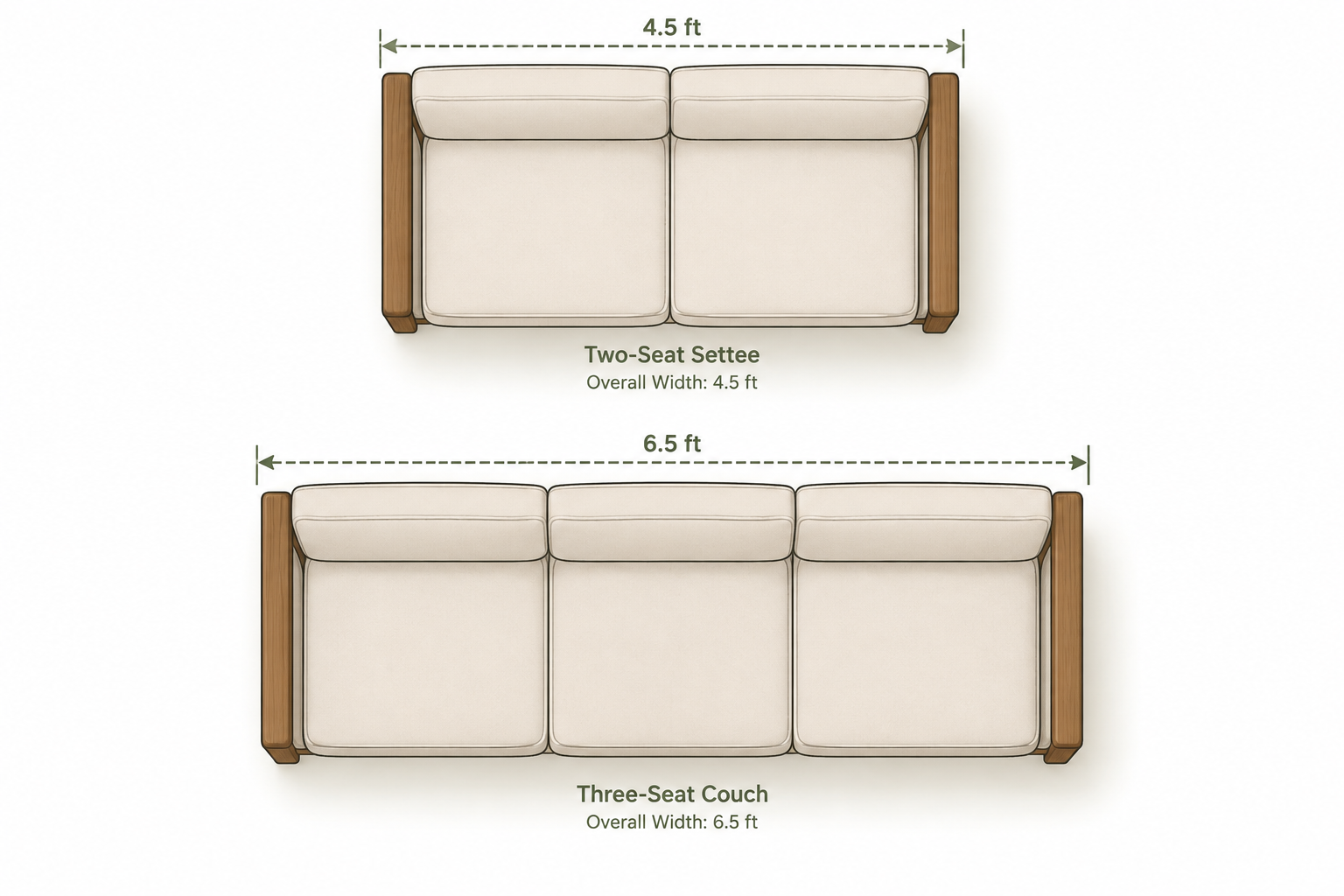
Three things separate a settee from the standard three-seat couch, and each one changes the foam order:
Two seats, not three. A settee is a two-seater by definition, which means the seats work as a matched pair — and a matched pair shows differential wear faster, because nearly every household has a favorite end. The order is almost always two cores cut to two separately verified measurements, not one measurement doubled.
Exposed frames and shallow decks. Many settees carry visible wood arms and rails, and the seat deck is often shallower front-to-back than a couch’s. Depth is measured inside the frame, and thickness is capped by how much height the rails allow before the cushion rides above the arms and looks wrong.
A different life per house. The same silhouette serves as a hallway piece sat on for minutes a week in one home and the daily television seat in another. The foam grade follows the hours, not the furniture category — which is why the density section below is organized by how your settee lives, not by style.
Measuring Settee Cushions Correctly
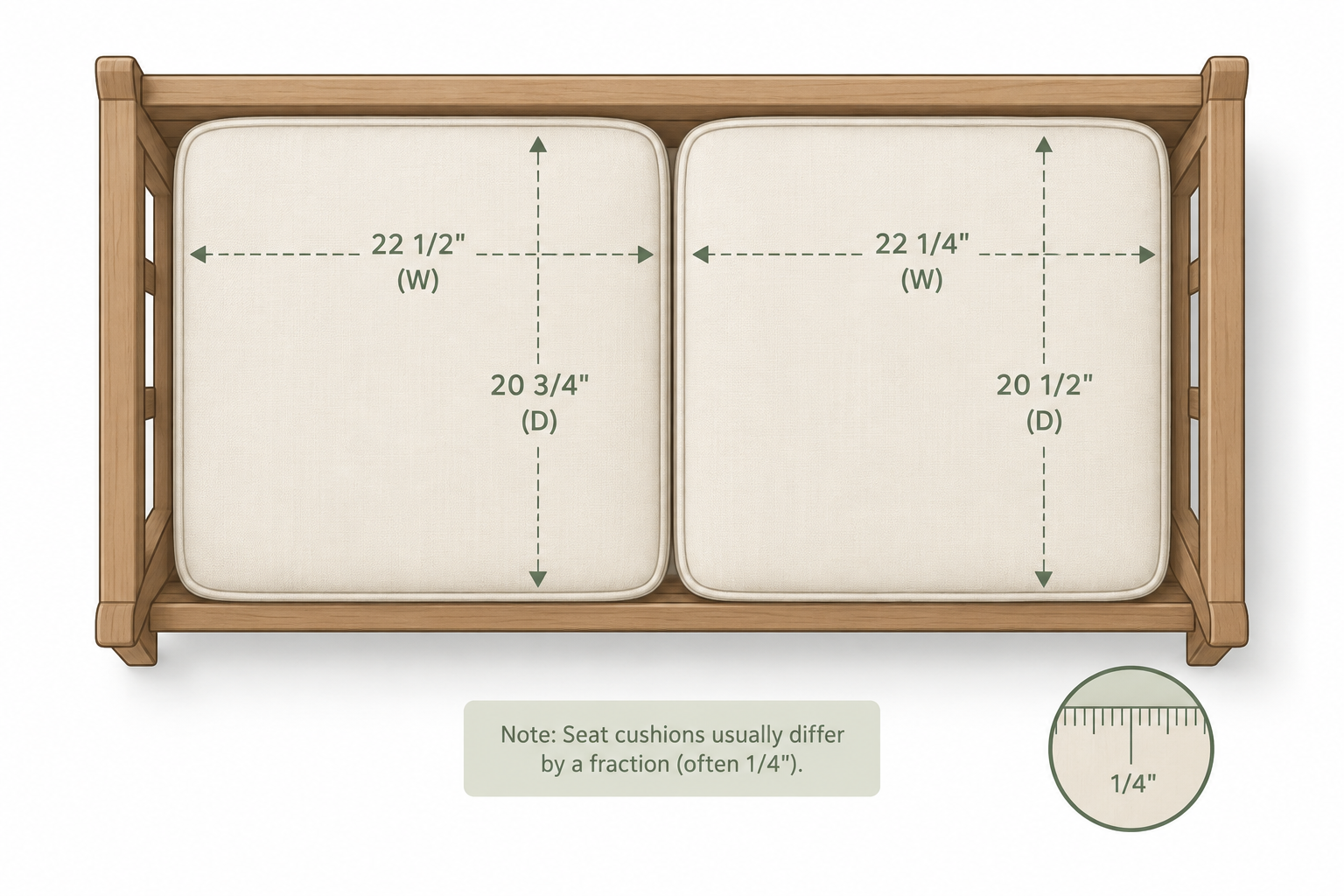
Four rules, the same discipline we use on every cutting ticket:
Measure each seat separately. Unzip each cover and measure each old core seam to seam at its tightest points, to the nearest quarter inch. The two cores in a settee usually differ by a fraction — and a quarter inch of mismatch shows as a visible step between neighbors. The rectangle method is walked in full in how to measure a rectangle cushion.
Measure the core, inside the frame. On rail-framed settees, confirm the cut size against the opening: the core should fill the space between arms and back without being forced. Where the old core and the frame disagree, trust the frame opening minus a small settling gap.
Add the compression allowance. Half an inch to width and depth — a quarter inch on very firm grades — with thickness ordered exactly as measured. The squeeze is what keeps covers filled out and corners sharp; it matters double on a pair, where one under-stuffed cushion ruins the line of both.
Sketch the exceptions. Settee seats are usually straight rectangles — T-cushions are rarer here than on couches — but curved-back and notched seats exist, especially on Victorian-inspired frames. Those orders go with a labeled drawing, using the same methods as T-cushion measuring and our curved-piece guides.
Density: Grade by How the Settee Lives
The grades we cut, mapped to settee lives rather than settee styles:
| How the settee lives | Grade | What to expect |
| Hallway, entry, bed-end — sat on for minutes | 35D | Soft-medium feel; ≈3–5 years of daily-equivalent wear, far longer at genuinely occasional use — effectively a decade plus |
| Dining nook, reading corner — real but moderate hours | 50D | The default for honest daily use; ≈5–8 years, holds loft under years of use |
| The household’s everyday seat — long hours, heavier sitters | 60D | Our standard seat-cushion recommendation; ≈8–10 years, slow to age |
| Café, tearoom, reception — commercial duty | 65D | 10+ years; outlasts the fabric |
The working rule from our floor: when a settee is anybody’s daily furniture, 60D in the seats costs single-digit dollars more per seat than 50D and roughly doubles the service life — the same economics as a couch, just on two cores instead of three. What density physically is, and how it differs from firmness (ILD), is unpacked in D-ratings vs lbs/ft³, the high density couch guide, and our high-resilience foam guide.
Thickness on a Shallow Seat
Couches happily carry 4–5 inch seat cores; settees often cannot. Three constraints decide settee thickness:
Rail height. On an exposed-frame settee the cushion should sit level with or just below the arms. Before ordering 5 inches, measure from the deck to the arm top — many settees top out at 3 or 4 inches of core before the proportion breaks.
Seat depth. Shallow decks read better with moderate thickness: a very thick core on a shallow deck pushes the sitter forward and looks padded past the frame’s scale.
Match the old core unless there was a problem. The original thickness is the manufacturer’s answer to both constraints above. Order it again unless the old core was visibly under-specified — foam height is one spec where “same as before” is usually correct.
Foam Only, or a Whole New Cushion?
Settees reach re-foam age in two patterns. In the younger pattern the covers are sound and the cores are dished — a foam-only order (two cores cut to your numbers, from any of the channels compared in where to buy foam) plus an afternoon of swapping, walked in our replacement guide, puts the piece right. In the older pattern — common, because settees are often inherited or vintage — the covers have faded, split, or simply predate the fabric, and cores alone reload the same tired bag.
The second pattern is the full-replacement case, and it is where a workshop earns its keep: both cores and covers cut and sewn as one matched order. Our settee cushions are built knife-edge with square corners — each face a single flat fabric panel, no piping, no attached ties, no quilting — a clean profile that suits both modern and traditional frames, and every dimension is re-verified against the order before anything is cut. The build-your-own starting point is the custom settee cushions page.
What Settee Cushions Cost
A worked example at our real rates (one flat $45 order base plus top area × a density-thickness foam rate plus fabric at a flat $7.43 per square foot, per custom cushion pricing explained) — a typical 48 × 18 × 3 two-seat settee, any fabric:
| Both seats, 48 × 18 × 3 each | The math | Total |
| 50D pair | 2 × (6.0 sq ft × $27.37) + $45 | ≈ $373 |
| 60D pair | 2 × (6.0 sq ft × $31.99) + $45 | ≈ $429 |
| 65D pair | 2 × (6.0 sq ft × $33.80) + $45 | ≈ $451 |
The same reading notes as every pricing table: the $45 base is charged once per order, so both seats — and a matching back pair, if the backs are due — share it; the density upgrade from 50D to 60D costs about $56 across the pair; and fabric choice never moves the number, because every fabric in the library prices the same. Shorter and longer settees price on their own area at the same formula.
FAQs
What size is a standard settee cushion?
There is no true standard — settees run roughly four to five feet overall, with seat cushions commonly in the 22–30 inch width range and 17–24 inch depths, but frames vary too much for a safe guess. Measure each old core seam to seam (or the frame opening, minus a settling gap) and order to the measurement; anything cut to a generic size is a cushion that almost fits.
Is a settee the same as a loveseat for cushions?
Functionally, yes — both are two-seaters, and the measuring, density and pricing rules are identical. Loveseats tend to run slightly wider and plusher; settees are often narrower with more exposed frame, which usually means a shallower, thinner cushion. The order process does not change.
What density foam should a settee have?
Grade by hours, not style: 35D for a hallway or bed-end piece sat on for minutes, 50D for honest daily use, 60D when the settee is the household’s everyday seat, 65D for commercial settings. When in doubt for a daily seat, 60D — the upgrade over 50D is tens of dollars on a pair and buys 8–10 years instead of 5–8.
Can I replace just the foam in settee cushions?
Yes, when the covers are sound — measure each old core separately, add half an inch of compression allowance to width and depth, and order both cores to their own numbers. The swap itself takes an afternoon; the full walkthrough is in our DIY replacement guide. Once the covers have failed too, a complete core-plus-cover order is the better buy.
How much do custom settee cushions cost?
A typical 48 × 18 × 3 two-seat settee prices at roughly $373 in 50D, $429 in 60D and $451 in 65D — complete cushions, any fabric, one flat $45 order base shared across the pair. Narrower four-foot and wider five-foot frames price on their own area at the same formula.
Do your settee cushions come with ties?
No — our cushions are built knife-edge with square corners, no attached ties, no piping, no non-slip backing, no quilting. It is a clean, honest profile: the cushions’ own weight and the compression fit hold them in place on a level deck. If your frame genuinely needs mechanical fixing, a local upholsterer can add hardware to the deck side without touching the cushion.
How long does a settee cushion order take?
Standard production runs 4–7 days, rush production 3–5 days, and shipping adds 3–6 weeks. Everything is cut and sewn on our own floor and shipped factory-direct — no brand, importer or retailer between the cutting table and your hallway.
My settee seats are curved or notched — can you still cut them?
Yes. Straight rectangles are the norm on settees, but curved-back and notched seats just need a labeled sketch with the key dimensions instead of three numbers — the same method as T-cushion measuring. Every shape prices on its area at the same rates, and odd numbers get a phone call before anything is cut.
Next Steps
1. Measure each old core separately — seam to seam, quarter inch, allowance added.
2. Pick the density by the hours the settee actually serves, and the thickness the rails allow.
3. Price the pair at custom settee cushions or the general custom cushions builder — nothing is cut until your numbers are confirmed.
Types of Wicker Materials: Natural, Resin and HDPE Compared
Every wicker material family ranked — rattan core, paper fiber, bamboo, willow and reed on the natural side; PVC-resin and woven HDPE on the synthetic side — with outdoor ratings, lifespans and what each means for cushions.
Bench Cushions: The Complete Guide to Sizes, Types and Custom Fit
A bench cushion is only as good as three numbers: the length and depth of the seat deck it sits
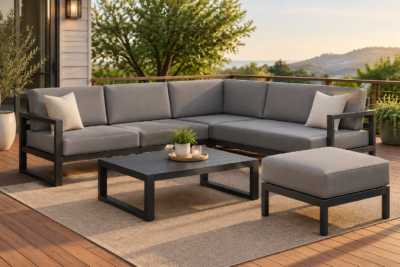
How to Buy Patio Furniture Online Without Regret: The Complete Method
The online patio-furniture method that prevents the classic regrets — dimension-verification discipline, photo-evidence buying, material questions to ask, shipping and return reality, and why custom cushions solve online’s worst problem: fit.
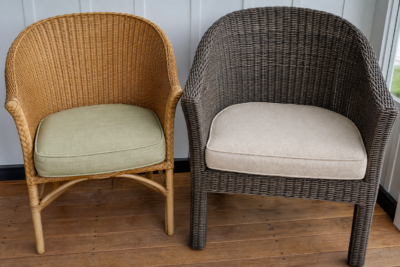
How to Tell Indoor from Outdoor Wicker: The Identification Guide
Five practical tests to classify any wicker piece — strand snap-test, frame magnet check, weave and weight inspection, tag and price decoding — and why getting this wrong is the most expensive wicker mistake there is.
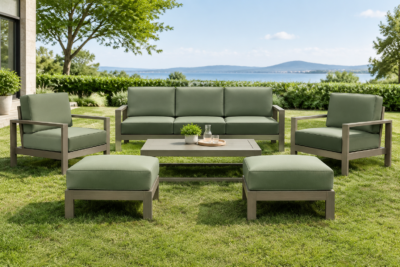
Patio Furniture Sets: How to Choose Seating Sets, Dining Sets and Modules
The patio-set decoder — set types by use pattern (dining, conversation, sectional, bistro), what set pricing bundles and hides, the OEM cushion problem, and the set-versus-separate decision made honestly.
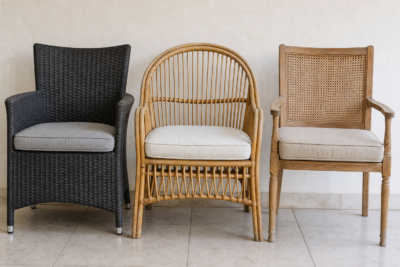
Wicker vs Rattan vs Cane: What Each Word Actually Means
The three most-confused words in woven furniture, sorted properly — rattan is a material, wicker is a weaving method, cane is a specific weave and fiber — and what each distinction means for cushions, care and outdoor use.