
An outdoor daybed cushion is the most exposed piece of soft furniture in a yard after a boat cushion: horizontal like a mattress, out in full sun like a patio chair, and slept on like a bed. That stack — rain pooling, UV, lying-duty loads — is why the stock pads that ship with canopy daybeds and cabanas are usually tired within three summers, and why the replacement market for this category runs to the top of the cushion world’s price range. This guide is the outdoor half of the story: the four frame shapes and what each does to the cushion, how the curved ones are actually measured, the weather spec at mattress scale, and what full exposure should cost. The indoor world — twin-scale sizing, foam grades for nightly sleeping, the one-piece-versus-sections logic — lives in daybed cushions, and the full measuring routine in how to measure a daybed.
Four Frames, Four Cushion Problems
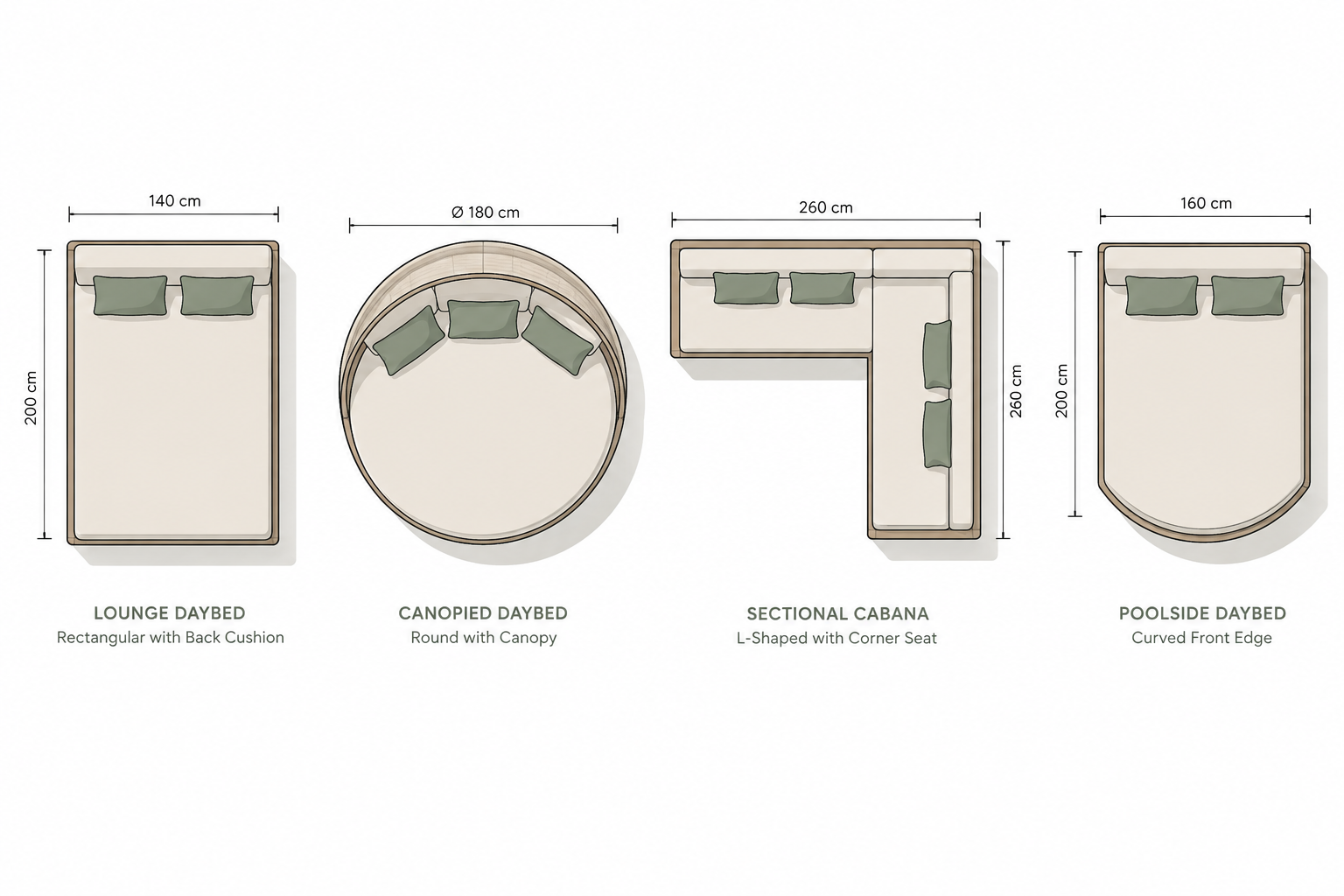
“Outdoor daybed” is not one furniture word, and the cushion spec differs by frame:
- The rectangular lounge daybed — a flat deck on legs, sometimes with a hinged back. Cushion problem: a big flat rectangle (patio decks run roughly 32 to 39 by 72 to 76 inches) is the simplest shape to order and the easiest for wind to lift.
- The round canopied daybed — the sphere-like “pod” or cabana with curtains. Cushion problem: the mattress is a full circle (pod frames run in the high seventies to mid eighties across) built from pie-slice sections around a central hub, with a curved backrest ring. Ordering it as “one round cushion” is exactly wrong; it is an assembly.
- The sectional cabana — L- or U-shaped deep seating meant for lying across. Cushion problem: corners. The corner cushion carries traffic from two directions and is the first piece to dish.
- The poolside daybed — loungers in daybed width, often with a curved front edge. Cushion problem: splash and chlorine on top of everything else, which pushes the fabric spec past “shower-resistant” into rinseable territory.
The common thread: every one of these is badly served by “universal” pads, because none of the four shapes is universal. The market’s own configurator specialists price the category from the high hundreds to $900-plus at the top — which is what weatherproof mattress-scale builds cost when configured piece by piece rather than formula-priced.
Measuring the Curved Ones: Pods, Arcs and Corners
The rectangular basics — deck inside the rails, two points per dimension, nearest quarter inch, cutting forms take 1/8-inch increments — are the same as any daybed and are covered step by step in the measuring guide. The outdoor-specific geometry is the curved work:
- Round canopy decks are measured as sectors, not as a diameter. Record the full deck diameter, then the width of one sector at its widest (the pie-slice base, where you sit), then the sector’s depth from base to hub. Most pods take four to six identical sectors plus a backrest ring; if your old sectors survive, lay one flat and trace it — a traced edge beats three tape numbers.
- Curved backrests follow the pod’s radius. Measure the arc’s chord (straight-line distance end to end), the arc height at the middle, and the cushion’s vertical height. Chord plus arc height is exactly what a bowed-front cushion is specified by — the same two-number method as a curved front seat.
- Sectional corners get both arms measured separately, plus the diagonal across the corner deck. Never assume a square corner on hand-woven resin wicker; out-of-square by a quarter inch is normal and the diagonal catches it.
One habit from the mill floor pays for itself here: photograph the old set in place before you remove anything, with a tape laid into the shot. Curved assemblies reverse-engineer badly from memory and well from photos.
The Weather Stack at Mattress Scale
Indoors, the daybed cushion spec is foam grades and sections. Outdoors the stack gets three more layers, in this order of importance:
- Fabric decides year one. A mattress-scale surface in full sun fades whatever dye sits on the yarn surface; solution-dyed acrylic (Sunbrella-class) puts color inside the fiber before weaving and is the default for open decks — Olefin is the value alternative, both covered in the outdoor fabric guide. For covered lanais where spills matter more than UV, a waterproof wipe-clean performance fabric is the pragmatic pick.
- Foam decides year five. Density is lifespan, doubled at mattress scale. Our outdoor daybed cushions are cut in high-density 35 to 65D grades — 50D to 60D for regular lying duty — the same grades we cut for every outdoor seat. The outdoor trade’s quick-dry (reticulated) foam exists for full-soak exposure and is explained honestly in quick-dry foam explained; it trades some density-life for drain speed, and it is not what we cut, but you should know the trade exists before you spec a fully uncovered pod.
- Closure decides the wet season. Our covers close with zippers and remove for washing. Day to day, spot-clean is the mode; when a full wash is due, the cover unzips and comes off the same way bedding does.
Where Rain Goes: The Pooling Problem
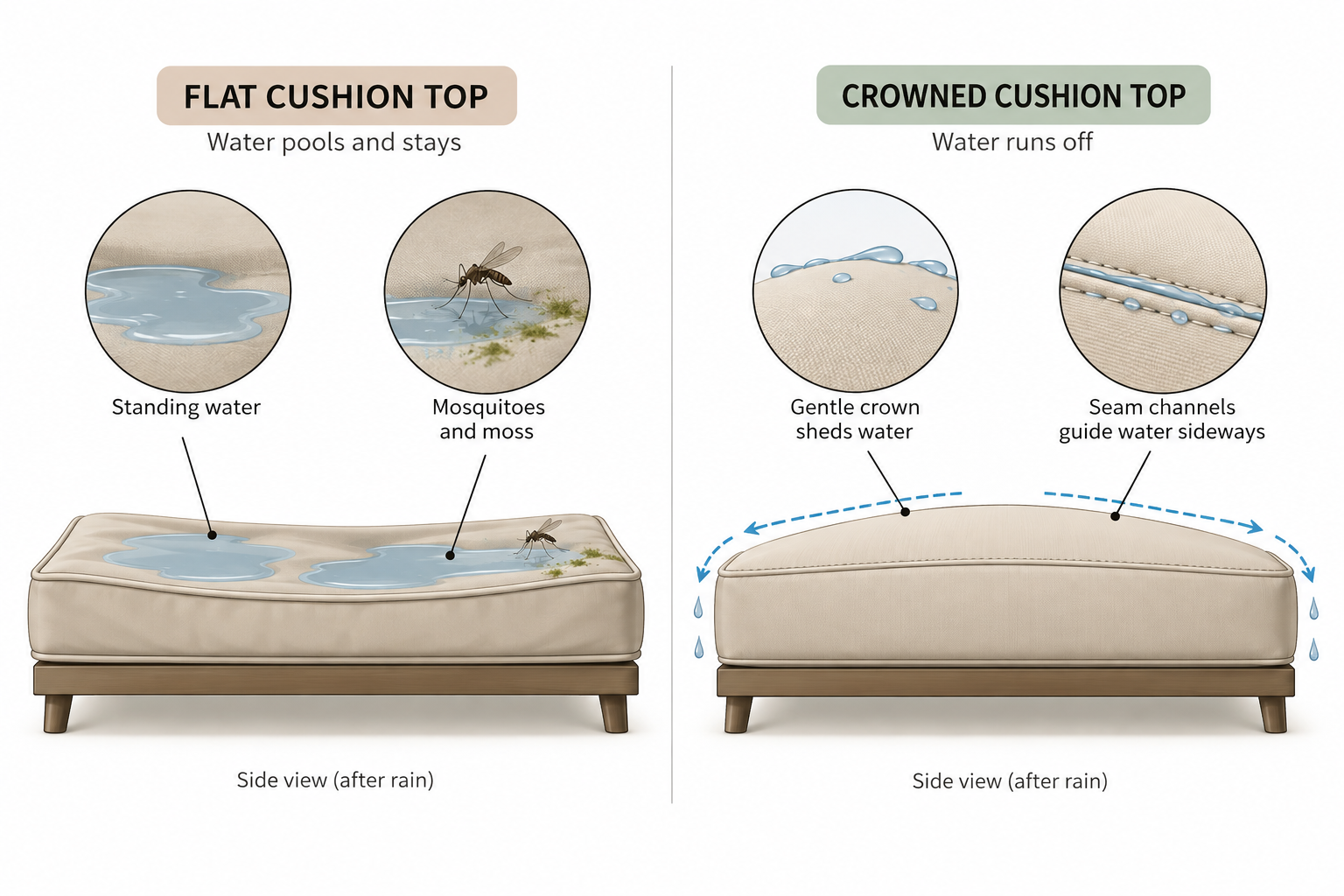
A seat cushion sheds rain because it is small and often tilted. A daybed cushion is a floor — rain lands on it and stays. What matters is where the water goes next:
- Crown beats dome beats dish. A firm surface with a slight crown runs water to the edges; a soft dome compresses into a dish under its own wet weight and ponds at center; a ponding mattress takes days to dry and mildews at the seams first. Order the firm end of your density range for uncovered decks — comfort at daybed scale comes from thickness, not softness.
- Seams are channels. Flush-stitched seams run water along the line; a planned seam across the cushion gives it a drainage path to an edge. This is one reason sectioned outdoor daybed sets outlive one-piece pads of equal foam — the section gaps are drains.
- Stand it on edge after weather. The single highest-value habit in this entire category: a mattress-scale cushion dries in hours on its edge and in days flat. Pods with hinged backs make this easy; flat decks need a wall.
Wind: A Mattress Is a Sail
The other force outdoor daybed cushions fight is lift. A 39 by 75 inch surface in a 30 mph gust is a sail with seams, and the industry’s stock answers are sewn ties, corner tabs and hook-and-loop strips — routes we do not sew. The physics that works without them:
- Mass. A 5-inch 60D daybed-top section is a heavy object; storms move it, breezes do not.
- Sectioning. Two or three sections weigh and trap the same as one piece but cannot catch a clean gust across a single huge face — the seams break the sail.
- The frame. Pod and cabana frames offer natural pinch points — the backrest, the hub, the rail corners — where cushion-safe clips or cords can be fitted by you under the cushion line, removable without touching the sewn cover.
In forecast wind, the honest answer for any uncovered daybed cushion is the same as for outdoor sofa cushions: bring it inside. Everything else is storm-delaying, not storm-proofing.
One Piece or Sections, Outdoors
Indoors the one-piece daybed cushion wins on sleeping comfort — no ridge through the middle. Outdoors the ledger flips toward sections, for reasons the indoor guide does not face:
- sections stand on edge to dry while the daybed stays usable;
- sections rotate — spread the sun wear across all pieces instead of sacrificing the south-facing one;
- a damaged section is a re-cut of one piece, not the whole mattress;
- and the seams between sections are the drainage channels from the last section.
The counter-case is real but narrow: a covered daybed used primarily for sleeping still earns a one-piece top. If the frame lives uncovered, section it.
What Full Exposure Costs
The custom-configurator specialists quote daybed and cabana builds from the high hundreds to roughly $900-plus at the top of the range — configured piece by piece. Formula-priced custom runs the same geometry as a $45 make-base plus per-square-foot foam and fabric rates, every shape at the same rate, with an instant quote on screen (our daybed line; pricing explained). Two levers move an outdoor daybed order more than any other: the density honest for your exposure (50D to 60D covers most lying duty; uncovered full-sun decks push toward the high end) and the sectioning decision above — sections are the same total area, but they change how the set ages, dries and survives its third summer.
FAQs
Can I leave outdoor daybed cushions outside all year?
No — and neither can the $900 sets. Solution-dyed acrylic and high-density foam take seasons of exposure, but winter storage is what stretches three summers into eight. Store them dry, on edge where possible, in breathable bags (the indoor guide’s storage notes apply).
How do I measure a round canopy daybed cushion?
As sectors, not one diameter: full deck diameter, one sector’s base width and depth, and for the backrest the chord plus arc height. Trace one old sector flat if you have it — the tracing beats tape numbers (full measuring routine).
What density does an outdoor daybed cushion need?
50D to 60D for regular lying duty — density is lifespan, and an uncovered deck argues for the high end because a firm crowned surface also sheds water instead of ponding it. The full grade logic is in daybed cushions.
Should an outdoor daybed cushion be one piece or sections?
Outdoors, sections, for drying, rotation and storm behavior — the seams double as drains. One piece only earns its ridge-free sleeping surface on a covered frame used mainly as a bed.
Do you sew ties to hold cushions on the frame?
No. Weight, sectioning and frame-side clips (fitted by you, under the cushion line) do the anchoring without stitch holes in a weather cover. In real wind, bring the cushion in — nothing sewn survives a storm anyway.
How much does a custom outdoor daybed cushion cost?
Formula-priced: a $45 make-base plus per-square-foot foam and fabric rates, every shape at the same rate — while configured category listings run to $900-plus at the top. Run your deck numbers at custom cushions for the instant quote; sector and arc jobs go through the inquiry route with photos.
Next Steps
- Identify your frame — rectangle, pod, sectional or poolside curve — and photograph the old set in place with a tape in the shot before removing anything.
- Measure per shape: deck basics with the daybed measuring guide, curved work by sector, chord and arc height.
- Quote it at custom cushions — or send the photos and numbers through the inquiry route for pod sectors — and nothing is cut until your numbers are confirmed.
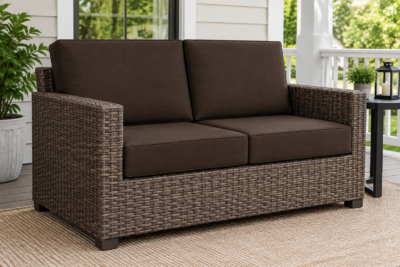
Wicker Loveseat Cushions: Curved Frames, Two-Seat Sets and Outdoor Duty
Wicker loveseat cushion guide: measuring curved and rounded frames, seat-and-back sets for two-position seating, outdoor fill and fabric for open patios, and replacing discontinued patio-set cushions.
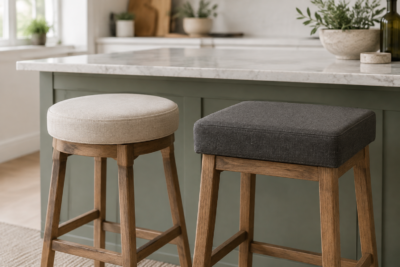
Round vs Square Bar Stool Cushions: Picking the Shape, the Backrest and the Size
Round decks take round cushions, square decks take square — the stool decides. The stock size ladder, the dog-ear corner trap and when a custom cut is the only real fix.
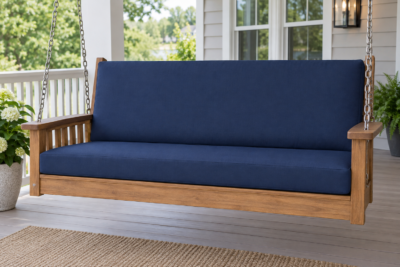
Replacement Porch Swing Cushions: Sizing a Frame You Already Own
A porch swing outlives several sets of cushions — that is the normal order of things. The hard part of
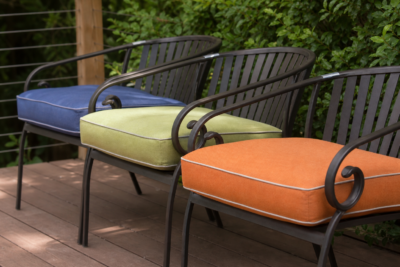
Patio Chair Cushions: The Complete Buying Guide (Outdoor Too)
Everything that decides a patio or outdoor chair cushion — sizes, thickness, ties, fabric tiers and where each buying route wins. Custom from $45 when grids fail.
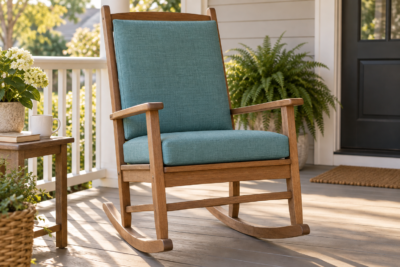
Outdoor Rocking Chair Cushions: The Weatherproof Guide to Sizes and Fabrics
An indoor rocking cushion dies fast on a porch. The sun bleaches the print in a single season, the foam
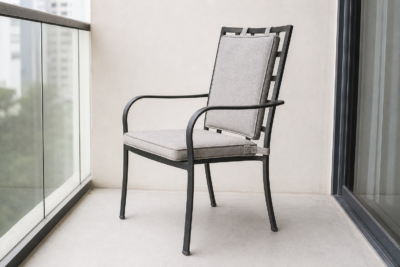
Cushions for Metal Patio Chairs: Frame Types, Grip and the Heat Question
Cushions for metal patio chairs guide: wrought iron, aluminum and steel frames and what each means for pads, sliding on slick metal, heat absorption in sun, sizing across mixed metal sets, and the outdoor duty spec.