
For about four decades, foam inside American furniture routinely contained additive flame retardant chemicals — not because anyone wanted them there, but because a California rule made them the cheapest way to pass a fire test. That rule was revised, the industry moved, and today most flexible polyurethane foam made for the US market is produced without the additive halogenated retardants that drove the original concern. “Most,” however, is not a purchasing standard, and “free of” claims on a listing are not a certificate. This page explains what changed, what the certifications actually cover, and the short list of questions that gets you a document instead of an adjective. The companion reading on foam grades themselves: how to choose foam density and the D-rating versus pounds explained.
Why Foam Ever Had Flame Retardants in It
A 1975 California standard — Technical Bulletin 117, or TB117 — required upholstered furniture to resist open flame, and additive chemicals were how the foam passed. The intention was serious: furniture fires, often started by dropped cigarettes, were a leading cause of home fire deaths in that era. But the standard’s test asked foam to withstand an open flame for seconds, and the practical way to make petroleum-based foam do that was to compound halogenated flame retardant chemicals — brominated and chlorinated compounds — into the foam itself.
Because California was too large a market to build two product lines for, TB117 effectively became the national default. Retardant-loaded foam went into furniture sold in every state, and the chemicals did not stay put: they migrated into household dust, and subsequent research associated several of them with health concerns, leading California to list a number of these chemicals under its Proposition 65 warning program. The rule designed to make furniture safer in a fire had loaded it with persistent chemicals — that contradiction is what eventually forced the rewrite.
What Changed: The 2013 Revision
TB117-2013, the revision adopted by California, shifted the test from open-flame resistance to smoldering resistance — a change in method that removed the reason for additive retardants in foam. A smoldering-cigarette test is conducted primarily against the furniture’s cover fabric, reflecting how furniture fires actually start, and foam no longer has to resist a direct flame to comply. Furniture built to the revised standard does not require retardant chemicals in the foam, and most major US foam producers moved to producing retardant-free grades as the default in the years that followed.
Three honest qualifications belong here, because this is where buyers get burned by over-reading “flame retardant free” labels:
- The revision removed a requirement; it did not ban the chemicals. Retardant grades still exist in the market for applications that genuinely need them, and imported foam does not automatically follow US practice. Where your foam actually comes from is a supply-chain question, not a legal guarantee.
- Other rules still apply to specific products. Mattresses and certain infant products sit under federal flammability rules of their own, and some contract markets — hotels, certain commercial interiors — specify fire performance that can pull treated materials back into the bill of materials.
- “Free of” claims age badly. Formulations and suppliers change. The claim that mattered at listing time may not describe the current production batch. This is why the working answer to chemical questions is a document with a scope and a date — the certification section below — rather than an adjective on a product page.
If a listing’s chemical posture matters to your purchase, verify with the supplier and ask for it in writing; anything else is marketing memory.
CertiPUR-US and GREENGUARD: What Each One Actually Certifies
The two names answer different questions: CertiPUR-US certifies what the foam is made of and emits, GREENGUARD certifies what a finished product emits — neither certifies “safe” as a blanket property. Reading them precisely is what separates a meaningful ask from a checkbox.
- CertiPUR-US is a content and emissions standard for flexible polyurethane foam. Foams certified under it are tested against a list of restricted content — specified flame retardant chemicals, heavy metals, formaldehyde, certain phthalates, ozone depleters — and against low-emission thresholds for VOCs. It applies to the foam itself: a cushion carrying CertiPUR-US foam has a certified core, and the fabric, sewing thread and any fabric treatments around it are outside its scope.
- GREENGUARD and GREENGUARD Gold (administered by UL) are emissions standards for finished products. They measure the chemical emissions of the product as built, in chamber testing, against VOC limits — with the Gold tier running stricter and aimed at sensitive environments such as schools and healthcare. GREENGUARD says little about content directly; a material can meet emissions limits while containing things a content standard would restrict.
- The scope line is the whole game. Foam certification does not cover the cover; finished-product certification does not itemize the foam. For a cushion, the strongest position is both: a certified foam core inside a certified finished product. When a seller offers only one, that is not necessarily a problem — it is just a smaller claim than the logo appears to make, and it tells you which question remains open.
One more boundary the logos do not advertise: certifications are issued against specific products, production methods and periods. They expire, they get renewed, and they cover batches. The practical consequence for a buyer is in the ask list below — request the certificate, then check that it covers what you are actually buying.
Off-Gassing: Reading the Smell
A faint odor from newly manufactured foam is normal, lasts a few days of airing, and is not a chemical-exposure alarm. Freshly cut polyurethane foam releases small amounts of residual volatiles; sealed shipping bags concentrate them; a day or three of airflow dissipates them. This is a property of the material family — cheap and expensive foams alike — and it fades on a timeline of days, not weeks. The full version of this diagnosis, including why smell is a poor proxy for toxicity in both directions, is in cushion foam myths.
What actually warrants action:
- Persistence is the flag. An odor that survives a couple of weeks of ventilated use, rather than fading, suggests something other than normal new-foam volatiles — query the supplier about the material and its certification rather than airing it out longer.
- Physical irritation is a stop signal. Headaches or airway irritation that track with the product and clear when you leave the room are a reason to move it out of the living space and have the conversation immediately.
- Sensitivity and nursery settings lower the tolerance for waiting. For a nursery or a chemically sensitive household, the answers worth shopping for are the emissions documentation above — and airing new furniture before it enters the room is cheap insurance regardless of paperwork.
A related note so the categories stay separate: the “new smell” of foam is not the same topic as stain-repellent treatments on fabrics (a perfluorinated-chemistry story) or the characteristic odor some people notice in natural latex. Different chemicals, different questions — and for latex specifically, a faint sweet odor that fades with airing is the material being itself.
The Ask List: Six Questions That Get Documents
Whether you are furnishing a nursery or buying seating for a contract space, the questions are the same, and they are designed so that every answer arrives as paper, not adjectives:
- “Can you send the certificate that covers this exact product?” Not the brand’s brochure — the certificate, with its scope, product listing and validity dates.
- “What does it certify — the foam core, or the finished cushion?” This is the CertiPUR-US-versus-GREENGUARD boundary above, and the answer tells you which half of the claim you are actually holding.
- “Is the foam free of additive flame retardants as a formulation, and can you state that in writing?” A written formulation statement binds the supplier to the current batch in a way a listing badge does not.
- “What are the VOC emissions results for this product?” Certificates summarize pass/fail; the results carry numbers a spec sheet can cite — which matters in commercial work.
- “For contract use: what flammability documentation do you provide?” Commercial interiors often need documented fire performance, and the honest answer may be that specific components carry it. Better to know at quote stage.
- “Who makes the foam, and has that changed since the certificate was issued?” Supply chains move. A certificate in the name of a former foam supplier is a document about history.
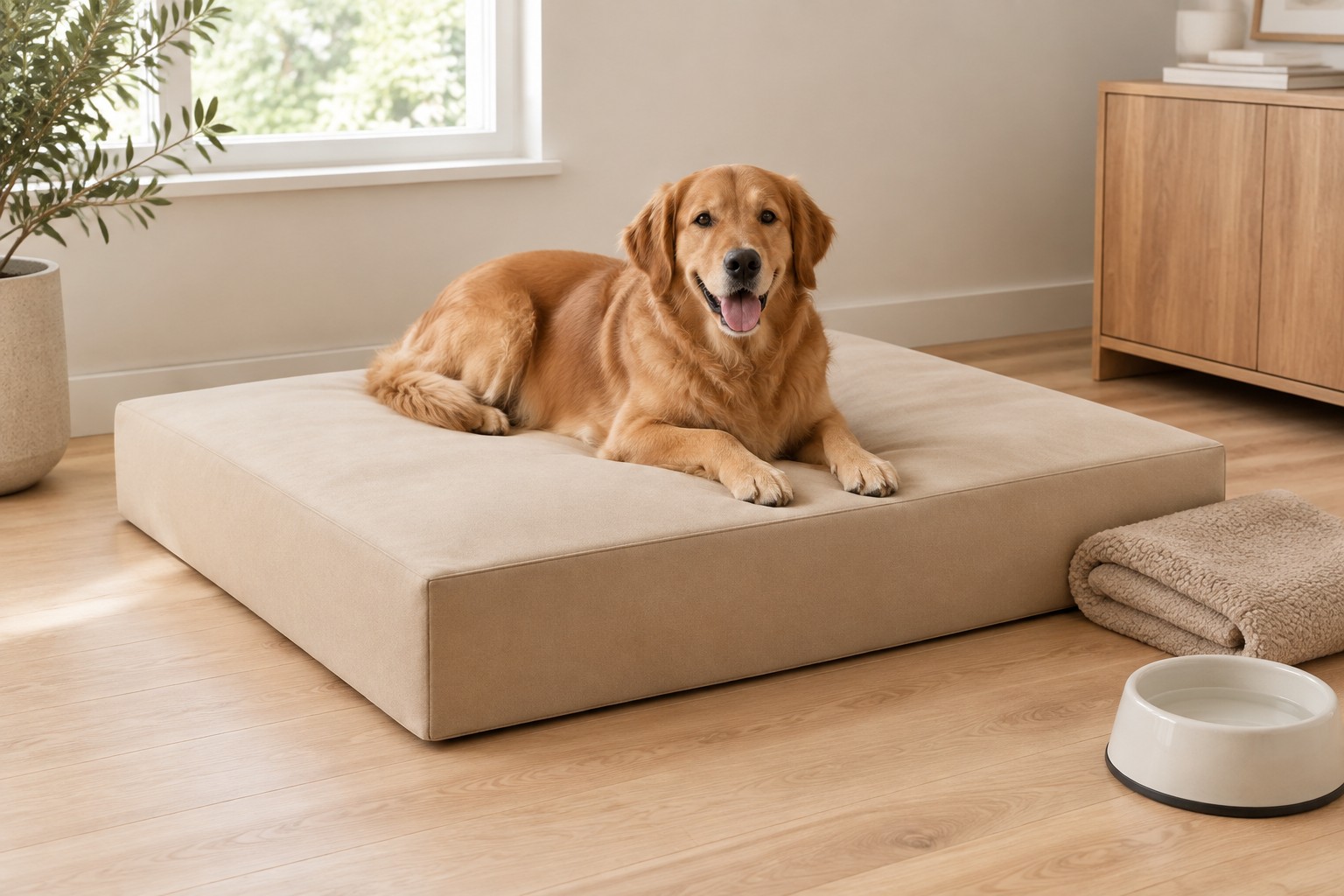
Nursery buyers realistically need questions one through three. Commercial buyers need all six, because their inspectors will ask for the same paperwork eventually — asking first is simply cheaper than re-ordering. The same low-exposure logic applies one room over, by the way, to the pet who sleeps nose-first in a foam cushion all night — the material questions for dog bed foam run on the same documents.
What Sits Inside the Cushions We Cut
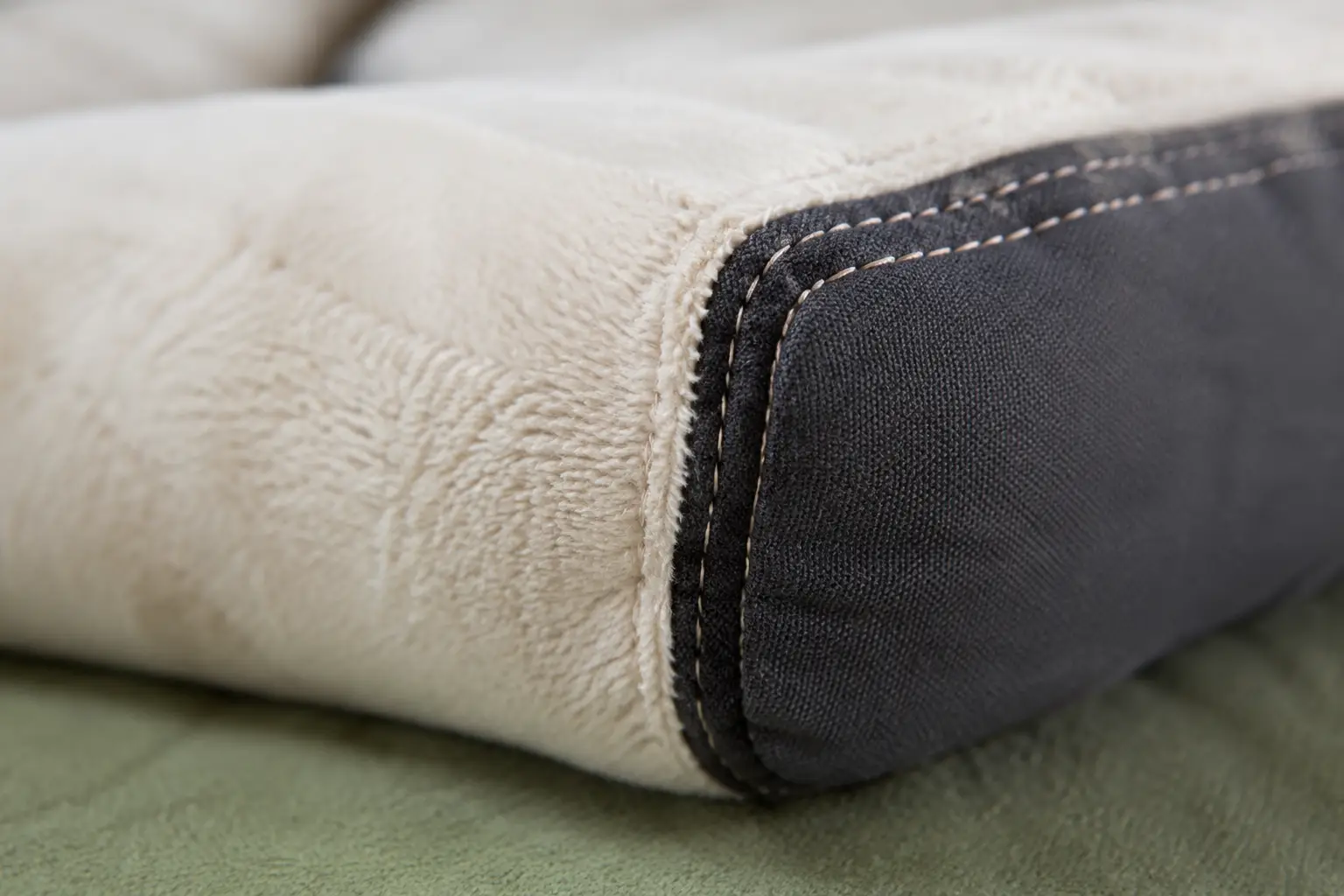
Our seat cores are high-resilience polyurethane foam, cut in the 35D to 65D density ladder, and the foam grades we buy are produced for the current US market — where retardant-free production is now the industry norm rather than the exception. What we do not do is dress that up as an in-house certification: content and emissions claims come from the foam industry’s certification programs, and they belong to the foam maker’s documentation, not to our word. When a customer’s project needs the paperwork — a nursery specification, a commercial submittal — the route is the ask list above, applied to us like anyone else: ask, and we will get you what our foam documentation covers for the batch your order is cut from. The foam itself, and where density fits into quality, is covered in high resilience foam explained and the density decision guide.
FAQs
Do cushion foams still contain flame retardants?
Most US-made flexible polyurethane foam is now produced without additive halogenated flame retardants, following the TB117-2013 shift — but “most” is not a guarantee, and imported foam or contract-graded materials can differ. Verify with the supplier and request the documentation.
What is CertiPUR-US certification for foam?
A third-party content and emissions standard for flexible polyurethane foam — restricted-content testing (specified flame retardants, heavy metals, formaldehyde, certain phthalates) plus low-VOC emission thresholds — covering the foam core only. Fabric and construction around the foam are outside its scope.
Is GREENGUARD better than CertiPUR-US?
They are not competitors: GREENGUARD certifies finished-product emissions, CertiPUR-US certifies foam content and emissions. For a finished cushion, one answers the cover-plus-core question and the other the core question; a certified core inside a certified product is the strongest position.
How long does new cushion foam off-gas?
A faint new-foam odor airing out over roughly three to seven days is normal and not a toxicity signal; persistence beyond a couple of weeks, or irritation that tracks with the product, is the flag to query the supplier. The full diagnosis is in cushion foam myths.
What should I ask when buying cushions for a nursery?
Three questions: the certificate covering the exact product, what it certifies (core versus finished product), and a written statement on additive flame retardants in the foam formulation. Documents, not adjectives.
Can I get flame-retardant-free foam for a commercial project?
Often, but commercial fire documentation runs on its own track — ask what flammability paperwork the supplier provides and expect specific components to carry it. For seating where the spec is standard-duty rather than fire-rated, retardant-free cores are commonly available.
Next Steps
- Decide what documentation your project actually needs — nursery-level (certificate, scope, written formulation statement) or commercial (the full six-question list with emissions results).
- Match the foam to the duty with how to choose foam density — the D grade sets the years, the certification sets the paperwork, and neither substitutes for the other.
- Load your dimensions at couch foam cushions — cut to your numbers in 4–7 business days, with the foam documentation questions answered before anything reaches the saw.
Foam Density Explained: D-Ratings vs lbs/ft³
What foam density actually measures, why D-ratings and lbs/ft³ (PCF) are two different languages with no direct conversion formula, and how to translate between them honestly — by use tier and lifespan, with the 35D–65D grades decoded.
Wheelchair Cushion Foam Replacement: Measure, Order, Revive
Replace wheelchair cushion foam instead of the whole pad: three signals the core is done, W x D and thickness measuring, 50D-65D density for all-day seats, and cover fit – cores cut to your measurements.
How to Care for Polyester Cushions: Washing, Fading and Stretching Them Back
Polyester cushion care from top to bottom: what spun polyester can and can’t handle, the wash-day routine that won’t ruin fills, how to slow the fading that defines the tier, and reviving covers that have stretched out.
How to Choose Foam Density: 35D vs 50D vs 60D vs 65D (Decision Guide)
Pick cushion foam density in three questions: 35D for occasional seats, 50D as the daily-use default, 60D for heavy sitters and long hours, 65D for commercial and marine duty — with lifespan rules of thumb and what each upgrade costs.
HD Foam vs Dry-Fast Foam: The Outdoor Cushion Guide
High-density foam vs dry-fast reticulated foam for outdoor cushions — cell structure, PPI, feel, the measured price premium (+9% at one configurator), and the simple covered-vs-uncovered test that picks for you.
Foam vs Fiber Cushion Filling: Which Lasts Longer?
Foam vs fiber cushion filling compared on structure, lifespan and real price — why foam wins seats, where fiber belongs, and what a live configurator price test shows about the durability premium.