
The T-cushion is the seat cushion that wraps around the arms of a classic chair — the center panel sits between the arms, and a rounded “ear” extends forward past each arm so the whole seat, thighs included, is covered. Club chairs, wingbacks and rolled-arm sofas have used the shape for a century, and it is still standard on traditional upholstery. It is also one of the shapes we see measured wrong most often, because a single tape pass cannot describe it: the outline needs four width-and-depth numbers plus thickness, not two. This guide walks the five measurements our T-Cushion shape card asks for — width between arms, seat depth, arm wrap per side, front overhang and thickness — the four mistakes specific to ear cushions, and what to do when your two ears refuse to match.
What Makes a Cushion a T-Cushion?
Look at the cushion from above. A plain rectangle has four corners and one width. A T-cushion’s front edge runs straight across the middle section, then jumps forward on each side: the outline grows wider at the front, past the arms. Trace the outline and you have drawn a T lying down — narrow stem between the arms, wide cap at the front. Those two forward extensions are the “ears.”
The shape exists because of the frames it sits in. On a club chair or wingback, the arms roll past the front edge of the seat platform, and a rectangle cushion would leave each thigh unsupported outside the arm line. The ears fill that space. You will meet the shape on three kinds of furniture: club chairs and wingbacks — the classic single-seat case; rolled-arm sofas and loveseats — one T-cushion per seat; and antique parlor chairs, where the ears are usually the most worn part of the cushion. Multi-seat frames get one T per seat — the block-by-block counting method for sofas is covered in the sectional replacement guide.
If you are replacing rather than measuring fresh, work from the old cushion: take it off the chair, lay it flat on a table, and measure seam to seam without stretching the cover. If the old cushion has collapsed or is gone, you can measure the frame directly — each field below says how.
In our cushion builder, this is the T-Cushion card — the fourth shape on Step 1. The card labels its five fields A, B, F, G and C, the same letters the line drawing uses, so a number can be matched to a letter at a glance.
The Five Measurements, One at a Time
Record every number to the nearest 1/4″ — our cutting forms accept 1/8″ increments, so fractions are welcome and guesses are not. Write each number down as you take it, and sketch the outline with the letters filled in; that sketch is what you will enter into the builder later. The flat-measuring basics behind all of this — seam to seam, cushion off the furniture — are in the complete measuring guide.
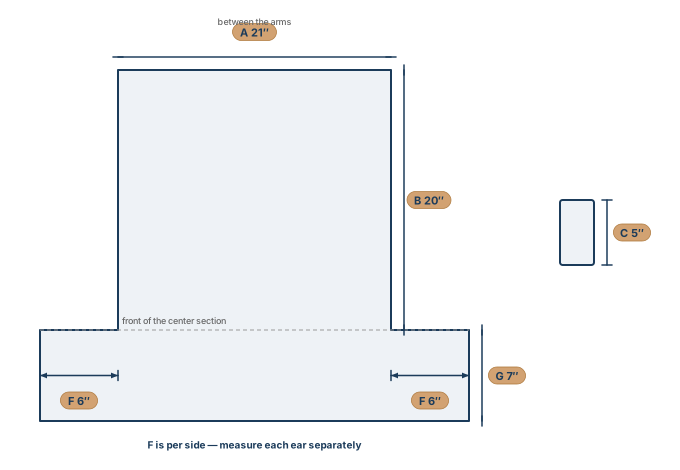
A — Width Between Arms
The width of the narrow center section, straight across, from one arm’s inner edge to the other’s. Between the arms — the narrow T, never the full cushion. On the old cushion, measure across the front seam of the center section, stopping where the seam turns the corner toward the ear. On a bare frame, measure the seat platform from inside-arm to inside-arm at the front.
B — Seat Depth
The depth of that same center section: from the back edge of the cushion to the line where the arms end — the line across the cushion where the ears begin. On the old cushion, that is the back seam straight to the corner seam where the ear starts.
F — Arm Wrap, Per Side
How far the cushion sticks out sideways past each arm, at the widest point of the ear. Measure one side: from the arm’s inner edge straight out to the cushion’s outer edge. Then do it again on the other side — F is a per-side number, and the two sides are often not identical (see mistake 2 below). Ears usually wrap 3–8″ per side.
G — Front Overhang
How far the front edge of the ears extends beyond the front edge of the center section. Lay a straightedge across the front of the center section — or use the seam line — and measure from that line out to the front-most point of the ear. This is the number that makes the ears read as ears rather than side flaps.
C — Thickness
Stand the cushion on edge and measure seam to seam at the side, through the foam, not over the welt. The builder takes 2, 3, 5, 6 or 8″. Before choosing, check the clearance above: on armed chairs a thicker cushion can ride above the arm line and look wrong from day one — the old thickness is the safe default unless you have headroom to spare.
Four Mistakes Specific to T-Cushions
The general errors — measuring on the furniture, rounding up “for safety,” diagonal reads — apply here too, and the nine most common ones are listed separately in our measurement mistakes guide. The four below only happen to ear cushions.
1. Measuring the total width and calling it A
The tape goes corner to corner across the widest part of the cushion — 32″, 33″ — and that one number gets entered as the width. It cannot work: A is the width between the arms only. Cut the full outline width into the center section and the cushion will not drop down between the arms at all. Total width is a real number, but it is a cross-check, not an input — the worked example below shows how the two relate.
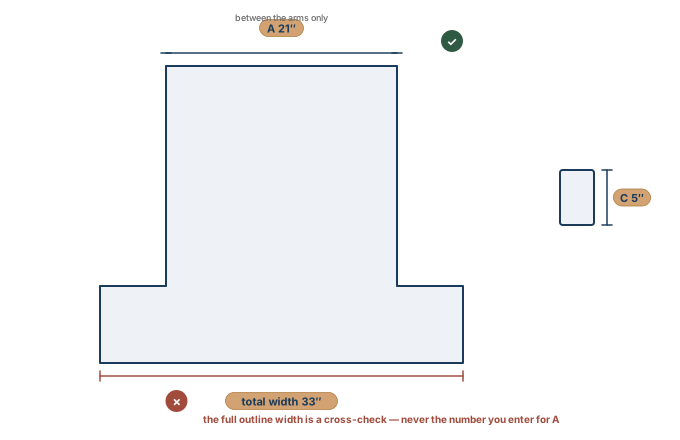
2. Treating F as one number for both sides
The card says “per side” because each side’s ear is its own measurement — and frames drift. Arms get re-stuffed, springs sag unevenly, and a cover that has been washed a few times shrinks unevenly; a ½″ difference between the two ears is common on chairs that have seen real use. Measure both sides and label them left and right. If they differ by more than ½″, enter the smaller number and tell us about the larger side in the order notes — the desk can cut asymmetric ears as a manual spec.
3. Measuring G to the wrong edge
G is the ear’s overhang past the front edge of the center section — not the depth of the center section, and not the total front-to-back of the ear. Measuring from the back seam to the ear’s front point gives roughly B + G, which double-counts the seat. The fix is the straightedge: lay it across the center section’s front edge and measure only what stands past it.
4. Trusting a deformed old cushion for the ears
Ears are the first part of a T-cushion to go — they take the weight of crossing legs, they hang past the frame edge, and their foam compresses years before the center does. On a decades-old cushion the ears can read short of their cut size. If the ear edges look crushed or rounded, cross-check against the frame: the ear’s outer edge should land at the outside face of the arm, its front edge near the arm’s front roll. Where old cushion and frame disagree, trust the frame.
A Worked Example (Typical Club Chair)
Here is the builder’s own example spec — the numbers preloaded on the T-Cushion card, sitting mid-range for a club chair:
- A — width between arms: 21″
- B — seat depth: 20″
- F — arm wrap: 6″ per side
- G — front overhang: 7″
- C — thickness: 5″
Read back what the cutting floor receives: a center panel 21″ wide and 20″ deep, each ear wrapping 6″ sideways and running 7″ past the seat front, at 5″ thick. Total footprint: 21 + 6 + 6 = 33″ across the front, 20 + 7 = 27″ front to back.
That footprint gives you a free self-check, and it works in both directions. Measure the full outline width, subtract the two arm wraps, and you should recover A. Measure the outline’s total depth, subtract G, and you should recover B. If either sum comes out more than ¼″ from your direct measurement, one of the numbers is wrong — remeasure before ordering, not after unpacking. A tighter wingback — say 19″ between the arms, 18″ deep, 4″ wraps, 5″ overhang — runs the same five fields on a 27 × 23″ footprint. Photograph the sketch next to the chair while you are at it — the review desk works from photos, and one labeled sketch says more than three loose numbers ever will.
FAQs
My two ears measure differently — what do I enter?
Enter the smaller arm wrap and note the other side in the order. Differences up to about ½″ are routine on older chairs and the review desk handles them as a manual spec; bigger differences usually mean a deformed cushion or a shifted arm, so add a photo of the chair from above and the review will confirm which side is telling the truth.
Should I measure the old cushion or the chair frame?
Measure the old cushion when it is intact; switch to the frame when it has visibly collapsed. An intact old cushion carries the original cut lines, which is exactly what you want. A compressed one bakes years of sag into the new cushion — the first of the nine mistakes in our measurement mistakes guide. When in doubt, measure both and let the review desk arbitrate.
My seat is separate pieces — a center piece plus two ear pieces. Is this still the T-Cushion card?
No — order separate pieces as separate cushions. The card cuts a one-piece T. If your seat is three pieces, measure each as its own rectangle — width, depth, thickness — and add them to the order individually. The piece-by-piece method, including seat-block counting on multi-seat frames, is in the complete measuring guide.
How exact do my numbers need to be — and what if one is wrong after I order?
Measure to the nearest ¼″; if you find an error, contact us before cutting and the fix costs nothing. We cut to a stated tolerance of ±½″, but the tolerance protects the cut, not the measurement — a half-inch input error ships as a half-inch misfit. Orders caught before cutting are corrected free; once foam is cut, the piece has to be remade, so the sooner the message reaches us the better.
Next Steps
1. Take the five numbers — A, B, F, G, C — plus the full-outline cross-check, and photograph your sketch next to the chair.
2. Open the T-Cushion card in the builder and enter them — the card is the fourth shape on Step 1, the letters match the drawing, and pricing updates as you type.
3. Order with photos. Every order is checked against your photos before anything is cut, a real person replies within one business day, and your cushion is cut and sewn in 4–7 business days.
The one-sentence version: A is between the arms, B is the center depth, F is each ear’s sideways wrap, G is the ears’ forward reach, C is the thickness — five numbers, measured flat, to the quarter inch, with both ears measured separately.
What Size Bed Gap Filler Do I Need? Thickness, Length and Density
Size a bed gap filler from three measurements, not the bed’s name: thickness equals gap width plus half an inch to one, length runs the full seam, height runs platform to mattress top. Density starts at 50D.

Cushion Thickness & Seat Height: Match the Pad to the Table
Cushion specs usually answer comfort questions. Thickness answers a geometry question: how high off the floor you end up sitting,

Church Pew Cushion Sizes: Standard Dimensions and How to Measure
Standard pew seats run 19-21 inches deep; cushions are cut 2-3 inches thick to measured runs at plus-or-minus half inch tolerance. Dimensions table, taper rules, and the pew-by-pew measuring method.
Chaise Lounge Cushion Measurements: A Complete Guide to Getting the Fit Right
How to measure a chaise lounge cushion correctly — seat depth, back height, thickness, hinge points and one-piece vs two-piece styles — with real Hampton Bay chaise dimensions.
How to Measure Rocking Chair Cushions: Seats, Backs and Tie Positions
How to measure rocking chair cushions — tapered seats, curved backs, slat-gap tie maps and rock clearance — with the three-number protocol for both pieces of a rocker set.
Window Seat Cushion Measurement: How to Get a Perfect Fit
Measure a window seat cushion correctly — width across alcoves, depth front to back, thickness vs sill height, radius corners and bay window angles — with tips from the cutting floor.