
“Free shipping” is the most successful pricing fiction in e-commerce. Shipping is never free — it costs fuel, boxes, and labor — it’s just paid somewhere other than the shipping line. In cushions specifically, where goods are bulky-but-light (the worst freight profile there is) and often made to order, the somewhere-else is structured: into the item price, behind the threshold, inside the surcharge, or in the fine print of custom work. Knowing the five places the money actually lives turns “free” from a marketing word into a comparable number — and comparison on true totals, not sticker prices, is the entire game.
For what cushions should cost at the item level: the outdoor cushions price guide and custom cushion pricing explained. This is the layer on top — the freight-and-fees anatomy.
Where “Free” Shipping Actually Gets Paid
1. Built into the item price. The classic structure: raise every item 10-15%, announce shipping is free. It’s honest in aggregate — the customer class that buys one cushion subsidizes the class that buys eight — but it means the sticker price isn’t comparable across retailers with different shipping structures. The fix is mechanical: build the true total (item + shipping + tax) for your actual cart at each candidate retailer, and compare those.
2. The threshold game. “Free shipping over $75” is a behavior machine: the $61 cart becomes a $79 cart, and the retailer’s engineering worked. Thresholds aren’t predatory, but they should be met deliberately — by consolidation (ordering the two-project list in one order — legitimately efficient for heavy freight) rather than padding (the $14 add-on item you didn’t want). The consolidation logic is real in cushions: freight economics genuinely reward fewer, fuller shipments of bulky goods.
3. Dimensional weight surcharges. This is the cushion-category-specific trap. Freight is priced on the greater of actual weight and dimensional weight (the package’s volume divided by a carrier divisor) — and cushions are the canonical dimensional-weight loser: a 4-pound cushion in a 24×24×6 box “weighs” far more than four pounds by the carrier’s math. Retailers that ship cushions “free” have already priced this in (see #1); retailers that charge shipping have line items that spike on exactly the light-bulky profile. Watch for: flat-rate shipping that excludes “oversize” items (deep-seat and extra-thick cushions commonly trip the boundary), and surcharges disclosed only at checkout. The freight anatomy is part of why patio furniture is expensive writ small.
4. Custom and made-to-order fee structure. Custom cushions carry fee categories stock goods don’t:
- – Setup or make fees — a per-order or per-piece base charge (on Cushion Mill quotes it’s an explicit $45 make-base, stated rather than buried — the transparent version of a universal practice).
- – Change fees — dimension or fabric changes after production starts; legitimate (materials may be cut) but worth knowing before you’re mid-change. The discipline that avoids them: measure once, correctly (how to measure outdoor cushions), and confirm everything before production.
- – Rush fees — paying to jump the made-to-order queue; a real service with a real price, and one worth knowing exists before the deadline is upon you (4–7 day standard production with 3–5 day rush is the typical band).
- – Cutting/complexity charges — odd shapes (T-cushions, trapezoids, curves) can carry per-piece premiums at some shops; ask before assuming, and treat “priced on its own footprint” (the shape priced by what it contains, not a surcharge for being odd) as the fairer structure — custom cushion pricing explains the mechanics.
5. Returns and restocking. The quietest fee category, and the most expensive when it lands on you. Stock goods: returnable, often with shipping on you and sometimes a restocking percentage. Custom goods: the industry norm is limited or no returns on made-to-order items — the item was made for your dimensions and can’t be resold. This is why the verification structure of good custom operations matters more than the return policy: photo-verified dimensions before cutting (the T-cushion routine shows the pattern) prevents the remake that a return policy would have to absorb. Read the custom return policy before ordering, and treat its strictness as a prompt for more careful measuring, not as a reason to avoid custom.
Reading a Quote for the True Total
The audit that makes fees visible, in five minutes:
- Itemize the cart — every piece, every fee line the checkout shows, shipping, tax. Screenshot it.
- Ask the three questions the checkout may not answer: are there dimensional/oversize surcharges for my specific pieces? What’s the change-fee policy after production starts? What’s the return policy on custom pieces?
- Run the same total at 2–3 comparable retailers — item + shipping + tax, same cart. The “free shipping” retailer’s advantage often evaporates or reverses at this step; occasionally it’s genuinely better.
- Check the consolidation math — one fuller order versus two partials (thresholds and dimensional weight both reward consolidation; if a second project is coming, combining is usually real money).
- Price the total against the item value, not the item price — a “free shipping” cushion at $68 and a “$52 + $14 shipping” cushion are the same cushion; the difference is which retailer is being straightforward with you. The straightforward one is easier to hold to account when something goes wrong.
The Trust Signals Worth Preferring
Fees are inevitable; opacity is a choice. The structures that indicate a straight-dealing retailer: stated make-fees (a number you can see before checkout), all-in pricing at quote time (the custom quote includes everything but tax), clearly bounded change windows (when changes stop being free), rush as an option with a price, and photo verification before cutting (the practice that makes strict custom-return policies reasonable — the maker caught the error, not you). On the cushion side, the pricing transparency question is really about whether you can compute your total before you commit; custom cushion pricing explained shows what that looks like when done openly.

International and Cross-Border Orders
One last fee layer for buyers outside the retailer’s home country: duties, brokerage, and cross-border handling, which none of the shipping labels announce and all of which arrive as surprises. Cushion orders crossing borders can trigger customs processing on the declared value including shipping — meaning the “free” shipping inflates the duty base even when it costs you nothing visible. Custom cushions add a wrinkle: made-to-order goods are typically non-returnable across borders at all, so the verification-before-cutting discipline (the ordering mistakes guide) stops being prudent advice and becomes the whole safety system. The practical audit for cross-border buyers: ask who is the importer of record, what the landed-cost estimate is before ordering, and whether the maker has shipped to your country before — a one-paragraph email that replaces a three-figure surprise at the door.
The Vacuum-Compression Wrinkle
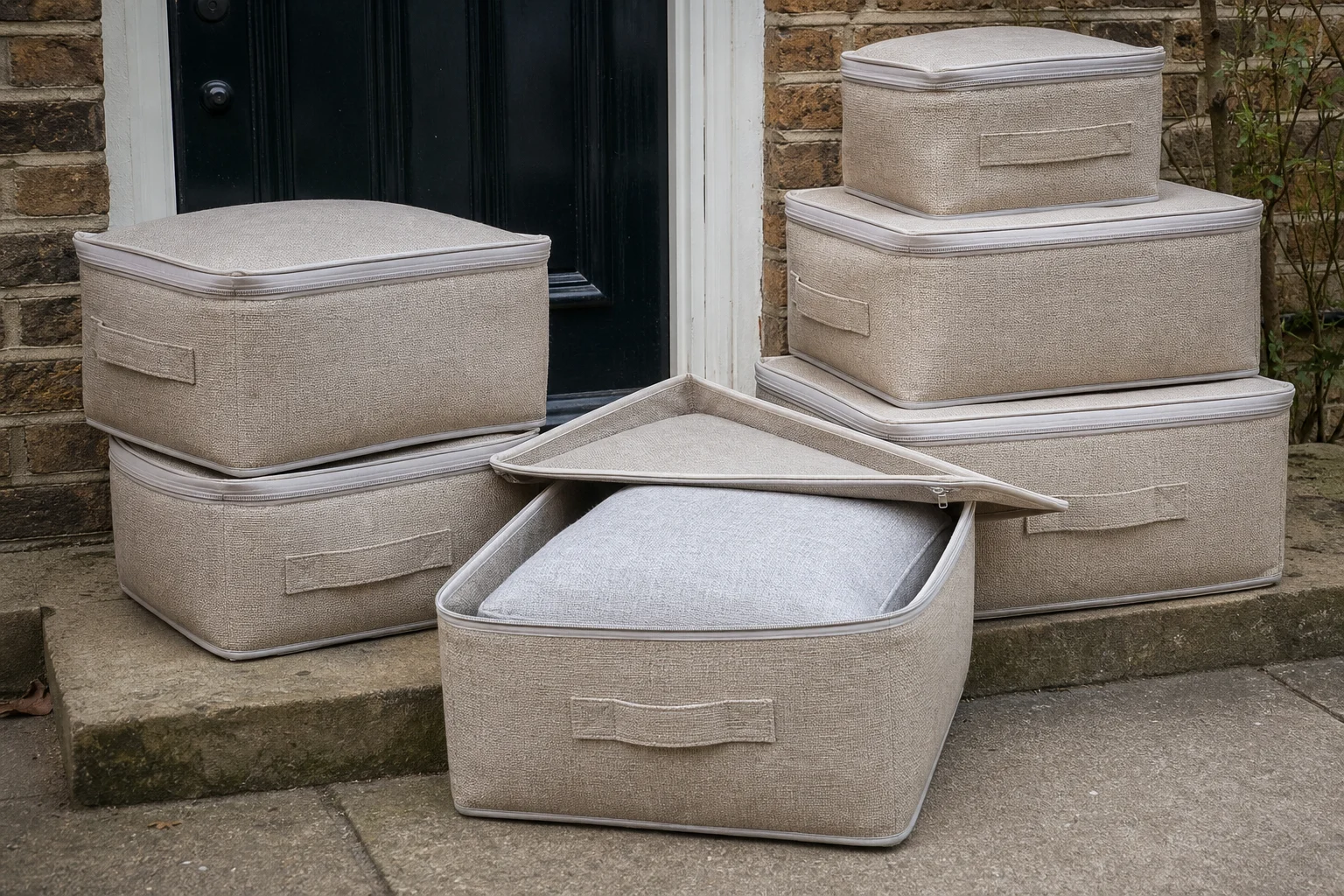
One shipping-related fact specific to foam-cushion orders that buyers should understand before the box arrives: quality foam work often ships vacuum-compressed — the air is pulled from the foam, collapsing a bulky cushion to a fraction of its volume for transit (the same dimensional-weight economics, worked in the customer’s favor). The cushion arrives flat, which alarms first-time buyers, and then recovers to spec thickness over 24–48 hours out of the box. Two practical implications: the flat box is not a defect, so give the foam its recovery window before judging anything; and re-compression at your end (stuffing cushions into storage bags) extends their recovery time later — the long-term storage routine in how to store outdoor cushions for winter works with this physics, not against it. Compression is the rare shipping trick where the savings reach the customer’s side of the transaction.
FAQs
Is free shipping really free?
No — it’s paid either inside item prices, at thresholds, or in surcharges elsewhere. The comparison that matters is true total (items + shipping + tax + fees) for your actual cart. Build that total at each retailer and “free” becomes a comparable number instead of a feeling.
Why do cushions cost so much to ship?
Dimensional weight — freight prices the greater of actual and volume-based weight, and bulky-light cushions lose that math badly. Deep-seat and extra-thick pieces trip oversize boundaries. Consolidating orders genuinely helps; the freight logic is in why patio furniture is expensive.
What fees should I expect on custom cushions?
A stated make/setup base, possible complexity premiums on odd shapes, bounded change fees once production starts, and rush as a priced option. Each is legitimate when disclosed; the audit is whether you can compute your total before committing. The transparent mechanics: custom cushion pricing.
Why can’t I return custom cushions?
Made-to-order goods can’t be resold — your dimensions have no second customer. The offset is the verification structure: photo-confirmed dimensions before anything is cut, which is what a strict return policy asks in exchange. Measure accordingly (how to measure outdoor cushions).
How do I compare cushion prices across sites honestly?
Same cart, true totals, fee questions asked up front. Sticker prices across different shipping structures aren’t comparable; totals are. Two minutes of arithmetic replaces every “but this one says free.”
Next Steps
- Before your next cushion order, build the true-total cart at your 2–3 candidates — the comparison that “free shipping” is designed to prevent is the one that saves you money.
- On custom work, ask the three questions up front (surcharge, change window, return policy) and measure to the discipline the answers imply.
- For all-in pricing at quote time — stated make-base, priced fabric and density, verified dimensions — the flow starts at custom cushions.
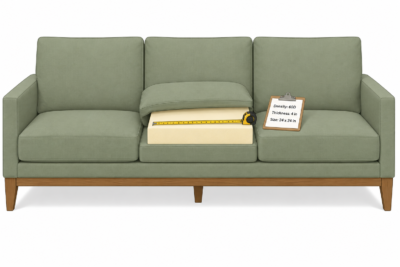
Couch Cushion Foam Replacement: Density, Cost and Buying Guide
Replace couch cushion foam in one right order: 50D vs 60D density, measuring the old core, four ways to buy, and real worked prices for one seat and a full set.
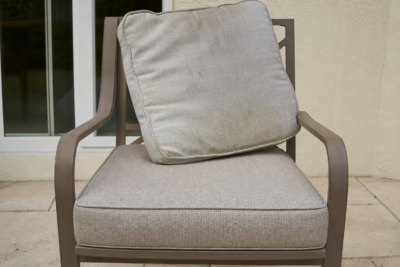
Where to Buy Replacement Patio Cushions: 5 Ways, Compared
Five ways to replace patio cushions — the set maker’s parts program, seasonal aisles, universal-fit listings, specialists and measured custom — plus the Home Depot house-line route with 31 measured collections.
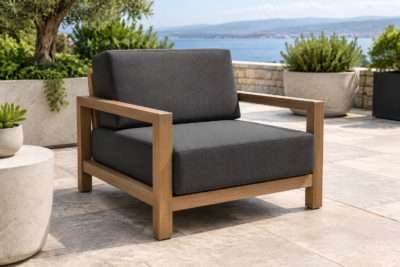
Why Is Patio Furniture So Expensive? The Cost Anatomy, Explained
What actually drives patio furniture prices — weatherproof materials, UV-stable finishes, marine-grade hardware, freight on bulky goods, and seasonal retail economics — why the good stuff costs 3-5x the box-store set, and where the value concentrates.
Patio Set vs Buying Separately: The Real Trade-offs
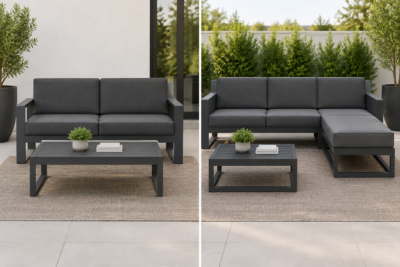
Buying a complete patio set versus assembling pieces: price coherence and one-click convenience versus fit-to-space precision, mixable quality and replacement flexibility — how to decide, and the hybrid strategy that captures both sides.

How Much Do Custom Cushions Cost? Price Ranges by Shape (2026)
Custom cushions cost USD 50-400 depending on shape, size, density and fabric. Live factory-direct price ranges for bench, window seat, outdoor, sofa and boat cushions — and how to price your own.
Outdoor Cushion Foam: Density and Thickness Guide With Real Numbers
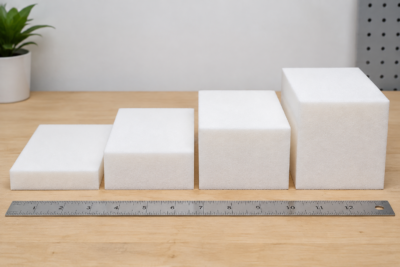
Short answer: for a daily-use outdoor seat, order 3 inches of foam at 50D–60D; move to 4 inches and 60D