
A custom quote usually arrives as one number. One number tells you nothing: you cannot tell whether the foam is worth it, whether the fabric line is fair, or whether a “shape surcharge” was quietly added. We build quotes from a published formula, and this page takes that formula apart, line by line — so by the end you can rebuild any cushion quote, ours or a competitor’s, on a napkin.
One boundary before we start. If your question is “what should cushions cost in 2026 across the market” — benchmark prices for dining chairs, chaises, loveseats — that is a different article: the outdoor cushions price guide carries the market tables. This page answers the mechanism question: how is your quote calculated, term by term. The two articles deliberately do not overlap.
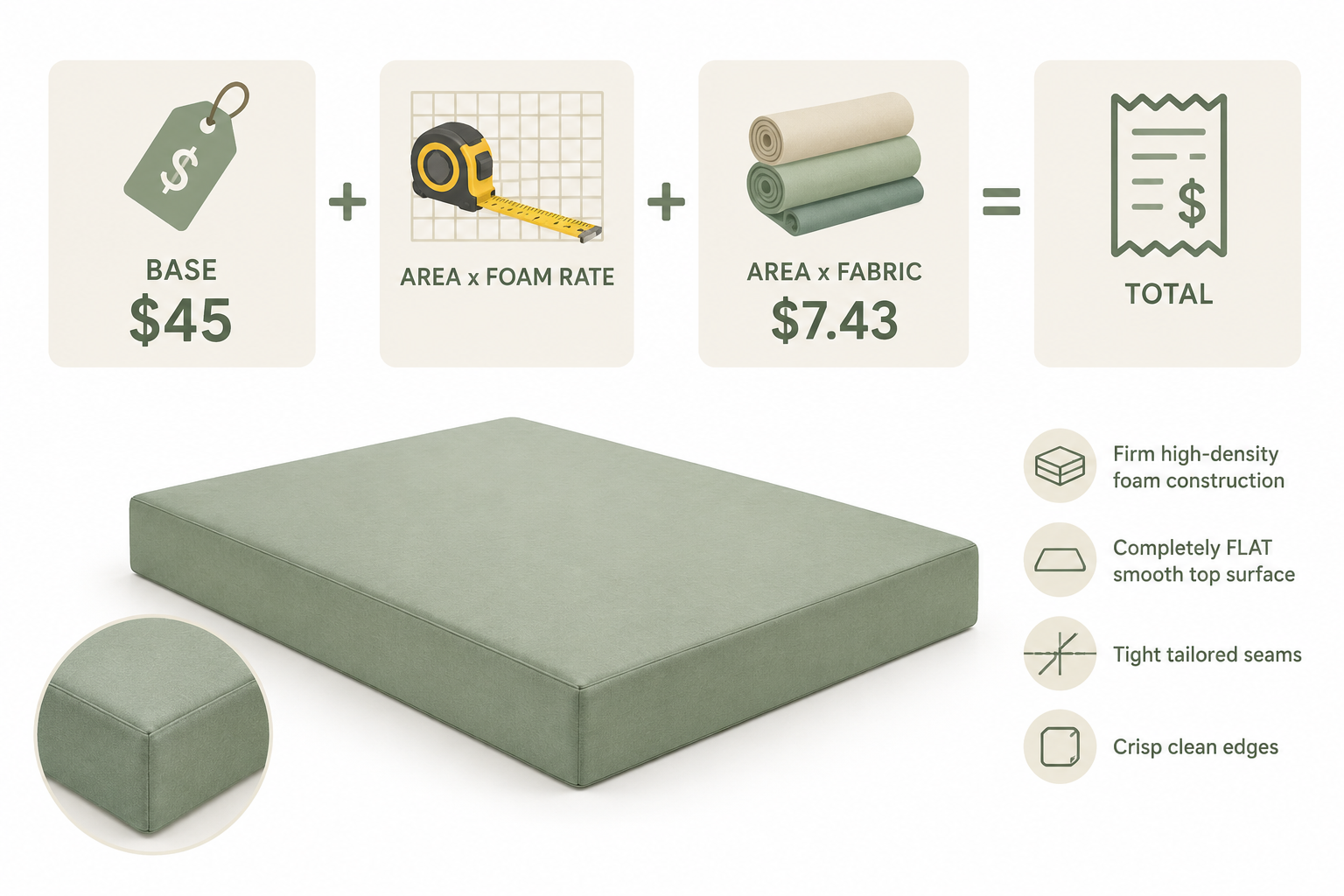
The Formula in One Line
Quote = $45 base + top area × (foam rate + fabric rate)Four moving parts, and nothing hidden behind a fifth:
- – $45 base — one flat charge per order, before size enters the math. Covers cutting setup and sewing labor that exists whether you order an 8 × 8 pad or a 60 × 24 bench.
- – Top area — width × depth of every panel, summed, in square feet (square inches ÷ 144). A loveseat’s two seats and two backs all count.
- – Foam rate — a dollars-per-square-foot rate set by your density × thickness combination. The biggest lever on the final number.
- – Fabric rate — a smaller per-square-foot rate set by fabric family, added on the same top area.
- – A flat list — no piece-priced add-ons exist; every option is already inside the rates.
That is the whole machine. The rest of this page explains why each term exists and how its rate is set.
Why Is There a $45 Base at All?
Because some of the work does not scale with size. Before a single stitch is sewn, an order needs pattern layout, machine setup, and the first fixturing of the cover — and that labor is nearly identical for a small dining pad and a large bench. The base charge covers it, once per order.
Two consequences worth internalizing:
- Small cushions are never proportionally cheap. An 8 × 8 × 2 cushion carries the same $45 per piece as a sofa set. The fixed work is the fixed work.
- Ordering pieces together beats ordering them one at a time. The base is per order — a loveseat ordered as seats-plus-backs in one order pays it once. Split the same pieces across three orders and you pay the setup three times.
Every made-to-order shop carries some version of this charge, because the cost is real. Shops that advertise “no base fee” have folded it into the per-square-foot rates — the money is collected either way; the only question is whether the sheet shows where.
How Top Area Is Measured: The Bounding Rectangle Rule
Every shape we cut — all 11 of them — prices at a simple footprint rule: the bounding rectangle for straight-sided shapes, the measured footprint for the two curved ones. No shape surcharge, no complexity fee, no “call for quote” zone for curves.
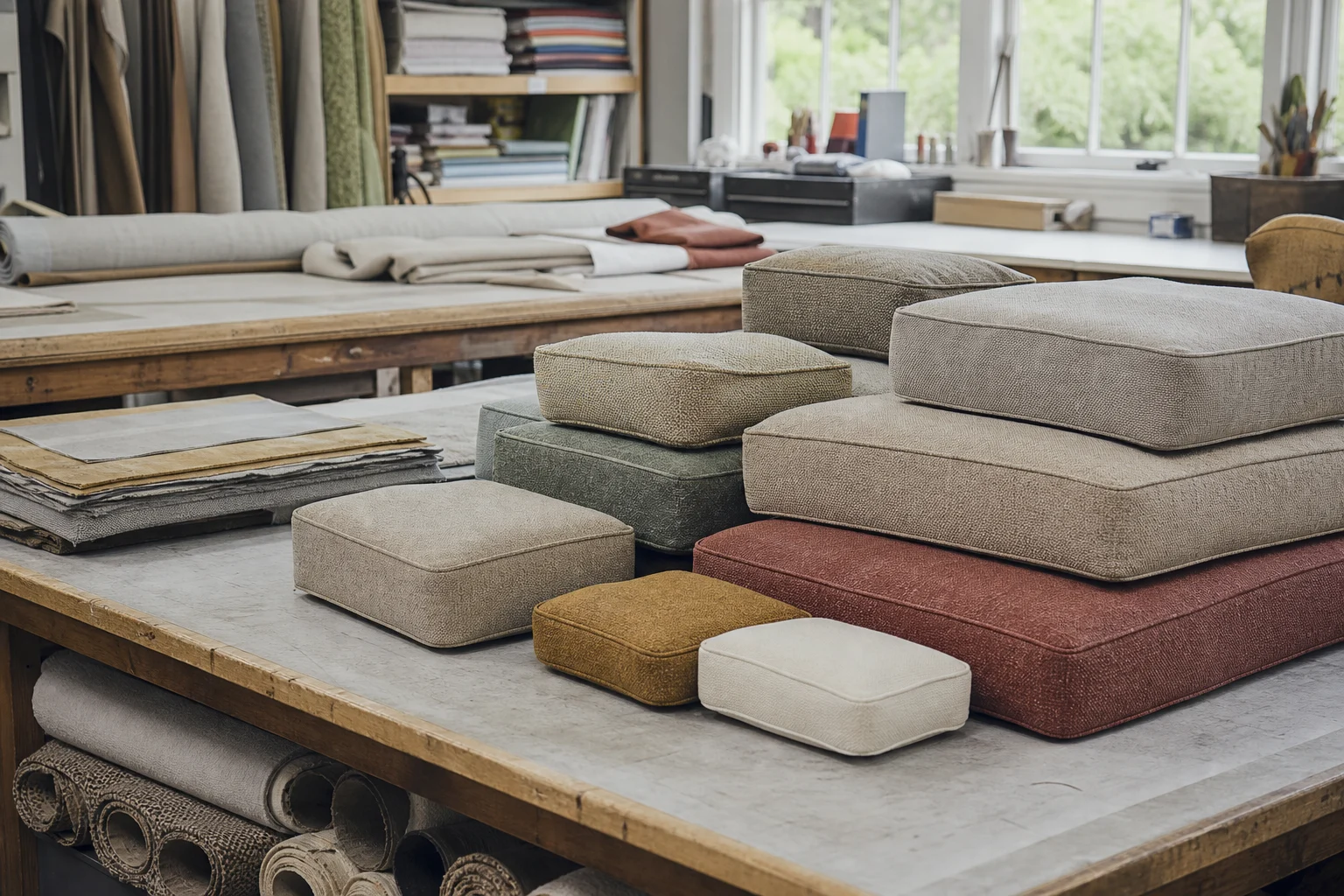
What that means per shape:
- – Round prices at diameter squared — a 24″ round costs the same as the 24 × 24 square it fits in. Seating-size rounds (custom floor cushions) price by the same rule.
- – Oval prices at major axis × minor axis, the rectangle around it.
- – L-shapes and corner pieces price at the long arm’s total length × total depth — the corner notch is a cutting detail, not a discount and not an upcharge.
- – Notched pieces (T-cushions included) price as if the corner were still there, plus the arm-wrap tabs where they exist.
- – Wedges and tapered seats price at the front width × depth.
- – Bowed fronts price at the chord × (depth + two-thirds of the bow height) — the arc’s footprint, not the full box.
- – Half-rounds price at their half-ellipse footprint.
This is the same convention foam cutters have used for decades, because it is how cutting actually works: the machine cuts a rectangular billet first, and the curve or notch is removed from it. Charging you for the removed corner as though it were waste, then charging again for the “complexity” of removing it, is a habit worth refusing. Our rates use a shape factor of 1.00 across the board.
How the Foam Rate Is Set
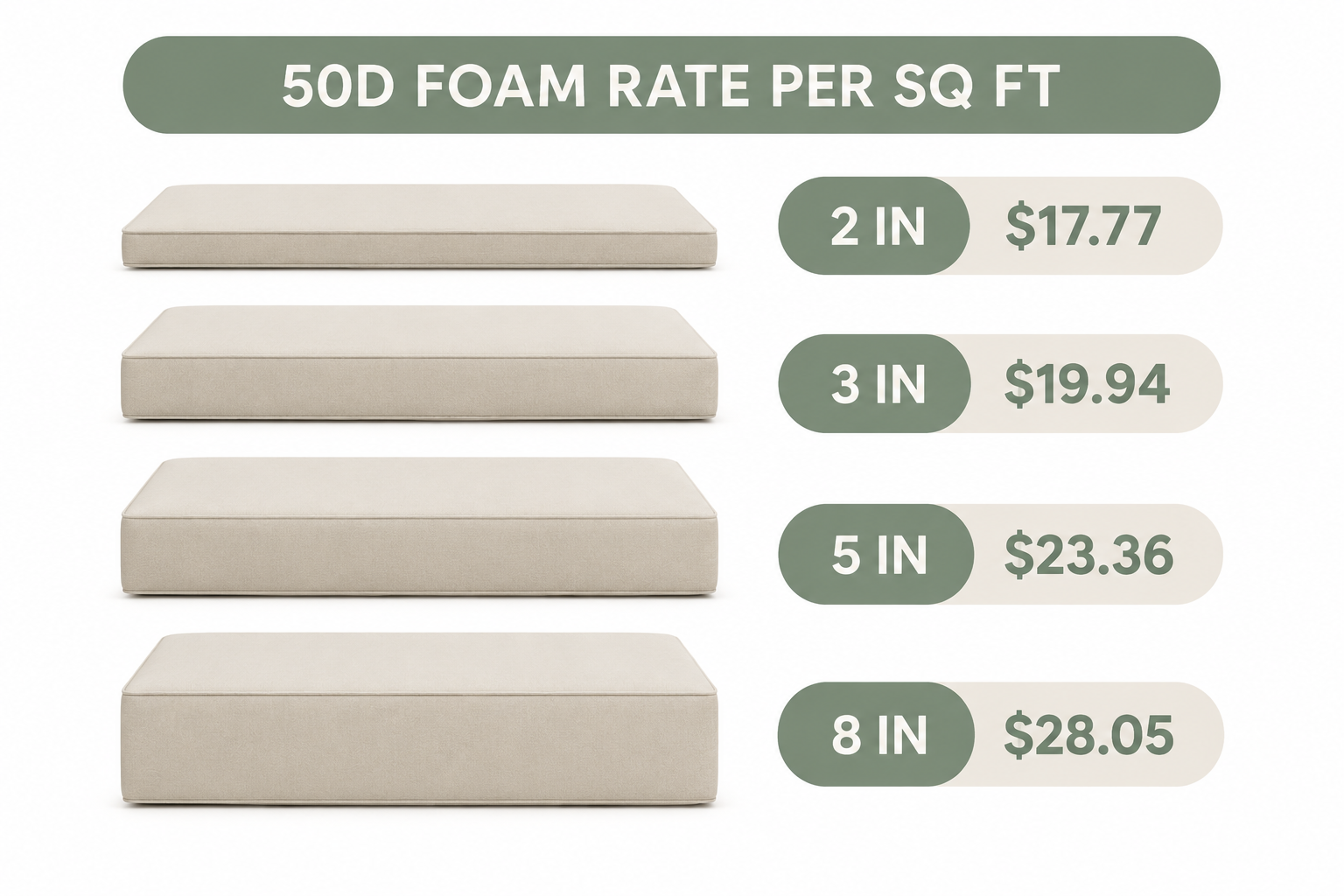
The foam rate is a table of density × thickness points, priced per square foot of top area. Density is lifespan — higher D holds its shape longer; the grades behind the numbers are covered in cushion filling types. Our current sheet spans $17.13 to $33.72 per square foot:
| Density | 2″ | 3″ | 5″ | 8″ |
| 35D — standard support | $17.13 | $19.04 | $22.38 | $25.32 |
| 50D — firm, most popular | $17.77 | $19.94 | $23.36 | $28.05 |
| 60D — extra firm | $18.12 | $20.43 | $24.56 | $30.57 |
| 65D — heavy use | $18.68 | $21.26 | $26.37 | $33.72 |
Three things the table quietly tells you:
- Thickness raises the rate, not just the area. A 5″ panel costs more per square foot than a 2″ panel of the same foam — more material per footprint.
- Density upgrades are cheap per year of life gained. 35D to 50D at 5″ is $0.98 per square foot — on a 4 sq ft deep seat, about $3.92 for a grade that holds its shape years longer.
- The span is roughly ×2 corner to corner. Entry 35D @ 2″ to 65D @ 8″ is 17.13 → 33.72. Foam spec is the biggest single lever you control; nothing else on the sheet moves the number this much.
How the Fabric Rate Is Set
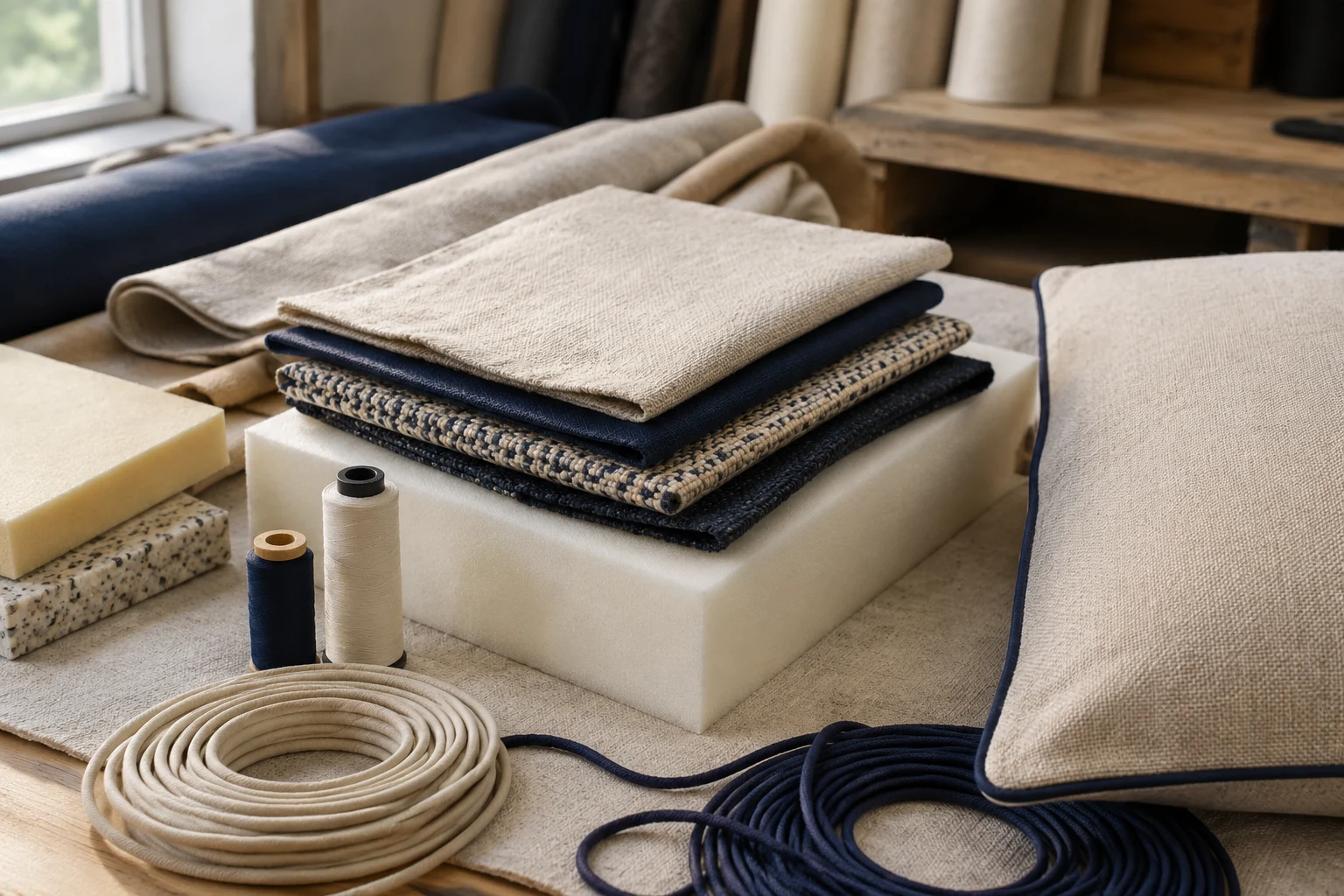
Fabric is priced the same way — per square foot of the same top area — at one flat rate: every fabric in the 119-weave library is $7.43 per square foot — pick by look, not budget.
Note the scale: fabric adds a flat $7.43 per square foot against foam’s $17.13–33.72. Fabric is the smaller term on any quote — which is why our standing advice is to never trade foam down to afford fabric up. Spend the money in the core, where it buys years, and pick the fabric family by how the cushion lives (covered or rained on, cats or no cats), not by price.
No Add-Ons: One Flat Sheet
There is no add-on menu — the price is the make-base plus the foam and fabric terms, and that is the whole sheet. (Readers comparing shops will find stitch styles, anti-slip bottoms and ties elsewhere in the market; we do not offer them, so they are not on the sheet.)
Every cover on the sheet closes with a zipper, cut to your exact measurements, so covers remove for washing — and spot cleaning handles the between-washes work: spills bead on Tech Fabric and wipe off instead of soaking in. When a cover has lived its life years from now, the honest arithmetic is a fresh custom piece cut to the same numbers — the trade-offs are laid out in replacement covers vs full cushions.
Two Worked Examples
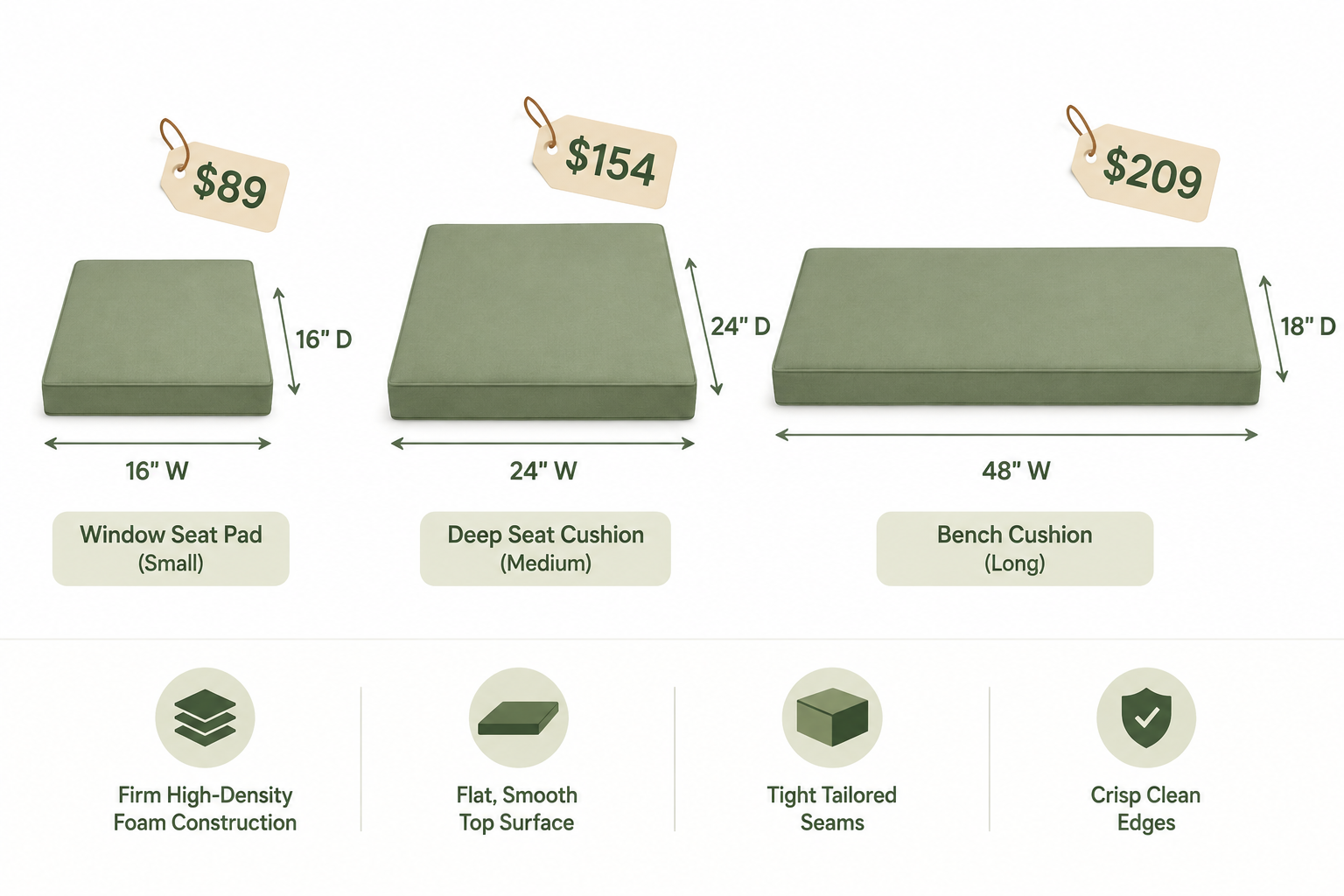
A small window-seat pad: 16 × 16 × 2, 35D foam, Cotton Linen.
Top area = 16 × 16 ÷ 144           = 1.78 sq ft
Foam   (35D @ 2"): 1.78 × $17.13   = $30.49
Fabric (any of 119):  1.78 × $7.43  = $13.23
Base                               = $45.00
                          Total    ≈ $89
Notice the base is most of this quote. That is what fixed setup labor does to small pieces, and why “why does a little pad cost $89” has a real answer rather than a shrug.
A deep seat: 24 × 24 × 3, 50D foam, any fabric at $7.43.
Top area = 24 × 24 ÷ 144           = 4.00 sq ft
Foam   (50D @ 3"): 4.00 × $19.94   = $79.76
Fabric:               4.00 × $7.43   = $29.72
Base                               = $45.00
                          Total    ≈ $154
Same formula, and now the foam line dominates — exactly what should happen as pieces grow. Run these two against the builder and you will get the same numbers to the dollar, which is the point of publishing the arithmetic.
Why We Publish the Formula
Because a quote you can rebuild is a quote you can challenge. The custom cushion market mostly prices behind configured forms and “request a quote” walls — a single number with no decomposition, which makes honest comparison impossible and lets under-specified foam hide inside a plausible total. A published formula makes three promises instead:
- – You can audit us. Every dollar of your quote maps to a term you just read. If a number ever fails to reconcile, that is our error to fix, not your argument to lose.
- – The estimate is checked before anything is cut. Nothing is cut until your numbers are confirmed: every dimension is re-verified against our database, and odd numbers get a phone call, not a guess. The builder’s output is an estimate built from your measurements — the tape measure wins the tie.
- – The price is factory pricing. We are the workshop — ten years of cutting foam and sewing covers — so the rates above have no brand, importer, distributor or retailer stacked between the cutting table and your porch.
Add the working terms — made to order in 4–7 business days of crafting, 3–6 weeks delivery (rush 3–5 available), a single flat shipping rate per order with tracking — and the full price of the order is on the table before you commit a dollar.
Next Steps
- Measure the piece you are replacing — the frame if you have it, the old cushion flat on a table if you don’t (how to measure).
- Price it live in the custom cushion builder — type your numbers, then toggle density and fabric and watch which term actually moves.
- Check the terms before you order: production window, shipping and the confirm-before-cutting process are all in the FAQ.
FAQs
How much do custom cushions cost?
A single custom cushion costs a $45 per-order base plus $17.13–$33.72 per square foot of foam (the density × thickness grade sets the rate) plus $7.43 per square foot of fabric — which works out to about $89 for a 16×16×2 window-seat pad, $154 for a 24×24×3 deep seat, and $209 for a 48×18×3 bench pad in 50D foam, with free shipping over $158 ($29 flat below).
How much does a custom bench cushion cost?
A 4-ft bench pad (48×18×3 in., 50D foam) prices at $45 base + 6.0 sq ft × $27.37 per sq ft = $209, and 5-ft and 6-ft runs price on their own area at the same formula. All 119 fabrics cost the same $7.43 per square foot, so length and foam grade move a bench quote and fabric choice never does.
What is the cheapest custom cushion I can order?
The smallest realistic order is a 16×16×2 pad in 35D foam at about $89 — $45 base + 1.78 sq ft × $17.13 foam + 1.78 sq ft × $7.43 fabric. The base is half that quote, so a single small pad is the worst per-piece value: order the pieces of a set together in one order and the $45 is charged once instead of per piece.
Is the online quote the final price?
It is a factory-direct estimate built from the formula above and your measurements. Before cutting, we re-verify every dimension against our database and call you if anything looks off — the confirmed numbers, not the first click, drive the order.
Why isn’t a small cushion proportionally cheaper?
Because the $45 base is charged once per order and exists before size enters the math. Setup labor is nearly flat across sizes; ordering several pieces together in one order is how you dilute it.
Do round, L-shape or notched cushions cost extra?
No — every shape prices at its footprint rule with a shape factor of 1.00. A round pays what the square it fits in pays; notches and curves are cutting details, not surcharge line items. For an L-shaped piece, the A × B footprint rule and how to measure the two outer edges are walked through in how to measure an L-shaped bench cushion.
What moves the price most?
Foam spec and area, in that order of leverage. The foam rate spans $17.13–33.72 per square foot across the density-thickness grid, while fabric is one flat $7.43 and there are no add-ons at all — a density-and-thickness decision moves a large set by tens of dollars; a fabric swap moves it by nothing.
Can I price a whole set this way?
Yes — sum every panel’s top area, apply the two rates, add one base per order. That is the entire arithmetic our builder runs, and it works the same on a competitor’s quote sheet if they will show you their rates.
Is a Custom Cushion Right for You?
Not always — and the honest answer is arithmetic, not enthusiasm. Four boundaries to check before you commit a dollar:
- Small single pieces are poor value. The $45 base is charged once per order whether you order one 16×16 pad or a five-piece sectional set, so the base is roughly half of a small-pad quote. If you need one small pad and nothing else, a stock size is the cheaper buy; if you need a set, order it together and the base amortizes across every piece.
- Tolerances are real, not zero. Covers are hand-cut and hand-sewn: width and depth land within ±½″, pieces over 36″ land within ±¾″, and thickness within ±½″. Fine for almost every seat frame; if yours is a recessed box lid that must seat with less than ½″ of total gap, say so when you order — the confirm-before-cutting call exists for exactly that conversation.
- Custom-cut pieces cannot be returned. A cushion cut to your numbers fits exactly one frame on earth, so it cannot be restocked or resold. The remedy for an error is a free remake — outside tolerance, wrong fabric, wrong foam, shipping included — not a refund; cancelling is free within 24 hours of placing the order.
- Plan on weeks, not days. Production runs 4–7 business days (straightforward rectangles toward the fast end, hinged chaises and large sectionals toward the full window) before carrier transit — most orders deliver within 3–6 weeks of purchase. Rush production compresses crafting to 3–5 business days for a surcharge; if you need it this week, no made-to-order workshop is the right supplier.
If your frame is a non-standard size, the old foam has flattened, or you are replacing a full set at once, the formula above works in your favor — one base, one dye lot, one tolerance promise in writing. One more deliberate trade-off: our covers close with zippers so they remove for washing; spot cleaning handles the between-washes work.
Couch Cushion Foam Replacement: Density, Cost and Buying Guide
Replace couch cushion foam in one right order: 50D vs 60D density, measuring the old core, four ways to buy, and real worked prices for one seat and a full set.
Where to Buy Replacement Patio Cushions: 5 Ways, Compared
Five ways to replace patio cushions — the set maker’s parts program, seasonal aisles, universal-fit listings, specialists and measured custom — plus the Home Depot house-line route with 31 measured collections.
Why Is Patio Furniture So Expensive? The Cost Anatomy, Explained
What actually drives patio furniture prices — weatherproof materials, UV-stable finishes, marine-grade hardware, freight on bulky goods, and seasonal retail economics — why the good stuff costs 3-5x the box-store set, and where the value concentrates.
Patio Set vs Buying Separately: The Real Trade-offs
Buying a complete patio set versus assembling pieces: price coherence and one-click convenience versus fit-to-space precision, mixable quality and replacement flexibility — how to decide, and the hybrid strategy that captures both sides.
How Much Do Custom Cushions Cost? Price Ranges by Shape (2026)
Custom cushions cost USD 50-400 depending on shape, size, density and fabric. Live factory-direct price ranges for bench, window seat, outdoor, sofa and boat cushions — and how to price your own.
Outdoor Cushion Foam: Density and Thickness Guide With Real Numbers
Short answer: for a daily-use outdoor seat, order 3 inches of foam at 50D–60D; move to 4 inches and 60D