
The hanging egg chair — the woven pod swinging from a stand — went from mid-century curiosity to the most-photographed patio seat of the past decade. Its cushion is unlike any other seat pad: contoured to the pod’s interior, attached at points the frame defines, and living a semi-exposed outdoor life that kills pads on the standard weather clock. When the original pad dies, replacement is a specific project: the shapes are model-specific, the market’s “fits most” claims are at their weakest, and the custom route requires the same contour discipline as the pod itself. This guide covers what egg chair cushions are, what wears first, the fit problem in detail, and the routes to a pad that fits your particular pod. The general curved-and-shaped measuring background: how to measure curved wicker seating.
The Anatomy of an Egg Chair Cushion
Most egg chair pads are a set of pieces, not one cushion:
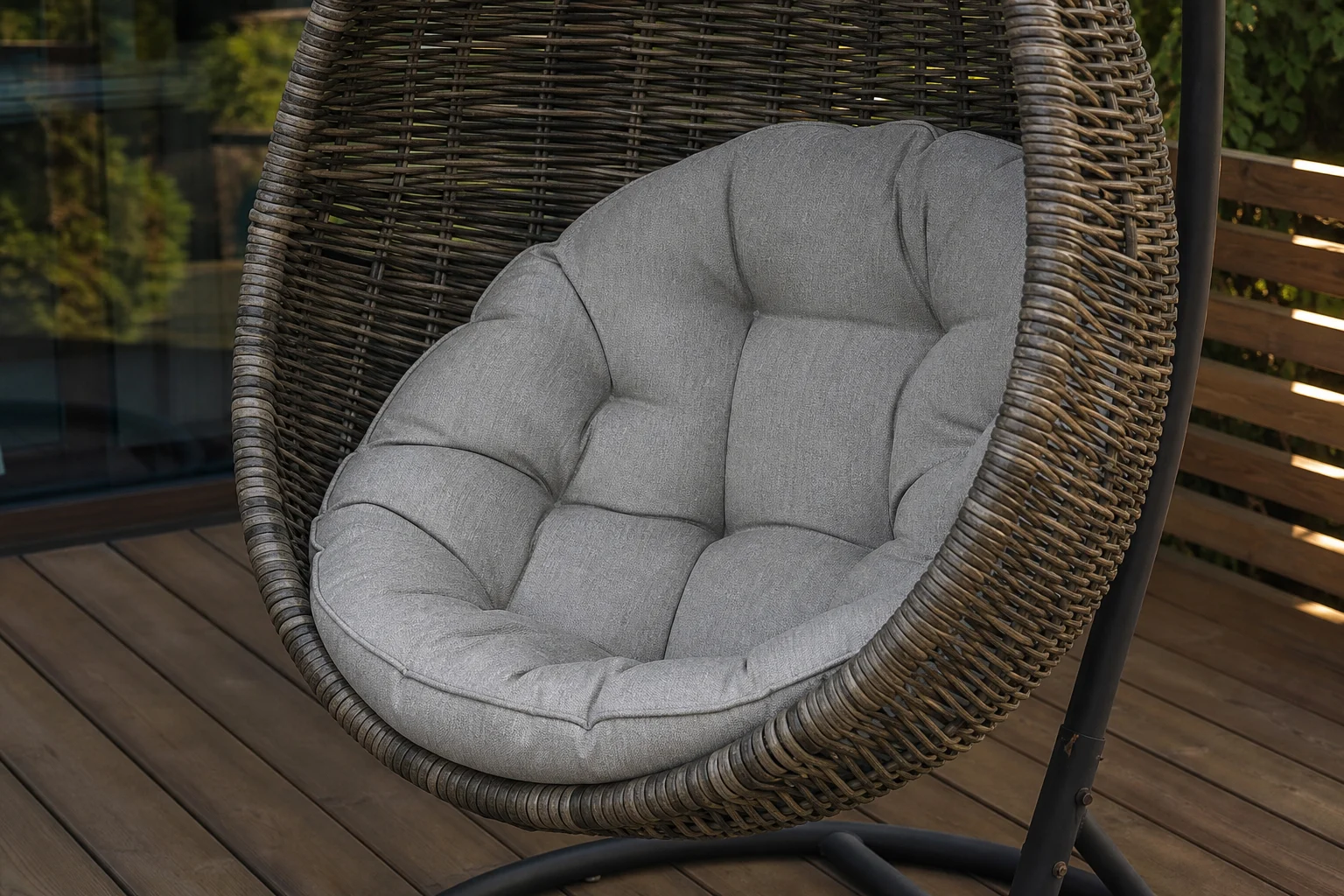
- The seat pad — contoured or flat-rectangular depending on the pod’s base; it carries sitting weight against a woven or solid base.
- The back pad — the large piece, often shaped to the pod’s inner curve, sometimes wrapping toward the sides.
- Armrest or side pads — on pods with defined arms, small shaped pieces.
- The headrest pad — on taller pods, a small upper piece.
The attachment system is where models diverge: ties at the weave’s strong points, hook-and-loop tabs aligned to the shell, or sleeves that button through the weave. The system matters as much as the dimensions — a pad with the right shape and the wrong attachment lives a sliding life inside a curved shell, and a curved shell amplifies every slide.
What Wears First
Egg chairs concentrate three failure modes:
- – Fabric fade in the upper half. The pod’s basket weaves shed water but hold sun; the back and headrest pads sit in a UV concentrator and fade years before the seat pad does. Fiber tiers matter more here than on flat furniture — solution-dyed acrylic or Olefin holds the pod’s look; polyester family fades to a different colorway within seasons (best outdoor cushion fabric).
- – Fill compression in the seat pad. The pod’s posture puts real weight through a small base; entry foam compresses to a veneer within a couple of seasons of regular use, and the pod becomes a hard shell with fabric in it. The density logic: how to choose foam density.
- – The water-trap problem. A pod’s geometry holds leaves, rain, and dew in the seat’s low point; pads that stay damp grow the interior mildew that ends them early (prevent mold on outdoor cushions, and the triage when it has already happened: how to drain waterlogged cushions). Covered placement — under a roof or at least a deep eave — is the single biggest lever on egg chair cushion life.
The Fit Problem, Honestly
“Universal egg chair cushions” are the least universal product in the cushion market, because pods differ on every axis at once:
- – Inner contours vary by manufacturer and generation — pod depth, back curvature, and the angle where seat meets back are model fingerprints.
- – The tie and tab geometry is frame-defined. A pad whose attachment points miss your pod’s strong points cannot be made to fit by tying it tighter; it slides at the curves.
- – Sizes drift across the market’s many factories. Two pods of nominally the same class can differ by inches in every dimension that matters.
The working method is the one this guide series applies to every shaped seat: measure yours, and treat every “fits most” listing as a hypothesis your numbers confirm or kill. For an egg chair, measure each piece against the shell it serves — the seat pad’s width and depth at the base, the back pad’s width and height along the shell’s curve (chord and camber, the curved-surface method), the attachment points’ positions from fixed seams — recorded to the nearest quarter inch.
Route 1: The Original Source
If the pod’s maker is known and current, start there: brands that sell the chairs usually offer replacement pads for current models, and the fit is factory-correct while the model lives. The identification discipline is the same as any brand furniture — the hang tag, the manual, the order records, the stand’s labeling. The window closes when the model rotates out, which for trend-driven egg chairs is fast.
Route 2: Universal Pads — Verify Everything
Universal egg chair pads exist and sometimes fit. The discipline: demand tabular dimensions for every piece, the attachment layout in the photos, and the fiber and fill specs by name; then compare each number against your measured shell before ordering. The failure mode when this route fails is specific — the pad bags at the curves, slides at the attachment points, and reads as a pillow stuffed into a sculpture. One purchase-rule from this series applies double here: buy one pad set, verify the fit for a week, then commit; never buy multiples on faith.
Route 3: Custom Pads Cut to Your Pod
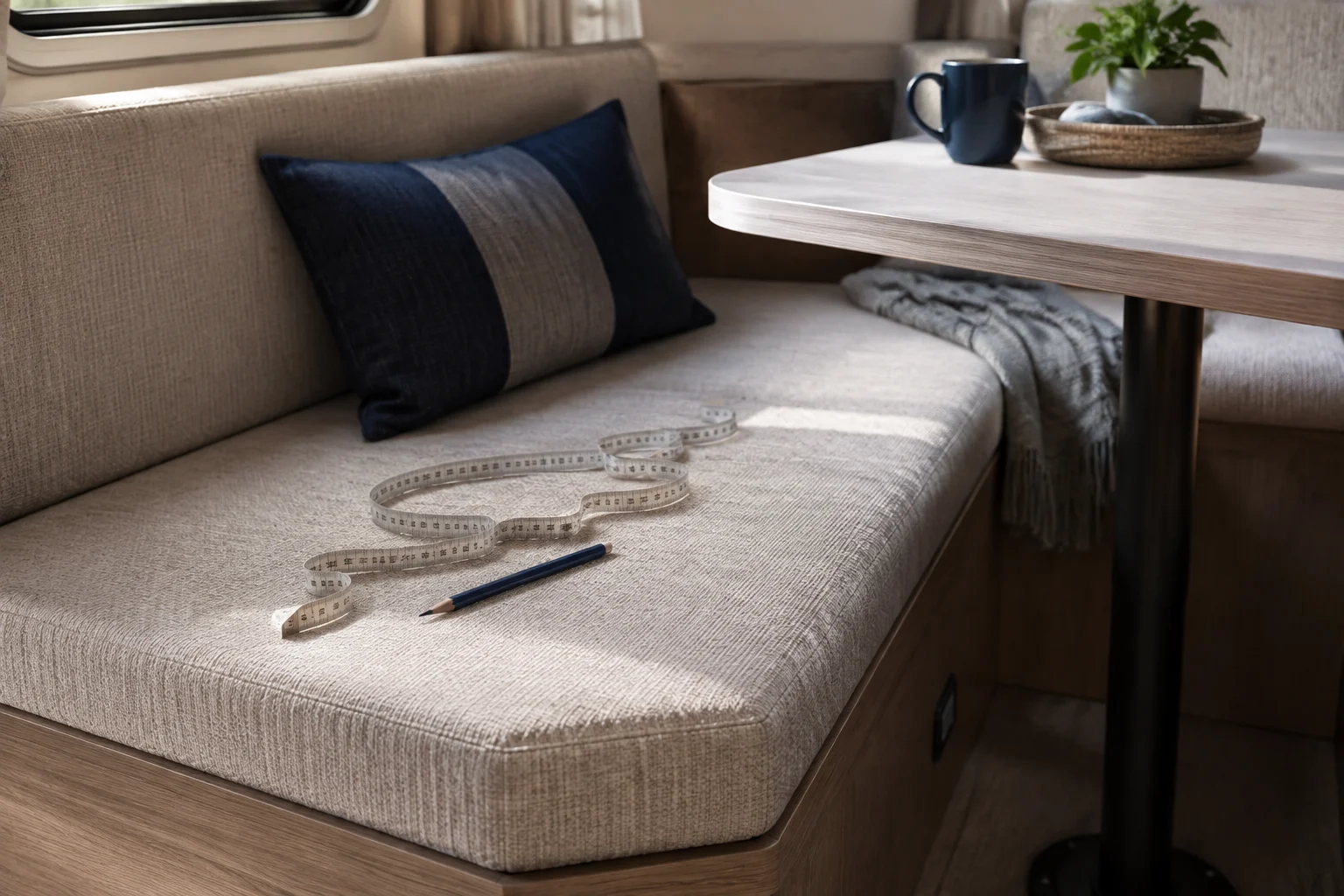
The route that fits every pod, current or retired: pads built to your measured pieces, with the attachment system matched to your shell’s strong points, in the fiber tier the exposure deserves. What the order needs:
- Measured dimensions per piece — seat, back, arms, headrest — including the curved surfaces captured properly (the curved measuring method).
- The hold — where the pad edges land on the pod, measured from seams. We don’t sew ties; an exact-footprint cut plus a thin non-slip rug pad does the holding.
- The spec choices — solution-dyed acrylic or Olefin for exposed placements, 45-60D cores for daily-use seats (how to choose foam density).
Entry point: custom outdoor cushions — shaped pads to measurements are the standard work of a cutting table, and nothing is cut until your dimensions are confirmed. For the round seat pad itself, custom egg chair cushions — any diameter the basket measures, any thickness from 2 to 8 inches, priced from $115.
Placement: The Big Lever
Where the pod lives decides which cushion specs matter. Fully exposed pods (no eave, no cover) want the full outdoor spec — acrylic or Olefin fabric, water-shedding fill choices, and the maintenance system honestly applied (the complete maintenance guide, winter storage). Covered and indoor pods can trade some weather spec for softness — and the same pod moved under cover doubles its pad life without changing anything else. If the pod’s placement is a choice still open, make it before the pad purchase: it is the cheapest cushion decision on this page.
Buying the Chair Itself? Read the Cushion Before You Pay
Most egg chairs are bought with their original pads, and the pad is the part that dies first — so the pad deserves inspection at purchase, because you are previewing your own replacement project:
- – Check the attachment system for the future. A pod with well-placed, robust anchor points (strong weave points, defined tabs) will accept replacement pads for years; a pod whose anchoring is ambiguous makes every future pad a compromise.
- – Judge the original pad’s spec honestly — fiber, fill, seam construction — because it sets the chair’s maintenance calendar. An entry-spec pad on an otherwise good pod is fine if you price the eventual replacement into the purchase.
- – The frame checks belong in the same inspection: the stand’s base and suspension point carry all the dynamic load. A chair that swings smoothly, hangs level, and shows no cracking at the weave’s stress points is a chair worth buying pads for; anything else is a repair project wearing a seating project’s clothes.
The same logic governs the secondhand market, where egg chairs circulate heavily: the price of a used pod plus a new custom pad set is often well below new — and the pod that passes the frame checks ages far better than any pad ever will.
The Suspension Point: Safety and Swing Quality
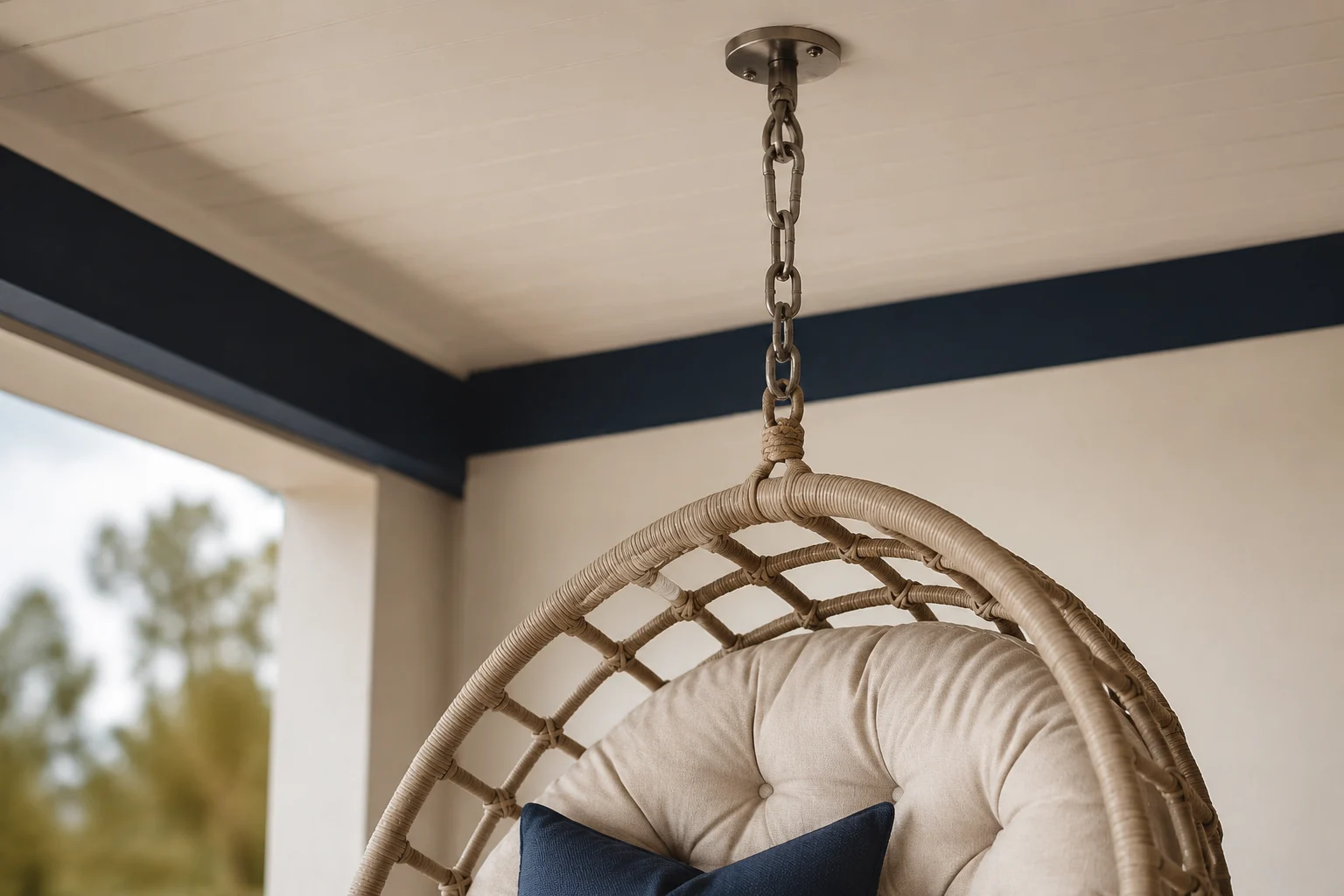
One subsystem deserves its own paragraph because it carries everything: the hanging hardware and stand. The inspection habit is a two-minute ritual — the suspension point and hooks for wear or deformation, the stand’s base for level and stability, the chain or rope for fraying at the load points, and the swing test (a gentle push, watch for smooth travel and true return). Any creak, catch, or visible wear at the load path is a stop-and-inspect signal, not a quirk. Manufacturers’ assembly and use instructions govern — follow them, including weight guidance — and the reward for the ritual is a chair whose motion stays silent and smooth for years, which is the entire charm of the form.
Winter and the Off-Season
The egg chair’s pod shape makes it a leaf-catcher and a snow-scoop, which shapes the off-season routine: cushions come out entirely (they store like any outdoor cushion — clean, dry, indoors, per the winter storage method), and the pod itself either comes under cover or gets a furniture cover that sheds rather than collects. The trap specific to this furniture: pods left outdoors with their cushions in place through one winter arrive in spring with the interior mildew case study already completed — the weave held moisture, the pad sat in it, and the remediation is the mold prevention protocol rather than a cleaning. Ten minutes at first frost — cushions out, pod covered — saves the entire spring.
FAQs
Can you buy replacement cushions for an egg chair?
From the pod’s maker while the model is current — factory-correct pads exist in that window; after rotation, universal pads sometimes fit (verify every dimension against your measured shell) and the reliable route is custom pads cut to your pod’s pieces and attachment points.
Why won’t a universal cushion fit my egg chair?
Pods differ in inner contour, back curvature, and tie geometry across manufacturers and generations — the shapes are model fingerprints, and a pad with the right look but the wrong contour and attachment map bags at the curves and slides at every sit-down.
How do I measure an egg chair for new cushions?
Piece by piece against the shell — seat width and depth at the base, back width and height with the curve captured as chord and camber, arm and headrest pieces, and every attachment point positioned from a seam — all to the nearest quarter inch (how to measure).
What fabric should egg chair cushions use?
Solution-dyed acrylic or Olefin on exposed pods — the upper pads sit in a UV concentrator and polyester fades to a different colorway within seasons; covered and indoor pods can trade toward softer fabrics (best outdoor cushion fabric).
Do egg chair pads last longer under cover?
Dramatically longer — the pod’s geometry traps leaves and moisture at the seat’s low point, so an eave or roof changes the pad’s life more than any fabric upgrade; if placement is still a choice, it is the cheapest cushion decision on the chair.
Next Steps
- Identify the pod if possible (tag, manual, order records) and check the maker’s pad window while it is open.
- Measure every piece and attachment point per how to measure — the numbers that sort universal-fit claims into true and false.
- For pads cut to your pod with the weather spec chosen deliberately, price custom outdoor cushions — 3-6 weeks delivery, crafted in 4-7 days, nothing cut until your dimensions are confirmed.
Patio Chair Cushions: The Complete Buying Guide (Outdoor Too)
Everything that decides a patio or outdoor chair cushion — sizes, thickness, ties, fabric tiers and where each buying route wins. Custom from $45 when grids fail.
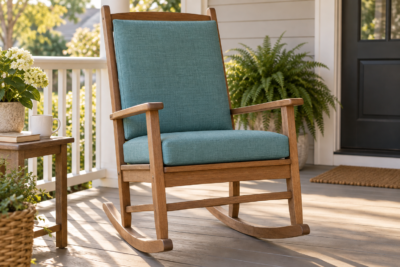
Outdoor Rocking Chair Cushions: The Weatherproof Guide to Sizes and Fabrics
An indoor rocking cushion dies fast on a porch. The sun bleaches the print in a single season, the foam
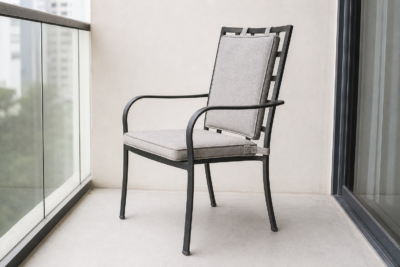
Cushions for Metal Patio Chairs: Frame Types, Grip and the Heat Question
Cushions for metal patio chairs guide: wrought iron, aluminum and steel frames and what each means for pads, sliding on slick metal, heat absorption in sun, sizing across mixed metal sets, and the outdoor duty spec.
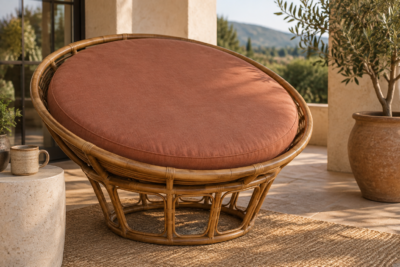
Outdoor Papasan Cushions: Weathering the Big Round
Outdoor papasan cushions fail in a known order — fabric, fill, bowl. The overhang-vs-inset diameter decision, fiber vs foam outdoors, and the honest line between a flat round and the concave original.
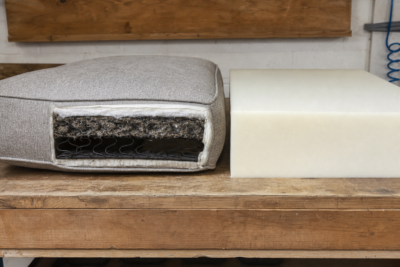
High Density Foam Couch Guide: What Density Actually Means
What high density foam actually means for a couch — the ×10 density convention, density vs firmness (ILD), the 35D–65D grades ranked by use, how each grade fails, and what density costs per square foot.
Adirondack Chair Cushions: Sizes, Selection & Replacement Guide
Adirondack cushion sizes decoded: 20×20 seats, tall-back options, tie patterns, best fabrics — plus fitting odd or vintage chairs.