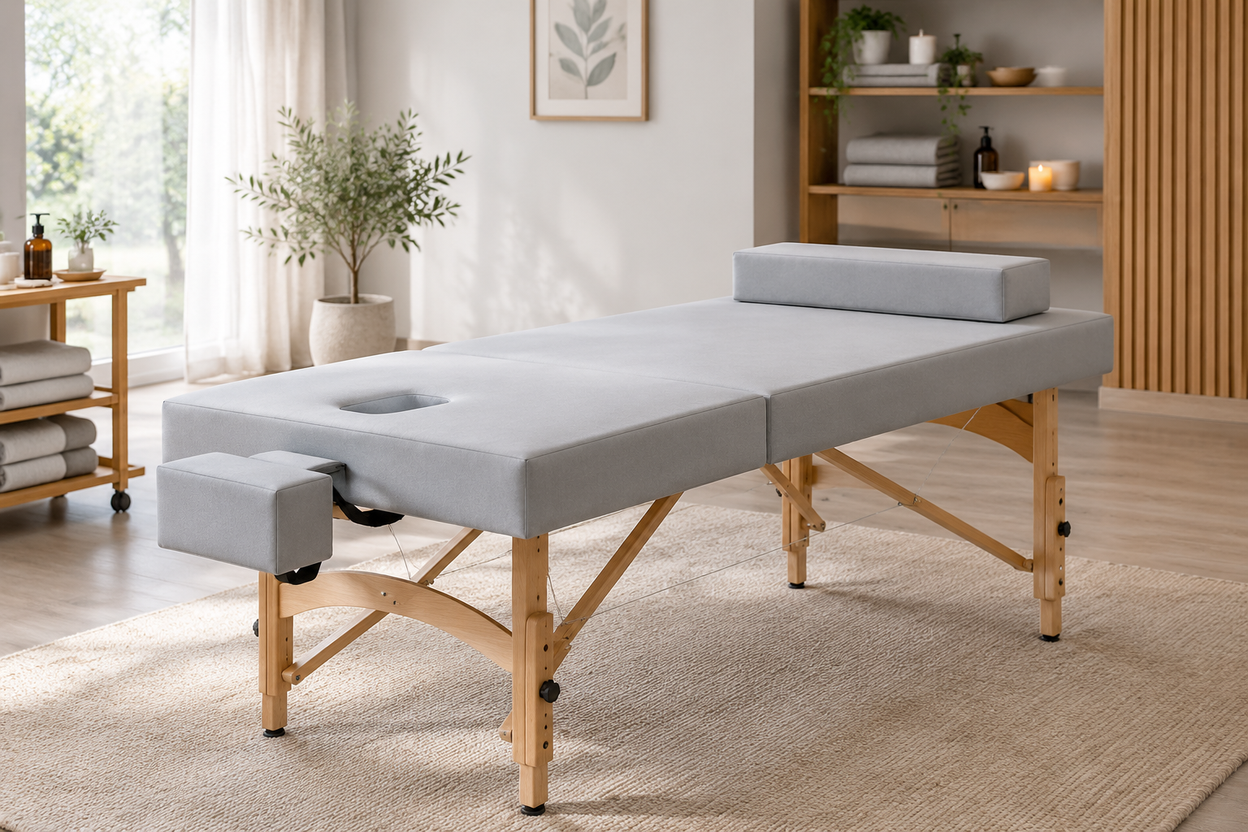
A massage table bolster is a firm block of high-density foam that holds a client’s ankles, knees, wrists or side exactly where you placed them — positioning work the table alone cannot do. Choose by placement first: length and height follow the body part the bolster serves. Then choose the build — solid 50D foam for constant load, or a layered firm-base build when skin meets foam for an hour at a stretch.
This guide covers the three bolster shapes you will meet in a professional studio, the four set sizes and the placement each was cut for, how solid foam and layered builds differ under a working client, where each bolster goes for prone, supine and side-lying work, and what a mill-direct bolster costs against the supplier catalogs. Ordering practicalities — fabrics, lead time, custom dimensions — close the page.
Why a Massage Table Wants Firm Foam, Not a Soft Pillow
A bolster’s whole job is to not move and not flatten while a client’s weight rests on it for most of an hour. A soft pillow passes that test for about ten minutes. Then the fill compresses, the supported limb sinks, and the position you set at the start of the session has quietly drifted by the end of it. High-density foam holds its cut height under load, which is why every professional bolster — round, half-round or wedge — is built on a firm core.
The second reason is durability under repetition. A studio bolster gets loaded and unloaded twenty or more times a day. Density is the lifespan spec as much as the firmness spec: a 50D-grade block holds its edges for roughly 5–8 years of daily use, where a low-density block dishes out in months. Buy the bolster once, not every season.
On our cutting floor, bolsters are cut from the same 50D foam grades as the replacement couch foam we ship to homeowners — the same blocks, the same tables, the same verification against the mill certificate before the blade moves. A bolster is not exotic equipment. It is furniture foam doing a positioning job, and it deserves to be priced like one.
The Three Shapes: Wedge, Round and Half-Round
Stability is what separates the three shapes. A full cylinder is the classic massage bolster, but a cylinder rolls — most suppliers sell it with a cradle or a hold-down strap to solve the problem they built in. A half-round (flat base, domed top) stops rolling by design: the flat bottom is the anti-roll system, with nothing added. A wedge goes further still — the lowest center of gravity of the three, a sloped ramp instead of a vertical face, and no way to roll anywhere.
The wedge also matches how limbs actually sit. An ankle or a wrist resting on a low ramp settles into a natural angle against the slope, where a vertical face asks the joint to bend over a hard edge. That is why the set sizes on our massage table bolster page are all wedges, and the half-rounds live on the knee bolster pillow page where a curved crest is the point.
Sizing: Match the Bolster to the Placement
Length follows the body part; height follows the joint you are supporting. The four set sizes below cover the standard placements on a 28–32 inch table — each priced with its fitted woven cover included, and each available in two builds at the same price.
| Size (L × W × H) | Placement it was cut for | Firm — 50D | Layered — firm base, soft top |
| 18 × 7 × 4″ | Under both ankles, prone; under the wrists | $57 | $57 |
| 22 × 7 × 3″ | Low-profile ankle line for taller clients; side-lying shin support | $59 | $59 |
| 22 × 7 × 4″ | Standard-height prone ankles on longer tables | $62 | $62 |
| 18 × 10 × 4″ | Wide build: under both knees in supine; under the thigh line | $66 | $66 |
Reading the table: an adult’s ankles side by side run roughly 12–16 inches, so the 18-inch lengths take the pair with room to spare. The 22-inch lengths exist for longer tables and bigger frames — the bolster should never become the thing that decides where the client lies. Height is the 3″ versus 4″ choice: 4 inches is the standard support height under ankles and knees; the 3-inch low profile suits clients whose ankles you want barely lifted, and side-lying work where the shin needs less elevation. Width does quiet work — the 10-inch wide build takes both knees of a supine client without either rolling off the crest.
Firmness: Solid 50D or a Layered Build
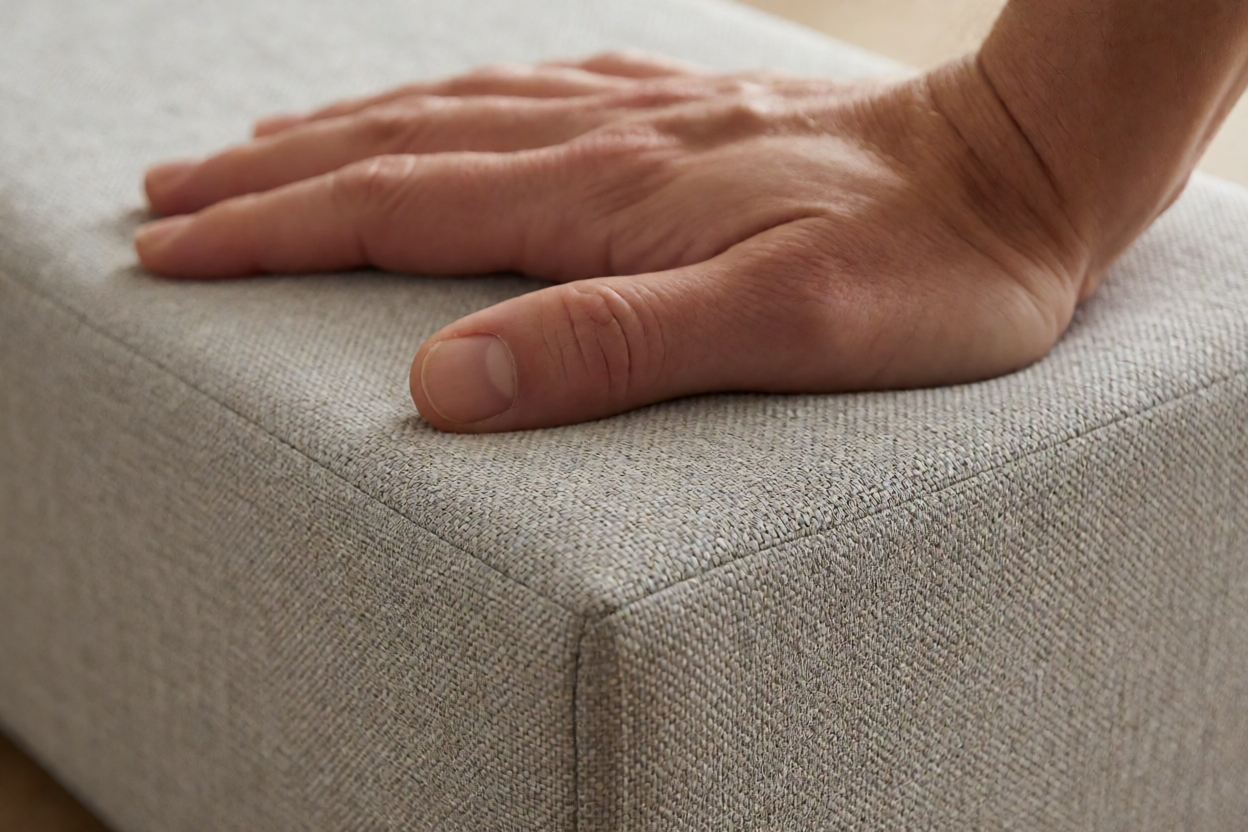
Solid and layered cost the same here — the layered build is a construction choice, not an upcharge — so the decision is purely about what happens under the client. The solid build is 50D high-resilience foam all the way through: one consistent grade, the one that matches the standard indoor cushion grades this mill ships every day. It holds a limb at a set height with a small, steady give.
The layered build is firm where it matters and forgiving where it shows: a firm base layer carries the load and keeps the height honest, and a soft top layer is what skin actually rests against through a 60–90 minute session. Layering is how premium cushions have always been built — the same logic as a firm HR core under a plush surface, laid out in our cushion filling types guide. For bolsters that spend all day under a working limb, layered is the build most studios end up preferring.
Placement: Where Each Bolster Goes
Under the ankles, prone. The default placement. The bolster sits just ahead of the foot of the table, ankles resting on the ramp, calves relaxed. The 18 × 7 × 4″ is the standard pick; taller clients and longer tables take the 22-inch lengths.
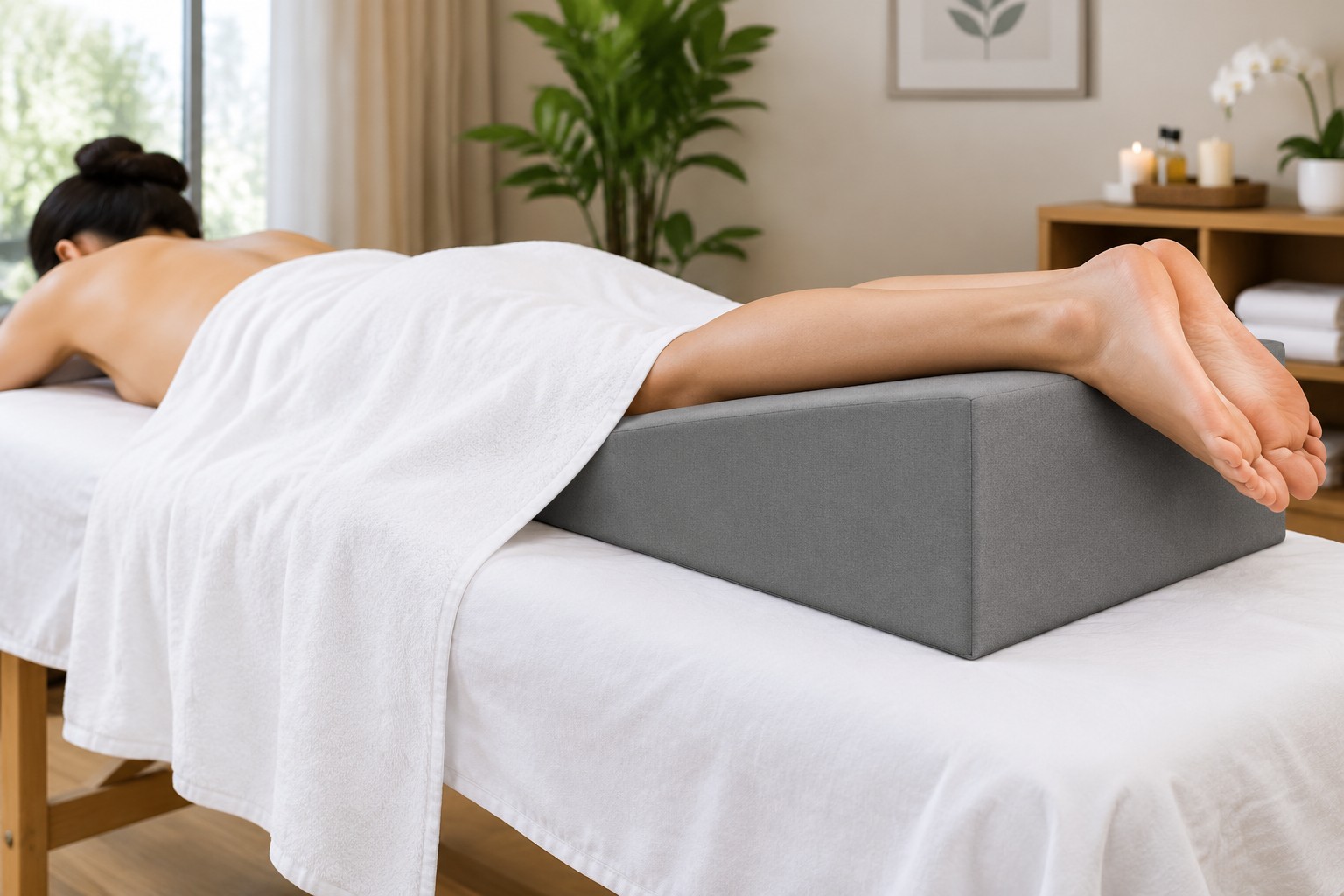
Under the knees, supine. A face-up client with knees straight on a flat table carries the load through the back of the knee. The wide 18 × 10 × 4″ build takes both knees side by side and introduces a gentle break at the joint instead.
Under the wrists. When the arms need a home, a low wedge under the wrists keeps them level with the torso instead of dropping off the table edge. The 18 × 7 × 4″ does this job as its second life.
Side-lying support. Side-lying work asks the most of positioning: the under-leg needs depth, the top leg needs a shelf. The low 3-inch profile runs under the shin line, and for a higher shelf the half-round profile in our knee bolster comfort guide covers the same territory from the sleep side of the house.
The Sourcing View: Supplier Catalog versus Mill Direct
The professional supply channel sells bolsters at three tiers — small soft-foam rounds from around $32, heavy-duty grades at $55–58, and premium positioning systems at $109–119 (observed across a leading supplier’s catalog of 19 bolster SKUs, September 2026). The tier you pay for has mostly to do with foam grade and duty rating, and the catalogs are honest about that. What the catalogs cannot do is vary the spec: each SKU is a fixed size at a fixed density, and if your table, your clients or your modality sit between two SKUs, that is your problem.
A mill-direct bolster starts from the other end. These four set sizes are cut from the same 50D grades on the same cutting tables as custom work — the difference is the process you skip. A custom cushion is cut to measurements you send in, and a person confirms every dimension before the blade moves. A set size needs neither step, so the price lands 20% below the custom quote: $57–66 against the $55–58 heavy-duty band, with the layered build and the fabric choice included rather than extra. Massage-therapist forums keep returning to the same conclusion when bolster threads come up — buy firm, buy several, and stop replacing soft ones every year (forum-reported, r/MassageTherapists).
Studios also buy bolsters in sets, not singles: an ankle bolster, a knee bolster and a side-lying support cover most modalities between them. Nothing on either bolster page is bundled or gated — the set prices are per piece, and a two-piece order ships as two pieces off the same cutting list.
Ordering, Fabrics and Lead Time
Every bolster is made to order in 4–7 business days — nothing is cut until an order lands on the cutting list, and then it goes straight on. Covers are sewn from the same fabric library as the custom line: all 119 fabrics at one price, so color is an order note at checkout rather than a separate SKU. The workshop reads and verifies each order against an 11-point checklist before it ships. A bolster needing other dimensions than the four listed is a conversation for the order desk, not the checkout — the set sizes are fixed, and that is exactly why they carry the lower price.
FAQs
What size massage bolster do I need?
Match the bolster to the placement: 18 × 7 × 4″ under prone ankles or wrists, 18 × 10 × 4″ under supine knees, 22-inch lengths on longer tables and for taller clients, and the 3-inch profile for side-lying shin work. Length should always clear the body part it carries — adult ankles side by side need 12–16 inches.
How firm should a massage bolster be?
Firm enough to hold height under a client for a full session — which in practice means high-density foam, 50D at minimum. A soft pillow compresses within minutes and the position drifts; the layered build (firm base, soft top) adds comfort at the skin without giving up the support underneath.
What is the difference between a wedge and a round bolster?
Stability and the resting angle. A round bolster rolls and usually needs a cradle or strap to stay put; a wedge has the lowest profile and cannot roll, and its sloped ramp lets an ankle or wrist settle at a natural angle instead of bending over a hard edge.
Can I use a regular pillow instead of a bolster?
Not for positioning work. A bedding pillow flattens under limb weight and the support height changes through the session — a bolster is firm foam cut to a set height, which is the entire point of it.
How long does a high-density foam bolster last?
Roughly 5–8 years of daily studio use at 50D density, longer at higher grades — density is the lifespan spec. Low-density blocks dish out in months of the same work.
Can I order a bolster in a different size?
Yes, through the order desk rather than this page — the four set sizes are fixed because skipping measurement and confirmation is what earns the 20% lower price. Other dimensions are quoted as custom work.
Sofa Foam Cut to Size: How to Order Exact-Fit Foam
How to order sofa foam cut to size — measuring the core, adding the compression allowance, specifying density, thickness and shape, and the checklist to run before any foam is cut.
Cheap vs Quality Outdoor Cushions: Where the Money Actually Goes
What separates a $15 cushion from a $60 one and a $150 one — fabric construction, fill, stitching and covers — which upgrades matter, which are markup, and how to buy the quality your furniture actually needs without overpaying.
Couch Cushion Foam Inserts: Measure and Order New Cores
A foam insert replaces the flattened core inside the covers you already own. Measure seam to seam, pick 60D seats and 50D backs, and price the set in one order.
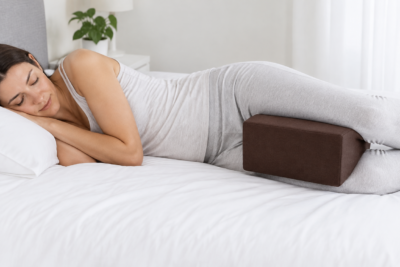
Knee Bolsters for Side Sleepers and Back Sleepers: A Firm Support Guide
A firm half-round D bolster fills the gap between the knees for side sleepers and under both knees for back sleepers. Heights, densities and lengths explained — positioning and comfort, made to order.
Kid-Friendly Patio Cushions: The Family-Proof Spec
Cushions that survive children — fabric families that shrug off juice and markers, construction that wipes fast, foam that handles jumping duty, attachment systems that stay put and stay safe, and the two-layer strategy that saves the good cushions.
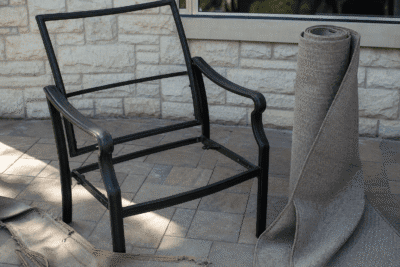
Re-Slinging Patio Chairs vs Replacing: When It’s Worth It
Sling furniture repair economics: what re-slinging is and what it costs relative to replacement, which frames deserve it, the fabric choice for slings, cushioned-conversion as the third option, and the DIY-versus-service decision.