
Most cushions are rectangles pretending to be interesting. A surprising number are not: lounge chairs and loveseats whose seats are wider at the front than the back, bay-window corner wedges, attic benches cut short by a sloped ceiling, fan-back chairs, angled benches. All of these are trapezoids — two parallel sides of different lengths, closed by two slanted sides — and a trapezoid cannot be ordered with a single width. Order the front width and ignore the back, and the cushion fits where your knees go and stands off the frame where your back rests. Order the average, and it fits nowhere.
The measuring itself takes five minutes. The discipline is in two things: taking three width readings instead of one, and knowing which of the three trapezoid types is sitting in front of you — because the symmetric bay-window wedge, the square-sided attic bench and the lopsided nothing-is-parallel seat each get measured differently. This guide walks all three, with the cardboard template method for the seats that refuse to behave.
Which Trapezoid Do You Have? The Three Forms
“Trapezoid” is one word for three different jobs. Before you touch a tape, look at the seat from above and sort it into one of three bins — the measuring method follows from the bin.
The Isosceles Trapezoid — Symmetric Slants (the Bay-Window Classic)
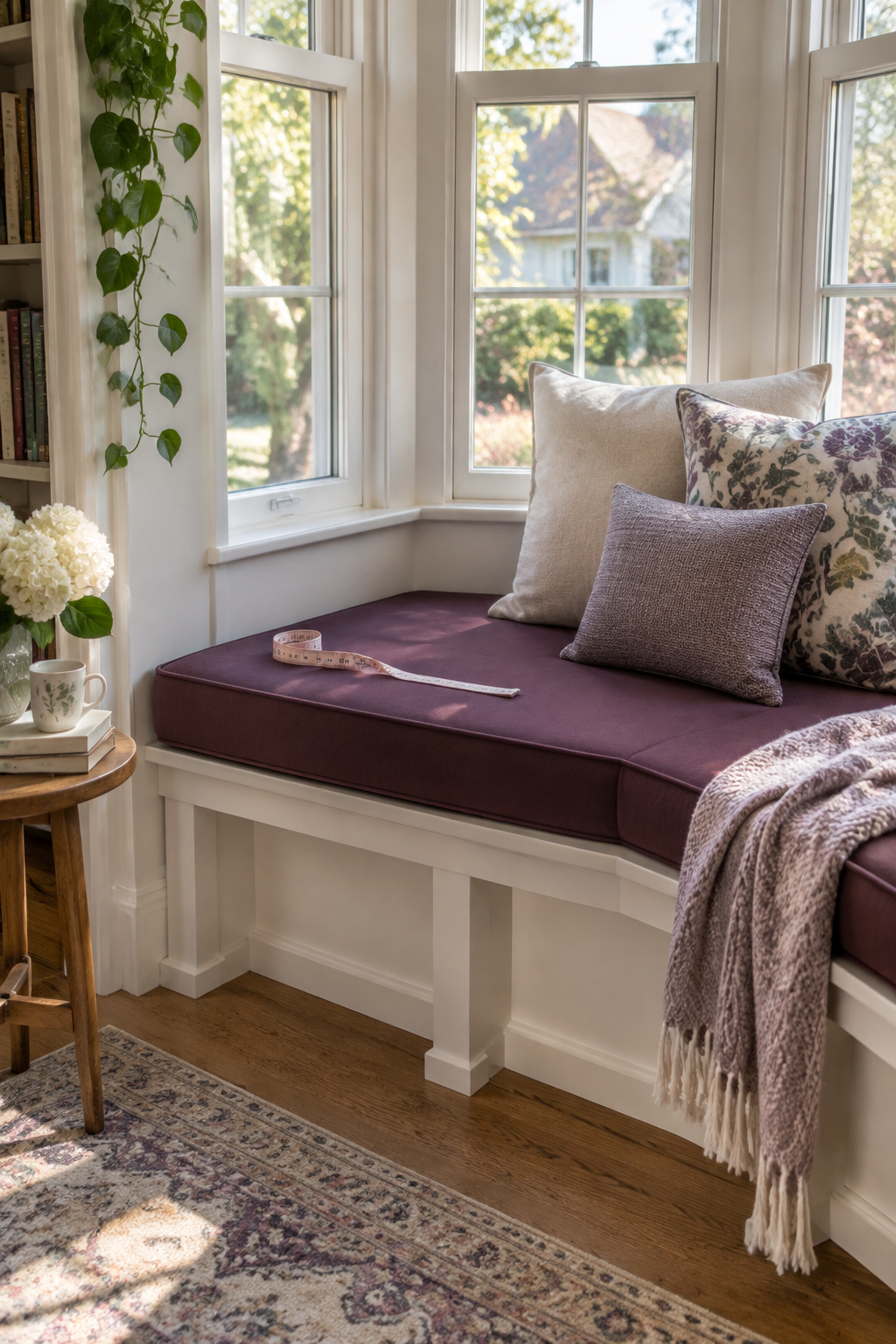
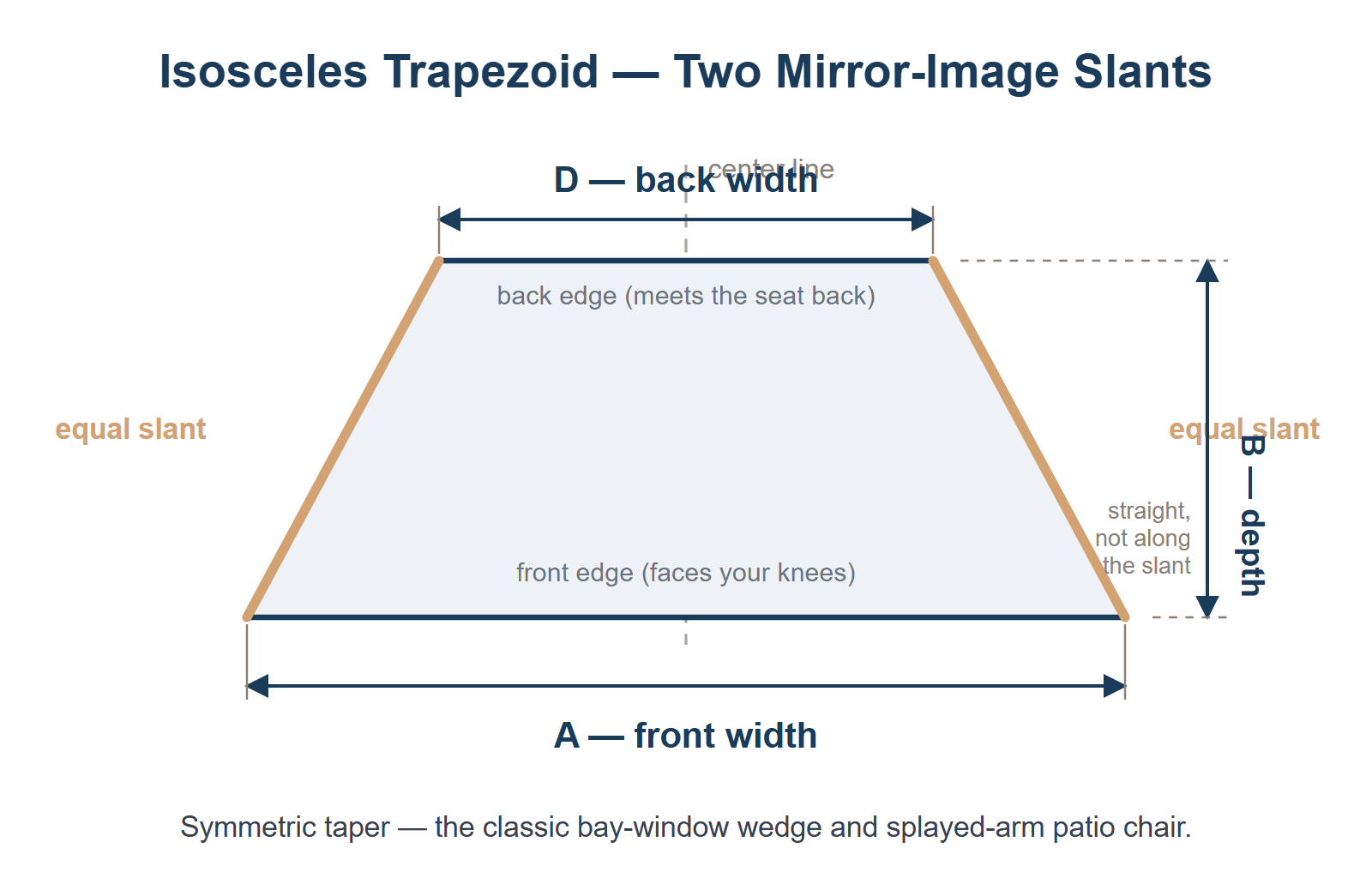
Two slanted sides that are mirror images of each other, front and back edges parallel, everything balanced around a center line. This is the shape most people picture when they hear “trapezoid”: the wedge cushion at each end of a bay window seat, the seat of a splayed-arm patio lounge chair, the tapered seat of a conversation-set corner. It is also the easiest to order, because it is fully defined by three numbers — front width, back width, depth — with no sketch required.
The Right-Angle Trapezoid — One Square Side, One Slant
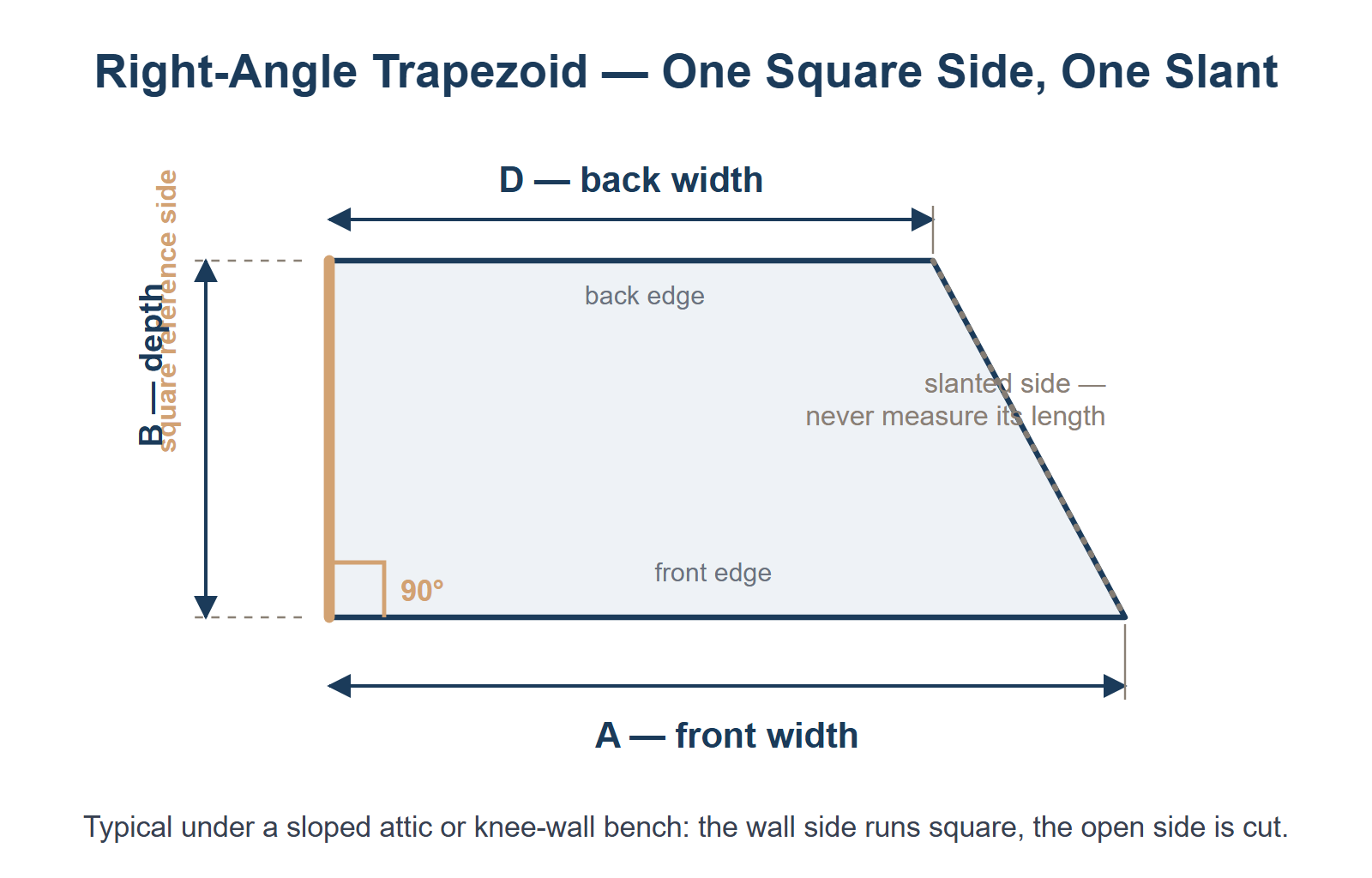
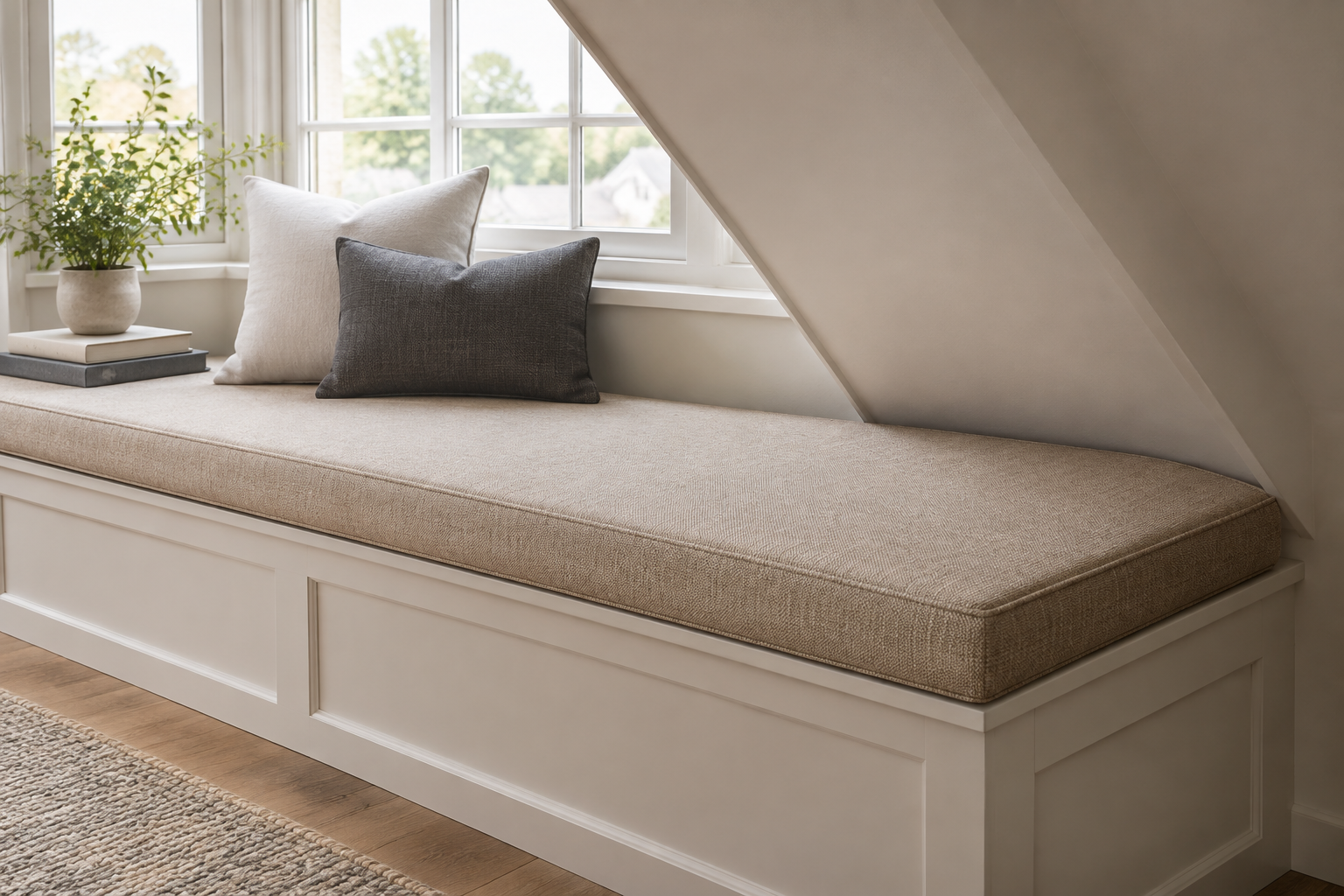
One side runs square (a true 90° to the front and back edges); the other side slants. The classic home for this shape is a bench or window seat under a sloped attic or knee-wall ceiling: the wall side runs straight down the room, and the open end is cut at whatever angle the roofline dictates. Boat settees and V-berth benches do the same thing where the hull narrows.
One from our order books: a 142-inch window-seat bench under a sloped attic roof. Most of that bench is a plain rectangle — but the right end loses a widening triangle where the roofline comes down to meet the seat, so the back edge runs a foot and change shorter than the front. Square side against the straight wall, slant where the roof decides. That is a right-angle trapezoid, and it measures exactly like the isosceles one — three numbers — with one convenience the symmetric version does not have: the square side is its own depth check, because the depth is simply the length of that side.
The Irregular Trapezoid — Both Slants Different
Front wider than back on one side, nearly straight on the other; or both sides slanted but at different angles. Seats drift into this territory when furniture ages, when walls are not plumb, when a previous owner built the bench around a radiator pipe. Two widths and a depth still describe it, but the description gets loose — the numbers can be true at every point you measured and still wrong between them. This is the bin that earns the cardboard template, in the last section.
First, Prove It Is a Trapezoid at All
Before the three forms matter, run the three-station width check from our standard measuring protocol: read the width at the front edge, at the middle, and at the back, tape level, inside arm to inside arm (or edge to edge on a frameless bench).
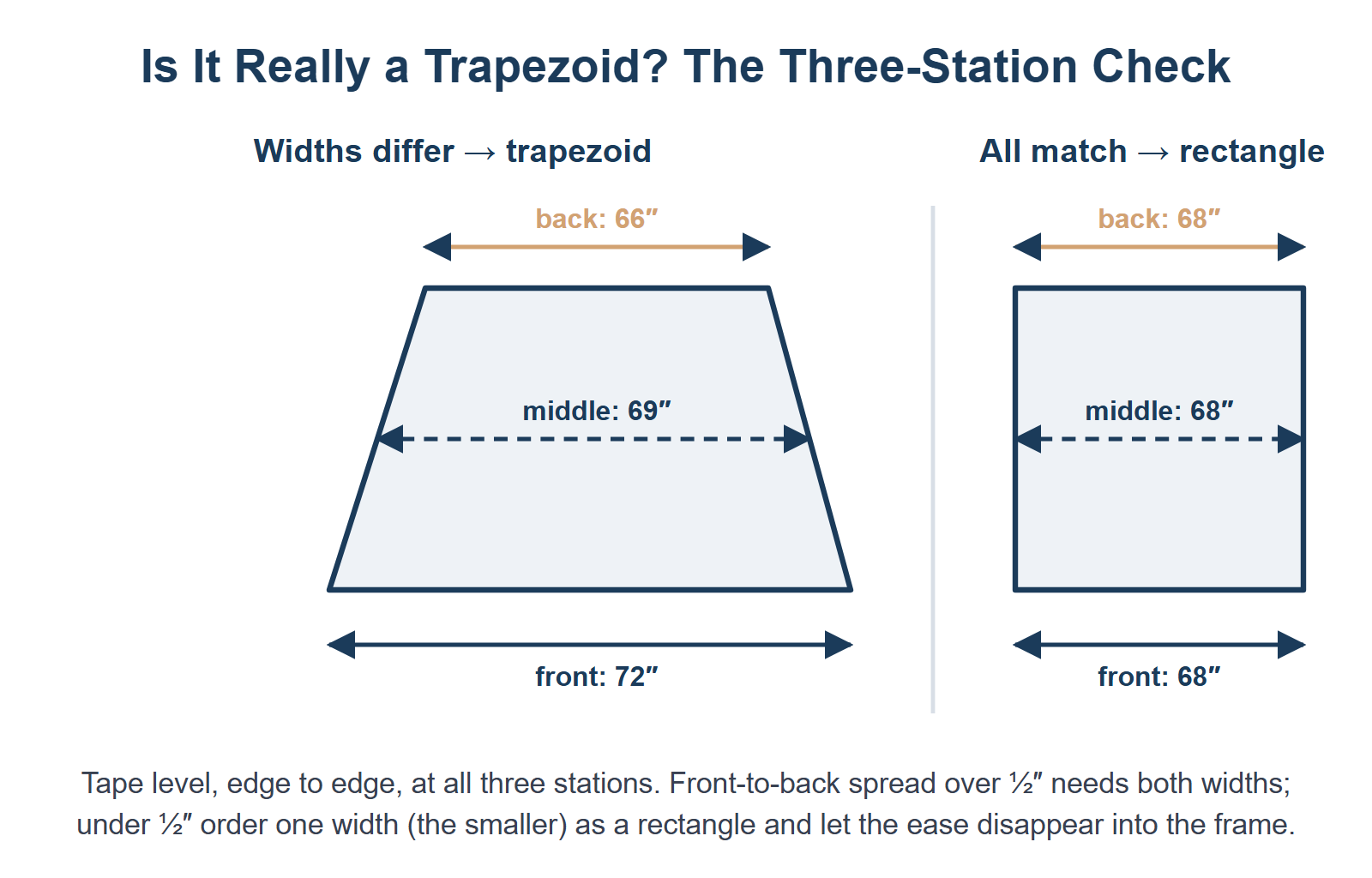
- – All three match (within ½″): rectangle. One width, done — and see how to measure a rectangle cushion for the full protocol.
- – Front and back differ, middle in between: trapezoid. Two widths, one depth — read on.
- – The spread is under ½″: order the smaller width as a rectangle and let the ease disappear into the frame. A snug cushion reads as tailored.
- – The two sides are not parallel (front and back run at an angle to each other in plan view): you have a wedge in the other axis — a bay-window corner piece — and the same two-width method still applies, but send a sketch with the angle if you have it.
Where trapezoids actually live: deep-seating patio chairs built with splayed arms (the arms rake outward, and the seat follows), bay-window window seats, attic and knee-wall benches, the angled corner sections of conversation sets, boat settees, and fan-back or barrel chairs. Our builder carries this shape as “Wedge / Tapered” — the names vary across the industry, the measurements do not: front width, back width, depth.
How to Measure an Isosceles Trapezoid
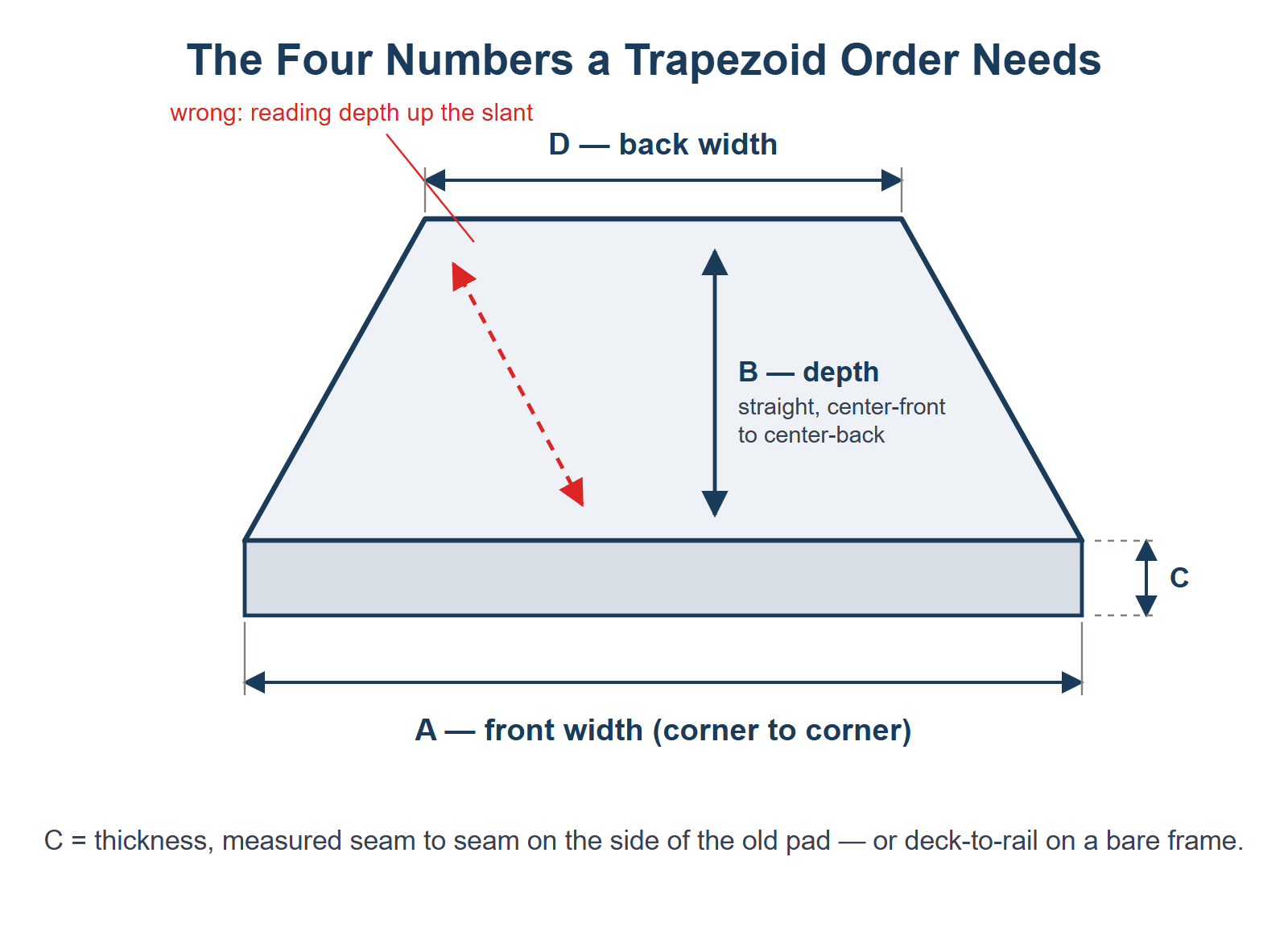
The symmetric wedge needs four numbers — A, D, B, C — and nothing else. Take them with a rigid steel tape (soft tailor’s tape bends along the seat surface and reads long), and take them on the frame whenever the frame is reachable, not on the old cushion.
| Field | Letter | What it is | Range we cut |
| Front width | A | Front edge width — the wider or narrower of the two; give the real number | 8–120″ |
| Back width | D | Back edge width | 8–120″ |
| Depth | B | Perpendicular depth, front edge to back edge, measured straight | 6–72″ |
| Thickness | C | Foam height, seam to seam | 2–8″ |
A — the front width
The front edge is the edge that faces your knees — the edge farthest from the seat back. Measure it end to end, corner to corner, along the edge itself, tape pulled taut and level. On a framed chair, that means inside-arm to inside-arm at the front, where the arms are at their widest on a splayed-arm chair. Read the number twice; on a wide bench the tape sags a quarter inch without you feeling it.
D — the back width
Same reading at the back edge, where the cushion meets the seat back or the wall. On the same splayed-arm chair, the arms are closer together back there — that is the entire reason the seat is a trapezoid. On a bay-window wedge, the back edge runs against the glass or sill; butted the tape into both corners rather than eyeballing where the wall “starts.”
Which number is bigger depends on the furniture, not on convention: patio lounge chairs usually run wider at the front (arms splay outward), while bay-window wedges and corner sections often run wider at the back against the wall. Give the real numbers in the real fields — A is always the front, D is always the back, regardless of which is larger. The builder draws what you type; it has no opinion about which end should win.
B — the depth, measured straight
This detail matters more than it sounds, and it is the single most common trapezoid error in every shop’s remake pile. The depth of a trapezoid is the perpendicular distance from the front edge to the back edge — measured from the center of the front edge to the center of the back edge, in one straight line — never along the slanted side. The slanted side of a taper always runs longer than the true depth, so a slant reading silently oversizes the cushion. If you are unsure your tape is square, check that it runs parallel to the side walls (on a symmetric seat) or parallel to the square side (on a right-angle seat) — not along either slant.
C — the thickness
Seam to seam on the old cushion stood upright, or deck-to-rail on a bare frame. Patio deep seating runs 5″; window-seat wedges 3–4″; attic benches under a low roofline often cap at 3″ so the sitter’s head clears the slope. If you are between two thicknesses on a framed chair, stack a book or two on the seat and sit on it — that is the height your body actually wants.
All four go straight into the wedge/trapezoid builder — the drawing tapers live as you type, and an A/D swap is instantly visible as a cushion that leans the wrong way against your seat.
How to Measure a Right-Angle Trapezoid
Same three numbers, with one gift built in: the square side is the reference edge. Lay the tape along it — that reading is your depth B, because a side that stands at 90° to the front and back edges cannot lie about the distance between them. On the attic bench, that is usually the wall side; on a boat settee, the side that runs straight down the hull’s flat section.
The slanted side gets exactly one job: to be ignored. Never measure its length, never type it into a depth field, never “split the difference” between it and the square side. A 24″ true depth with a 26″ slant, ordered at 26″, produces a cushion two inches too deep — under a sloped attic roof there is often nowhere for that error to hide except buckling up at the front edge. Read A and D exactly as on the symmetric seat — corner to corner, front and back — and let the drawing worry about the angle.
One more check that costs thirty seconds and saves a remake: confirm the “square” side actually is square. Old benches sag, kneewalls settle, and previous owners improvise. Hold any framing square (or a hardcover book) into the corner between the side and the front edge; if daylight shows under it, you are holding an irregular trapezoid wearing a right-angle costume — skip to the template method below.
How to Measure an Irregular Trapezoid: The Cardboard Template Method
When the two slants differ, numbers alone stop telling the whole truth — a width read at the left corner and the same width read at mid-edge can disagree by more than the ½″ tolerance, and every cutting pattern has to pick one. The fix costs a cereal box and ten minutes.
What to gather:
- – A sheet of cardboard, kraft paper, or flattened gift wrap larger than the seat (tape two pieces together for a long bench)
- – A pencil and a marker
- – A rigid steel tape
- – Scissors or a utility knife
- – A phone camera and ten minutes of daylight
The five steps:
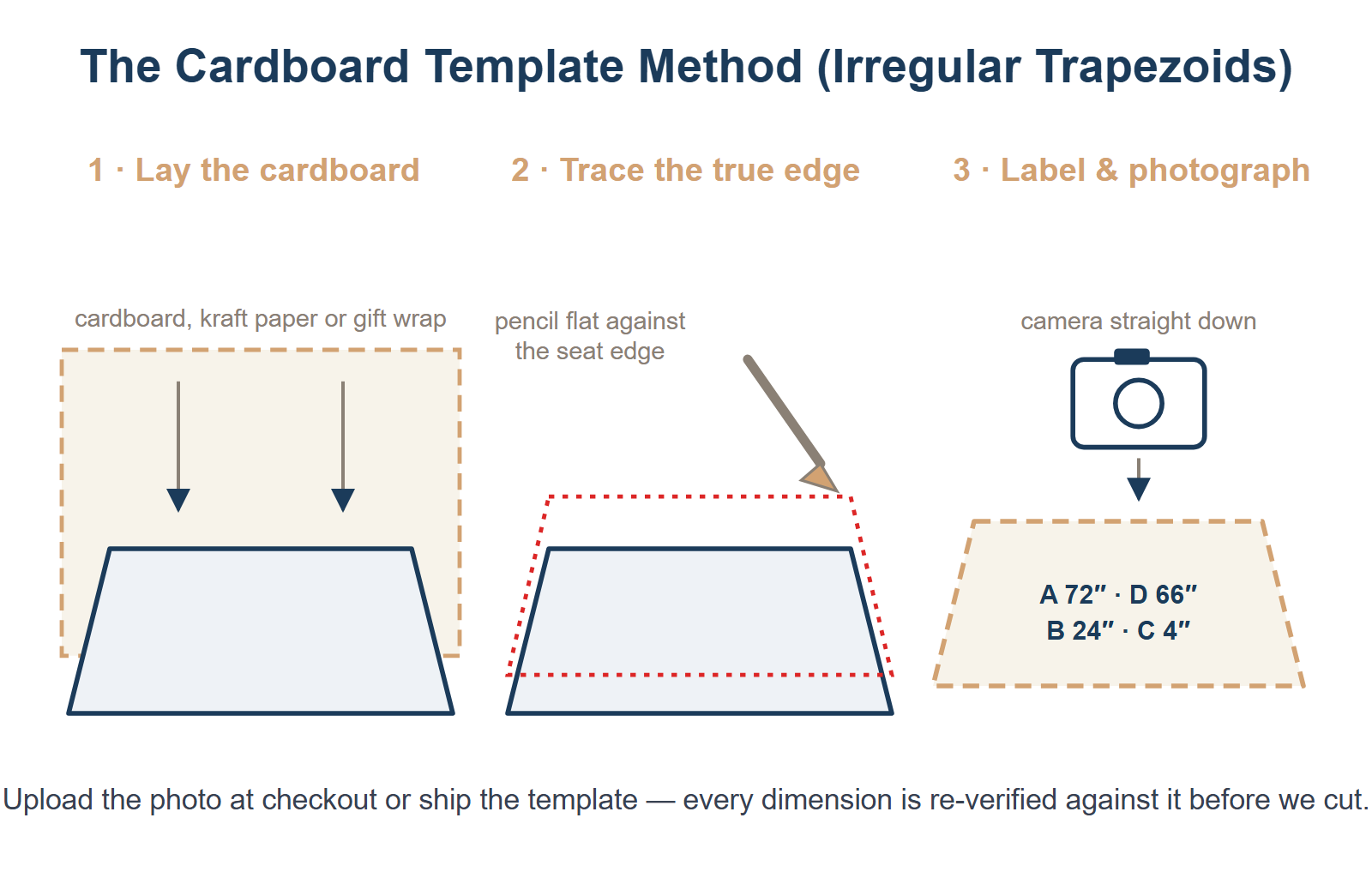
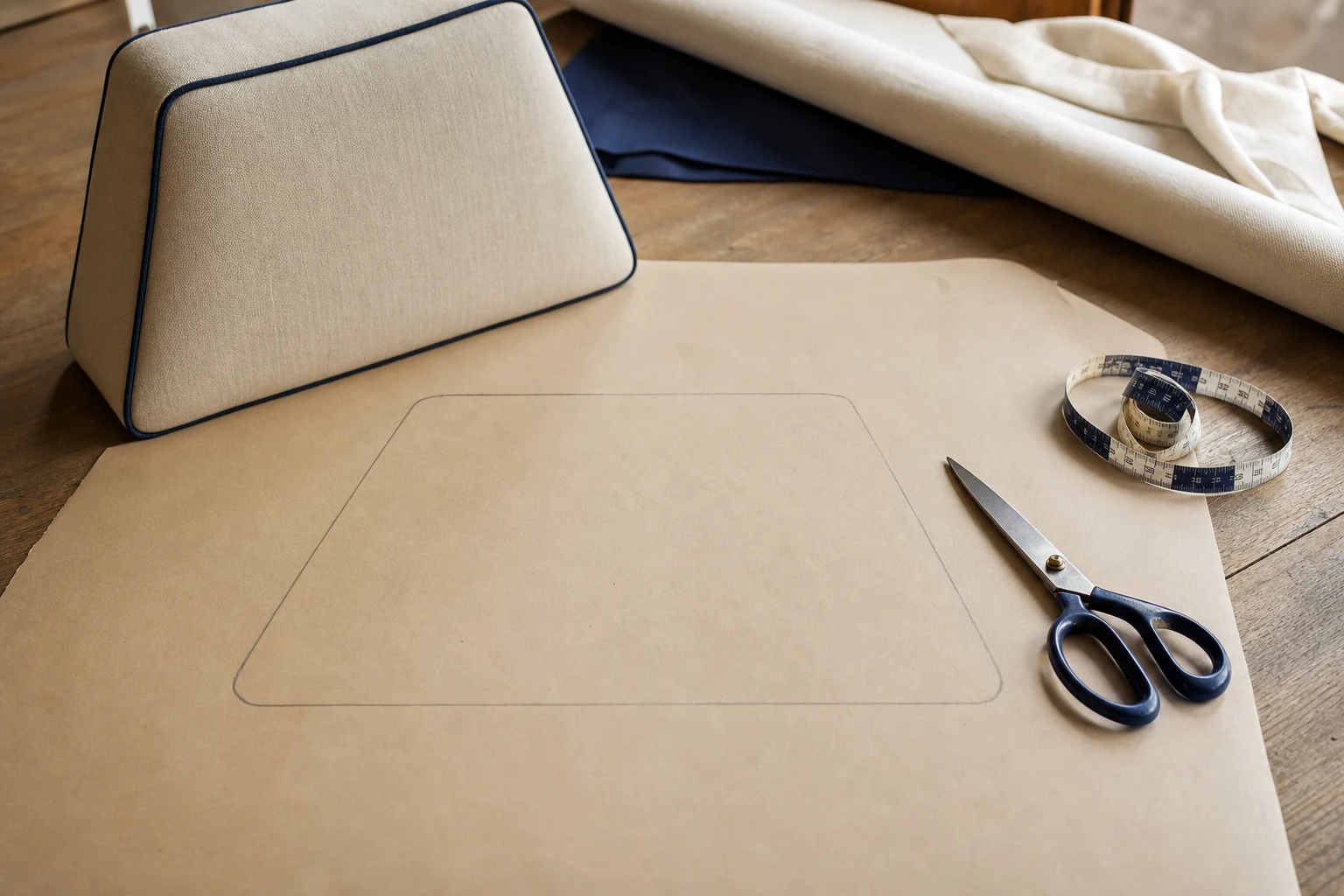
- Lay the sheet over the bare seat (old cushion off, frame exposed) and let it flop into every corner. Weight or tape it so it cannot wander.
- Trace the true edge with the pencil held flat against the seat edge — vertical pencil, tip riding the frame, not floating an inch inside it. Follow the entire outline: front edge, both slants, back edge.
- Cut along the line and dry-fit the template back on the seat. It should settle into place without forcing. Trim where it bunches; the template is allowed to be perfect, and only the template.
- Label it: mark FRONT on the front edge, write the measured A, D, B and C on the face, and initial the “this side up” surface.
- Photograph it from directly above — camera level, centered over the template, whole outline in frame, a tape or ruler laid along one edge for scale. Straight-down means straight down: a shot from the doorway distorts the slant angles more than you would guess.
- The rectangle that almost fits. The classic, and the one we see most: a 25/23 taper ordered as a 25-wide rectangle. It fits at the front and stands proud at the back, or gets shoved back and bags at the front — either way, the cushion looks like it belongs to a different chair. Two widths or nothing.
- Averaging the widths. Averaging 25 and 23 into 24 fits neither edge and gaps both. There is no field on the order form for the average, and no cutting pattern that can use it.
- Swapping front and back. A is the front because A is always the front. A swapped pair produces a mirror-tapered cushion — it will look almost right sitting on the table and wrong the moment it meets the frame.
- Measuring depth along the slant instead of straight across. On a gentle taper the difference is small; on a bay-window wedge or an attic bench it is not. The slanted side always reads longer than the true, perpendicular depth — measure front to back, straight, down the center.
- Measuring the slanted side’s length on a right-angle seat. The square side is the depth; the slant is geometry, not a dimension. If the two differ, trust the square side and ship the sketch.
- Treating an irregular seat as symmetric. One width read at one corner does not describe a seat whose slants disagree. The seat gets measured at both ends or gets a template — there is no third option that ends well.
- Copying the old cushion without checking it. Aged covers stretch wider at whichever end gets sat on. Run the three-station check on the frame if it is reachable; the old-cushion protocol (seam to seam, flat, unstretched) covers the rest, as we break down in cushion measurement mistakes.
- Run the three-station width check — front, middle, back — and record both widths plus the straight (perpendicular) depth to the nearest quarter inch.
- Enter A, D, B and C in the wedge/trapezoid builder and check the live drawing against your seat from above. For bay-window shapes, start from the bay window cushion page; for the round and T-shaped cousins, see how to measure an oval cushion and how to measure a T-cushion.
- Attach an overhead photo (or ship the template) at checkout — every dimension is re-verified before cutting, and production runs 4–7 business days (rush 3–5).
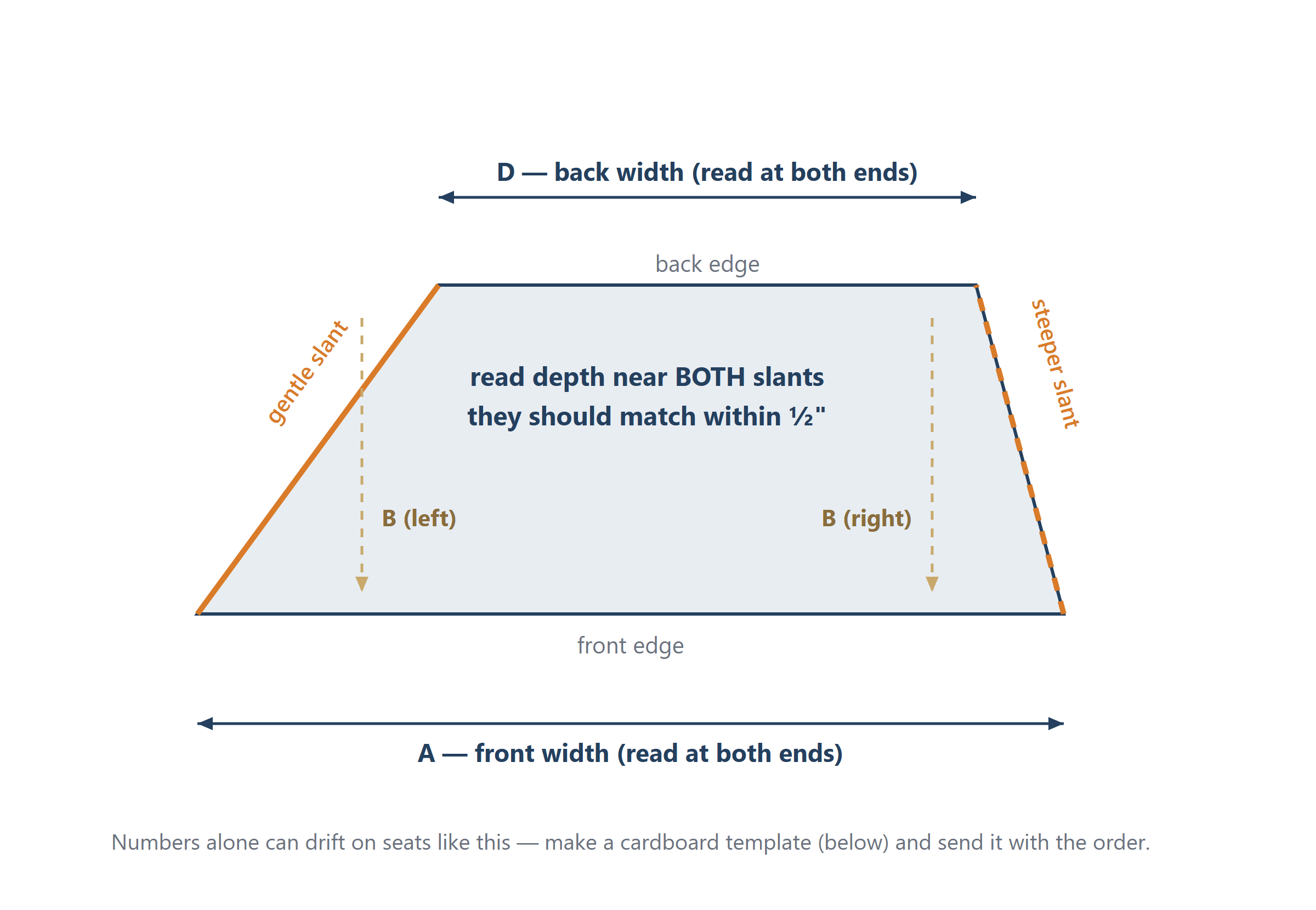
Upload that photo at checkout, or ship us the template itself with your order number — either works, and every dimension gets re-verified against it before anything is cut. While you are at it, run the two-point cross-check: read the front width and the back width each at both ends (left side and right side of the seat). On a true irregular seat the pairs disagree; the template absorbs the disagreement, and the two readings tell us which way and by how much.
The Traps That Cause Trapezoid Remakes
Real Trapezoid Dimensions from Our Database
Trapezoids are not exotic in the Home Depot patio world — Hampton Bay and Martha Stewart sets alike take tapered seat cushions, verified piece by piece from aftermarket supplier dimensions. The best-documented example is the Miramar, a Martha Stewart collection:
| Series | Piece | Front width | Back width | Depth | Thickness |
| Miramar (Martha Stewart) | Lounge chair seat | 25″ | 23″ | 25″ | 5″ |
| Miramar (Martha Stewart) | Loveseat seat | 49″ | 46″ | 25″ | 5″ |
| Miramar (Martha Stewart) | Lounge chair back | 25″ (top) | 23″ (bottom) | 21″ (high) | 5″ |
Two things the chart teaches. First, the taper is real but modest on these sets — two to three inches front to back — which is exactly the range where the eye says “close enough to a rectangle” and the frame says no: a 25-inch-wide rectangle on a 23-inch back width leaves an inch of cushion standing past the frame on each side, visible from across the patio. Second, the back cushion tapers too — 25 at top, 23 at bottom on the Miramar (series page) — so a full piece set means measuring both pieces as trapezoids, not just the seat. Every piece gets its own line on the order, the same rule we enforce in how to measure outdoor cushions.
On the indoor side, the 142-inch attic bench from earlier is the cautionary twin: the customer’s first read came back “rectangle, 142 by 24” because the sloped-end loss hid behind a reading taken only at the square side. The three-station check caught it — the middle and back stations came up short by growing amounts toward the right end — and the bench went into production as a right-angle trapezoid with the roofline’s angle confirmed from an overhead photo. For bay-window corners: the wedges at the ends of a bay typically follow the bay’s angle — usually 30°, 45° or 60°. Measure the two widths and the depth as above, note the angle if you know it, and photograph the bay from above; the order desk confirms wedge orders against the sketch before anything is cut.
What Does a Trapezoid Cushion Cost?
Custom cushions start at a $45 make-base plus material at per-square-foot foam and fabric rates, and every shape prices at a simple footprint rule — the trapezoid prices at its front width times the depth, at the same shape factor as any rectangle. The taper is a cutting detail, not a surcharge, and neither is the right-angle or irregular version: a template order cuts on the same floor at the same rates. Fabric runs a flat $7.43 per square foot (all 119 fabrics), and the custom cushion builder prices your wedge live as you enter A, D and B. Production runs 4–7 business days, with rush service at 3–5.
FAQs
How much front-to-back difference makes it a trapezoid?
Anything over 1/2 inch needs both widths. Under that, order the smaller width and let the half inch of ease disappear into the frame — a snug cushion reads as tailored, as our sewing floor puts it.
Do I measure the old cushion or the frame for the two widths?
The frame whenever it is reachable — inside arm to inside arm at the front, then again at the back. Old cushions stretch unevenly and the taper drifts with age.
What if the back is wider than the front?
That is normal for bay-window wedges and corner sections. Enter the real front width in A and the real back width in D — the builder handles either direction.
Can you match a specific bay-window angle like 45 degrees?
Yes. Widths, depth and a noted angle (30°/45°/60° are the usual bays) fully define the wedge; an overhead photo with the order removes any doubt, and the order desk confirms before cutting.
Should I send a cardboard template even for a symmetric trapezoid?
Not necessary — three clean numbers fully define the symmetric and right-angle forms. Templates earn their shipping cost on irregular seats, seats with wandering walls, and any bench where the two ends of the same edge disagree by more than ½″.
Is a tapered cushion more expensive than a rectangle?
Same rates, same shape factor — it prices at its front width times the depth, like every shape we cut at its footprint. No taper surcharge, in either direction.
Next Steps
What Size Bed Gap Filler Do I Need? Thickness, Length and Density
Size a bed gap filler from three measurements, not the bed’s name: thickness equals gap width plus half an inch to one, length runs the full seam, height runs platform to mattress top. Density starts at 50D.
Cushion Thickness & Seat Height: Match the Pad to the Table
Cushion specs usually answer comfort questions. Thickness answers a geometry question: how high off the floor you end up sitting,

Church Pew Cushion Sizes: Standard Dimensions and How to Measure
Standard pew seats run 19-21 inches deep; cushions are cut 2-3 inches thick to measured runs at plus-or-minus half inch tolerance. Dimensions table, taper rules, and the pew-by-pew measuring method.
Chaise Lounge Cushion Measurements: A Complete Guide to Getting the Fit Right
How to measure a chaise lounge cushion correctly — seat depth, back height, thickness, hinge points and one-piece vs two-piece styles — with real Hampton Bay chaise dimensions.
How to Measure Rocking Chair Cushions: Seats, Backs and Tie Positions
How to measure rocking chair cushions — tapered seats, curved backs, slat-gap tie maps and rock clearance — with the three-number protocol for both pieces of a rocker set.
Window Seat Cushion Measurement: How to Get a Perfect Fit
Measure a window seat cushion correctly — width across alcoves, depth front to back, thickness vs sill height, radius corners and bay window angles — with tips from the cutting floor.