
The mudroom bench is where the outdoors is processed: wet coats dropped, boots pulled off, dogs toweled, school bags landed. Its cushion takes more abuse in a week than a living-room cushion takes in a year — moisture, grit, pet claws, and full-weight sits by people in motion — yet most mudroom pads are bought as an afterthought, a decorative pad that looks right for one winter and is gray forever after. This guide is the duty-spec approach: what the mudroom actually does to a cushion, and the fill, fabric, and fastening choices that survive it. The general bench sizing background is in indoor bench cushions; the moisture-management logic borrows from the outdoor playbook in how to prevent mold on outdoor cushions.
What the Mudroom Does to a Cushion
Four damage channels, all daily:
- Moisture. Wet coats, snow pants, rain-soaked bags — the pad absorbs at the surface and, with standard indoor fill, holds the water in the foam core. That is the mold-and-mildew path, identical to the outdoor-cushion failure mode covered in prevent mold on outdoor cushions.
- Grit. Boot grit rides in on every coat hem and works into the weave, abrading fibers from the inside — the reason mudroom pads wear thin at the coat-drop zone specifically.
- Pet traffic. Claws at the bench edge, the dog’s spot claimed at the sunny end. The claw-resistance hierarchy (tight weaves resist, loose weaves and loops invite) is laid out in dog friendly outdoor fabric.
- Impact sits. People sit down on a mudroom bench the way they sit down nowhere else — hard, in motion, often leaning to pull a boot. The foam takes spike loads, not settled loads.
The spec answers each channel directly.
Fill: Quick-Dry Logic Indoors
The single best mudroom decision is treating the fill like outdoor fill:
- – Quick-dry open-cell foam — the reticulated fill sold for outdoor cushions — drains and air-dries instead of holding water. A mudroom pad built on quick-dry foam shrugs off the wet-coat season that ruins standard indoor foam. The full case for the material is in quick dry foam for outdoor cushions; nothing about the argument changes indoors.
- – If quick-dry isn’t available for your build, density is the fallback. A 50D-class core at 3 inches survives the impact sits and resists the compression set that moisture accelerates — the density logic is in how to choose foam density.
- – Fiber-only pads are the wrong tool. Fiber holds moisture longest of any fill and compresses under impact sits fastest — the double failure. The fill landscape and where fiber belongs is in cushion filling types.
- – Thickness: 2–3 inches. Mudroom sits are short (boots on, boots off); the pad’s job is durable comfort, not lounge depth.
Fabric: The Outdoor Tier, Indoors
The honest answer is that mudroom duty is outdoor duty, and the fabric should be graded that way:
- – Solution-dyed acrylic (the Sunbrella family) is the over-spec that is actually right: fade-proof if the mudroom has a door to the light, bleach-tolerant for the deep clean, and the tightest color-fastness in the business. Whether the premium pencils out is argued in is Sunbrella worth it — in a mudroom, the answer is more often yes than anywhere else indoors.
- – Heavy indoor weaves — cotton linen blends, chenilles — serve lighter-duty mudrooms (the contained entry, no pets). Choose the tightest weave available; the tier framework is in best outdoor cushion fabric.
- – Color: dark mid-tones or patterns, deliberately. The mudroom pad lives in the interval between cleanings; a patterned weave hides grit-wear and water marks that a pale solid wears as a permanent record. The hide-the-wear logic is in choosing cushion colors.
Cleaning follows the fabric grade: mild soap, water, and a brush at the weave, done weekly in the wet season rather than at visible-dirt time — the full routine is in how to clean outdoor cushions, and it applies to sewn-closure pads exactly as built.
Fastening: Ties Beat Grip in the Wet
The mudroom twist on the anti-slip question is moisture: grip backings lose traction on a damp bench top, and mudroom tops are damp half the year. So the ranking flips from the general indoor one:
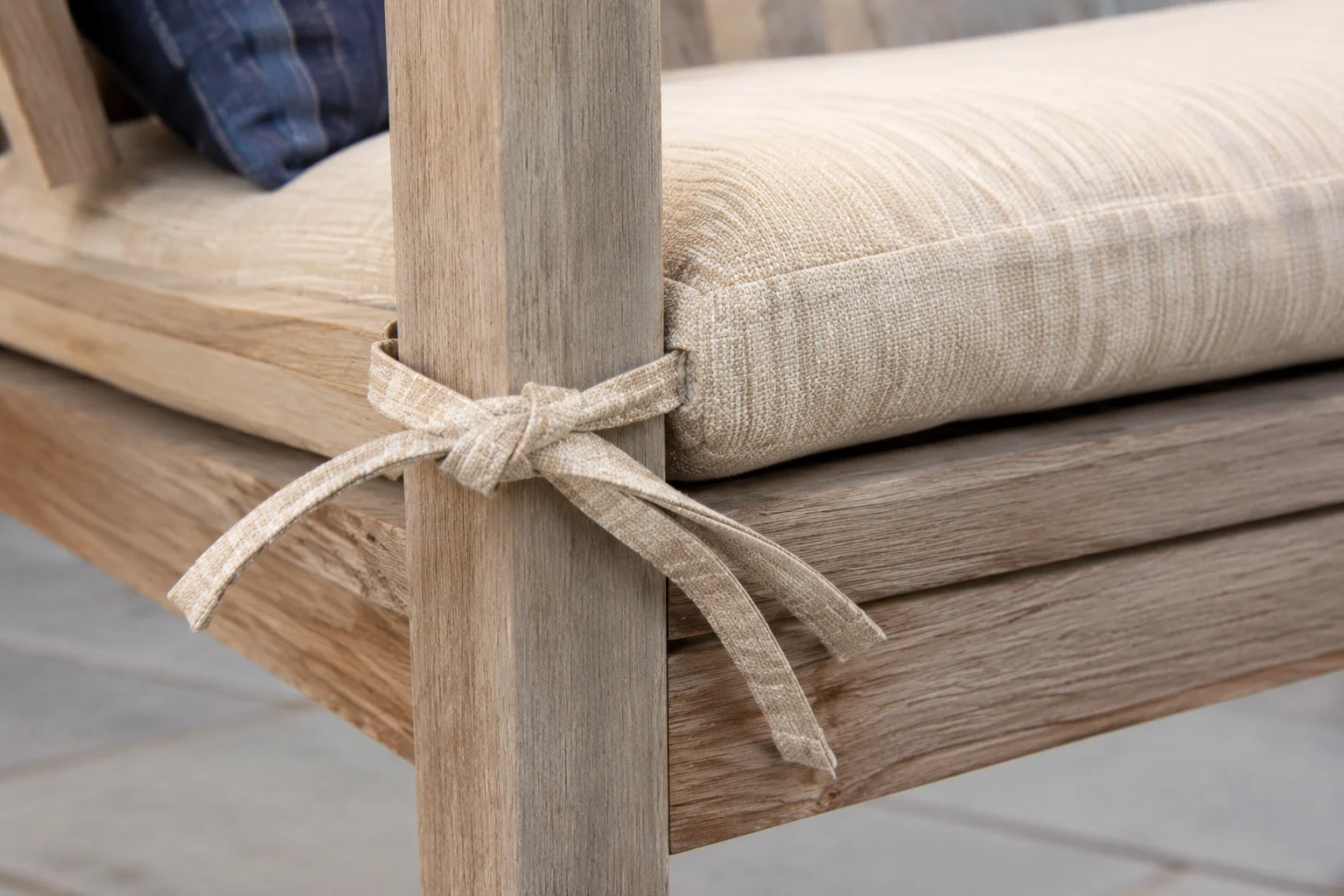
- Ties, anchored at the bench’s end panels or frame bars. Positive mechanical attachment — unaffected by water, and the pad stays put through the boot-pull lean.
- Grip underside as the secondary layer. Still useful for the dry season and for pads on storage lids that shouldn’t have ties flopping into the storage. A non-slip bottom layer is standard practice on mudroom pads.
- Hook-and-loop. The industrial answer for fixed benches — mudroom benches rarely move, and loop strips on the bench hold the pad through everything short of the dog’s full commitment.
The general mechanics are in how to stop cushions from sliding.
The Storage-Lid Reality
Most mudroom benches are storage boxes — the pad sits on a lid that opens daily for the shoe stash. The lid changes the spec the same way it does in bay window and banquette builds:
- – Size to the lid’s footprint exactly. An overhanging pad jams the lid; an underhung pad looks wrong and catches grit at the gap.
- – Keep the build light. 2–3 inches, drainage-minded fill (our build: high-density core under wipe-clean fabric; reticulated quick-dry is a specialist buy we do not carry), and if the lid is opened many times a day, mention it — the hinge-leverage consideration caps sensible thickness.
- – Rounded front corners as a spec: the mudroom is a walk-by space, and square pad corners at thigh height are the household’s bruise generator.
Sizing and Ordering
Mudroom benches run 30–48 inches typically, with lid footprints that follow the cabinetry, not furniture standards — measure the seat board or lid edge to edge (bench cushion measurements for the routine) and order to the number. The route for the full duty spec:
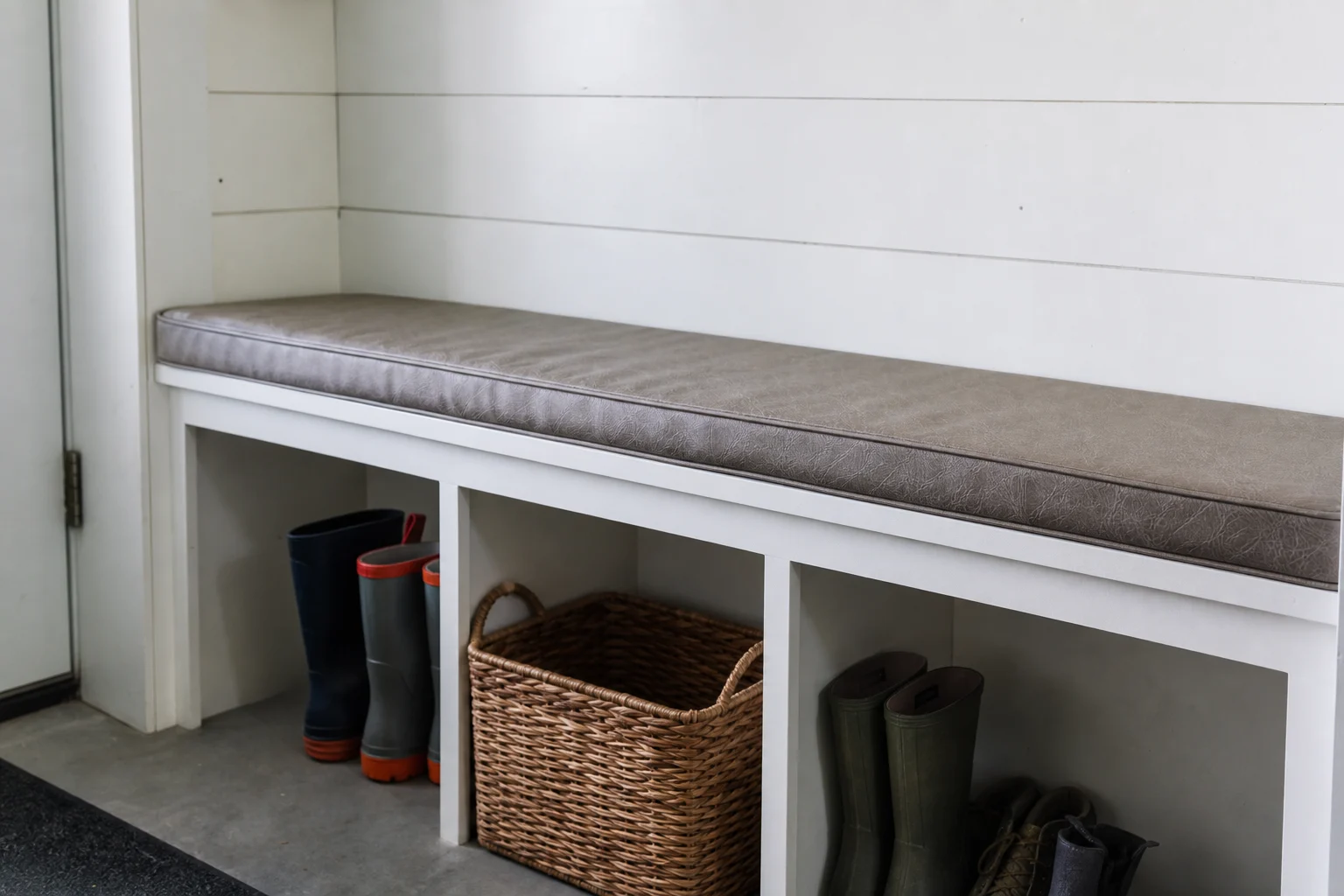
- Measure the lid or seat board; note tie anchor points and whether the lid opens (and how often).
- Set the build: 50D core under wipe-clean outdoor-grade fabric (we do not carry a reticulated/quick-dry core), 2–3 inches, in a hide-the-wear color.
- Order at custom indoor bench cushions — dimensions, fill and fabric in one specification; pricing from a $45 make-base plus per-square-foot foam and fabric rates, 4–7 business days, dimensions confirmed before cutting.
One mudroom-specific habit worth adopting from the outdoor world: stand the pad on its edge to dry after the soggiest days — the drainage habit that ends waterlogged cushions is in how to drain waterlogged cushions, and it works identically four feet from the back door.
The Two-Pad Rotation: The Mudroom Trick Worth Copying
Households that keep mudroom benches for a decade tend to share one habit: two pads in rotation, alternating monthly. The economics and the hygiene both work:
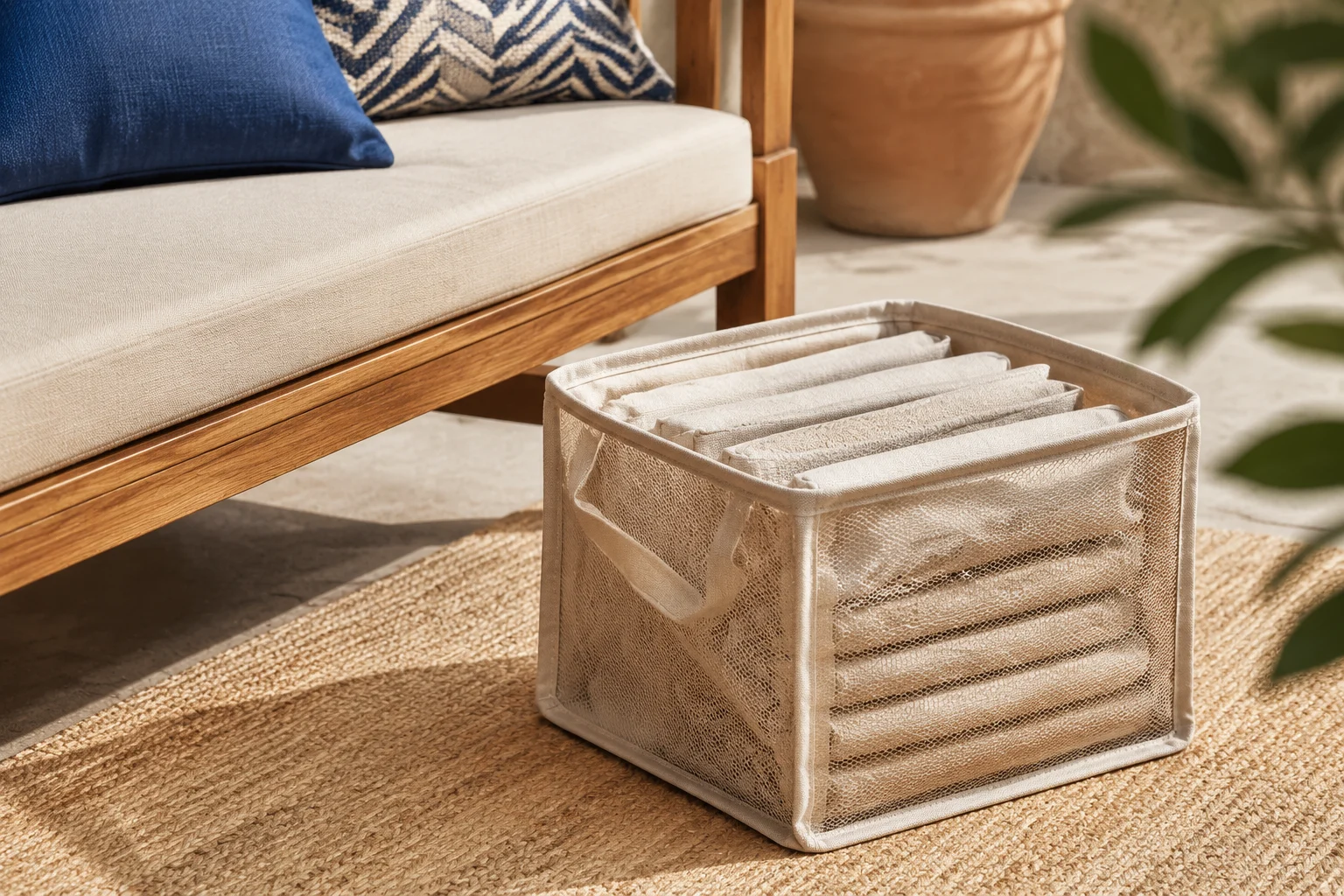
- – Each pad lives half the time. The wet-coat season that wears one pad continuously wears two pads in alternation — the same halving of duty cycles that makes the seasonal cover rotation worthwhile in kitchens (kitchen chair cushions covers the logic). Two pads age at half speed each, and the pair outlasts two sequential singles by a wide margin.
- – The off-duty pad dries completely. The moisture that survives spot-cleaning gets a full month of dry storage to leave the fill — which is the difference between a pad that smells like nothing in year five and a pad that smells like the mudroom in year two. It is the indoor version of the dry-storage habit in how to store outdoor cushions for winter.
- – The rotation catches damage early. Pulling a pad for its off month forces the inspection nobody otherwise performs: the tie about to fray through, the seam opening at the corner, the lid hinge loosening underneath. Small repairs at rotation time are minutes; the same failures found mid-January mean a bare bench for weeks.
The two-pad build is exactly the kind of thing custom ordering makes easy: two identical pads in one specification, same fabric lot, at the small incremental cost of one extra piece on a small order.
FAQs
What fabric is best for a mudroom bench cushion?
Solution-dyed acrylic — the outdoor grade — in a dark mid-tone or pattern. Mudroom duty is outdoor duty (wet, gritty, pet-clawed); the tier logic is in best outdoor cushion fabric.
Should a mudroom cushion use outdoor foam?
Yes — quick-dry open-cell foam is the single best mudroom choice. It drains and dries instead of holding wet-coat moisture into the mold zone; the case is in quick dry foam for outdoor cushions.
How do I keep a mudroom cushion from sliding?
Ties — mechanical attachment that water doesn’t defeat. Grip backing loses traction on damp bench tops; ties hold through the boot-pull lean. The full ranking is in how to stop cushions from sliding.
How thick should a mudroom bench pad be?
2–3 inches. Mudroom sits are short; the pad’s job is durable comfort, and a light build also suits daily-opening storage lids.
How do I stop a mudroom cushion from smelling?
Dry it fast — stand it on edge after wet days, and clean weekly in the season. Moisture held in fill is the odor path; quick-dry fill plus the drainage habit breaks it (how to drain waterlogged cushions).
Can I put a decorative pad on a mudroom bench?
Only if you accept replacing it — the duty kills decorative-grade builds within a season or two. Spec the mudroom like the outdoors and the pad lasts years instead.
Next Steps
- Measure the lid or seat board edge to edge, note tie points and lid-opening frequency, and record the front-corner radius on your sketch.
- Set the duty build: 50D core under wipe-clean outdoor-grade fabric, in a hide-the-wear color — ties added after-market as the primary fastener.
- Order the pad at custom indoor bench cushions — fill and fabric specified in one flow, confirmed before cutting, 4–7 business days.
Patio Chair Cushions: The Complete Buying Guide (Outdoor Too)
Everything that decides a patio or outdoor chair cushion — sizes, thickness, ties, fabric tiers and where each buying route wins. Custom from $45 when grids fail.
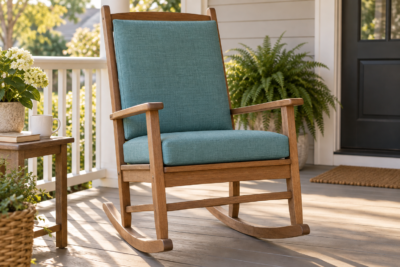
Outdoor Rocking Chair Cushions: The Weatherproof Guide to Sizes and Fabrics
An indoor rocking cushion dies fast on a porch. The sun bleaches the print in a single season, the foam
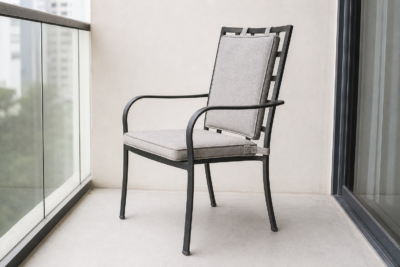
Cushions for Metal Patio Chairs: Frame Types, Grip and the Heat Question
Cushions for metal patio chairs guide: wrought iron, aluminum and steel frames and what each means for pads, sliding on slick metal, heat absorption in sun, sizing across mixed metal sets, and the outdoor duty spec.
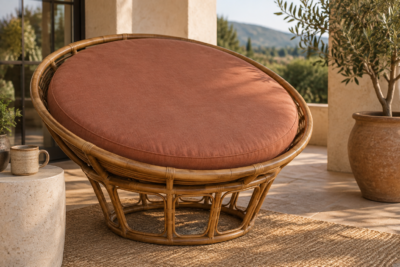
Outdoor Papasan Cushions: Weathering the Big Round
Outdoor papasan cushions fail in a known order — fabric, fill, bowl. The overhang-vs-inset diameter decision, fiber vs foam outdoors, and the honest line between a flat round and the concave original.
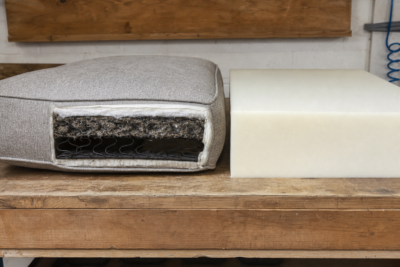
High Density Foam Couch Guide: What Density Actually Means
What high density foam actually means for a couch — the ×10 density convention, density vs firmness (ILD), the 35D–65D grades ranked by use, how each grade fails, and what density costs per square foot.
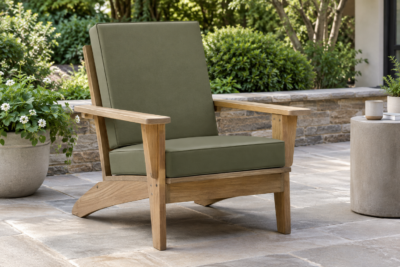
Adirondack Chair Cushions: Sizes, Selection & Replacement Guide
Adirondack cushion sizes decoded: 20×20 seats, tall-back options, tie patterns, best fabrics — plus fitting odd or vintage chairs.