
The shape of your stool’s seat deck decides the shape of your cushion — round decks only take round cushions, square decks only take square, and the backrest decision comes second. Measure the deck before you shop, because stock sizes step in one-inch jumps and the tolerance between “fits” and “slides around” is about half an inch.
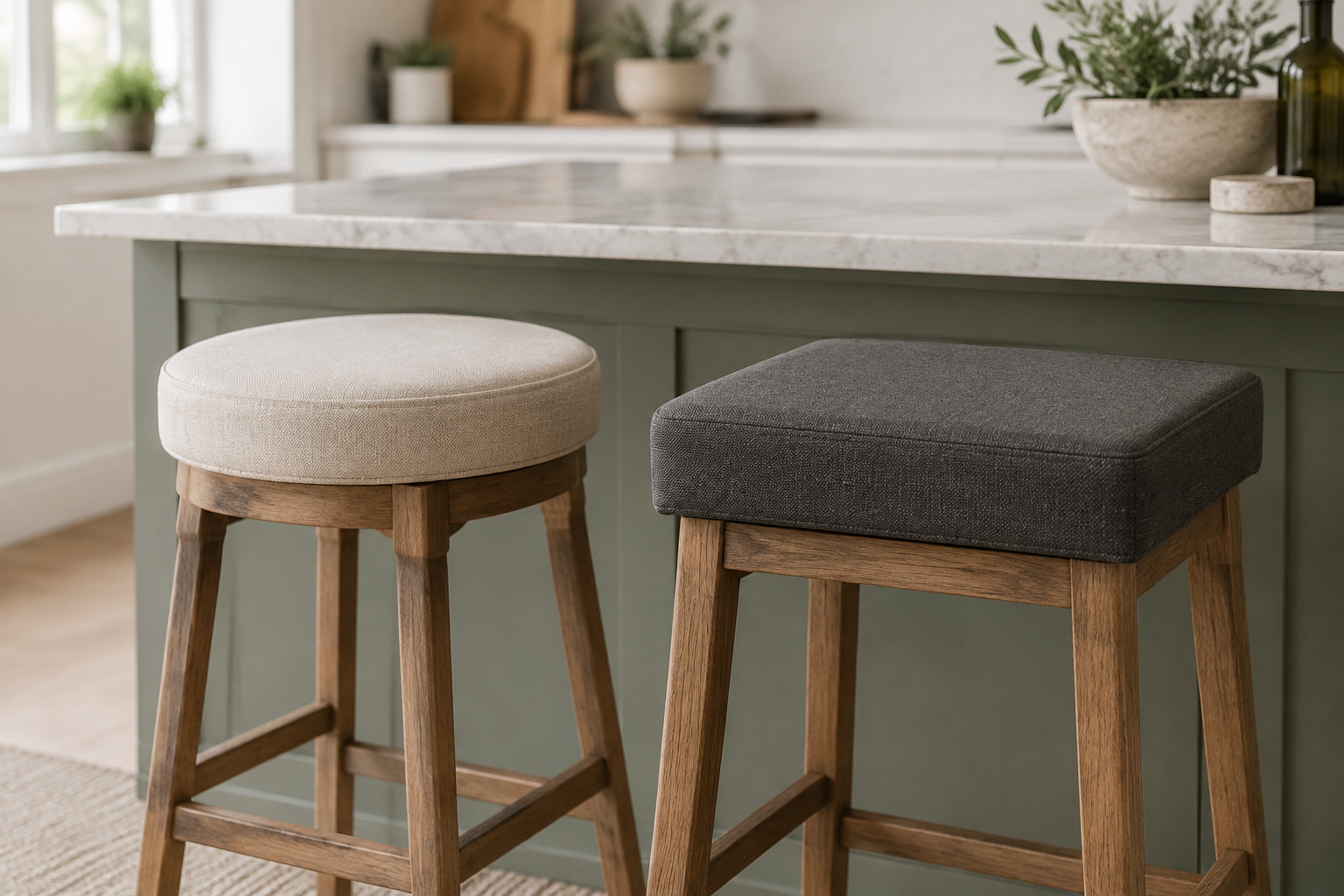
This guide covers the three stool-top shapes you will meet at a kitchen island or bar, the stock size ladder for round and square cushions and where it fails, what a backrest cushion changes, the foam that survives daily stool duty, and the replacement math when an old pad flattens out. For the full measuring walkthrough, see how to measure bar stool cushions; this page is the shape-and-size decision that comes first.
Start With the Deck: Your Stool Is Telling You the Shape
Cushion shape is not a style choice. It is a fit choice, and the seat deck has already made it:
- Round decks — classic turned-wood stools, most swivel tops, pub-style stools. The cushion must be a circle, sized by one number: diameter.
- Square decks — farmhouse and industrial stools, Tolix-style metal seats, most backless counter stools. The cushion is a square, sized by width and depth, which on a true square are the same.
- Rectangular decks — saddle-seat stools, tractor-seat stools, some Tolix reproductions and upholstered-top stools. The cushion is a rectangle, and here width and depth are two different measurements that both matter.
Two minutes with a tape measure settles it: measure the widest point of the deck across, then front-to-back. Same number twice means square or round; different numbers mean rectangle. If the deck has rounded corners on a square outline, note that too — it changes the corner treatment, and we come back to it below.
Round Bar Stool Cushions: One Number Decides Everything
A round bar stool cushion is the simplest product in the cushion world: one diameter, one thickness, done. That simplicity is also its trap.
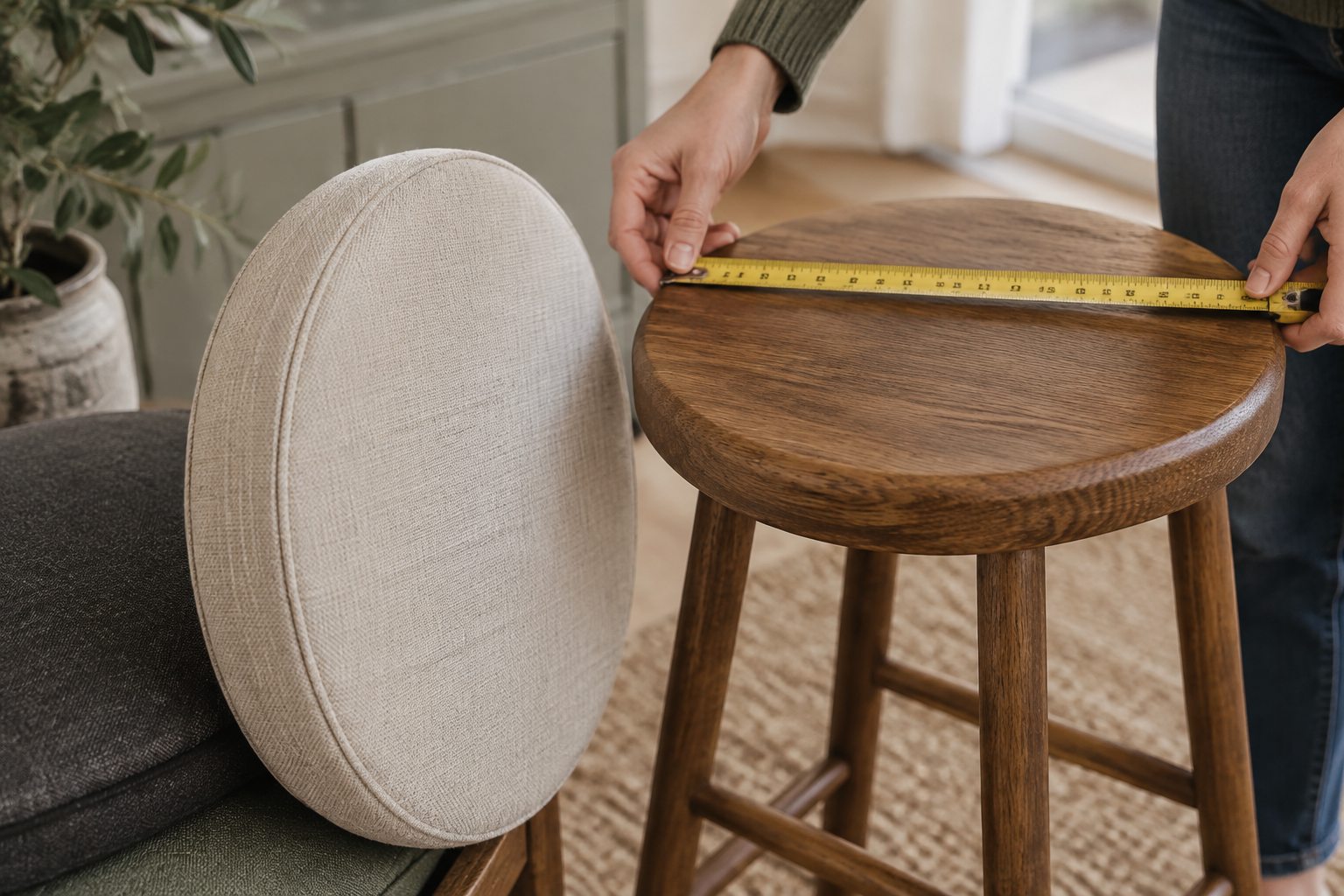
Stock round pads step in whole inches — 12, 13, 14, 15 — while real stools do not. A stool deck measuring 13¼ inches sits between stock sizes, and either choice shows: the 13-inch pad leaves a visible ring of bare deck and drifts off-center, while the 14-inch pad overhangs the edge and rolls under your legs. On a flat deck, a quarter inch of slop reads as “wrong cushion” within a week.
Round cushions also concentrate their wear in the center. A stool cushion gets climbed on and spun off daily, and on a small circle there is no edge territory to rotate into — the foam directly under the sit bones takes every landing. That is a density question, and what goes inside matters more here than on any dining chair.
Diameter, thickness, one tie pattern decision (covered in the measuring guide) — a round cushion ordered to your measured diameter instead of a stock size is the cleanest custom order in the catalog, which is why custom bar stool cushions carry so many round specs.
Square Bar Stool Cushions: When “Square” Isn’t
Square decks sound easier, and mostly are — with two catches.
First, measured squares are rarely square. A “14-inch” farmhouse stool usually measures 13⅞ by 14¼ once you get a tape on the deck, because wood seats are cut, sanded and finished by hand in quantity. The number printed on the box, when there is one, is nominal. Measure both directions and order to the smaller one if you want the pad to sit inside the edge, or to the larger one if you want full coverage — but decide deliberately, because the half-inch band between them is where square pads go wrong.
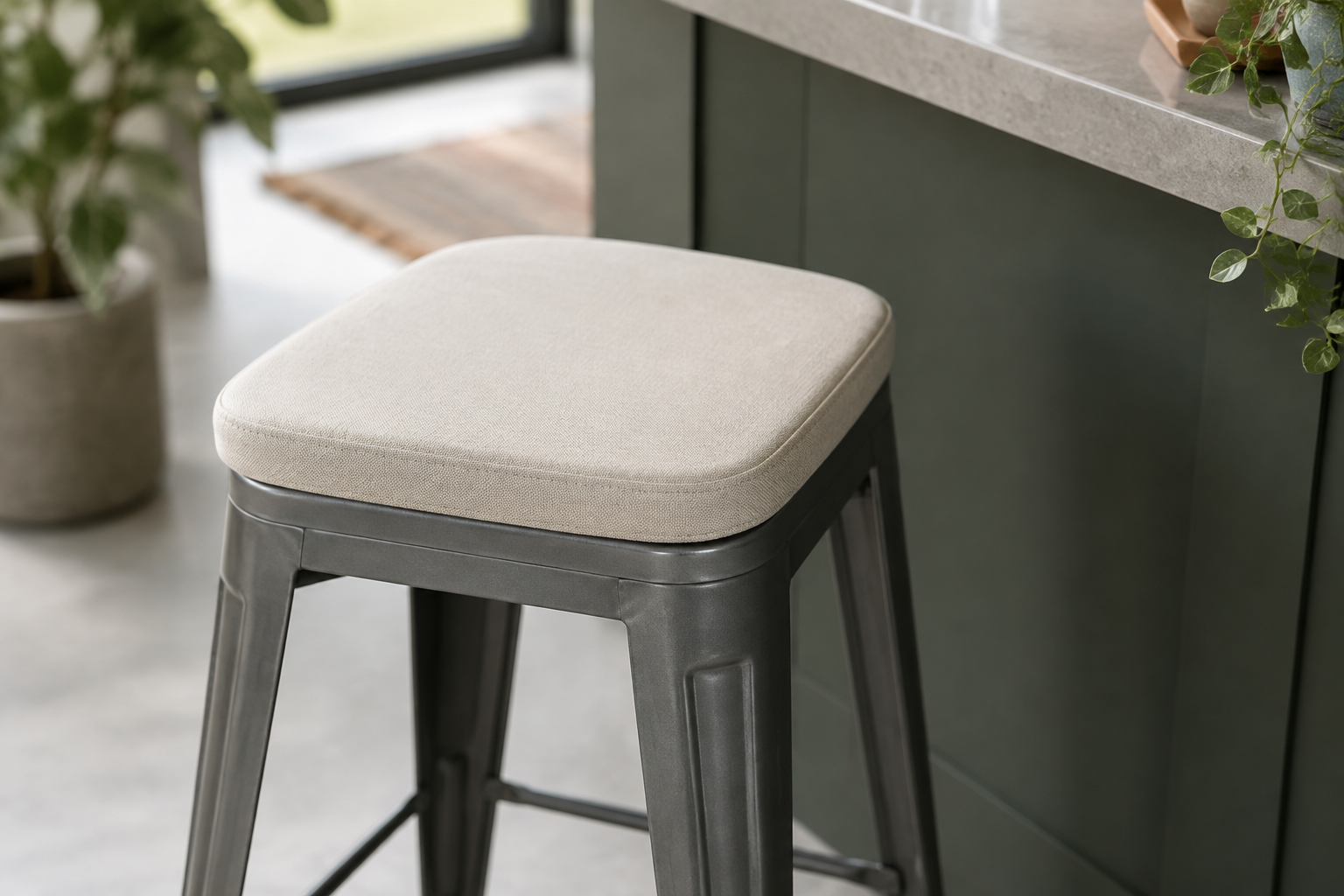
Second, rounded corners. Many square decks — especially metal Tolix-style seats — have corners knocked back anywhere from a shallow chamfer to a genuine 1–2 inch radius. A sharp-cornered cushion on a radiused deck leaves four fabric ears, the “dog ears” our sewing floor knows from wicker and patio rounds. The fix is ordering the cushion cut with matching corner radii rather than four 90-degree corners. This is a standard custom spec, not an upgrade tier: you send the two face dimensions and the corner radius, and the corners are drawn to match.
The stock ladder for squares is 12, 13, 14 and 15 inches — the same whole-inch steps as rounds, with the same gap problem on hand-finished wooden decks.
Rectangles, Saddle Seats and the Tight-Tolerance Fit
Rectangular stool cushions live and die by two numbers, and neither can be guessed:
- Saddle seats — the scooped wooden seats on many counter stools — take a rectangle, but a saddle’s raised rear lip means the cushion must clear it or sit proud of it. A stock pad thin enough to look right gets pushed forward every time someone sits; a pad thick enough to stay put can lift your seated height past the counter edge. Measure seat width at the widest, depth from the back lip to the front edge, and note the lip height.
- Tractor-seat stools — the molded pans borrowed from farm tractors — are longer front-to-back than side-to-side and often curved at the back. A plain rectangle works if the rear corners are radiused to follow the pan; a stock square stretched across one never looks settled.
- Tolix-style metal stools — the French café line-look — combine several of the above: a slightly rectangular deck, radiused corners, sometimes embossed ridges that a thin cushion telegraphs through. A firm, medium-thickness rectangle cut to the measured deck with radiused corners is the spec that works.
Metal decks add one more factor: no gap to pass a tie through, and a surface that is slicker than wood. How a cushion stays put on a metal stool is a mounting question — the mechanisms are compared in the measuring guide’s attachment section.
The Backrest Question: Backless or Supported
The shape of the seat is decided by the deck. Whether to add a backrest cushion is the second decision, and on stools it is genuinely optional:
- Backless stools — backless bar stool cushions are a single-layer product: seat pad only. Backless stools are usually chosen deliberately (they slide under the counter, they read cleaner), and adding a back cushion to a backless stool is usually a mistake — there is nothing to attach to.
- Stools with low backs — the pub-height stools with a short backrail take either a seat-only cushion or a seat-plus-back set. The back cushion on a stool is small and steeply angled, because stool backs recline more than dining chairs; a generic dining-chair back pad on a stool back wrinkles at the top corners and gaps at the rail.
- Full-back counter chairs — upholstered-back counter chairs want the seat and back made as a set. Matching fabric across two separately-sourced cushions is where sets drift: the seat bought this year, the back next year, the colors from two dye lots.
If the stool has a back you actually lean on, budget for the set from the start. A seat-only cushion on a stool with a hard backrail is the most common “comfort upgrade that didn’t” we hear about.
The Stock Size Ladder (and Where It Fails)
| Stool deck shape | Common stock sizes | Typical real-world deck measurement | Failure mode |
|---|---|---|---|
| Round | 12 / 13 / 14 / 15 in diameter | Anything between whole inches | Ring of bare deck or edge overhang |
| Square | 12 / 13 / 14 / 15 in | 13⅞ × 14¼ — nominal, not true | Dog ears on radiused corners |
| Rectangle | 14 × 15 in, a few café sizes | Saddle and tractor seats vary widely | Pad pushed forward by back lip |
| Back sets | Almost none stocked to match | Stool backs are steeper than dining | Wrinkles, gap at the backrail |
The pattern across every row: stock sizing assumes a nominal stool that mostly does not exist. If your measurements land inside a quarter inch of a stock size, buy the stock size. If they do not — and on hand-finished wooden stools they usually do not — a cushion cut to your measured numbers, in quarter-inch increments, is the whole point of custom bar stool cushions.
What Goes Inside: Density for a Seat That Gets Climbed On
Stools are the hardest-working seats in a house. A dining chair gets sat in for dinner; a counter stool gets climbed onto, spun, stood on briefly by someone who should know better, and sat on for hours of homework and laptops. The foam spec should reflect that:
- 35–44D seating grade — the standard-grade high-density foam that carries daily dining duty fine. On a stool used mainly at breakfast, it is enough.
- 45–60D heavy-duty grade — the right spec for kitchen islands that carry homework, remote work and dinner parties. On a small cushion the upgrade is a few dollars of foam; the lifespan difference on a climbed-on stool is years, not months.
- Memory foam toppings get asked about often — “memory foam bar stool cushion” is a common search — and the honest answer from the cutting floor: a memory layer on a stool mostly adds squish without adding support, and on a small round pad it is the first thing to flatten. A denser core, not a softer topper, is what a daily-use stool wants. The density-versus-feel distinction is laid out in cushion filling types.
Thickness is a height decision before it is a comfort decision: counter-height seats sit at roughly 24–26 inches and bar stools at 28–30 inches, and the counter edge does not move. A 2-inch cushion is the safe default; 3 inches is the comfort pick if your legs still clear the counter with it.
Replacement Math: When to Re-Cover and When to Re-Cut
Every stool cushion eventually flattens — seats sag to half their loft within a few seasons of daily use. When the old pad gives out, there are three routes:
| Route | What you get | When it makes sense |
|---|---|---|
| Stock replacement | A new nominal-size pad, same fit compromises | Your deck measures within ¼ inch of a stock size |
| Re-cover only | New fabric over your old foam | The foam still rebounds; only the fabric is stained or dated |
| Custom re-cut | New foam and cover, cut to measured numbers | The foam is flat, or the deck never matched stock sizes |
The test for the middle route: press the old foam hard for ten seconds. If the dent stays visible, the foam is done and recovering is money on a dead core. If it rebounds, a re-cover buys years. And if you are re-cutting anyway, that is the moment to upgrade the density grade — the labor is identical.
Cushions close with zippers — covers remove and wash, which at a bar stool is worth having: it is a small thing until a stool cushion has survived its second spilled drink.
FAQ
Are bar stool cushions round or square?
They are whatever the seat deck is — the stool decides, not your decor preference. Turned-wood and swivel stools are usually round, farmhouse and metal stools usually square or slightly rectangular. Measure across the deck at its widest point to confirm before ordering anything.
What size bar stool cushion do I need?
Your measured deck size, recorded to the nearest quarter inch — not the size printed on the stool’s box. Stock pads come in whole-inch sizes (12 through 15 for rounds and squares); if your deck measures between them, that gap is exactly what custom cutting closes.
Can I put a square cushion on a round stool (or the reverse)?
No — the corners or the bare edges will announce the mismatch within a week. A square pad on a round deck leaves four overhanging corners that curl and catch; a round pad on a square deck leaves bare deck at the corners and drifts off-center. Shape-matching is the one decision with no workaround.
Do backless bar stools need a back cushion?
No — backless stools take a seat pad only, and there is usually nothing on the frame to attach a back cushion to. Back cushions belong on stools that already have a backrail. For those, ordering seat and back as one set in one fabric avoids the two-dye-lot mismatch of piecemeal replacements.
How thick should a bar stool cushion be?
2 inches is the safe default, 3 inches if your legs still clear the counter comfortably. Thickness eats into the height relationship between seat and counter edge — a counter that was right with a flat pad may suddenly feel low with a thick one, so treat thickness as part of the height budget, not just comfort.
Is a memory foam bar stool cushion worth it?
Usually not — a denser core outlasts a softer topper on a small, hard-used pad. Memory foam adds initial squish but is quick to flatten under the concentrated, repetitive load a stool sees. Upgrading the foam density (45–60D) rather than adding a memory layer is the change riders actually feel a year later.
Next Steps
- Measure the deck, not the old cushion — widest point across, front to back, corner radius if the corners are rounded. The full sequence, including thickness and attachment points, is in how to measure bar stool cushions.
- Price your shape — round, square or rectangle, every stool cushion is cut to your numbers through custom bar stool cushions or the quote selector.
- Expect it in one to two weeks — made to order in 4–7 business days, with rush service at 3–5 when a kitchen project is waiting on it.
Outdoor Daybed Cushions: Specs for Full Exposure
Outdoor daybed cushions take rain, sun and lying duty at once. Four frame shapes, measuring pod sectors and arcs, the weather stack at mattress scale, wind and pooling.
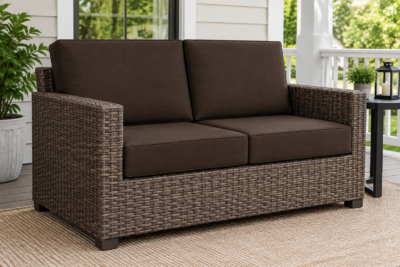
Wicker Loveseat Cushions: Curved Frames, Two-Seat Sets and Outdoor Duty
Wicker loveseat cushion guide: measuring curved and rounded frames, seat-and-back sets for two-position seating, outdoor fill and fabric for open patios, and replacing discontinued patio-set cushions.
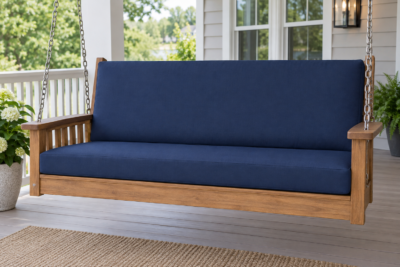
Replacement Porch Swing Cushions: Sizing a Frame You Already Own
A porch swing outlives several sets of cushions — that is the normal order of things. The hard part of
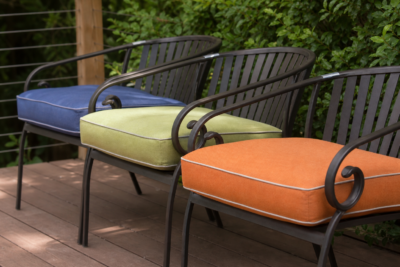
Patio Chair Cushions: The Complete Buying Guide (Outdoor Too)
Everything that decides a patio or outdoor chair cushion — sizes, thickness, ties, fabric tiers and where each buying route wins. Custom from $45 when grids fail.
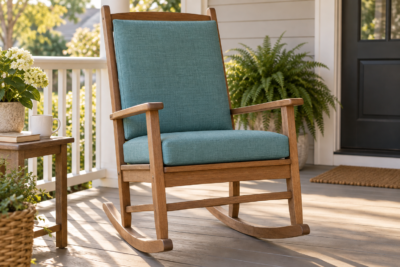
Outdoor Rocking Chair Cushions: The Weatherproof Guide to Sizes and Fabrics
An indoor rocking cushion dies fast on a porch. The sun bleaches the print in a single season, the foam
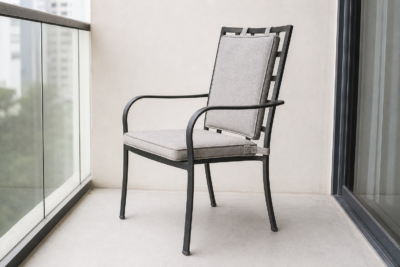
Cushions for Metal Patio Chairs: Frame Types, Grip and the Heat Question
Cushions for metal patio chairs guide: wrought iron, aluminum and steel frames and what each means for pads, sliding on slick metal, heat absorption in sun, sizing across mixed metal sets, and the outdoor duty spec.