
A cushion slides for one reason: it has somewhere to go. The re-centering ritual — sit, watch the cushion walk forward two inches, stand, straighten it, sixty times a month — is not a fabric problem or a quality problem; it is a clearance problem. A cushion cut to the measured dimensions of the seat has no gap to travel into, and that single fact does more against sliding than any coating, tie or gripper sheet added to a cushion that was the wrong size to begin with. This page is the physics of that argument: what actually drives sliding, what a measured fit changes about it, where geometry alone holds a cushion in place with zero hardware, and — fairly laid out — how the market’s other anti-slide solutions compare. If your cushions already slide and you want the fix list, that is the companion page: how to stop cushions from sliding.
Sliding Is a Gap Problem, Not a Grip Problem
Three forces decide whether a cushion stays put, and only one of them is about grip:
- The friction pair. Cushion fabric against a smooth deck — sanded wood, lacquered plywood, polished metal pan — is a low-friction pairing. Rougher pairings grip more, but this is the weakest lever in the system: it shifts the sliding threshold, it does not remove it.
- The load angle. Nobody sits straight down. You sit down and slightly back, then push forward off the balls of your feet to stand. Every transfer applies a horizontal shove, and the friction pair has to absorb it or the cushion moves.
- The travel budget. Here is the force nobody names: sliding is only possible across the gap between the cushion’s edge and the seat’s boundary. A stock cushion sized generously for “most chairs” typically carries an inch or two of clearance on each axis — and that clearance is the runway. Every sit-down cycle shoves the cushion until an edge finds the frame, every stand-up resets it somewhere new, and the smooth pairing means nothing ever pulls it back to center.
The grip products — coatings, bonded non-slip bases, underlays — all attack force number one. The measured fit attacks force number three, and it is the only one of the three you can reduce to zero.
What a Measured Fit Changes Physically
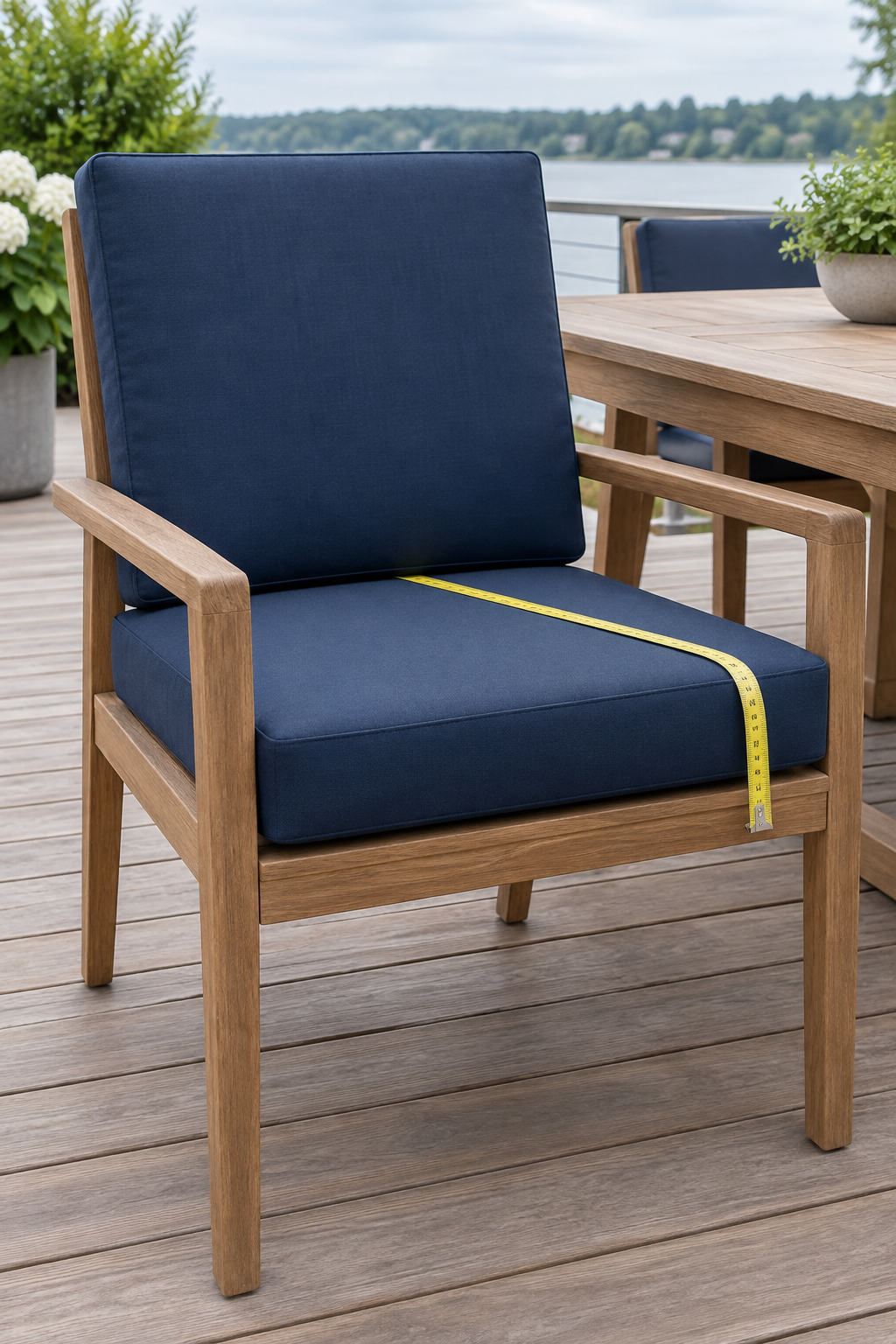
Cut to the frame’s own numbers, a cushion gains three anti-slide properties at once:
- Full contact, maximum friction. Friction scales with contact area under the same load. A cushion floating somewhere inside an oversized seat presents its load across whatever fraction happens to be touching; a cushion matching the seat presents all of it. Same materials, more grip, because more of the cushion is doing the gripping.
- Edges that meet the frame. With the cushion’s perimeter sitting against the rails or walls of the seat, forward creep ends at the front rail — the shove from sitting is absorbed by the frame, not by the cushion’s freedom to move. Sideways drift ends at the side rails. The cushion can be shoved; it has nowhere to arrive.
- Geometry as anchor. On any seat bounded by structure — walls, rails, a raised lip — a cushion cut to the boundary is located by the enclosure itself. This is why a wall-to-wall banquette cushion never slides and a same-size pad on an open bench sometimes does: same foam, same fabric, different geometry.
None of this requires the measurement to be perfect to the thousandth. Cushion work runs on pliable materials — fabric and foam settle and flex — and a fit within about half an inch of the frame reads as fitted in daily use. What the physics does require is that the numbers describe the seat, not a guess: recorded to the nearest quarter inch at the tape, which is exactly the increment our cutting forms work in (they accept measurements down to 1/8″). The discipline that makes a measured fit hold is the measuring itself, and the failure modes are catalogued in cushion measurement mistakes.
Where Geometry Does All the Work
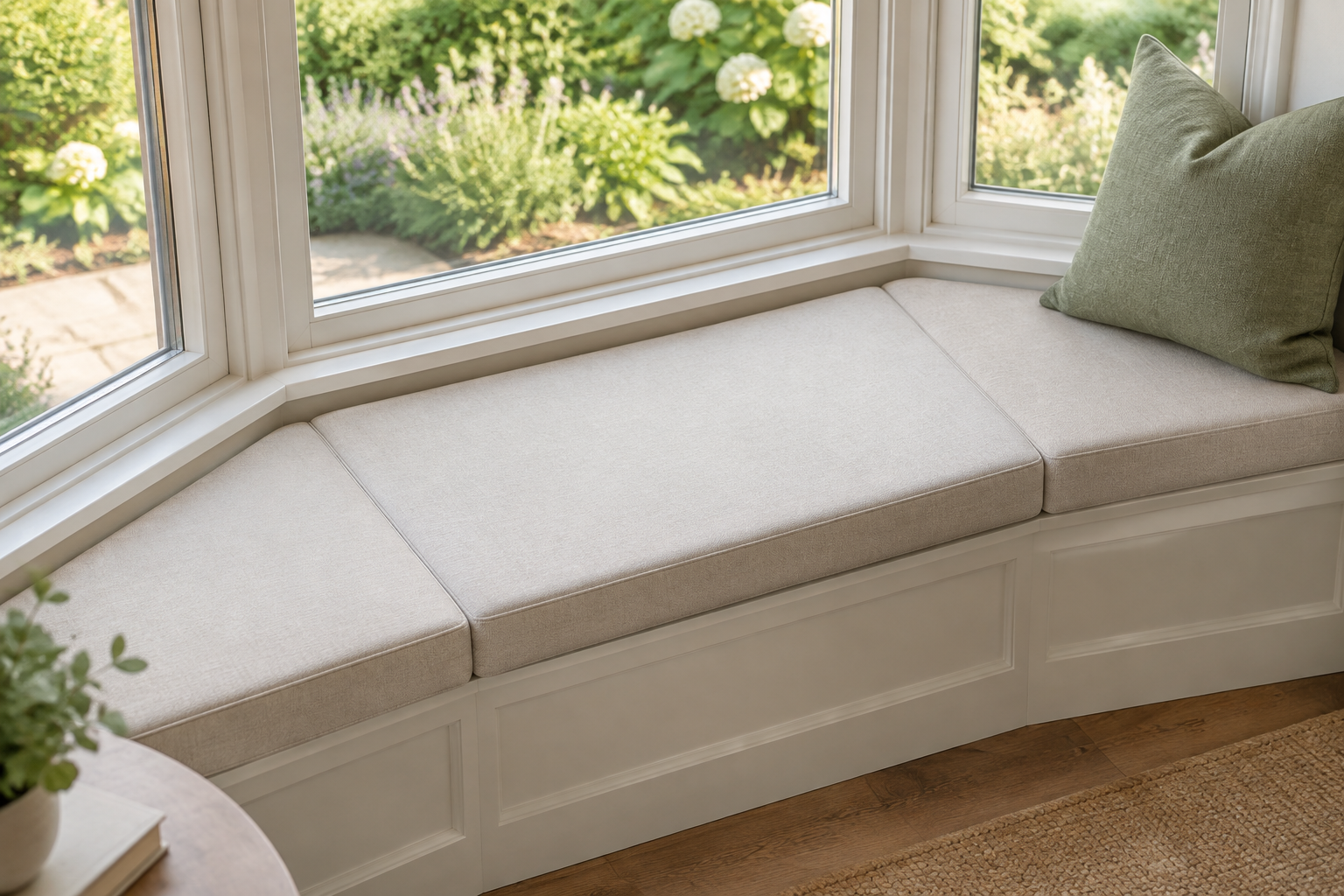
Some seats barely need friction at all, because their structure encloses the cushion:
- Banquettes and window seats. Wall-to-wall by design — three sides bounded, front edge finished. A cushion measured wall-to-wall is a piston with no stroke. The routine that gets those numbers right, including the corner and out-of-square checks, is how to measure a banquette.
- Built-in benches and nooks. Frame rails locate the cushion on all four sides; the measurement job is the frame’s interior, not any old cushion that sat on it. Bench specifics, including what to do when the frame isn’t square, are in bench cushion measurements.
- Booth and dinette seating. Enclosed on two or three sides, table edge effectively closing the fourth — the dinette cushion that slides was measured wrong, not built wrong.
The common thread: wherever the furniture provides boundaries, the cushion’s size against those boundaries is the whole attachment system. It is also why the same physics scales down to open-seating chairs — a dining chair’s rails and back posts still form a partial enclosure, and a cushion filling that enclosure drifts a fraction of what an undersized one does.
Measured Fit and the Market’s Other Fixes, Compared
The anti-slide aisle offers several answers besides fit. Laid out neutrally, because each is a legitimate solution to a real problem:
| Approach | How it works | Where it’s strong | Where it’s limited |
|---|---|---|---|
| Measured cut (the fit itself) | Eliminates the travel gap — cushion meets frame on every edge | Any seat with boundaries: banquettes, benches, framed dining chairs; permanent, no parts to wear or manage | Depends entirely on measuring discipline; needs the frame measured, not the old cushion guessed |
| Ties | Mechanical anchoring — loops through slats, rails or frame members | Slatted chairs and frames with natural anchor points; the traditional ladder-back and Windsor answer | Requires anchor points to exist; ties loosen, wear and need re-tying; adds visual hardware |
| Bonded non-slip base | A gripper layer laminated to the cushion’s underside | Open seats with smooth, flat surfaces; invisible once installed | Friction layers lose effectiveness over years and are effectively permanent — the base is part of the cushion |
| Loose underlay (rug gripper, drawer liner) | A separate high-friction sheet laid under the cushion | The cheapest, fastest retrofit; works tonight, on almost any flat seat | Can shift with the cushion, traps grit and moisture, needs periodic replacement — a consumable, not a fixture |
Our own route is the first row — cushions cut to your measured numbers, where the fit is the attachment. It is not the only honest answer in the table: ties suit genuinely open slatted frames, and an underlay is a five-dollar fix for a rental chair. The reason fit comes first is structural: every other row fights the sliding force while leaving the gap in place, and the gap is the only part of the problem that never wears out or needs re-tightening. The full fix-by-furniture breakdown, including where each of these approaches belongs, is the companion page: how to stop cushions from sliding.
When Even a Measured Fit Wants Backup
Measured fit is the physics answer, and physics is honest about its edges:
- Open, boundary-free surfaces. A floor cushion on hardwood, a pad on a completely open stool with no rails — there is no enclosure to cut against, and grip products earn their place there.
- Frequently moved cushions. Cushions that get carried outdoors daily or tossed around a play room get re-placed imperfectly; a light underlay forgives what geometry cannot when the boundary is a memory of where the cushion usually sits.
- Slicker-than-normal pairings. Marine-grade polished pans and powder-coated metals sit at the low end of the friction spectrum; a fitted cut still stops the travel, but a gripper sheet quiets the micro-scoot within the fit.
The honest summary: measure first, add grip if the seat’s geometry genuinely offers nothing to cut against. Most seats offer more enclosure than they get credit for — the dining chair measurement routine shows how much of a chair’s frame is actually usable boundary.
FAQs
Why do custom cushions slide less than standard ones?
Because they are cut to the seat’s measured dimensions, leaving no travel gap — the cushion’s edges meet the frame, so sit-down shoves are absorbed by the boundary instead of becoming movement. Grip is secondary; clearance is the variable that a measured fit zeroes out.
Can a cushion be too tight a fit?
Marginally — a fit within about half an inch of the frame reads as fitted and functions fully; the failure mode is undersizing, where the cushion floats and regains a travel gap. Measure the frame, record to the nearest quarter inch, and let the cutting tolerance (increments to 1/8″) do the rest.
Do I need ties if the cushion is cut to size?
On framed seating, usually not — the fit is the anchor. Ties remain the right answer for genuinely open slatted frames without usable boundaries, which is why they persist as a traditional solution; the comparison above lays out the trade-offs.
What keeps a bench cushion in place without hardware?
The bench frame’s own boundaries — a cushion measured to the frame’s interior dimensions is located by the rails and walls around it. The measuring routine, including non-square frames, is bench cushion measurements.
Is a non-slip base better than a measured fit?
They solve different parts of the problem: a non-slip base adds grip on open smooth surfaces, a measured fit removes the travel gap — and only the second is permanent with nothing to wear out. Where a seat has boundaries to cut against, fit first; where it has none, grip products do a job geometry cannot.
How precise do my measurements need to be?
Record to the nearest quarter inch at the tape — that matches the cutting forms’ increments, which run to 1/8″. The precision that matters is describing the frame accurately, not estimating decimals; the error patterns to avoid are in cushion measurement mistakes.
Next Steps
- Measure the seat’s boundaries — frame interior or wall-to-wall, per the dining chair routine or the banquette routine — recording each dimension to the nearest quarter inch.
- Check what geometry you already have: rails, walls and lips are attachment hardware you did not know the seat owned.
- Load the numbers at the builder and let the fit be the fix — custom versus standard cushions runs the cost arithmetic, and every set is cut in 4–7 business days with the dimensions confirmed before anything reaches the saw.
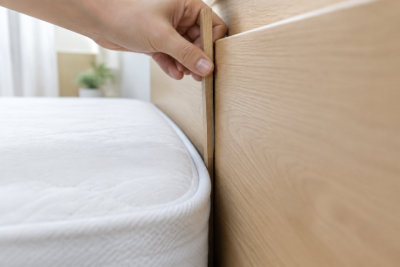
What Size Bed Gap Filler Do I Need? Thickness, Length and Density
Size a bed gap filler from three measurements, not the bed’s name: thickness equals gap width plus half an inch to one, length runs the full seam, height runs platform to mattress top. Density starts at 50D.

Cushion Thickness & Seat Height: Match the Pad to the Table
Cushion specs usually answer comfort questions. Thickness answers a geometry question: how high off the floor you end up sitting,

Church Pew Cushion Sizes: Standard Dimensions and How to Measure
Standard pew seats run 19-21 inches deep; cushions are cut 2-3 inches thick to measured runs at plus-or-minus half inch tolerance. Dimensions table, taper rules, and the pew-by-pew measuring method.
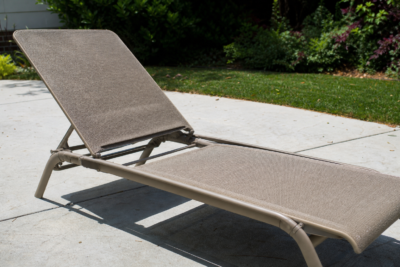
Chaise Lounge Cushion Measurements: A Complete Guide to Getting the Fit Right
How to measure a chaise lounge cushion correctly — seat depth, back height, thickness, hinge points and one-piece vs two-piece styles — with real Hampton Bay chaise dimensions.
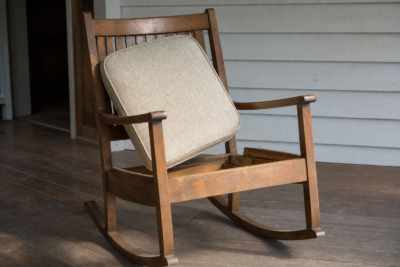
How to Measure Rocking Chair Cushions: Seats, Backs and Tie Positions
How to measure rocking chair cushions — tapered seats, curved backs, slat-gap tie maps and rock clearance — with the three-number protocol for both pieces of a rocker set.
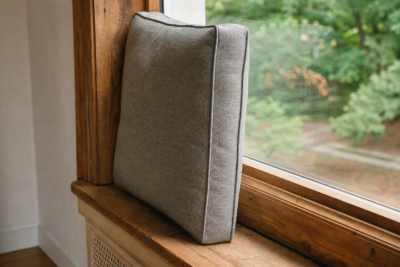
Window Seat Cushion Measurement: How to Get a Perfect Fit
Measure a window seat cushion correctly — width across alcoves, depth front to back, thickness vs sill height, radius corners and bay window angles — with tips from the cutting floor.