
The ladder back chair is one of the oldest forms still in everyday dining rooms: horizontal rails across the back, turned posts, and a seat that is deliberately shallower than almost anything built since. That last trait is the whole sizing problem. Cushion makers cut for the average modern seat — 17 to 20 inches deep — and a ladder back seat frequently offers 15 to 16 inches of usable depth, sometimes less, with a woven cane or rush panel that adds its own texture underneath. The result is a cushion that overhangs the front rail, rocks on the woven panel, or slides because it was never the size of the seat in the first place. This guide covers what the chair is, how to measure it, whether a back cushion makes sense, and how it differs from the other spindle-and-slat chairs it gets confused with. The general measurement routine is in how to measure dining chair cushions; the most common measuring errors are collected in cushion measurement mistakes.
What Makes a Ladder Back Hard to Cushion
Three structural traits, all of them visible from across the room:
- The seat is shallow. Ladder back seats run proportionately less deep than modern chairs — the depth was set when chairs were built light and upright, for posture rather than slouching. A standard 18-inch-deep cushion on a 15.5-inch seat hangs over the front rail, and every time you sit down the overhanging edge folds and creases against your knees.
- The seat is often woven, not solid. Shaker-style ladder backs traditionally carry hand-woven cane or rush panels, stretched frame to frame. Woven panels sit slightly proud of the rails, flex under load, and on older chairs the weaving wraps around knobs and dowels that intrude into the seating surface. A thin cushion transmits every one of those irregularities straight through.
- The seat frame is narrow between the rails. Turned front posts and side rails eat width that a modern box seat gives back. The usable rectangle between the rails is smaller than the chair looks, which is why cushions measured “by eye to the chair” arrive too wide and perch on the rails instead of resting inside them.
None of these are defects — they are the chair working as designed, a century or three before anyone standardized a seat. The cushion has to fit the chair, not the other way around.
How to Measure a Ladder Back Seat
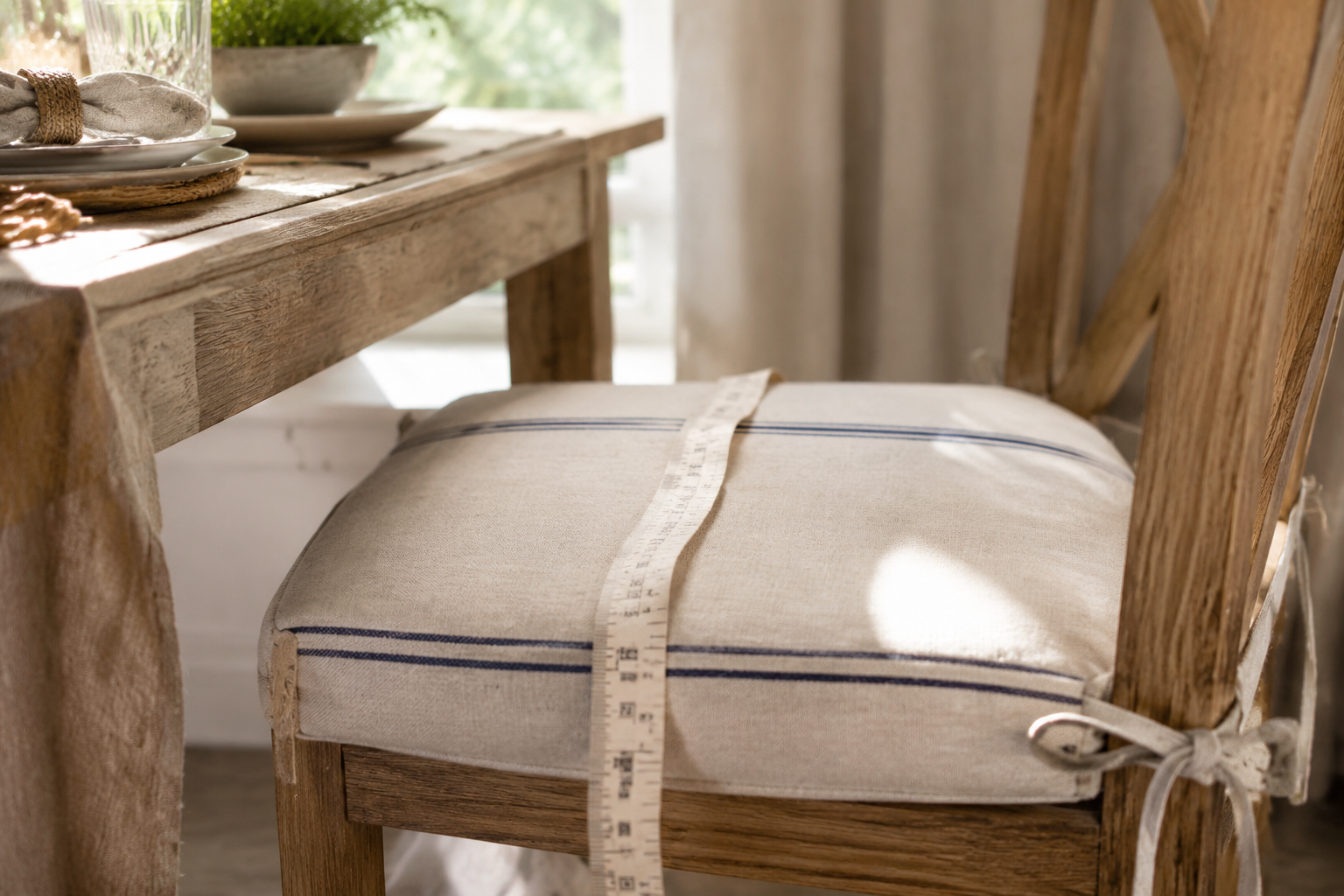
Measure the structure, not an old cushion, and record to the nearest quarter inch — our cutting forms accept increments down to 1/8″, so precision at the tape transfers directly to the cut.
- Depth: front rail to back rail, at the seating surface. Hook the tape over the inside face of the front rail and read at the back rail (or the back edge of the woven panel where it meets the frame). If the cane panel bulges, measure at the bulge — that is the surface the cushion actually rests on.
- Width: rail to rail, at the narrowest point. Turned posts taper; measure where the posts are widest into the seat, because that is what the cushion has to clear. If the front posts flare outward, take a second width reading at the back rail — you may have a trapezoid, which is cut from a front-width and a back-width rather than one number.
- Thickness: budget for the bulge and the apron. Two checks decide it. First, the clearance test: slide height minus seat height tells you how much thickness the table apron allows before thighs go wooden — check it with someone sitting at the table, forearms level. Second, the panel test: on cane or rush seats with raised knots or dowel ends, 3 inches of foam does the covering work that 2 inches cannot, sitting over the irregularities instead of printing them through.
- Count the chairs, not the set. Handmade and older ladder backs vary chair to chair within one set — the craftsman’s tolerance, not a quality problem. Measure every chair if the set has any age on it.
One tolerance note before you order: cushions made from fabric and fill are pliable, and pliable materials settle. A seat within an inch of the measured size reads as fitted; the discipline is in the measuring, and the mistakes to avoid are catalogued in cushion measurement mistakes.
Does a Ladder Back Need a Back Cushion?
Most ladder backs do not — the rails are the back, and they are comfortable the way a solid chair back is not. The horizontal rails run edge-up, which gives the spine a series of firm horizontal rests; that is the design doing its job. Adding a back cushion to a ladder back is a decision about padding the rails, not about fixing a flaw.
When it does make sense:
- Upholstering for longevity. On a daily-use set where the finish on the rails is already worn from lean-back contact, a back cushion shields the wood from shirt buttons and belt hardware.
- Tall sitters and long dinners. If the uppermost rail lands at your shoulder blades instead of mid-back, a back cushion spanning two rails restores a continuous backrest.
- Sizing the back cushion, if you order one. Width between the outer posts at the rails you want covered, height as the span of rail to cover — the cushion needs to reach the rails it rests against, and depth (thickness) stays modest at 2 to 3 inches because there is no dish to fill. The specifics of measuring seat-plus-back sets as one coordinated job are in how to measure dining chair cushions.
What a back cushion cannot do is follow the gap pattern between rails — cushions are cut to planes, not to lattices. Order it to span the rails flat and let the ties question take care of itself (more on attachment options in the comparison below).
Ladder Back, Cross Back, Spindle Back, Slat Back: The Differences That Matter
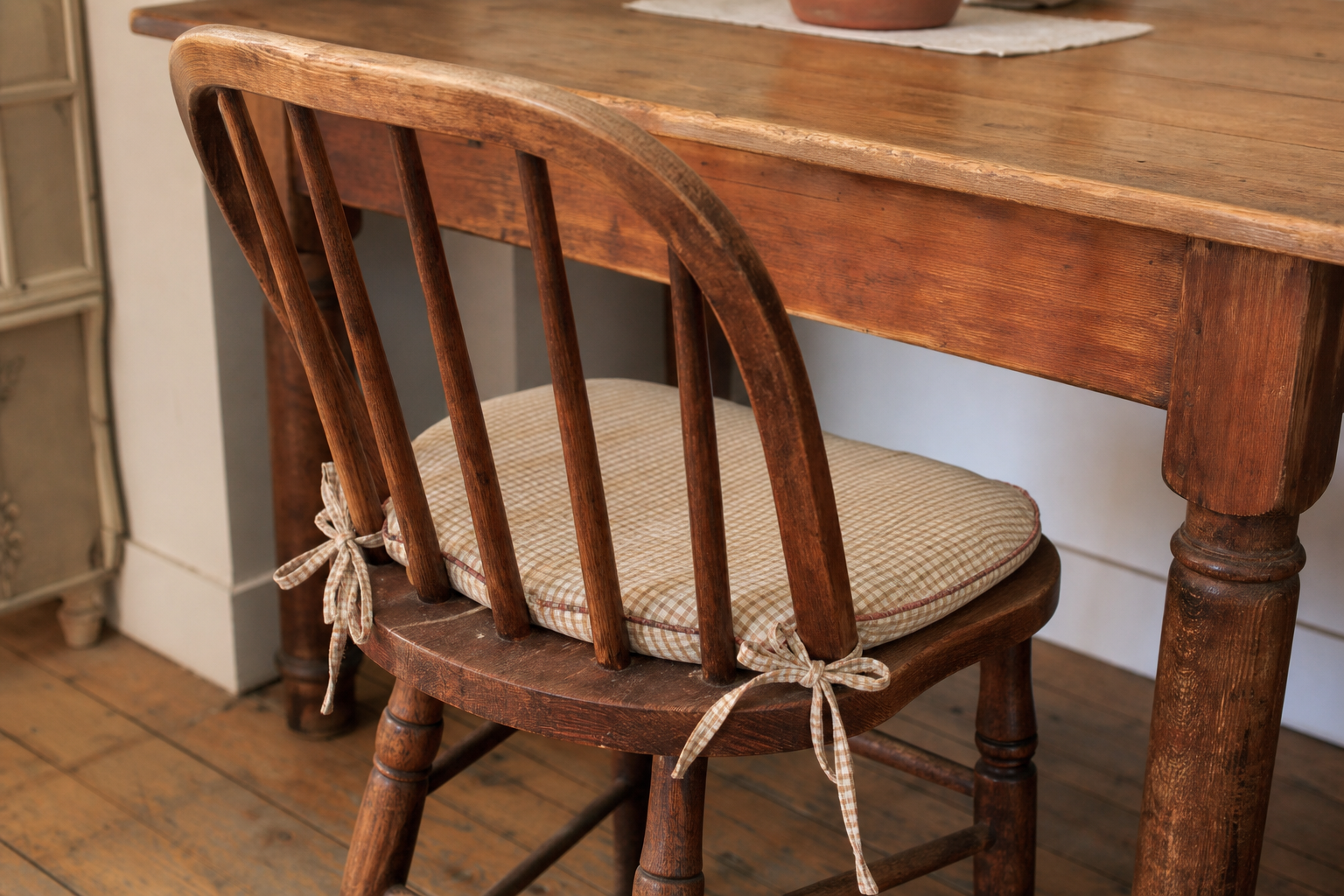
These four chairs get conflated because they all read as “wood chair with an open back” from across a showroom. The differences change the cushion:
| Chair | The back | The seat it usually comes with | What the cushion has to account for |
|---|---|---|---|
| Ladder back | Wide horizontal rails, edge-up | Shallow, often woven cane or rush | Depth overhang, panel bulge, rail-to-rail width |
| Cross back | Flat straps crossing in an X (French bistro origin) | Sculpted or slightly dished, sometimes raised cane | The dish: a tufted or thicker cushion bridges it better than a thin flat one |
| Spindle back (Windsor) | Many thin turned spindles into a steam-bent bow | Carved saddle seat, often effectively round | The saddle dish and rounded corners — covered in Windsor chair cushions |
| Slat back (Mission/Shaker) | Flat vertical or horizontal slats, square posts | Squarer, deeper, solid seat | Least demanding of the four: measure as a normal solid seat |
Two practical upshots. First, cushion advice does not transfer across these forms: a Windsor’s thin-pad logic exists because of the saddle dish, and applied to a ladder back’s shallow woven seat it gets you a cushion you feel every knot through. Second, if your chairs are hybrids — cross straps below, spindles above — identify by the seat, because the seat sets the cushion’s size and the back only sets the back cushion’s span.
Thickness and Fill for Daily Dining
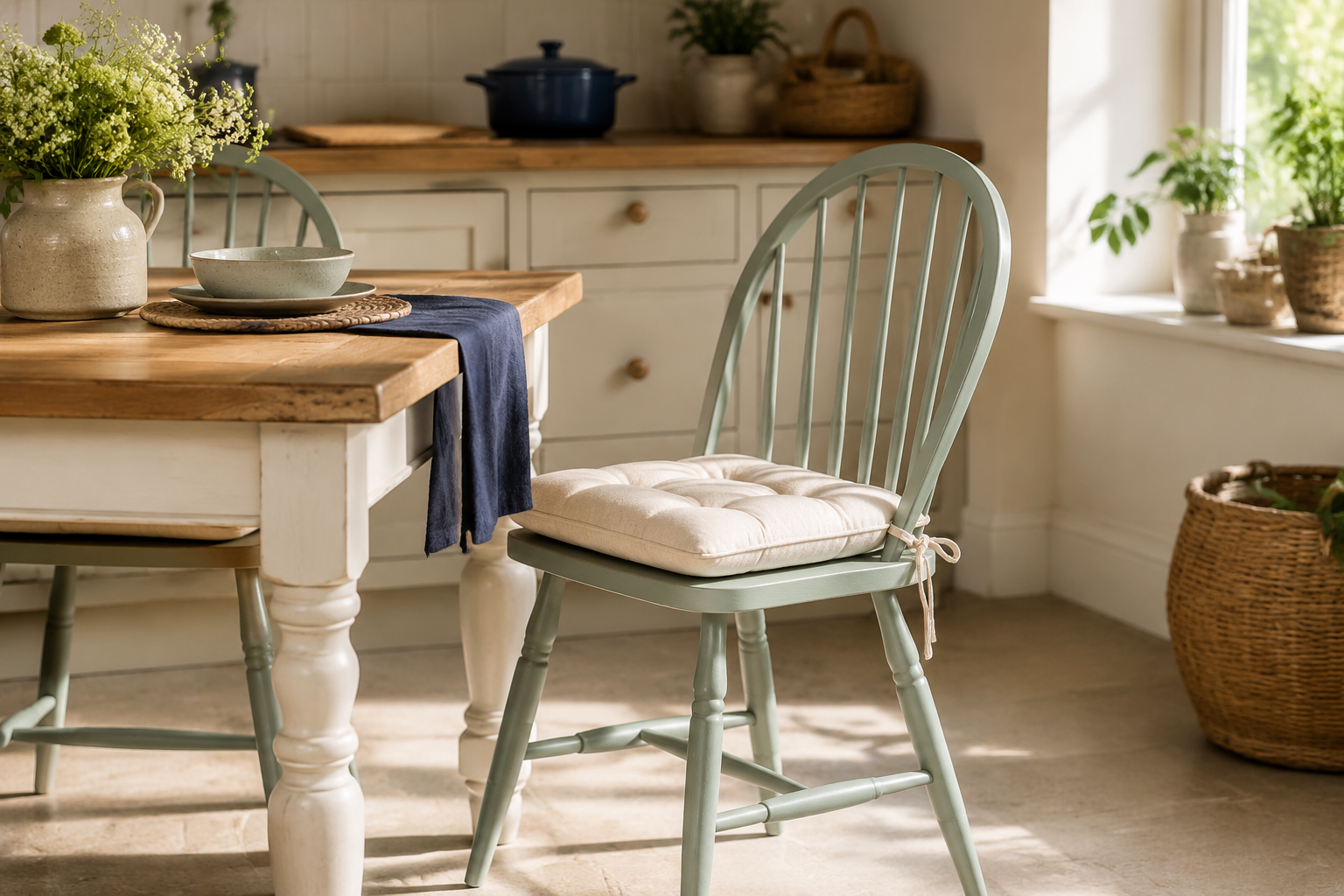
Ladder backs are working chairs — kitchen tables, homework hours, long dinners — and the fill has to carry that duty.
- Thickness: 2.5 to 3 inches is the working band for daily dining chairs. Below 2.5, cane-panel texture starts to print through on older chairs; above 3, check the apron clearance before committing.
- Density by duty, not by feel. A daily dining chair carries one to four hours of sitting a day, which is 50D territory — the grade that holds its loft through years of nightly use. Occasional display chairs clear at 35D. The three-question decision tree is in how to choose foam density.
- Fiber-only is the wrong fill here. Quilted fiber pads suit the look of country interiors, but on a shallow seat with a woven panel underneath, fiber compresses into the weave and goes flat within seasons. Foam by density, fiber by loft — seat equals foam.
Ordering for Seats That Are Not Standard
Here is where the ladder back story turns in our favor. Ready-made cushion makers cut three sizes — small, medium, large — and a 15 by 14.5-inch seat between turned rails is none of them. The order desk’s most common returns in this trade trace to guessed sizes, and a ladder back is the chair family where guessing fails first, because every dimension it has is off-standard in the same direction: shallower, narrower, textured underneath.
A custom cut inverts the problem. You send the four numbers — depth at the rail, width at the narrowest point, thickness the apron allows, chair count — and the cushion is cut to those numbers, re-verified before anything reaches the saw. That includes the odd cases: trapezoid seats from flared posts are cut from front and back widths; cane bulges just become the measured surface. The entry point is custom dining chair cushions, and the stock-versus-custom arithmetic is in custom vs standard cushions.
One attachment note, stated plainly because this page is about sizing and buyers ask: ladder back cushions traditionally attach with ties looped through the back rail gap, and ties remain common on ready-made pads. Our builds take a different route — the fit itself is the attachment. A cushion cut to the rail-to-rail rectangle has no gap to travel into, which is the same physics that keeps a wall-to-wall banquette cushion planted. The full mechanics are in why custom cut cushions don’t slide.
And if the ladder back chairs flank a storage ottoman or a window-side seat as part of the same nook, the same cut-to-numbers route covers those pieces too — a custom ottoman cushion from the same production run matches height across the set, which matters when chairs and ottoman share a room.
FAQs
What size cushion fits a ladder back chair?
The size of the seat, measured rail to rail at the seating surface — typically 14 to 16 inches deep by 15 to 17 inches wide, but the spread across antique and imported chairs is wide enough that no universal size fits. Measure depth at the front rail and width at the narrowest point, to the nearest quarter inch.
How thick should a ladder back chair cushion be?
2.5 to 3 inches for daily dining — thick enough to bridge cane-panel knots and weaving irregularities, subject to table apron clearance. Occasional and display chairs can go thinner; verify the slide-under height with a sitter at the table before ordering anything over 3 inches.
Do ladder back chairs need cushions with backs?
Usually no — the rails are designed as the backrest. Order a back cushion only for specific reasons: worn rail finish on a daily set, a rail line that lands wrong for tall sitters, or long-dinner comfort — and size it to span the rails, width between outer posts.
Can I use a Windsor chair cushion on a ladder back?
Not reliably — Windsor sizing assumes a carved saddle dish and rounded seat, while the ladder back needs rail-to-rail rectangle sizing on a shallow flat or woven seat. The two families look related and measure differently; the Windsor method is in Windsor chair cushions.
My ladder back seats are trapezoid-shaped. Is that a problem?
No — trapezoid seats from flared front posts are cut from a front-width and a back-width, a routine shape on custom orders. Record both widths plus the depth; see custom dining chair cushions to load the numbers.
Next Steps
- Measure every chair in the set — depth at the rail, width at the narrowest point, thickness the apron allows — recording to the nearest quarter inch per the dining chair measurement routine.
- Pick the fill for the duty: 50D at 2.5 to 3 inches for daily dining, 35D for the occasional chairs (the density decision guide).
- Load the numbers at custom dining chair cushions — nothing is cut until your measurements are confirmed, and made-to-order runs in 4–7 business days.
What Size Bed Gap Filler Do I Need? Thickness, Length and Density
Size a bed gap filler from three measurements, not the bed’s name: thickness equals gap width plus half an inch to one, length runs the full seam, height runs platform to mattress top. Density starts at 50D.
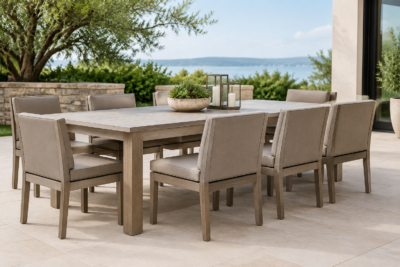
Cushion Thickness & Seat Height: Match the Pad to the Table
Cushion specs usually answer comfort questions. Thickness answers a geometry question: how high off the floor you end up sitting,

Church Pew Cushion Sizes: Standard Dimensions and How to Measure
Standard pew seats run 19-21 inches deep; cushions are cut 2-3 inches thick to measured runs at plus-or-minus half inch tolerance. Dimensions table, taper rules, and the pew-by-pew measuring method.
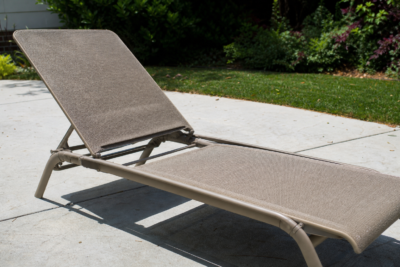
Chaise Lounge Cushion Measurements: A Complete Guide to Getting the Fit Right
How to measure a chaise lounge cushion correctly — seat depth, back height, thickness, hinge points and one-piece vs two-piece styles — with real Hampton Bay chaise dimensions.
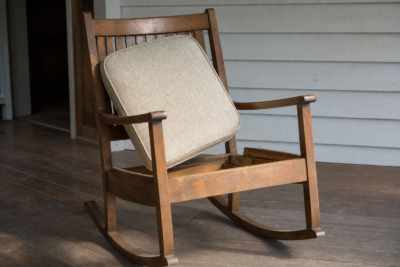
How to Measure Rocking Chair Cushions: Seats, Backs and Tie Positions
How to measure rocking chair cushions — tapered seats, curved backs, slat-gap tie maps and rock clearance — with the three-number protocol for both pieces of a rocker set.
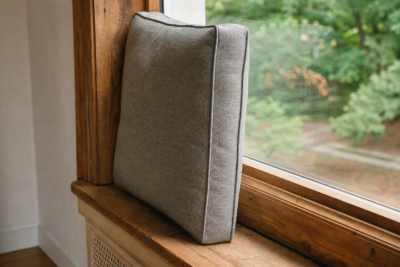
Window Seat Cushion Measurement: How to Get a Perfect Fit
Measure a window seat cushion correctly — width across alcoves, depth front to back, thickness vs sill height, radius corners and bay window angles — with tips from the cutting floor.