
OW Lee Studio Replacement Cushions
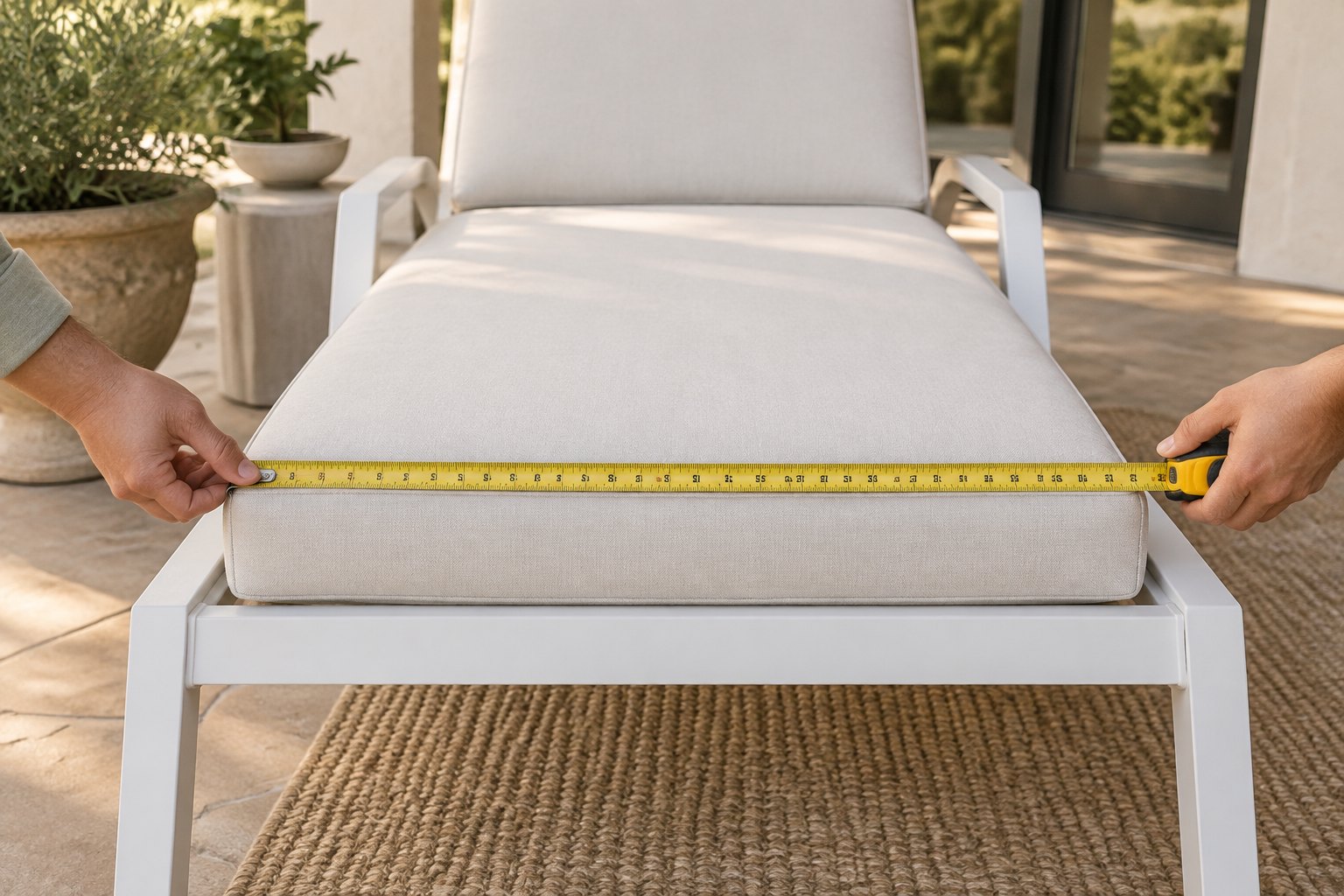
Sometimes the frame is worth keeping and the look is not — re-covering a Studio set in a fresh palette is a weekend-scale project when the pads are rebuilt to measured dimensions. This page covers identification, the taping routine, and fabric-to-price behavior.
The Studio profile, quickly
Studio is a retired O.W. Lee catalog name — and, judging by the word itself, one that sat on the cleaner-lined side of the company’s range, where O.W. Lee’s modern families live today. That reading is a hint, not evidence: what’s constant and verifiable is the build — hand-forged frames, finished and upholstered to order, sold through dealers, cushion specs never charted.
Restyling starts with facts, not mood boards. The cues below fix the Studio identity, the tape fixes the three dimensions per pad, and the rebuild is sewn to those figures — any of 119 upholstery options, one price level, from the floor that delivers.
Restyle on facts: the maker first — O.W. Lee hangs a brass plaque or a stamped mark on a rail of every frame; the era second — an invoice or order history names the collection, because the brand retails through a nationwide dealer network and never big-box shelves; the build third — hand-forged scrollwork over heavy-gauge stock separates it from the import racks. Then the taping walkthrough turns identity into numbers.
Naming your set: Studio or not
Start with the maker’s marks: a brass plaque or stamped frame rail, hand-forged weight, and a baked-on finish — on every O.W. Lee piece, Studio included. Then read the frame language: if the sections run straight and slim rather than scrolled, that fits the name’s cleaner-lined reading.
Use the order trail: Studio pieces were sold on dealer tickets that named the collection. A dealer invoice, an old quote, or email history with the store that sold the set beats frame-guessing — one search of your records usually settles it.
Don’t confuse it with: the many “studio” named furniture lines and apartment-scale collections across the industry — the word is everywhere. The O.W. Lee plaque plus the dealer paper is what makes a set an O.W. Lee Studio rather than a same-named import.
Restyle economics, sourced: original pads from a sunset line turn up on the factory-store clearance page in end-of-run cloth, sizes as printed, never re-cut. Fresh covers on new foam, cut from your three figures, is what actually refreshes a Studio set.
The Studio paper trail that isn’t
Restyling runs on dimensions, and the official record supplies none: O.W. Lee publishes no per-line cushion figures, and a sunset name like Studio is charted nowhere at all. Whatever numbers circulate describe assembled furniture. By design there is no size chart here — the three figures you tape per pad are the entire brief for the new covers.
No mark on the rail, no invoice in the folder? Send frame photos before choosing fabric — the line gets named, the three dimensions per pad get recorded, and the restyle proceeds.
Start with dimensions
Before the palette, the numbers: width, depth and thickness at the seam, per pad, with our measuring guide as the reference — sets of chairs get measured one by one. No size chart exists to quote, so your entries are the entire brief every Studio rebuild is cut from.
Closest O.W. Lee neighbors: Aris (the current modern aluminum family) and Palazzo (a retired wide-body name). The O.W. Lee collection directory rounds up the rest.
Fabric options & estimated pricing
Restyle within three registers: cotton linen for a hard-wearing neutral base, tech fabric where life happens — water-resistant, wipe-clean — and premium velvet for the statement finish, claw-proof as it reads. the cloth board in the order flow prices the whole palette identically behind one measured cut.
Restyle pricing: $168 for the typical block, adjusted by dimensions and density (35D through 65D), untouched by cloth choice. The number you approve at checkout is the number that stands; cutting follows confirmation, not the calendar. Each cover zips free for laundering.
The Studio piece map
Studio ran a short, architectural list: a bench, an ottoman, and the modular bodies — lounge sectional units, corner sectionals and sectional chaise blocks — that assemble into clean, straight-run seating. It is the most contemporary silhouette in the retired catalog: where Creighton dressed its modules in traditional weight, Studio stripped the same idea down to straighter rails and a lighter visual line, built for lofts, roof decks and modern patios.
The bench is the sleeper piece. Studio benches served both the dining table and the foot of the sectional, and the two roles take different abuse — dining benches compress in two sit zones, sectional benches wear as a leg rest. Measure the pad across both ends and through the middle, and if the old cover shows two distinct sit hollows, say so in the order notes; the fill plan can answer the wear pattern even though the cut follows the frame. The sectional blocks follow the modular rule: one pad per block, every figure seam to seam, arms measured at the seam they share with the next block.
Studio against its neighbors: Creighton is the constant confusion, and the shortcut is ornament — scroll accents and heavier rails point to Creighton, clean lines and lighter frames to Studio. A bench with no ornament at all is nearly always this line; neither Classico’s glider bench nor any dining-family bench ran as plain.
Design context for the cutter’s notes
Modern silhouettes show wear faster than traditional ones — there is no scrollwork to distract the eye from a flattened edge. That cuts in the owner’s favor here: Studio’s straight blocks are the cleanest pads in the brand to measure, with curves appearing only where a chaise block slopes. One careful pass with the tape, block by block, and the rebuild restores the crisp profile the line was drawn to have.
Frequently asked questions
Is Studio stocked anywhere official?
Not from the catalog. Studio is a sunset run; original pads linger only on the factory store’s clearance page — end-of-bolt cloth, sizes as listed — and dealer customs run 18–20 weeks. Restyles here rebuild from your own figures across 119 fabrics.
Are mass-market cushions an option for Studio frames?
Restyling on top of a bad fit just decorates the problem. These decks are deep and specifically proportioned; universals matching width miss depth or loft, and no stock piece follows a curve. The measured rebuild is the base the new look stands on.
What identifies Studio beyond the nameplate?
The dealer invoice or original order record names the collection outright; the brass plaque or stamped mark names the maker. With a name as common as “Studio”, the paper is the anchor — the frame alone can’t carry the identification.
Are official specs required for an order?
Yes; restyles are built the same way. Width, depth and seam thickness per pad, from your tape, re-verified against the piece count, and the new covers follow your figures alone.
How is a Studio restyle priced?
Restyles run from $168 per typical piece, adjusted by dimensions and density grade through 35D–65D with all fabrics equal. The figure confirms before cutting.
How long from approval to arrival?
Restyle timing: every set sews post-order — 4–7 business days standard, 3–5 rush — with flat-rate freight behind it.
What you’re buying into here
- The factory enters its second decade — every order cut, filled and stitched under our roof, unbrokered and never dropshipped.
- Restyle orders get the pre-cut read too: three figures per pad, re-checked against the piece count, fabric unopened until the audit clears.
- Restyles aren’t pulled from stock — any material, any piece, whether the order counts one block or forty.
- Restyle protection included: cut errors beyond ±½″ (±¾″ past 36″), wrong fabric or wrong sewing — remade on us.
Restyle your Studio set from $168 per piece: identify, measure, approve the figure.
Restyle target unconfirmed? Photos first — then fabric, then cutting. Not Studio? Custom covers any shape, or revisit the OW Lee lineup.