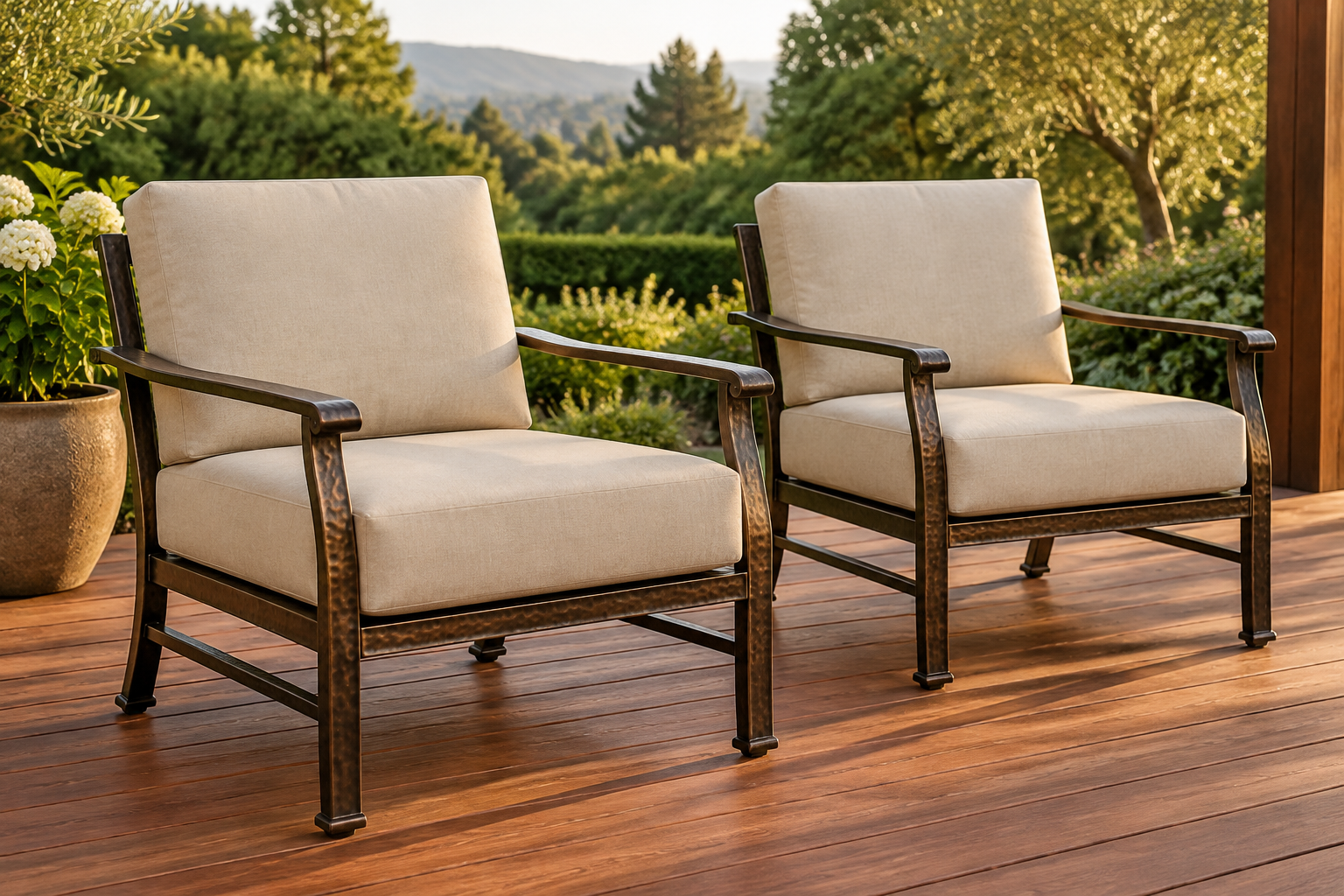
OW Lee Ashbury Replacement Cushions
Estate sales and marketplace listings turn up Ashbury frames regularly, usually priced as generic patio furniture — which makes new pads the cheap part of the rescue. Verify the line, take three figures per position, and the set lives on.
The Ashbury name, decoded
Ashbury is a retired O.W. Lee catalog name — a street-district name, like others in the era’s naming, that left the dealer charts with the rest of the earlier catalog. What stays constant is the workshop behind it: hand-forged frames in heavy gauge, finished and upholstered to order, sold through dealers nationwide.
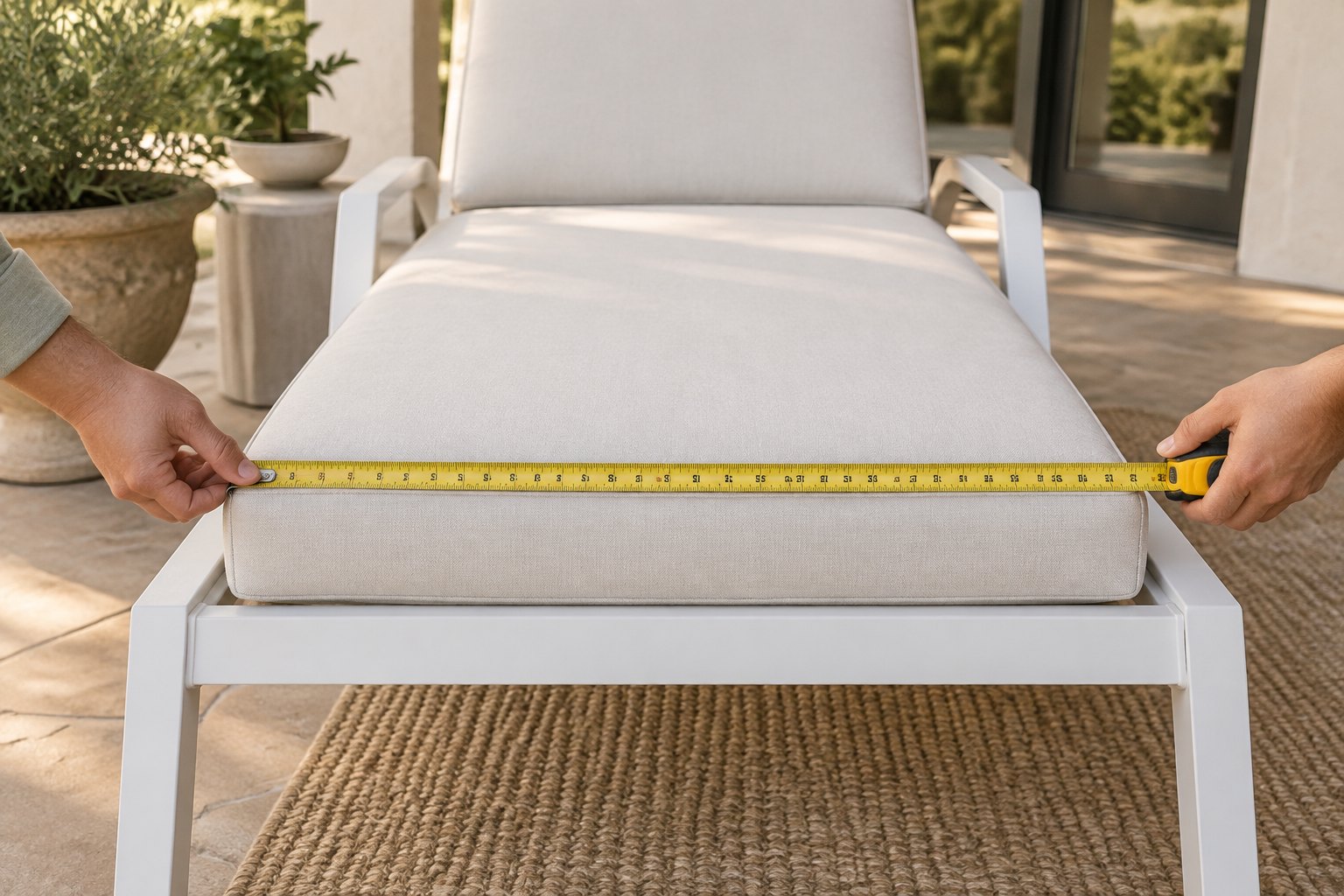
Rescues run better with the line pinned. The cues below identify Ashbury frames regardless of what the listing claimed; the tape supplies three figures per pad; the rebuild follows your numbers in whichever of 119 upholstery options you prefer — one rate, sewn where it ships.
A rescue listing deserves due diligence: the frame first — hand-forged scrollwork on heavy-gauge stock marks real O.W. Lee work against imports; the rail next — a brass plaque or a stamped mark rides on every piece; the paperwork last — the brand retails through a nationwide dealer body, never big-box, so a surviving invoice or order history names the collection outright. The taping walkthrough completes the vetting.
Spotting Ashbury at a glance
Start with the maker’s marks: a brass plaque or stamped frame rail, hand-forged weight, and a baked-on finish — the constants across every O.W. Lee line, Ashbury included. Imports carry none of the three; one lifted chair end usually settles which world your set is from.
Use the order trail: Ashbury pieces were sold on dealer tickets that named the collection. A dealer invoice, an old quote, or email history with the store that sold the set beats frame-guessing — one search of your records usually settles it.
Don’t confuse it with: the many “Ashbury” named products unrelated to patio furniture — venues, apparel, home goods all carry the district name. The O.W. Lee plaque and the dealer paper are the two anchors that keep the identification honest.
Rescues meet the same shelf: retired-line pads surface through the factory-store clearance page, cut in leftover cloth, sized as listed and never re-cut. A Ashbury rebuild from your own three figures per pad is the path no clearance drought can block.
The size chart Ashbury never got
Marketplace math includes a documentation gap: O.W. Lee has never printed per-line pad dimensions, and a delisted name like Ashbury is charted nowhere. The figures that float around dealer pages describe whole pieces of furniture. No size table appears below on purpose — your tape, on your rescue, supplies the only three numbers per pad we need.
Listing photos rarely show the plaque, and old invoices rarely survive — send us the frame shots you have, we will narrow the collection, and three figures per pad set the rescue in motion.
The tape pass, first
Vet the rescue with a tape: width, depth and thickness at the seam, taken per pad with our measuring guide open, figures written individually. No chart exists for the line, so those three entries are the entire spec behind every Ashbury cushion we build.
Closest O.W. Lee neighbors: Creighton and Vista — retired names from the same catalog era. The full O.W. Lee line directory covers the rest.
Fabric options & estimated pricing
Dress the rescue however it deserves: cotton linen for the honest everyday recovery, tech fabric for weathered exposures — water-resistant, wipes down — or premium velvet to bring the formal back, cats considered. the fabric sheet inside the flow holds every option at the same price for the same measured cut.
The rescue’s new pads start at $168 for a typical piece, moving with dimensions and density grade — 35D to 65D — and never with fabric. Checkout settles the final number; nothing is cut before your figures are confirmed. All covers close on zips and come off for the wash.
The Ashbury piece roster
Ashbury ran the broadest retired list after Classico: dining chairs, lounge chairs, a spring lounge chair, loveseat, sofa, adjustable chaise, a large ottoman, and the full run of elevated seating — bar stool, counter stool, swivel bar stool, swivel counter stool and swivel dining chair. And it holds one body no other O.W. Lee family carries: the cuddle chair, a rounded single seat built wide enough to curl up in — part armchair, part mini-sofa, and the line’s signature piece.
The cuddle chair is also the line’s careful measurement. Its back wraps a curve, so a straight-across width reads short of the true seam length — the same rule as any curved back, measured along the seam with a second straight figure for reference. The swivel bodies carry their own note: the seat turns on its base, so measure with the pad settled at rest, and send the back figure separately at its full height. The spring lounge chair follows the deck rule — figures from the old cover’s seams, not from a ruler laid across flexing steel.
Ashbury against its neighbors: with Vista it shares the spring lounge chair, and with Palazzo the adjustable chaise; it shares its stool run with Silana and Chalet. What it shares with nobody is the cuddle chair — a single rounded seat in this brand points here before any other identification question is asked. For everything else, the base and the dealer invoice sort the family in one pass.
Design-era context
This was the social line of the retired catalog — built for households that seat a crowd, from the counter stools at the bar to the sofa on the patio. That breadth is why Ashbury orders so often arrive as mixed carts: two stools, a cuddle chair and a chaise, all in one family, all in one fabric run. It is exactly the job a measured rebuild handles best — every body style, one order, one consistent hand.
Frequently asked questions
Can I source Ashbury pads through OW Lee?
Only as leftovers. The Ashbury name is retired: the factory outlet’s clearance page carries residual pads at listed sizes, and dealers commission customs at 18–20 weeks. A rescue rebuild here is cut fresh from your figures, 119 fabrics available.
Do universal cushions fit rescued Ashbury pieces?
A rescued frame deserves a pad that finishes the job. O.W. Lee decks are deep and individual — universals that clear width fail depth or loft, curved fronts defeat stock sizing. Replacements from your own figures restore the original sit.
What proves a rescue set is Ashbury?
The dealer invoice or original order record names the collection; the brass plaque or stamped mark names the maker. With a place-name this common on other products, the dealer paper is the anchor that links the frame to the O.W. Lee line.
Can a rescue order run without documents?
Rescues included, yes. Width, depth, seam thickness for each block from your tape; verification against the piece count here; then cutting to your numbers — no provenance paperwork needed.
How much to re-cushion a Ashbury set?
The rescue’s pads price from $168 per typical piece — dimensions and density grade (35D–65D) adjust it, cloth does not. Confirmation precedes the build.
How soon can a rebuild land?
Rescue math: 4–7 business days of standard build after the order, a 3–5 day rush lane, flat-rate freight home — inside 4-7 business days all-in.
What a build here promises
- A ten-plus-year workshop record — cutting, filling and sewing done in-house on every order; brokering and dropshipping play no part.
- Rescue orders clear the same audit — your three numbers per pad, re-verified against the count of pieces ahead of any unrolling.
- Rescues get built, not picked — any cloth, any frame, from one pad to a forty-piece run.
- Rescues land right or get redone: cuts outside ±½″ (±¾″ beyond 36″), wrong cloth, wrong build — remade free.
Rescue your Ashbury from $168 per piece — verify, tape, quote, done.
Rescue identity still open? Send the listing photos plus your own — we confirm before cutting. Not Ashbury after all? Any shape, built, or check the full OW Lee range.
A fresh rebuild on the Ashbury frame
Hand-forged aluminum frames like Ashbury deserve pads that match the build quality – sand solution-dyed acrylic on a redwood deck is the classic pairing for this deep-seating line.