
Custom T Cushions
T-cushions for dining chairs, armchairs, wing chairs, gliders, and sofa seats — the shape with ears that wrap forward past the arms, cut to your five measurements. It’s the classic replacement shape for any chair with arms, and the one universal pads fit worst: guess the ears and the cushion either misses them or swallows them. Send your five numbers and a photo, and we cut your T exactly.

Start with your shape
Not sure? Pick the closest — every measurement is confirmed before we cut.
Don't see your shape? We make any shape.
Straight edges? A top photo + the edge numbers is all we need. Curved? Trace it on paper next to a tape measure and email us a photo.
Enter your measurements
Measure the old cushion flat, edge to edge — never the frame.
Choose your fabric
Six families, 90 cuts, one flat rate — pick by look and feel. Click a family to see its swatches below, or its ⓘ for what the fabric is and where it works best.
No fabrics match the current filters — clear one above.
All covers cut to your exact dimensions — no stock sizes, zippered covers that remove for washing.
Review & order
Calculated live from your measurements — every line, no surprises.
Free shipping over $158 · $29 flat below
Estimates only — we re-verify every dimension before cutting and will contact you if anything looks off. Prefer email? Email me this quote
Odd shape or tricky frame? Upload a photo of your furniture or old cushion — one overall shot, plus a top and side view of the old cushion if you can.
JPG, PNG or WebP · up to 10 MB each · max 3
Why T-Cushions Are the Shape Universal Pads Can’t Fake
The T exists because of arms. On any armed chair, the seat between the arms is narrower than the chair’s full width, and the cushion’s front section — the ears — reaches forward past the arm fronts so the whole seat is usable. Every maker resolves those proportions differently, which is why T-cushions come in endless variations and why no two manufacturers’ “standard T” agrees with any other’s.
Universal pads handle this with either a plain rectangle (which abandons the ears entirely — the front corners of the seat sit bare while the pad ends meekly between the arms) or with elastic and hope. The specific failure of an aging T is the ears themselves: they’re narrow single-foam extensions that take knees, hands, and hauling, and once they flatten or splay, the whole chair reads as tired even when the main seat is fine.
How to Measure a T-Cushion
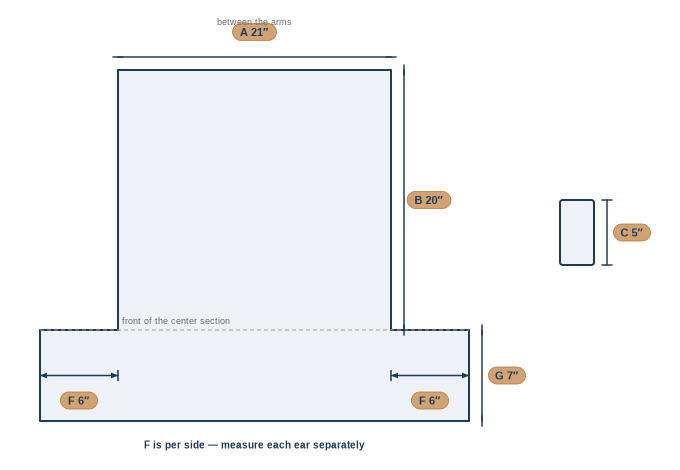
Take the old cushion off and lay it flat, front edge toward you. A T gives up five numbers:
Measure each ear separately — on older chairs one ear is often half an inch different from the other, and we cut what you send. And cross-check the widths against the chair itself, not just the old pad: ears splay as foam dies, so the frame’s numbers are the truth. One photo of the cushion flat beside a tape catches everything else. We cut to ±½″ and remake free if a piece misses it.
Foam & Thickness for Chairs With Arms
Ears are the first place a T-cushion shows age — they’re narrow foam edges that get sat on, kneed, and hauled by. Density is what keeps them crisp: 50D is the floor for a T in daily use, and for a nursery glider or family sofa seat, 60D holds the ears’ shape for years. Resist over-specifying thickness on dining chairs — much past three inches and the sitter rides above the arms.
Pricing
*Per piece, calculated live in the customizer with the exact numbers you enter — a T is priced on the area the shape actually covers, ears included, never on the rectangle around it. A $45 cutting charge per piece, foam by density and thickness, fabric at one flat $7.43/sq ft across all 119 options. These anchors are honest arithmetic, not teaser rates.
Frequently Asked Questions
Yes — every cover closes with a zipper and removes for washing. Unzip it off the foam core, wash the cover, zip it back on — clean the cover, keep the cushion.
Width between arms (the narrow rear section, seam to seam), total width (ear tip to ear tip across the front), main depth (the narrow section), ear depth (how far each ear reaches past the main front seam), and thickness with the foam at rest. Measure each ear separately, cross-check the widths against the chair frame, and add a photo of the flat cushion beside a tape. We cut to ±½″ and remake free if a piece misses it.
Because ears splay as foam dies — a flattened old T often measures an inch wider across the front than the chair it belongs to. The frame is the truth: total width follows the arm fronts, not the tired pad. If old pad and chair disagree, send both numbers and a photo, and we cut to the chair.
Yes — that’s exactly why each ear carries its own measurement. Asymmetric ears are normal on older and handmade chairs; enter the real numbers for each side rather than averaging them, and the custom cut follows your chair instead of arguing with it.
2–2.5 inches for dining chairs — much past three and the sitter rides above the arms — 2.5–3 for daily armchairs, and 3–4 inches in 60D for sofa seats and nursery gliders that take real daily weight.
Yes — we sew replacement covers to your five numbers in the same 119 fabrics, with a zipper where the original had one. If the old cover still exists, mail it and we pattern from it directly, ears and all. Press the old seat hard first: if you feel the deck through it, the foam is done too.
Yes — the shaped back pads that pair with T seats are standard work. Order seat and back in the same order and they come from the same fabric bolt, cut to pair.
Antiques are the heartland of custom T work: five numbers, each ear measured separately, and a photo or two cover even a drifted, asymmetric seat. The ±½″ tolerance with a free remake is the safety net if anything reads differently in the workshop.
Standard builds leave the workshop in 4–7 days, rush builds in 3–5, then delivered by freight in 3–6 weeks. Your order confirmation states the exact dates for your build slot.