
Custom Curved Cushions — Arcs, Crescents and Fan Backs
Curved cushions for crescent ottomans, bow-front window seats, curved banquettes, and fan-back chairs — cut from your chord-and-camber numbers or from a paper template of the seat itself. Curves are where universal pads fail hardest: there is no standard arc, and a straight pad on a curved frame both gaps at the middle and bunches at the ends. Send two numbers, or a tracing, and we cut the curve your furniture actually has.
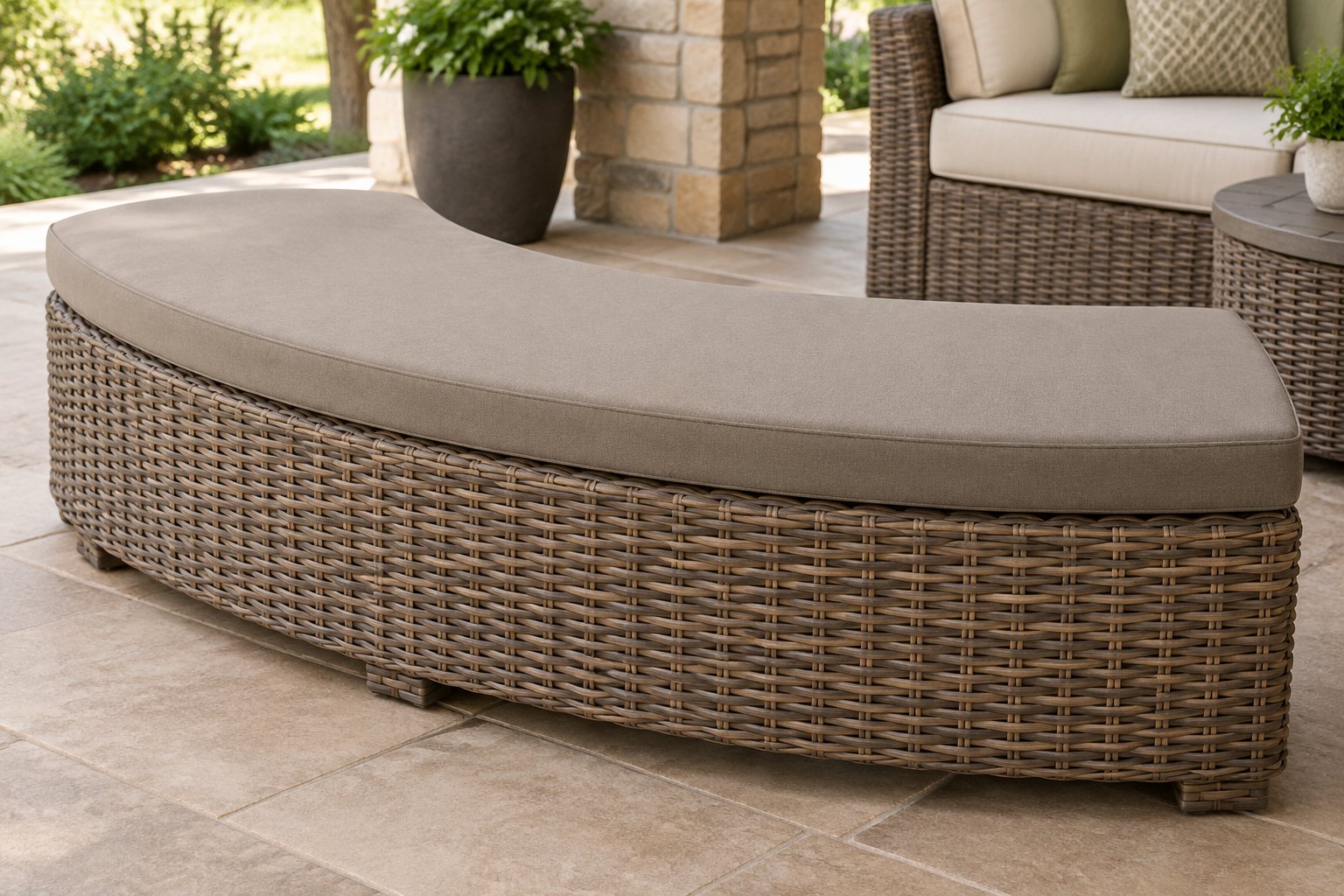
Start with your shape
Not sure? Pick the closest — every measurement is confirmed before we cut.
Don't see your shape? We make any shape.
Straight edges? A top photo + the edge numbers is all we need. Curved? Trace it on paper next to a tape measure and email us a photo.
Enter your measurements
Measure the old cushion flat, edge to edge — never the frame.
Choose your fabric
Five families, 119 cuts, one flat rate — pick by look and feel. Click a family to see its swatches below, or its ⓘ for what the fabric is and where it works best.
No fabrics match the current filters — clear one above.
All covers cut to your exact dimensions — no stock sizes, zippered covers that remove for washing.
Review & order
Calculated live from your measurements — every line, no surprises.
Free shipping over $158 · $29 flat below
Estimates only — we re-verify every dimension before cutting and will contact you if anything looks off. Prefer email? Email me this quote
Odd shape or tricky frame? Upload a photo of your furniture or old cushion — one overall shot, plus a top and side view of the old cushion if you can.
JPG, PNG or WebP · up to 10 MB each · max 3
The workshop that cuts it is the one that ships it
Every fabric on the list, open in the configurator
Your chord and camber, or your template line — no standard arcs
Miss on our side and the remake is free
Why Curves Are Where Stock Cushions Give Up
Curved furniture has no shared standard — every maker’s crescent ottoman, bow-front banquette, and fan-back chair follows its own mold. That is precisely why the shelf has nothing for you: a universal pad is built to the lowest common denominator, which is a rectangle. Lay one on a curve and the middle bridges empty while both ends bunch into wrinkles; the more elegant the curve, the worse the straight pad looks on it.
Curves also age faster at the seams. Fabric pulled around an arc lives under constant diagonal stress, so the stitching along a curve’s edge is the first thing to loosen — which is why so many ten-year-old curved pads look fine in the middle and blown out along their arcs. The wicker or hardwood frame beneath, meanwhile, has decades left.
Measuring a curve is less mysterious than it looks. A single gentle arc surrenders to two numbers — the chord across it and the camber of its bulge — and anything more complicated surrenders to a sheet of butcher paper. Either way, the curve comes to the workshop as your curve, not as somebody’s approximation.
Why order from a mill instead
Every cushion is cut after you order, from your numbers or your template: high-density foam in the density you pick, in any of 119 fabrics, sewn to a quarter-inch tolerance. If a piece lands outside that tolerance, we remake it free. The customizer above prices your piece in real time — no quote wait, no email ping-pong before you see a number.
| Big-box universal pad | Cushion Mill custom cut | |
|---|---|---|
| Fit | Straight pad on a curved frame — gaps and bunches | Your curve, cut to ±½″ |
| Foam | Fixed low-density fill | 35D / 50D / 60D, your choice |
| Fabric | 3–5 colorways | 119 fabrics, one flat rate |
| The curve itself | “Closest size” — a rectangle that pretends | Your chord and camber, or your template |
| When it wears | Buy a new set, same bad arc | Re-cut the same specs in minutes |
Curved Cushion Sizes — What We Typically See
| Piece | Typical range | Notes |
|---|---|---|
| Crescent ottoman pad | 32–42 in. chord × 14–18 in. D × 3–5 in. T | The classic conversation-piece curve |
| Curved banquette section | 36–60 in. chord × 18–22 in. D × 3–4 in. T | Kitchen nooks and bay seating runs |
| Bow-front window seat | 48–72 in. chord × 16–20 in. D × 3–4 in. T | Bow and bay windows with a radiused front |
| Fan-back chair seat | 18–22 in. W × 16–20 in. D × 2–3 in. T | Adirondacks and wooden fan-back loungers |
Pricing — estimated starting at
| Piece | Example size | Foam | Estimated price* |
|---|---|---|---|
| Fan-back chair pad | 20 × 18 × 3 in. | 50D | $111 |
| Crescent ottoman pad | 36 × 16 × 4 in. | 50D | $128 |
| Curved banquette section | 48 × 20 × 4 in. | 50D | $217 |
| Bow-front window seat | 60 × 18 × 4 in. | 50D | $248 |
*Per piece, calculated live in the customizer with the exact numbers you enter: a $45 cutting charge per piece, foam priced by density and thickness, and fabric at one flat $7.43/sq ft across all 119 options. Arc pieces are priced on the area the shape actually covers — never on the rectangle the curve was cut from. These anchors are honest arithmetic, not teaser rates.
Curved nook with several sections? Each piece is measured and priced on its own in the customizer, ships in one order, and meets its neighbors at a clean seam — no bundle guesswork.
Foam & Thickness for Curved Duty
| Foam | Best for | Typical thickness |
|---|---|---|
| 35D | Display seating, rarely-sat curves | 2–3 in. |
| 50D | Daily dining nooks and ottomans | 3–4 in. |
| 60D | Curved banquettes built for lounging | 4–5 in. |
A curve concentrates stress along its arc, so density matters more here than on a straight pad of the same duty: 50D holds the arc’s shape where softer foam slowly flattens toward the chord. For curved banquettes people actually lounge on, treat thickness as a mattress decision and pick 60D.
How to Measure a Curved Cushion
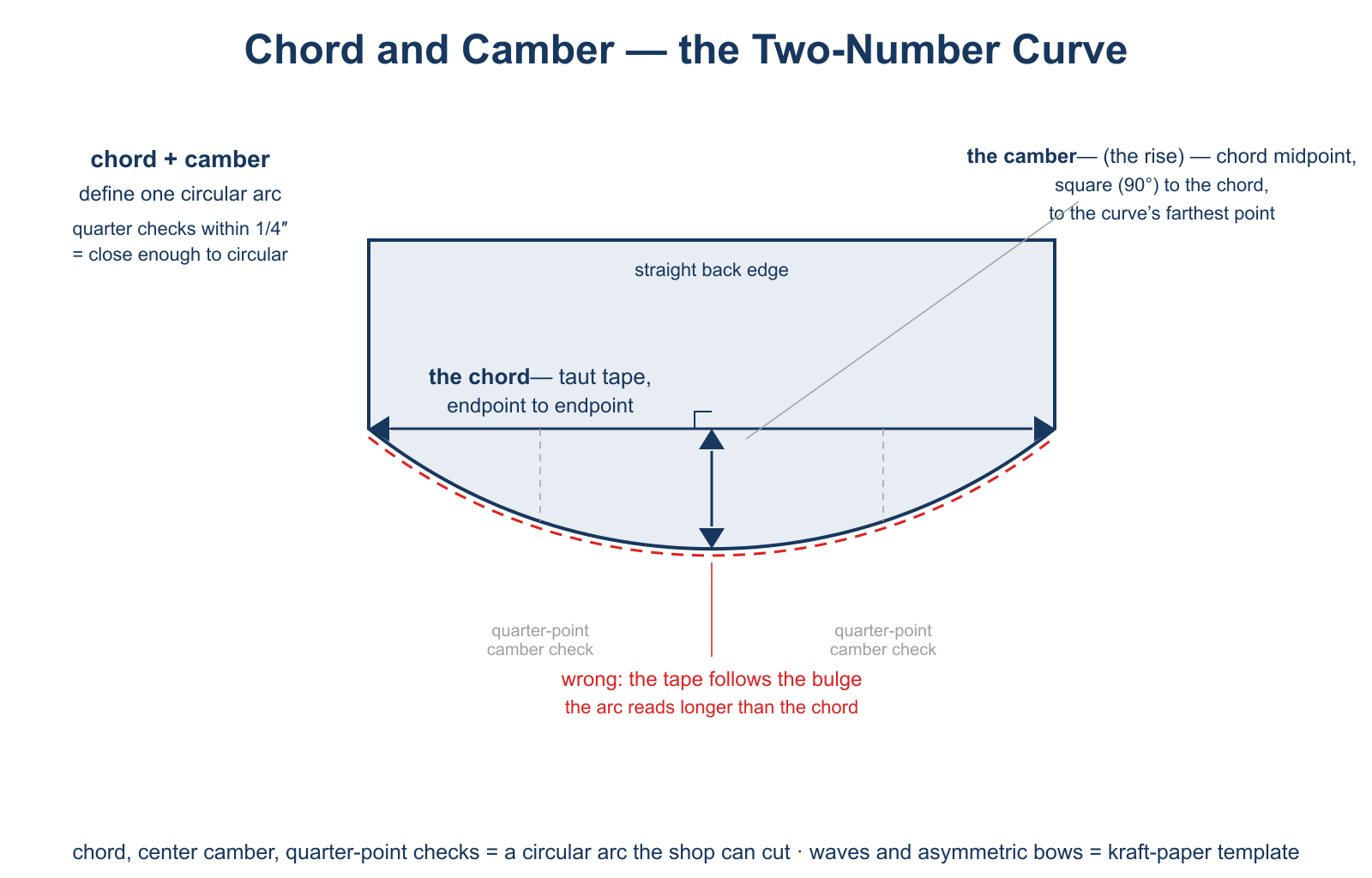
Curves surrender to two methods. Use the two-number method when the arc is a simple bow; use a template when it isn’t.
- Chord — a straight line across the curve from end to end. Lay a ruler or a taut tape between the two ends of the arc and read that length.
- Camber — how far the curve bulges from that line: measure the gap from the chord’s midpoint out to the arc’s midpoint.
- Depth and thickness — front to back at the widest point, and bottom to top with the foam at rest.
For anything beyond a single gentle arc — crescents with inner and outer curves, S-bends, fan backs — skip the geometry and make a template: butcher paper over the seat, crease it along the edges, cut, then set it back on the furniture to check. Mail the paper with your order (a photo of it beside a tape is a good sanity check) and we cut to your line. We cut to ±½″ and remake free if a piece misses it.
Fabrics That Follow a Curve
A curved cushion shows fabric differently than a flat one — the arc stretches the weave around the bend, so texture reads louder and patterns bend visibly. Choose accordingly:
- Tech Fabric — waterproof and wipe-clean; outdoor crescents and patio curves live longest in it.
- Cotton Linen — a calm, natural look for indoor banquettes in mild, dry rooms.
- Pet-friendly weaves — curved ottomans are cat magnets; these weaves shrug it off.
- Chenille & velvet — an arc catches light beautifully in these; for curves whose job is being the room’s focal point.
All 119 options price at the same flat rate, and the customizer charges for the true area of the arc — pick by how the piece lives, not by budget tier.
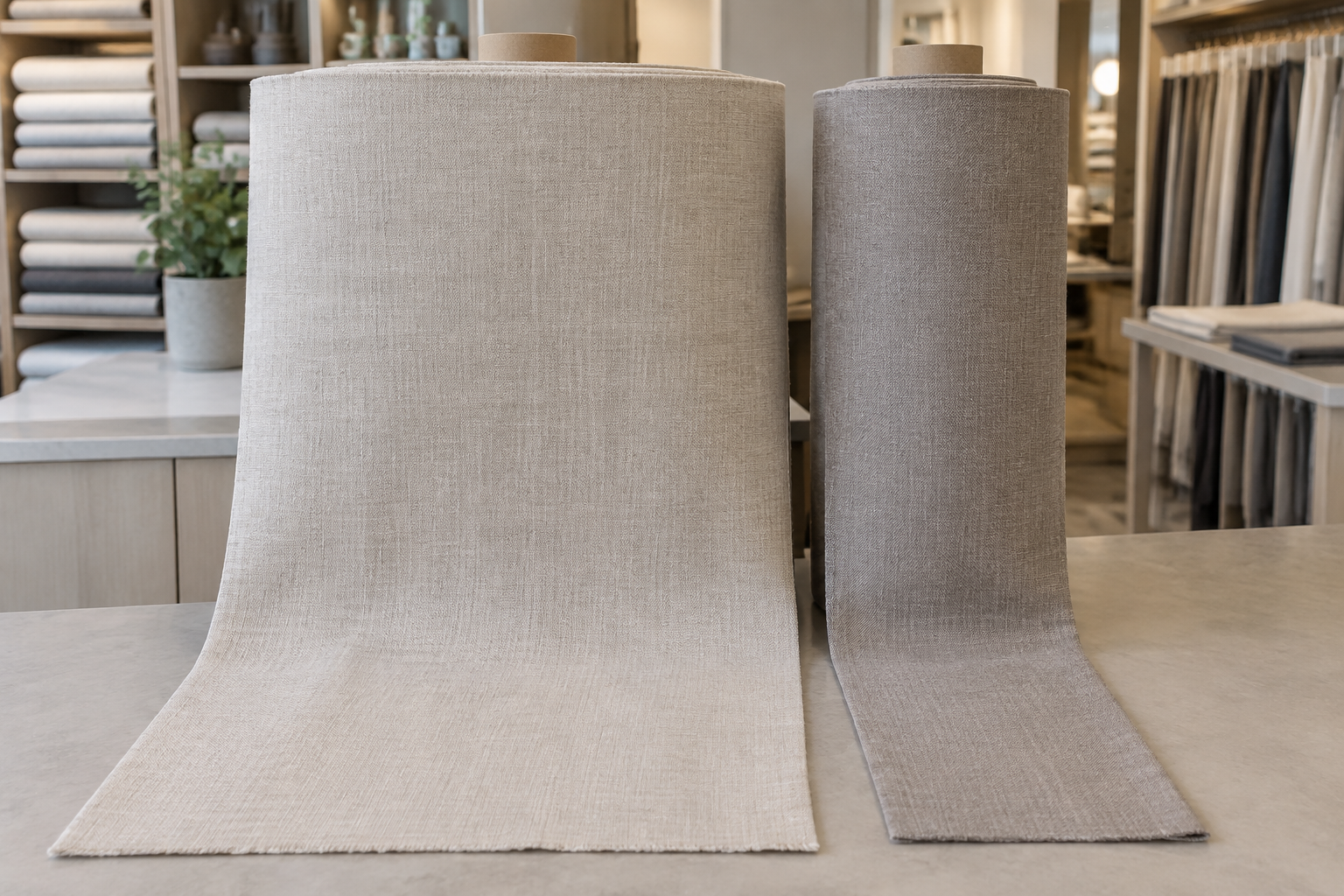
Curved Pieces We Cut Every Week
- Crescent and semicircle ottoman pads — indoor and patio
- Curved banquette and kitchen-nook sections, including multi-piece runs
- Bow-front window seat pads following the bay’s radius
- Fan-back chair pads for Adirondacks and wooden loungers
- Curved bench pads for porch swings and garden arcs
Every curved piece starts from your two numbers or your template — there is no shelf of standard arcs to approximate from. Concave and convex curves are both normal work. If the cushion curves in more than one plane (a saddle, a twisted section), a template is the only honest way, and we cut to it.
Before You Order — Worth Reading
- Curved outdoor cushions — arcs, bows and camber on the patio, in depth
- How to measure curved wicker seating — the template method, illustrated
- Curved vs bowed cushions — the terms, untangled
Frequently asked questions
How do I measure a curved cushion without finding the center?
You don’t need the center. The chord-and-camber method needs two end points and the deepest point of the arc: straight-line distance end to end is the chord, and the gap from that line to the curve’s midpoint is the camber. Check the camber at two or three spots to confirm the arc is even.
When should I send a template instead of numbers?
A single gentle bow takes numbers fine. Reach for the butcher paper when the piece has an inner and an outer curve, two curves back to back, a fan shape, or any S-bend. Crease the paper along every edge, cut on the crease, and check it back on the furniture before it goes in the mail.
Can you match my existing curved cushion exactly?
Yes. Lay the old piece on paper and trace its outline — sewing lines, not the loose fabric edge — and mail the tracing with the thickness noted. Or send the old piece’s chord, camber, and depth, and we cut to them. Either route carries the ±½″ tolerance with a free remake if we miss it.
Do you cut trapezoid shapes?
Yes — straight slanted edges are line work, not curve work, so a trapezoid rides the same process as any four-sided piece. Measure the two parallel sides (front and back, each corner to corner), the depth straight from front edge to back edge — never along the slanted side — and the thickness. If the two slants differ, label each edge on a sketch. The Wedge/Tapered shape in the customizer covers most bay-window trapezoids; anything odder takes the paper-template route.
Do curved cushions cost more than straight ones?
The customizer prices the true area the shape covers, so an arc costs less than the rectangle it was cut from — there’s no curve surcharge. The cutting charge is the same flat $45 per piece as any shape.
How thick should a curved seat cushion be?
2–3 inches for display curves, 3–4 for daily seating, 4–5 for banquettes built for lounging. On curves, density matters more than thickness — 50D is the floor for anything sat on daily, because soft foam flattens toward the chord and the arc visibly relaxes.
Can I order just a cover for my curved cushion?
Yes — we sew replacement covers to your chord-and-camber numbers or to your template in the same 119 fabrics. Curved covers are where mailing the original pays off most: if the old cover still exists, send it and we pattern from it directly.
Will a curved pad work on my wicker furniture?
Yes — wicker curves are template country. Paper over the seat, crease the edges, cut, and check it back. The full walk-through for woven frames is in the curved wicker measuring guide linked above.
How long do custom curved cushions take?
Standard builds leave the workshop in 4–7 days, rush builds in 3–5, with shipping typically 3–6 weeks. Your order confirmation states the exact dates for your build slot.
Made and Shipped by the Same Hands
- Cut in our own workshop — factory direct, no middleman
- Standard build 4–7 days, rush 3–5 days
- Shipping typically 3–6 weeks, tracked
- ±½″ tolerance or we remake it free
Custom curved cushions from $111 — two numbers or a paper template per piece, priced live in the customizer. Enter your chord and camber, pick density and fabric, and the number is on screen before you commit.
Ready when you are. Trace the seat tonight, enter the numbers, and the curve that never fit anything off the shelf finally gets a cushion that fits it.