
OW Lee Heartland Replacement Cushions
Frames from the Heartland era are built to outlive several sets of pads; the canvas and foam are the wearing parts. This guide covers the care-driven route to new ones: verify the line, tape the old pad or the deck beneath it, and replacements arrive cut to your own dimensions — 119 upholstery options, one flat rate across all of them.
Open the Customizer — Outdoor Preselected →
Heartland: the quick profile
Heartland is one of the earlier O.W. Lee catalog names that dealer charts no longer carry — the company lists it among its retired lines, alongside Kensington and Creighton. What stays constant is the build behind the name: hand-forged frames in heavy gauge, finished and upholstered to order in the factory’s own workshop, sold through dealers nationwide.
Care work rewards order. Establish the line from the cues below, read the worn set or the deck with a tape, and your Heartland rebuild is cut to the figures you record — 119 upholstery options, one price across every one, sewn where it ships from.
Maintenance starts with identification: run the checks in any order — the rail, where O.W. Lee fits a brass plaque or a stamped mark on every forged frame; the filing cabinet, where a dealer invoice or order history names the collection (the brand retails nationwide through dealers, not big-box aisles); and the welds, where hand-worked scrollwork on heavy-gauge stock distinguishes the maker from imports. Our taping walkthrough takes it from there.
Identifying Heartland frames
Start with the maker’s marks, not the name: every O.W. Lee piece — Heartland included — carries a brass plaque or stamped mark on a frame rail, and the frames themselves are hand-forged in weights imports don’t match. If your set is light enough to carry one-handed, it isn’t this factory’s work.
Lean on the paperwork: Heartland was sold through the dealer network on order tickets that named the collection, the finish and the fabric. A dealer invoice, an old quote, or the original order history beats any frame-guessing — one search of your records usually settles it.
Don’t confuse it with: other retired traditional names in the same catalog era — Kensington and Creighton carry similar scroll vocabulary. And don’t confuse the O.W. Lee Heartland with “Heartland” brand shed and fence products at farm stores; those are a different company entirely.
Years in service tell you where the originals surface: retired-line pads appear mainly on the factory-store clearance page, sewn in end-of-roll cloth, dimensions as listed with no re-cut option. For care planning, a measured rebuild is the dependable arm — the one that never waits on leftover stock.
The missing Heartland size chart, explained
Upkeep planning hits the same wall every owner does: O.W. Lee publishes no per-line pad dimensions, and sunset runs like Heartland appear on no chart anywhere. Dealer-page figures, where they exist, describe complete pieces rather than the pads. So the dimension list below the care schedule is yours to write — three numbers per pad off the piece, and that is the entire specification we work from.
If both the plaque and the paperwork have been lost to the years, email photos of the frame and we will sort the line from the details — after that it is three dimensions per pad and the order moves to the floor.
Dimensions come first
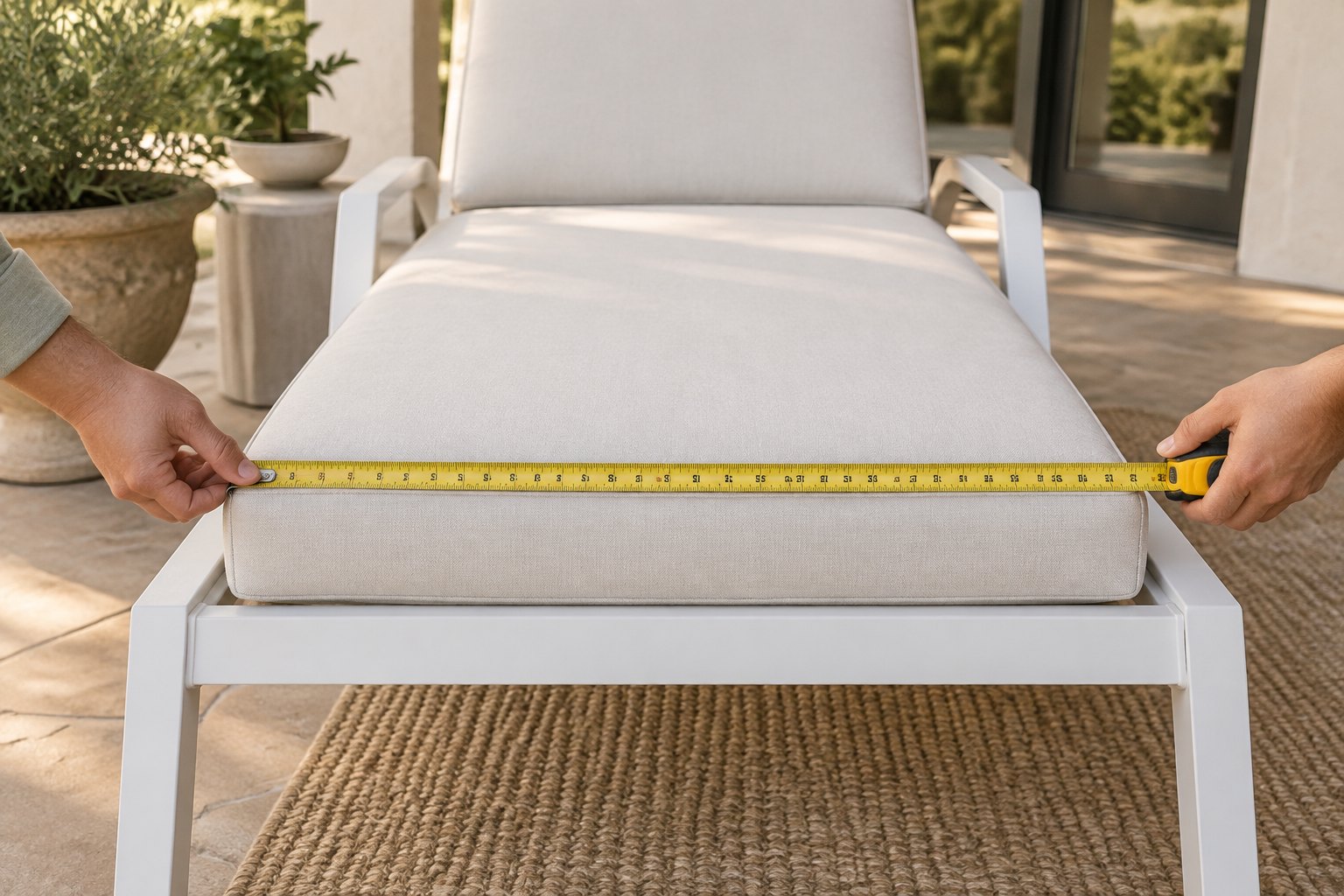
The care routine’s measuring step: run the tape with our measuring guide — width across, depth front-to-back, thickness at the seam — writing each pad’s figures separately rather than one set of numbers for all. Absent any factory chart, those entries are the whole specification behind every Heartland rebuild.
Closest O.W. Lee neighbors: Cambria (retired traditional line with the crescent loveseat) and Chalet (another retired catalog name). The remaining O.W. Lee collections sit on the brand index page.
Fabric options & estimated pricing
Care profiles differ; the bill does not. Cotton linen is the low-fuss everyday workhorse; tech fabric repels water and cleans with a wipe, which outdoor upkeep rewards; premium velvet delivers the dress-grade finish and stands up to claw traffic. Weighing one against another? the swatch board in the order flow — identical measured cut, identical price, all bolts.
Estimates open at $168 per typical piece and move with size and density grade (35D to 65D); the fabric choice never moves the number. The checkout quote is final, and no foam is touched until your figures pass a second read. Each cover unzips for the wash cycle.
The Heartland body styles in the catalog run
Heartland ran nine body styles, and unlike most O.W. Lee lines, half of them move. The glider loveseat and glider sofa ride suspended platforms built for a slow back-and-forth travel; the swivel rocker lounge chair turns a full circle on its base; the spring lounge chair answers pressure on flexed steel; only the static lounge chair, loveseat, sofa, ottoman and adjustable chaise sit still. Motion is the line’s signature — it is also what makes Heartland pads wear differently from seat to seat.
Glider frames are the reason this line needs an extra figure. The seat platform travels fore and aft beneath a stationary back, so the seat block must stay under the sitter at both ends of the stroke without binding the mechanism — measure the platform at its full forward and full rear positions and send both depths. On the spring base pieces, the pad rests on a flexible deck rather than solid straps; the old cover’s seam lines mark the original block edges better than any ruler pass across the springs.
Heartland against its neighbors: the adjustable chaise appears in both this line and Palazzo, and the two share a traditional weight, but Palazzo never shipped on motion bases — a Heartland chaise can usually be identified from below, by the linkage under the seat. Within the line itself, the swivel rocker and the spring lounge chair are often confused for each other; rock the frame by hand, and a rocker answers with an arc while a spring base answers with a bounce.
Because motion pieces flex their pads with every cycle, covers on this line take more abrasion than static seating in the same weather. The zippered rebuild helps exactly here — the cover comes off for washing without disturbing the fill, which is the practical answer for a piece that gets used every evening from spring through fall.
The design story behind Heartland
Heartland was sold to a specific buyer: the household that wants the porch to do something. Gliders for the evening rock, a swivel rocker that turns to follow the conversation, spring bases that give with every sit — this was the motion line of the retired catalog, decades before “outdoor living” became a showroom phrase. Motion frames outlast their pads by design, because the mechanism is serviceable and the fabric is not.
That is the quiet argument for measured rebuilds on this family: the replacement market for motion pieces either stocks nothing or ships closest-match pads that fight the mechanism. A cut built from the stroke figures — platform depth at both ends of travel, back length in the resting position — moves with the frame instead of against it, which is the entire point of owning the piece.
Frequently asked questions
Are Heartland cushions still in the OW Lee catalog?
Not as an active line. Heartland has been sunset; what remains at retail is the factory store’s clearance shelf — pads in end-of-run cloth, listed sizes only — while dealers book custom replacements on 18–20 week tickets. Fresh builds from your dimensions run through us, 119 fabrics deep.
Are store-bought universal cushions a fit for Heartland seating?
Rarely, and the mismatch shows up fast in daily use. These decks are deep and individually proportioned — a universal that fits width-wise tends to sit wrong in depth or height, and curvature escapes the format entirely. Measured replacements return the intended sit.
How can I prove my set is Heartland?
The dealer invoice or original order record names the collection outright — O.W. Lee sold through dealers, not stores. The brass frame plaque names the maker, and the hand-forged weight rules out imports when the paper is gone.
Can cushions be built with no published dimensions?
That is the routine here. Uncharted lines are rebuilt from owner-taped figures — width, depth, thickness per pad — which we verify against the piece count and cut to without reference to any chart.
What’s the price on Heartland cushions?
Estimates start at $168 per typical piece and shift with size and density between 35D and 65D; every fabric carries the same rate. The confirmed figure precedes the work.
How fast can replacements arrive?
Every set is a post-order build: the standard run takes 4–7 business days, the rush lane 3–5, and flat-rate shipping covers the last leg — 4-7 business days from click to doorstep.
The terms behind every build
- The workshop has run its own benches for over a decade — fill, cut and sew all happen in-house, and no broker or dropshipper touches an order.
- No material is unrolled until your entries pass a second pass here — three figures per pad, matched against the count of pieces on the order.
- The shelves hold fabric, not finished pads — any option, any frame, one piece or forty on the same order.
- Off-tolerance cuts — past ±½″, or ±¾″ beyond 36″ — plus wrong-material or wrong-build orders, are redone without charge.
Rebuild your Heartland set from $168 per piece — identify, record, approve, done.
Can’t place the collection from memory? Email the frames and we will pin it down pre-production. Turned out to be another line? Custom covers any shape — the OW Lee hub has the rest.