
Castle Rock (Hampton Bay)
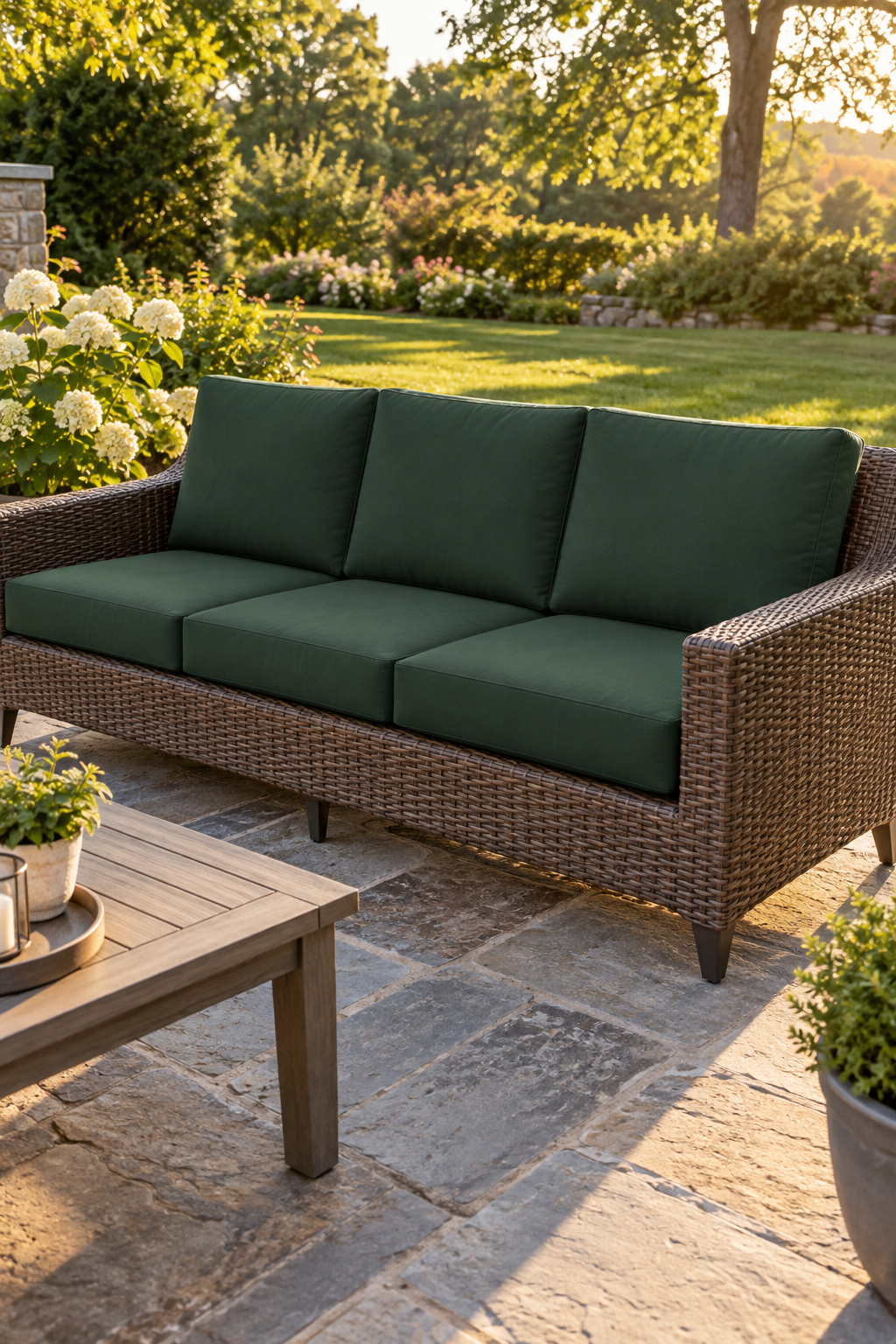
A private patio asks maybe fifty good sittings from its cushions in a year. The same Castle Rock frames, moved into a weekend rental, ask for that many by March. Every turnover brings new bodies, new sunscreens, new juice boxes, and a wash cycle nobody scheduled — and the foam compresses under guests who treat a lounge chair like the hammock it isn’t. Hosts discover the difference around month four, when the “outdoor set” in the listing photos no longer matches the one guests keep mentioning in reviews.
How rental duty breaks a cushion
Rental wear is not home wear accelerated — it is a different damage profile altogether. Three mechanisms lead it.
Load without rest days. Residential foam spends most of its life uncompressed, recovering between the occasional sitting. A booked calendar removes those rest intervals: guests sit mornings, afternoons, and evenings, and the same seats — the two with the view, always the same two — carry the load continuously. Foam that would hold its loft for eight home years reaches the same compression in a fraction of the time, because recovery, not sitting, is what foam is starved of.
Chemistry nobody manages. Guests arrive coated: sunscreen, insect repellent, tanning oil, pool chlorine on wet skin. Each of these lands on the seat top, bakes in the sun, and sets into the weave. A household notices its own spills and rinses them; a guest’s residue sits until the next turnover, and by then the fabric has logged it permanently.
The wash-cycle creep. Diligent hosts launder covers on every turnover, which protects guests and punishes fabric — dozens of washes a season is commercial laundry territory, well past what any household cloth expects. The fabric does not fail suddenly; it slowly pales, thins at the seams, and loses the water repellency it started with.
Specifying for the calendar you actually run
None of this argues against putting rental cushions on the frames — it argues for ordering them like equipment rather than decor. Three specifications carry most of the value:
- Density at the top of the working range. Seats built around 60D to 65D — inside the menu’s 35D to 65D span — hold their height through continuous occupancy far better than the 40s, and the taller the foam, the longer the set photographs like its listing.
- Cloth chosen for chemistry and cycles. Solution-dyed acrylic-family weaves resist both the sunscreen spectrum and repeated laundering; multicolor patterns hide the residue that does get past you; pale solids, however photogenic, turn the seat tops into a stain ledger.
- Covers engineered to come off. Every CushionMill cover unzips fully from the foam — a full machine cycle per turnover, no spot-wiping marathons, no sewn-shut construction pretending to be washable.
One honest boundary belongs on the record: this is a residential workshop, and everything we build is made to residential specification. Hosts run our cushions on rental patios successfully all the time — but the warranty of the piece is the warranty of a home cushion, and the smart move is ordering the tougher end of the menu so the calendar never tests the difference.
The five-minute turnover check
Turnovers decide everything in a rental, so the cushion care has to fit inside one. Between guests, while the linens run: walk the seating and press each seat once — a palm-flat press tells you in two seconds whether the foam is still pushing back or beginning to negotiate; scan seat tops for the orange shadow of sunscreen and treat it same-day, because it cures in the sun within hours; tug each zipper once so a failing slider surfaces on your schedule instead of a guest’s. Once a month, unzip everything and run a full wash cycle — and while the covers tumble, flip the bare foam end-for-end, which rotates the compression zones the guests keep finding.
Log it lightly: a line per turnover in the same notebook as the linen count. Six months of one-line history tells you which two seats die first (the view ones), which month the set went in looking tired, and exactly when the rebuild order should have gone in — which is the knowledge that keeps the listing photos honest.
Naming the frames in the listing
Castle Rock belongs to the uncharted side of the Hampton Bay catalog — identified through retail listings and owner reports, no official cushion chart ever published. Hosts usually crack it fastest through paperwork: the original purchase record for the property, the old listing description, or the assembly leaflet in the owner’s binder. The white tag under a seat frame — model number beside a GLD or THD prefix — answers just as fast, and where the paper trail and the tag have both vanished, photos of the frames sent to the bench narrow the construction era. However the name resolves, the cutting specification is the three dimensions you take per cushion — width, depth, thickness at the seam, per the measuring guides — because same-name sets across production years can carry different lofts.
Equipping the set, price-plainly
Hard-duty cloth costs nothing extra here: every cushion starts at a $45 make-base, moved only by finished size and the density chosen within 35D to 65D, while all 119 fabrics — the bleach-tolerant patterns included — price identically at a given size. That flat list suits rental logic well: specify the tough weave and the 65D foam because the calendar wants them, and the invoice reads the same as a decorative choice would. Hosts rebuilding seat-by-seat as pieces retire can also spread the outlay across turnovers, one chair per gap week, without any minimum order forcing the whole set at once.

Adjacent uncharted lines: Hampshire and Tobago. A charted series appears on the Melbourne page for comparison, and the Hampton Bay hub indexes everything the bench tracks.
Frequently asked questions
Are residential cushions workable on a rental patio?
Workable, yes — with eyes open. Ours are built to home specification, and hosts run them hard with good results when they order at the durable end: top-of-range density, patterned solution-dyed cloth, full wash cycles on turnover. What we do not offer is a commercial-grade warranty, so the calendar, not the label, should set your expectations.
Which density survives constant guests?
The upper working band — seats around 60D to 65D, back-rests in the 50s, from the 35D to 65D menu. Continuous occupancy starves foam of recovery time more than it punishes the sitting itself, and firmer foam simply holds its height longer between rebuilds.
How do I get sunscreen stains out of seat tops?
Fresh is everything: rinse or launder the same day, because sun cures the residue into a yellow shadow within hours. Once set, a full machine wash of the unzipped cover lifts some of it — which is also why patterned, mid-tone cloth is the rental recommendation: what stays behind stops reading as damage.
Can I replace the two worn-out seats instead of the whole set?
Yes — no minimums, single pieces from the $45 make-base are routine, and phased rebuilds (the two view chairs first, the rest as they fade) match how rental wear actually lands. Match the surviving pieces’ density so the seat heights stay level across the set.
What is the lead time around a booking calendar?
Sewing occupies 4 to 7 business days standard, 3 to 5 rushed, and freight runs 3 to 6 weeks to most addresses. Scheduling a rebuild into the slow season — order after the last high-season turnover, arrive before the first spring booking — keeps the listing never once photographing a tired seat.
Do the covers handle this many wash cycles?
Better than most, by design: each cover removes from the foam entirely through a full-length zipper, so it machine-washes as cloth rather than fighting foam inside it. Outdoor weaves from the 119-fabric menu are chosen for repeated laundering; pale solids are the one category a busy rental should simply avoid.
What ordering from this bench gets you
- A single independent workshop — over a decade of cutting, filling, and sewing in the same hands that quote the job.
- Every submitted figure set verified against your piece count before fabric is cut; discrepancies are raised, never assumed through.
- No minimum order and no inventory seasons — one retiring chair now, the rest of the set after the next turnover, any of 119 cloths.
- Remake terms stated plainly: any cut outside ±½″ (±¾″ once past 36″), or the wrong fabric or build, redone at no cost.
Castle Rock replacement cushions specified for the calendar that actually uses them — turnover-proof cloth, hold-height foam, covers built to be washed.
Running a listing and want durability advice against your guest volume? Tell the bench the calendar and we will recommend the build. Different line on the patio? Any frame, cut to your figures — or open the Hampton Bay index.