
OW Lee Cambria Replacement Cushions
An heirloom frame outlasts its pads — that is the whole story of the Cambria, a retired O.W. Lee run with no published spec sheet behind it. This page shows how to pin down the line you own and commission replacements sewn to the three dimensions you take yourself.
Open the Customizer — Outdoor Preselected →
The Cambria line at a glance
Cambria sits among O.W. Lee’s earlier hand-forged collections — a dealer-catalog line that predates the company’s current navigation. Two things travel with the name: traditional scroll motifs on heavy-gauge frames, and a piece list that ran ottomans, dining chairs, lounge chairs, chaises and a crescent loveseat — that curved two-seater is the line’s best-known silhouette, and the reason “Cambria cushions” alone never tells us what to cut.
No guessing enters our process. The line gets confirmed from the cues below, the worn pad or the bare deck gets taped, and your Cambria replacements are stitched to the figures that come back — one flat rate across all 119 upholstery options, sewn by the same floor that ships them.
Three checks settle it: first the metal — O.W. Lee hangs a brass plaque or a stamped mark on a rail of every frame it forges; second the paper — the brand retails through a nationwide dealer body, never big-box aisles, so an invoice or order history states the collection outright; third the construction — scrollwork done by hand and heavy-gauge stock are the tells that separate these pieces from imports. Our taping walkthrough covers the rest.
How to tell you have the Cambria
Start with the metal: Cambria pieces carry O.W. Lee’s traditional vocabulary — scroll and vine motifs worked into seat backs and arms, on frames heavy enough that one chair needs both hands. The finish is a baked-on coating over hand-forged steel or aluminum, not the thin paint on imports.
The crescent loveseat is the giveaway piece: a curved two-seat frame with a sweeping outer radius. Cambria ottomans and chaises ran matching curves — if your seat front bows outward, measure along the curve at the seam, not straight across, and send both figures with the order.
Don’t confuse it with: other O.W. Lee traditional lines with similar scrollwork — the current Monterra deep-seating pieces run heavier with 5–6″ lofts, while Cambria dining chairs sit on slimmer pads. When the plaque is gone, the dealer invoice settles it in one search.
Dating the set matters: Cambria exited the factory catalog ahead of the current ranges, so the pads you meet today come mostly off the factory-store clearance shelf in whatever cloth was current that season — dimensions as printed, no re-cuts offered. A rebuild from your figures is the version of the upgrade that never depends on leftover inventory.
Why there is no official Cambria size chart
O.W. Lee has never issued pad dimensions for individual collections, and a retired run like Cambria is charted nowhere at all — the figures that circulate on dealer sites describe the whole furniture piece, foam and frame together. We leave the size table out on purpose for exactly that reason: your own tape, on your own piece, is the only dimension list that reaches our cutting bench.
No plaque on the rail and no paper in the drawer? Send the frame photos over — we will narrow the line together, and from there each pad is three dimensions and the commission is running.
Measure before you order
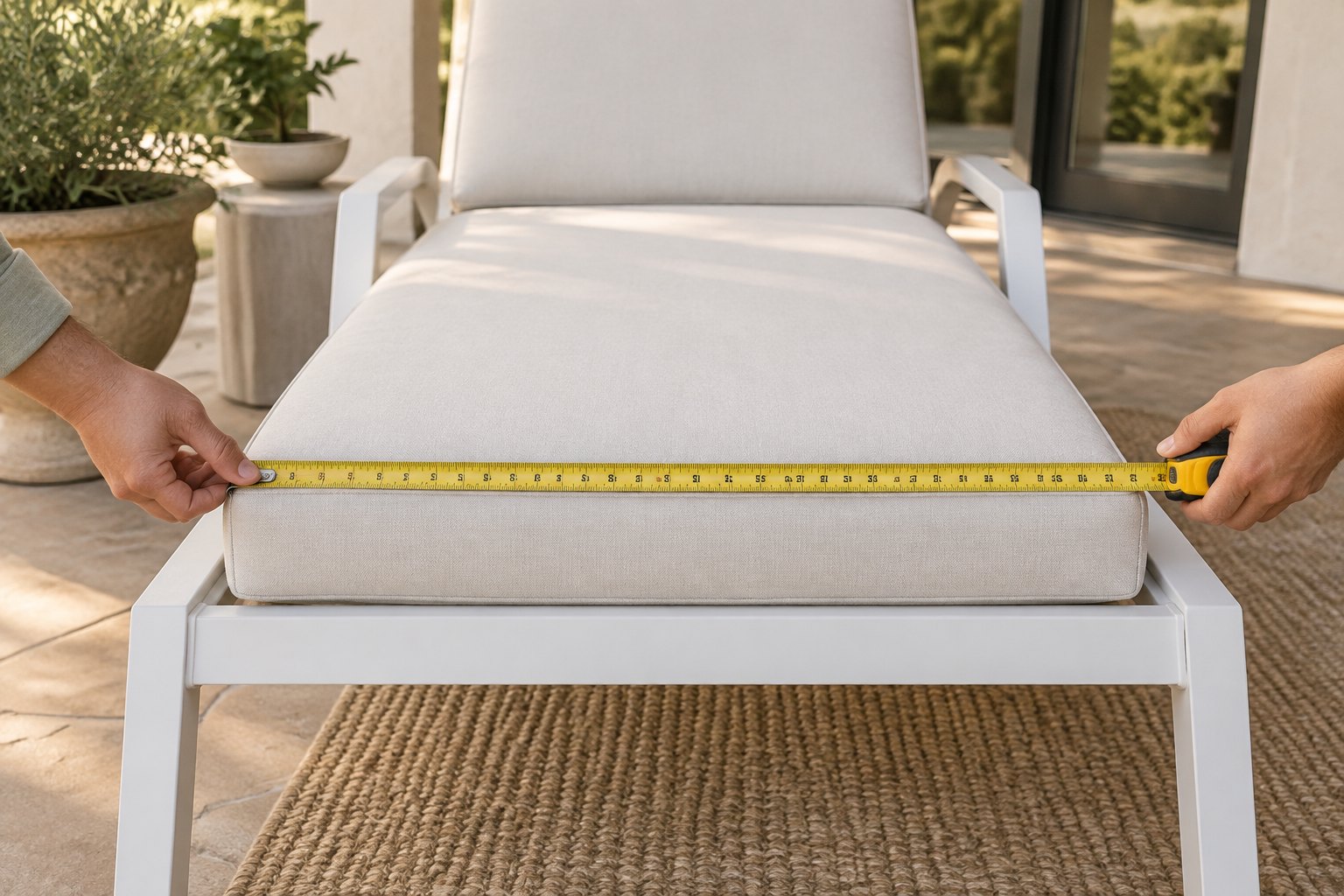
Begin with the tape: a three-minute pass following our measuring guide — width, then depth, then thickness at the seam, logged per pad rather than per set. With no factory chart to lean on, those three entries are the entire specification, and every Cambria cushion we stitch follows them to the line.
Closest O.W. Lee neighbors: Monterra (current deep-seating flagship, charted piece codes) and Heartland (another retired traditional name). The whole O.W. Lee range is indexed on the OW Lee page.
Fabric options & estimated pricing
One cut, one rate, whichever cloth you land on. Cotton linen earns its keep on daily-duty seats; tech fabric shrugs off rain and wipes down in a pass; premium velvet brings the formal register and holds its own against cat claws. Comparing swatches? the fabric menu inside the order flow — the pattern changes, the measured cut never does, and neither does the price.
Cambria work is quoted from $168 for a typical block and climbs only with size and foam density (35D up to 65D) — cloth never enters the price. The figure you see at checkout is the figure you pay; nothing moves to the bench before your numbers have been re-read and confirmed. Covers close on a zippered edge, so each one comes off for the wash.
The Cambria piece list, as the dealer catalog built it
Cambria reached customers through dealers in five body styles, and each style carries its own block count. Dining chairs and lounge chairs ran the standard two-block build — one seat, one back — ordered singly or in matched sets of four, six and eight around a table. The chaise stretched the same vocabulary into a reclined length with a leg-support section that slopes down toward the foot; the ottoman closed the line as a single squared block with nothing to measure but width, depth and height.
The crescent loveseat stands apart as the only curved frame in the family. Its seat front follows the frame’s outer radius, so the pad runs wider through the middle than at either arm, and a straight ruler laid across the front will read short of the true seam length every time. The order needs two widths at the same depth — one taken along the curved seam itself, one straight across from arm to arm — and the cutter reproduces the radius from that pair without ever seeing the frame.
Telling Cambria from its closest catalog neighbor saves a round of photos. Palazzo shares the traditional scroll vocabulary and overlapped Cambria in the same dealer showrooms, but Palazzo seating ran straight rails throughout — no bowed fronts anywhere in its run. Where the two lines cross paths is at the dining table: both carried scroll-backed dining chairs in similar weights, and those are best sorted by invoice or plaque rather than by silhouette alone.
On fill, Cambria shipped in the low-loft register of its catalog era, and long service compresses that further. A rebuild at matching loft returns the chair to its original sit height; a taller fill lifts posture — noticeable under a dining table where knees meet the apron. Either way the cut follows your three figures, not a stock chart, because no factory chart for this line was ever published.
Design context, for the order notes
Cambria belongs to the hand-forged era of the catalog, when the scroll motif was the brand’s public face and the weight of a frame was read as a promise. Owners of these lines tend to know exactly what they have — the pieces were bought at dealers, kept for decades, and often carry the original brass plaque on a rail. The pads are the consumable layer of an heirloom frame, and a rebuild cut from the old pad’s own figures is the version of replacement that respects the original: no guessing at stock sizes, no settling for the closest match on a shelf.
Curved-front pieces reward patience at the measuring step more than any straight frame in the brand. The crescent rule — seam width plus straight width, both at the same depth — takes under a minute with a flexible tape and saves the round trip a wrong figure guarantees. When the photos and figures go in together, the build starts the same day.
Frequently asked questions
Does OW Lee still sell Cambria cushions?
Not off the shelf. The Cambria run has left the active catalog; what the factory store sells is clearance pieces in leftover cloth, and dealers commission replacements on an 18–20 week custom ticket. The route here is a ground-up rebuild — your dimensions, 119 fabrics open.
Will universal cushions fit an O.W. Lee Cambria piece?
Almost never a good fit. O.W. Lee decks are cut deep and to specific proportions, so a universal pad that matches the width tends to miss the depth or the loft — and no off-the-shelf piece will trace a curved front. Replacements built from your figures sit the way the originals left the factory.
How do I verify my set is really Cambria?
The brass plaque or stamped mark on the frame rail names the maker; your dealer invoice or order history names the collection outright. The crescent loveseat silhouette and the scroll cues in the chart above narrow it when the paper is gone.
Can you make cushions without official specs?
Yes — undocumented lines are our standard workload. The dimensions come from you: width, depth and thickness for every block; our bench then re-reads the figures against the piece count and sews to what you sent.
How much do Cambria replacement cushions cost?
Quoted from $168 for a typical piece, moving with size and foam density across 35D–65D; the cloth choice never adjusts it. The figure is confirmed before anything reaches the bench.
How long do they take to make and ship?
Nothing is sewn ahead of your order — each set is built after it lands: 4–7 business days on the standard ticket, 3–5 on rush, then flat-rate freight to the door. Call it 4-7 business days end to end.
What you get ordering from us
- A cushion workshop in its second decade — every order is cut, filled and sewn in-house, with no brokering and no dropshipping anywhere in the chain.
- Before a single bolt is opened, the figures you sent get a second read — three entries per pad, cross-checked against the count of pieces.
- No stock, no warehouse of pre-sized pieces — any material, any frame, whether the order is one pad or forty.
- Tolerance misses on our side — beyond ±½″ (±¾″ past 36″), wrong cloth, or wrong workmanship — are remade at no charge.
Cambria replacements, quoted from $168 per piece — the sequence is identify, tape, approve, build.
Line still unresolved? Send the photos in and we will settle it before any cutting. Not a Cambria after all? We build any shape to order — or browse the full OW Lee lineup.